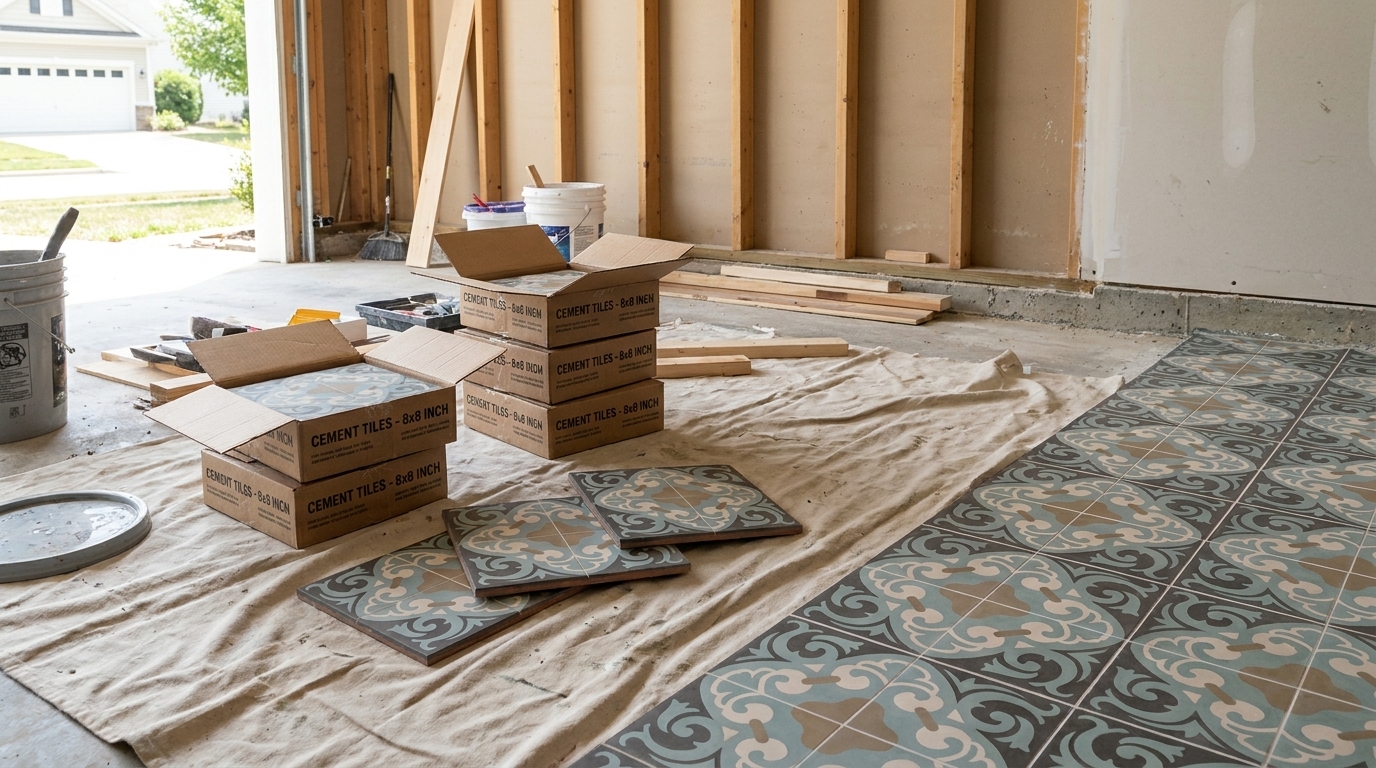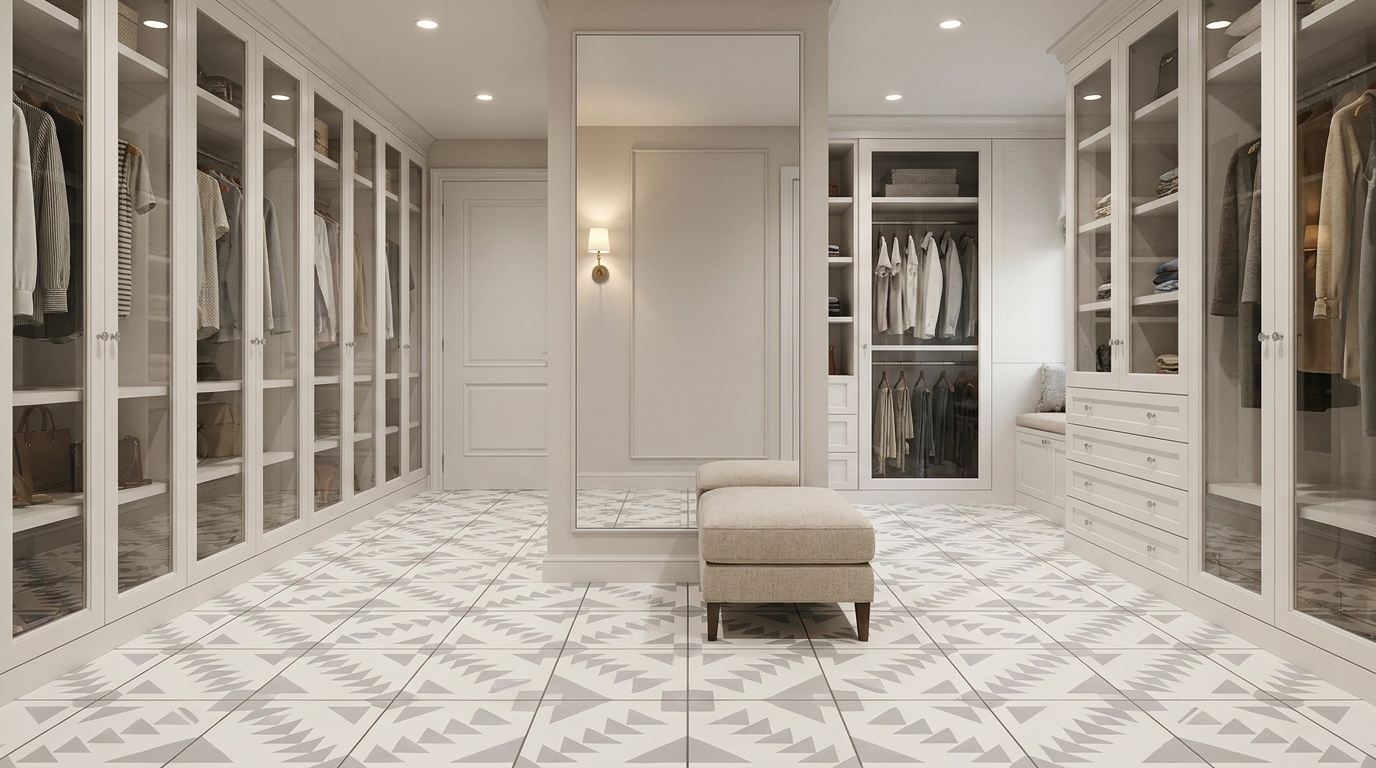
You’re probably in one of two places right now. You’ve fallen for the look of cement tile flooring and want to know if it’s practical, or you’re specifying a project and need more than the usual mood-board talk.
That’s the right instinct. Cement tile isn’t a generic floor finish. It asks more from the installer, more from the substrate, and a bit more from the owner. In return, it gives something porcelain, vinyl, and most factory-made surfaces can’t quite replicate. Depth of color, hand-built variation, and a floor that feels architectural rather than applied.
The problem is that many guides stop at “beautiful but porous.” That’s not enough if you’re budgeting a restaurant, detailing a mudroom, or choosing a kitchen floor you’ll live on every day. You need to know how the tile is made, what its performance numbers mean, where installations fail, and what kind of maintenance is realistic.
Your Authoritative Guide to Cement Tile Flooring
A client walks into the showroom with a porcelain sample in one hand and a photo of a century-old entry floor in the other. The question is usually the same. Can cement tile deliver that kind of presence and still hold up in daily use?
It can, but only when the material is specified for what it is. Cement tile flooring brings weight, color depth, and hand-made variation that read as part of the architecture, not a printed finish laid over it. That comes with real requirements. The substrate has to be right, the installer has to understand the material, and the owner has to accept routine sealing and proper cleaning.
Its origins help explain why it behaves differently from ceramic or porcelain. Cement tile developed in Southern France and Catalonia in the second half of the nineteenth century, where makers used hydraulic pressing and curing rather than kiln firing to produce patterned floor tile. That origin is key to understanding the material's character.
For homeowners, the appeal is often simple. The room needs a floor with more permanence and more visual substance than a factory-made surface can offer. For architects, designers, and builders, the decision is more technical. Load, flatness, moisture conditions, grout selection, movement joints, and finish maintenance all need to be addressed before the first tile is set.
That is where many buying guides fall short. They tell you cement tile is beautiful and porous, then stop there. A useful guide should explain how the tile is made, what the wear layer means, where installations fail, and which maintenance routines are realistic in kitchens, baths, entries, and commercial spaces.
If you’re weighing broader Flooring solutions across a renovation or new build, cement tile deserves serious consideration when the project calls for a floor with structural presence and lasting pattern. Chosen well, installed correctly, and maintained with discipline, it becomes part of the building fabric rather than a surface trend.
Cement tile flooring rewards informed decisions. It is at its best when design intent, substrate preparation, and long-term care are handled with equal care.
The Art and Science of Handmade Cement Tile
A box of cement tile arrives on site and the first surprise is often the finish. The surface is matte, cool to the touch, and slightly alive from piece to piece. That character starts at the factory floor, not in the sealer.
Handmade cement tile is built in layers from Portland cement, sand, marble dust, and mineral pigments. The face mix uses white cement and very fine fillers so color stays crisp and saturated. Behind it sits a denser body mix that gives the tile its mass and structural stability. Good makers control those mixes carefully because small changes in water, pigment load, or compaction show up later as shade variation, edge inconsistency, or weak corners.
What actually creates the pattern
The pattern is formed with a metal mold, often called a divider or trepa. A craftsperson sets that mold on the tile face and hand-pours different pigmented cement slurries into each compartment. Once the pattern layer is in place, backing layers are added and the tile is compressed under a hydraulic press.
That sequence matters more than many buyers realize. The design is part of the tile itself, not an image applied after the fact. In service, that gives cement tile a different visual depth than printed porcelain. For a useful material comparison, see this guide to cement tile vs porcelain tile.

Why pressing and curing matter
Hydraulic pressure compacts the face and body into a single unit. The tile then cures with water and air rather than in a kiln. That curing process is the heart of cement tile production and the reason the material behaves differently from ceramic.
The lack of glaze creates a matte, tactile finish. The absence of a printed image makes the pattern feel embedded. The handmade process introduces slight variations that read as life, not defect.
Those are strengths, but they come with obligations. A hand-pressed tile can show minor shade shift, a little movement in thickness, and occasional surface clouding before sealing. In a well-run installation, those variations are sorted in the dry layout and blended across the floor rather than treated as flaws after the fact.
Why the method spread
Cement tile gained ground because it solved both a cost problem and a production problem. Decorative multicolor floors once depended heavily on fired ceramic methods that were slower and more expensive to produce at scale. Pressed and cured cement tile offered rich pattern without kiln firing, which made it attractive for residences, civic buildings, hotels, arcades, and verandas across several regions.
That history still shows in the material today. Cement tile belongs to architecture with weight, permanence, and visible craft. It was never meant to impersonate a perfectly uniform factory surface.
What that means for today’s buyer
A cement tile floor develops character through use. In the right setting, that aging is part of the appeal. In the wrong setting, or in the hands of an installer who treats it like porcelain, the same qualities can frustrate the owner.
The smart approach is to judge the material fairly. Cement tile offers depth of color, a soft mineral finish, and a pattern that feels built into the floor. It also asks for proper sealing, a flat substrate, careful handling during installation, and maintenance that respects a porous cement-based surface.
Practical rule: Choose cement tile for substance, variation, and long-term patina. Choose another material if the project demands exact repetition, very low upkeep, or a fully stain-proof glazed surface.
Comparing Cement Tile Flooring to Other Materials
A client walks into the showroom wanting one answer. Which floor will hold up, look right in five years, and not create problems for the installer or owner. In practice, the answer depends on traffic, moisture, substrate conditions, cleaning habits, and how much visible character the project can carry.
Cement tile belongs in that conversation, but it should be judged on what it is. It is a dense, cement-based architectural finish with a handmade wear layer, not a glazed factory product pretending to be stone or wood.
Where cement tile stands apart
Published test data shows that cement tile can handle serious interior use, with measured hardness, compressive strength, flexural strength, wet traction, and water absorption values that place it in a very different category from soft decorative surfaces. The same data also confirms the trade-off. Cement tile is porous by nature, so sealing, proper specification, and climate judgment are part of the material, not optional extras.
That distinction matters on real jobs.
A porcelain floor can survive neglect better. A hardwood floor can feel warmer underfoot. LVT can solve budget and schedule problems quickly. Cement tile earns its place when the floor needs both performance and visual substance, especially in entries, kitchens, baths, hospitality spaces, bars, and retail interiors.
For a tighter material comparison, see this guide to cement tile vs porcelain tile, which covers the matchup owners ask about most often.
Cement Tile vs. Alternatives at a Glance
| Attribute | Cement Tile | Porcelain Tile | Hardwood | Luxury Vinyl Tile (LVT) |
|---|---|---|---|---|
| Surface character | Handmade, matte, with natural variation | Factory-made and often highly uniform | Natural grain with warmth and movement | Printed surface over a manufactured core |
| Pattern depth | Color and pattern are pressed into the wear layer | Usually glaze or printed decoration | No tile-based pattern system | Printed visual layer |
| High-traffic suitability | Well suited to commercial and hospitality interiors when specified and maintained properly | Common choice for hard-working spaces | Can dent, scratch, or wear in demanding conditions | Often selected for utility and fast turnover projects |
| Slip behavior when wet | Matte surface generally offers dependable traction | Depends heavily on finish | Depends on finish and site conditions | Depends on embossing and product texture |
| Maintenance profile | Needs sealing and pH-neutral cleaning | Usually simpler to maintain | Needs finish care and moisture control | Routine care is usually straightforward |
| Customization | Strong flexibility in color, pattern, and format | Wide catalog range, but less handcrafted variation | Limited to species, cut, stain, and plank size | Many visuals available, but the image is printed |
| Repair character | Single tiles can often be replaced, though patina and shading should be considered | Single tiles can often be replaced | Board repair is often more invasive | Patch repair depends on product availability and dye lot match |
| Best fit | Design-driven interiors where material presence matters | Clean-lined, low-maintenance projects | Dry living spaces where warmth is the priority | Budget- and schedule-sensitive work |
Trade-offs that matter on site
Porcelain is usually the easiest material to specify. Installers know it well, the category is broad, and routine maintenance mistakes are less likely to leave a mark. For many multifamily, commercial, and resale-driven projects, that simplicity carries real value.
Hardwood answers a different need. It softens a room acoustically and visually, but it does not welcome standing water, tracked grit, or repeated wet mopping. In kitchens, bars, and busy entry zones, those limits show up quickly.
LVT solves a practical problem, not a material one. It installs fast, controls cost, and gives a predictable appearance. What it cannot give is the depth, edge definition, and mineral surface of a true cement tile floor.
Cement tile occupies a narrower lane, but it is an important one. It gives designers and owners a floor with weight, color depth, and a wear surface that feels built into the architecture. The price of that character is discipline. The substrate needs to be right, the installer needs to understand the material, and the owner needs to maintain a sealed cement surface correctly.
Where it makes the most sense
Specify cement tile when the floor is expected to carry the room, not disappear into it. It performs well in interiors where traffic is real and design is doing serious work.
Avoid it on autopilot. A beautiful photograph is not a specification, and cement tile should never be handed to a crew that plans to treat it exactly like porcelain.
Designing with Cement Tile Formats and Patterns
Design is where cement tile flooring really opens up. Not because there are endless choices for the sake of choice, but because the material carries pattern with weight and permanence.
A black-and-white geometric floor can make a narrow entry feel composed instead of cramped. A warm neutral field tile can quiet a room while still giving it texture. A bold patchwork can turn a café floor into branding without a logo in sight.

Pattern scale changes the room
Small repeating motifs tighten the visual rhythm. They suit powder rooms, vestibules, and compact kitchens where you want a floor to feel deliberate and finely drawn.
Larger geometries read more subtly across bigger spaces. In a restaurant dining room or open-plan kitchen, oversized forms can keep the floor from becoming visual static.
Many people make mistakes at this stage. They choose a pattern they love in isolation, then ignore viewing distance and room size.
In a large room, a tiny busy motif can blur into noise. In a small room, a giant pattern can feel cropped and unresolved.
Formats that shape the architecture
Square tile is the classic language of cement tile flooring, especially traditional patterned fields. But format changes tone just as much as color does.
Consider how different shapes behave:
- Hexagon brings a softer geometry than a square grid. It suits transitional and contemporary interiors well.
- Arabesque introduces a more decorative silhouette and works when the architecture can support ornament.
- Fish scale shifts the floor toward a more fluid, graphic expression, often useful on walls and feature zones too.
- Star and cross has strong historic roots and can anchor Spanish Colonial, Mediterranean, and revival interiors.
- Plain color fields are often the smartest move in rooms that already have strong cabinetry, stone, or millwork.
A floor doesn’t need a loud pattern to feel special. Sometimes a single-color cement tile field with a restrained border is the more mature choice.
How designers use it best
The strongest cement tile installations usually do one of three things.
They create a tile rug
This works in kitchens, entries, hotel lobbies, and dining rooms. A bordered composition defines the occupied zone and lets surrounding materials stay simple.
They pull the eye through a threshold
A patterned floor at a vestibule, bar front, or transition from one room to another gives the architecture a visual hinge. It tells you where you are.
They support a style without copying it
Historic homes don’t need fake “old-timey” floors. Modern homes don’t need pattern for its own sake. The best designs use the tile’s vocabulary to reinforce proportion, color balance, and period cues without becoming costume.
Choosing color with discipline
Cement pigments tend to read with a softer, more mineral quality than glossy industrial finishes. That gives you room to work with bold color without making the floor feel synthetic.
A few practical rules help:
- Use contrast carefully if cabinetry, wallpaper, or upholstery already carry strong pattern.
- Let neutrals breathe in rooms with dramatic natural light. Matte surfaces show shadow and texture beautifully.
- Match the home’s age authentically. Historic structures often want complexity and layered tones. New builds often benefit from simpler compositions.
The floor should still belong to the building ten years from now. That’s the benchmark, not whether it feels exciting in a sample box.
Critical Installation and Subfloor Requirements
A floor can look perfect on setting day and still fail six months later if the structure underneath was never right. With cement tile, that usually shows up as cracked grout, tented edges, hollow spots, or tiles that begin to fracture at the corners. The pattern gets blamed. The problem is usually below it.
The mistake I see repeatedly is treating cement tile like ordinary glazed ceramic. It is a heavier assembly, it has a porous cement face, and it asks more of the substrate and the installer. A floor that is merely "good enough" for commodity tile often is not good enough here.

Start with the substrate, not the tile
Before layout, color, or grout joint decisions, confirm what is being built over. That means structure first, surface second.
A proper assessment usually answers four questions:
- Is the floor stiff enough for a cement tile assembly? Movement in the joists, subfloor, or slab can transfer directly into the finished surface.
- Is the substrate flat, true, and fully prepared? Handmade tile does not hide waves, dips, or patched areas that were left proud.
- Is the location suitable for a porous cementitious material? Moisture exposure, freeze-thaw risk, and use conditions matter.
- Has the underlayment been chosen for this assembly? Build-up, bonding surface, and movement management all affect the result. For background, this guide to floor underlayment for tile is a useful reference.
If those answers are vague, stop the job and get them resolved. No sealer, grout color, or installation trick fixes a floor that moves.
What proper prep actually includes
On concrete, the slab should be cured, clean, sound, and free of bond breakers. Paint residue, dust, curing compounds, and weak surface laitance can all interfere with adhesion. On wood framing, the whole assembly matters, including joist span, subfloor thickness, panel condition, fastening, and the underlayment above it.
Good prep also means checking flatness with a straightedge, correcting low areas, and dealing with height transitions before tile arrives on site. For teams looking at site-readiness from a broader project standpoint, this article on concrete floor preparation is useful because it treats prep as a sequence of checks, not a quick cleaning task.
One sentence field rule: if the installer says the mortar will make up for a bad floor, the floor is not ready.
Mortar, joint spacing, and handling
Cement tile rewards controlled installation. It should be placed into a properly combed bed, pressed evenly, and fully supported. It should not be hammered into submission. Aggressive beating can crack the tile, force uneven support beneath it, or push excess mortar into places that create cleanup problems later.
Tight grout joints are possible with well-made cement tile, often in the 1/32-inch to 1/16-inch range, and some manufacturers produce tile with very close dimensional tolerance. That option does not mean every floor should be set at the smallest possible joint. Real-world conditions still govern. If the room is out of square, the substrate is less than ideal, or the tile blend has natural variation, a slightly wider joint usually produces a cleaner result.
Several installation habits make a visible difference:
- Choose setting materials deliberately. Cement tile is dense and heavy. Mortar selection should match the substrate, tile format, and site conditions.
- Maintain full, even coverage. Unsupported corners and voids are a common source of failure.
- Manage moisture during installation. The tile face and body interact differently with water, mortar, grout, and sealer than a glazed product does.
- Clean as the work proceeds. Cement haze and grout residue are much harder to correct once they cure into a porous surface.
For a visual walkthrough of installation workflow, this video is worth reviewing before the crew starts.
Conditions that put the job at risk
Cement tile is a poor fit for rushed schedules, uncertain substrates, and crews that plan to sort out sealing after the floor is already in service. It also performs poorly where structural movement is ignored or where installers treat a handmade cementitious material as interchangeable with mass-produced ceramic.
If the floor has bounce, if moisture conditions are unresolved, or if no one has established the sequence for setting, grouting, cleaning, and sealing before installation day, the project is already compromised. That is the part many surface-level guides skip. The longevity of a cement tile floor is decided as much by specification and prep as by the tile itself.
Lifetime Care for Your Cement Tile Investment
Cement tile flooring is often described as high-maintenance. That’s not quite right. It’s more accurate to say it needs informed maintenance.
This is a living finish. It has a matte cementitious face, not a hard glaze. That means the care routine should protect the surface without fighting its nature.
Sealing is part of the system
Because cement tile is porous, sealing isn’t optional. It’s part of making the floor usable in everyday conditions.
The exact product and schedule depend on the location, traffic, and exposure. High-use kitchens, entries, and hospitality interiors need closer attention than a low-traffic powder room. The important thing is consistency. Don’t wait for visible staining to decide the tile needed protection.
There are two broad sealer categories owners will encounter:
- Penetrating sealers are intended to protect within the surface while preserving a more natural look.
- Topical treatments can alter sheen and surface appearance more noticeably.
The right choice depends on the visual goal and the maintenance plan. Either way, the installer and owner should agree on the approach before the floor goes into service.
Clean gently and regularly
Routine care should be simple. Sweep or vacuum grit off the floor. Damp mop with a pH-neutral cleaner. Keep standing messes from sitting longer than necessary.
Avoid acidic or harsh chemicals. Cementitious surfaces can etch, dull, or discolor when cleaned with the wrong products.
This matters in kitchens and baths where people often reach for all-purpose cleaners without checking the label. The floor may survive that habit for a while, but it won’t thank you for it.
Patina is not damage
A handmade cement tile floor won’t look frozen in time. With use, it can gain softness and variation that many owners value. That’s one of its strengths.
The goal of maintenance isn’t to make the floor look factory-new forever. The goal is to keep it sound, clean, and protected so age reads as character rather than neglect.
For owners who want product-by-product guidance, this resource on cleaning cement tiles covers the care mindset well.
Clean it like a crafted mineral surface, not like a sheet of plastic. That single shift in attitude prevents most avoidable mistakes.
Planning Your Project Ordering Custom and In-Stock Tile
By the time a project reaches ordering, most of the important decisions should already be made. Not just the pattern, but the substrate strategy, the installation team, the sealer plan, and the room’s actual use.
That sequence matters because cement tile flooring isn’t a finish you buy first and figure out later. It performs best when procurement follows specification, not the other way around.
In-stock versus custom
In-stock tile makes sense when the schedule is tight, the design is already resolved, or the project needs a proven pattern without a long development cycle. It’s often the cleanest path for remodels, hospitality refreshes, and builder-led jobs where timing controls the whole process.
Custom tile makes sense when the floor needs to solve a design problem no stock pattern can quite address. That may be a color match, a border condition, a brand-driven hospitality scheme, or a historically sensitive restoration.
Neither path is better. They answer different project conditions.
Budgeting with the right mindset
One of the more useful ways to think about cement tile is as a material with a different cost profile, not merely a higher one. Available guidance consistently notes that initial material cost can be higher than ceramic, while also noting that meaningful long-term cost-of-ownership analysis remains limited. Existing resources don’t provide a quantified comparison across 10 to 20 years once sealing, maintenance, repairs, and replacement are included, even though longevity may make lifecycle cost competitive in some projects (Original Mission Tile remodel guide).
That gap is important. It means buyers should be wary of simplistic “too expensive” or “worth every penny” claims. Both flatten the meaningful conversation.
A more disciplined budgeting approach asks:
- What’s the expected wear level? A floor in a quiet guest bath and a floor in a restaurant entry won’t age the same way.
- Who will maintain it? An informed owner or facilities team changes the outcome.
- How important is design specificity? If the floor is central to the architecture, a generic substitute may create hidden design costs elsewhere.
- Can the project support proper installation? A premium material installed poorly is false economy.
Ordering without surprises
Before placing the order, confirm the tile quantity, project phasing, installer readiness, and overage strategy. Handmade material should be ordered with the logic of a complete system, including cuts, attic stock, and future repair planning.
If you’re comparing suppliers, ask practical questions, not just aesthetic ones. Ask about dimensional consistency, sealing guidance, format availability, custom capabilities, and support for installers and trade professionals. Those answers usually tell you more than a gallery page does.
One manufacturer option in this category is Original Mission Tile, which offers handmade cement tile in both in-stock and custom programs for residential and commercial projects.
If you’re selecting cement tile flooring for a renovation, hospitality build, or custom home, take the next step with Original Mission Tile. Review available patterns and formats, explore custom design options, and use the site’s installation and care resources to plan the project with clear expectations from the start.