

When you’re choosing new floors, the term “eco-friendly” is everywhere. But what does it actually mean? The best eco friendly flooring options are more than just a label—they’re made from renewable or recycled materials, produced with a light environmental touch, and designed for a long, healthy life in your home.
It’s about prioritizing sustainability from start to finish.
What Makes a Floor Truly Eco Friendly
That “eco-friendly” tag is more than just marketing. It signals a real commitment to the planet’s health and, just as importantly, to the well-being of everyone living in your home. To understand what makes certain flooring sustainable, you have to look beyond the surface and consider its entire lifecycle.
Think of it as a floor’s biography. The story starts with where the raw materials came from, moves through manufacturing, includes its time in your home, and ends with what happens when it’s eventually removed. A genuinely eco-friendly floor has a good story to tell at every stage.
The Three Pillars of Sustainable Flooring
We can break this down into three core principles. Think of them as a “sustainability scorecard” you can use to evaluate any material, helping you ask the right questions and make a confident choice.
This diagram shows how these key ideas work together.
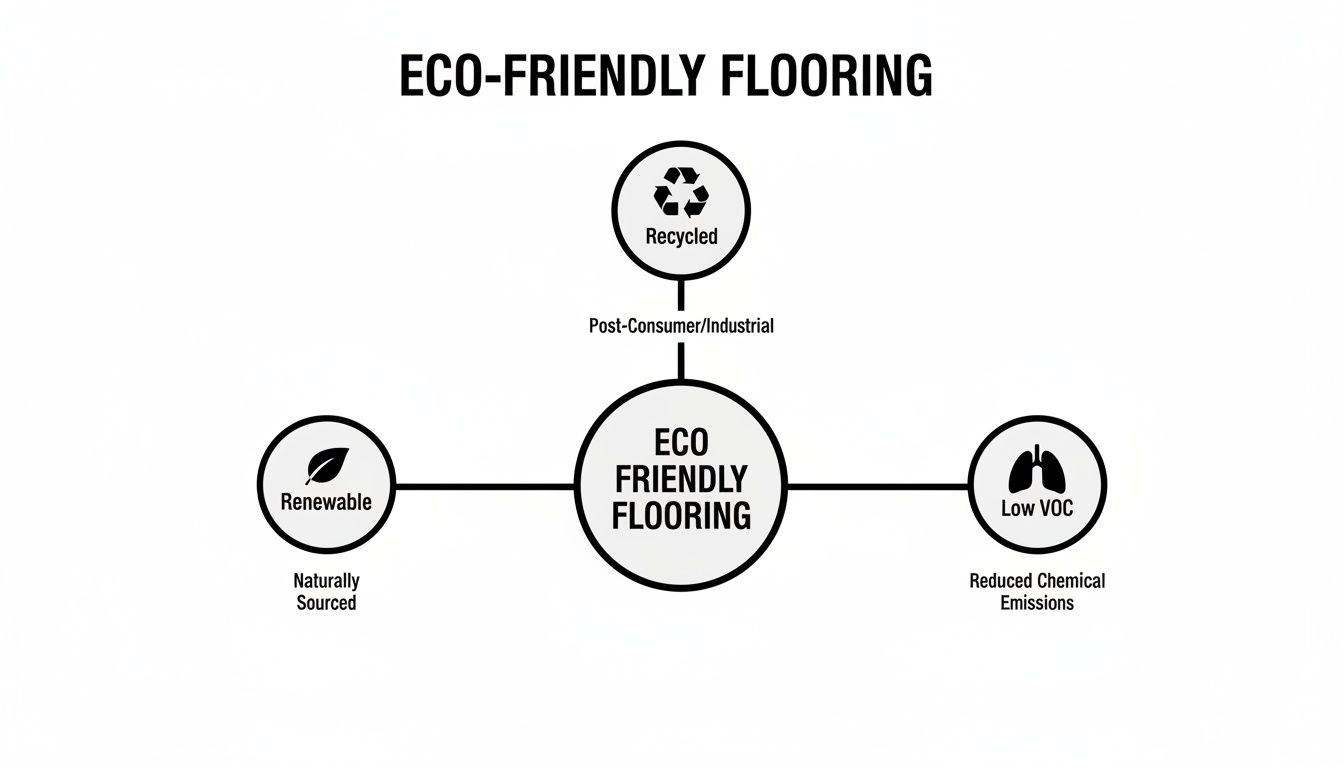
As you can see, a floor’s green credentials depend on whether its materials are renewable, if it uses recycled content, and how it impacts your indoor air quality through low VOCs.
This quick reference guide breaks down what to look for when choosing materials.
Key Criteria for Evaluating Eco Friendly Flooring
| Sustainability Factor | What It Means for Your Floor | Why This Matters |
|---|---|---|
| Material Source | The flooring comes from responsibly managed, renewable, or recycled sources. | Reduces deforestation, minimizes landfill waste, and lessens the need for new raw materials. |
| Manufacturing Impact | The production process uses minimal energy and water and avoids harmful chemicals. | Lowers the floor’s carbon footprint and prevents pollution of air and water. |
| Indoor Air Quality | The flooring, adhesives, and finishes release few or no Volatile Organic Compounds (VOCs). | Creates a healthier living space by preventing off-gassing that can cause respiratory issues. |
| Durability & Lifespan | The floor is built to last for decades, not just a few years. | A long-lasting floor means less waste, less-frequent replacement, and a better long-term value. |
Looking at flooring through this lens helps you see past the marketing and focus on what truly makes a product sustainable.
Deconstructing Eco-Friendly Concepts
Let’s dive a little deeper into what these terms mean when you’re standing in a showroom.
-
Renewable & Responsibly Sourced: This means the materials can be replenished naturally and quickly. Bamboo and cork are classic examples because they can be harvested without killing the plant. Reclaimed wood also fits here, as it gives old timber a new life and stops more trees from being cut down.
-
Recycled Content: Some of the smartest eco friendly flooring options are made from post-consumer or post-industrial waste. Think tiles made from recycled glass or rubber flooring created from old tires. Using recycled content keeps waste out of landfills and cuts down on the energy needed to produce new materials.
-
Low-VOC for Healthy Indoor Air: Volatile Organic Compounds (VOCs) are chemicals that can be released from flooring, adhesives, and finishes, hurting your home’s air quality. Choosing materials with low or zero VOCs is a must for a healthy home. To learn more, check out our guide on the importance of low-VOC building materials.
A floor’s true sustainability isn’t just about the material—it’s also about its manufacturing process and what happens at the end of its life. A durable, long-lasting floor that won’t need replacing for decades is inherently more sustainable than a trendy, disposable one.
The demand for these healthier, more sustainable products is growing fast. The global eco-friendly flooring market was valued at $15 billion in 2025 and is projected to climb to over $26 billion by 2033. This growth shows a clear shift away from floors laden with harmful VOCs toward greener alternatives. You can explore more data on this market trend at DataInsightsMarket.com.
Comparing the Top Sustainable Flooring Materials
Alright, you’ve got the theory down. Now comes the fun part: putting that knowledge to work. Picking the right material is always a balancing act—you’re weighing the eco-benefits against the look, feel, durability, and your budget. Let’s line up the most popular eco friendly flooring options to see how they really stack up.

We’ll look at each one through the lens of our sustainability scorecard, digging into where it comes from, how it’s made, and how it will perform in your home for years to come.
To make things easier, this table lets you quickly weigh the pros, cons, and key sustainability metrics of different flooring materials to find your perfect match.
At-a-Glance Comparison of Eco Friendly Flooring
| Material | Key Eco-Friendly Trait | Best For | Durability Rating | Average Cost Per Sq. Ft. |
|---|---|---|---|---|
| Bamboo | Rapidly renewable grass | Living rooms, bedrooms | Medium to High | $5 – $15 |
| Cork | Harvested bark (tree is unharmed) | Kitchens, playrooms, quiet spaces | Medium | $4 – $12 |
| Reclaimed Wood | Recycled from old structures | Any space needing character | Very High | $8 – $25+ |
| Linoleum | Biodegradable, natural materials | High-traffic areas, kitchens | High | $4 – $9 |
| Recycled Tile | Diverts waste from landfills | Bathrooms, kitchens, accents | High to Very High | $5 – $30 |
| Cement Tile | Extreme longevity, low-energy production | Floors, walls, high-impact areas | Very High | $10 – $30 |
This is just a starting point. The real story is in the details, so let’s explore what makes each of these materials a smart choice.
Bamboo Flooring: The Fast-Growing Grass
People often think bamboo is a type of wood, but it’s actually a grass that grows at an incredible speed. Some species shoot up several feet in a single day and are ready to harvest in just 3-5 years. Compare that to traditional hardwoods, which can take decades to mature, and you see why bamboo is such a renewable powerhouse.
But not all bamboo flooring is created equal. Most of it comes from China, which means shipping it across the globe adds to its carbon footprint. Always look for bamboo certified by the Forest Stewardship Council (FSC) to know it was grown and harvested responsibly.
The manufacturing process is also a big deal. The stalks are sliced, boiled, and laminated together with adhesives under heat and pressure. The quality of those adhesives is what determines your indoor air quality, so stick with reputable brands that offer low-VOC or no-added-formaldehyde products.
Cork Flooring: The Comfortable and Quiet Choice
Cork is another champion of renewability. It’s harvested from the bark of the cork oak tree, which grows mainly around the Mediterranean. Skilled workers carefully strip the bark by hand every nine years without hurting the tree. These trees can live for over 200 years, providing a sustainable resource for generations.
This harvesting process is what makes cork so exceptional. The trees keep right on absorbing CO2, and the industry provides a vital economic anchor for the region.
Beyond its green story, cork has some amazing natural benefits:
- Antimicrobial: It naturally resists mold and mildew.
- Insulating: It keeps rooms warmer in the winter and cooler in the summer.
- Cushioning: The cellular structure feels soft and forgiving underfoot.
The flooring itself is made from the granules left over from producing wine stoppers. They’re ground up and pressed into planks and tiles with minimal binding agents. Just like with bamboo, you’ll want to choose products that use low-VOC sealants to keep your indoor air clean.
Reclaimed Wood Flooring: A Story in Every Plank
This is the ultimate form of recycling for wood lovers. Reclaimed wood gives timber from old barns, factories, and warehouses a second act. Instead of rotting in a landfill, this character-rich wood is salvaged, re-milled, and turned into floors with a story to tell.
Because it’s a salvaged product, no new trees are cut down, which preserves our forests and wildlife habitats. Plus, the wood often comes from old-growth trees that are much denser and more durable than a lot of the timber being harvested today.
The main environmental hit comes from the energy needed for transportation and re-milling. But even that is far less than the energy it takes to fell, transport, and process virgin timber. It’s no surprise that reclaimed wood is one of the most celebrated eco friendly flooring options for its one-of-a-kind beauty and powerful sustainability story.
Linoleum: The Misunderstood Natural Wonder
Don’t confuse it with vinyl—true linoleum is a completely different beast. It’s made from a mix of all-natural materials: linseed oil, cork dust, wood flour, and a jute backing. These are all renewable resources that are biodegradable when the floor eventually reaches the end of its life.
The production process itself is also pretty gentle on the environment. The ingredients are mixed together and then rolled onto the jute backing to cure naturally over several weeks. Linoleum is incredibly tough, often lasting 40 years or more, even in busy commercial spaces.
It’s also naturally antibacterial and antistatic, so it’s a hygienic choice that’s a breeze to clean. While it might have a bit of a “retro” reputation, today’s linoleum is available in a huge array of vibrant colors and modern patterns that offer serious design flexibility.
Recycled Content and Concrete Tiles
This category covers a whole world of innovative materials that turn waste into beautiful, long-lasting surfaces. You can find recycled-content tile made from post-consumer glass, salvaged porcelain, and even industrial scrap metal. These products keep a massive amount of waste out of landfills and cut down on the need for new raw materials.
When you’re looking at sustainable options, it’s good to know the material’s basic characteristics; for instance, an article comparing concrete properties can help you understand its inherent durability, a key factor in its long-term eco-friendliness.
Handmade cement tiles, like ours at Original Mission Tile, fit perfectly into this eco-conscious philosophy. They’re crafted from natural materials—cement, sand, and mineral pigments—and are cured using a low-energy hydraulic press process. This avoids the carbon-heavy firing that ceramic tiles require. Their legendary durability means they can last for over a century, embodying the “buy it once, buy it for life” ethos of true sustainability. This incredible longevity dramatically reduces waste and the cost of replacement over a building’s entire lifespan.
How to Read Green Labels and Certifications
Walking into a showroom, you’re hit with a dozen claims: “green,” “natural,” “eco-friendly.” But what do those words actually mean? When every product seems to have a green story, it’s easy to feel lost.
The real secret is to look past the marketing and find the third-party certifications. These labels are your translator. They prove a product has been tested against strict, independent standards for health and environmental impact. Think of them as a non-negotiable gut check—if a floor has one, its eco-claims are legit.
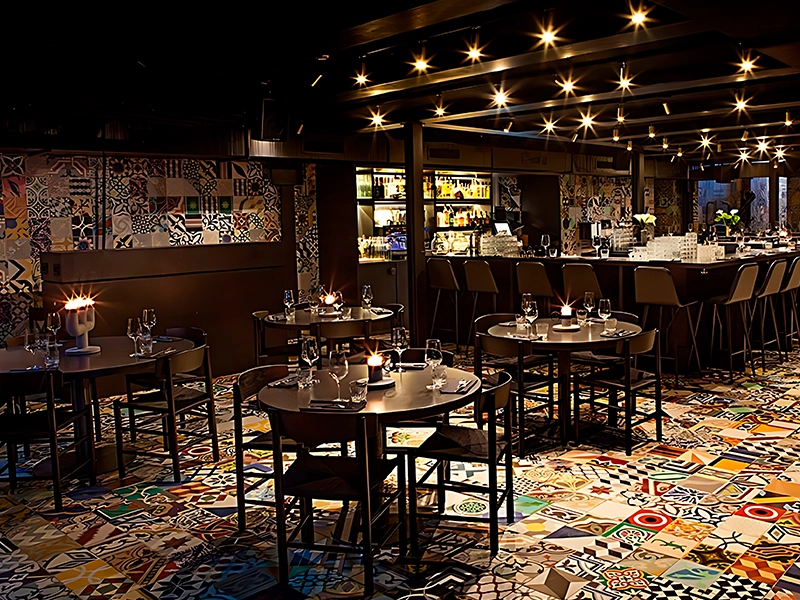
Decoding the Most Important Green Certifications
You don’t need to memorize every label out there. Just a few key players have become the benchmark for architects and designers. Knowing what they stand for puts you in control.
-
GreenGuard Certification: This one is all about air quality. It tests for over 10,000 chemicals and Volatile Organic Compounds (VOCs), ensuring a product won’t pollute your home. For homes with kids, pets, or anyone with sensitivities, look for GreenGuard Gold—it’s an even stricter standard.
-
Cradle to Cradle (C2C): This is the gold standard for circular design. C2C looks at the entire lifecycle, from how a product is made (material health, renewable energy) to where it goes at the end of its life (material reuse, water stewardship). A C2C-certified product is designed to either biodegrade safely or be recycled into something new.
-
LEED (Leadership in Energy and Environmental Design): You’ve probably heard of LEED for buildings, but it heavily influences what goes inside them. Using materials that contribute to LEED credits—like those with low VOCs or recycled content—is a huge focus for architects trying to hit project-wide sustainability goals.
These standards aren’t just suggestions anymore; they’re driving the market. With corporate ESG audits and building codes getting stricter, demand for certified flooring is climbing. One industry report even noted that 67% of developers plan to specify only eco-certified products for new projects by 2026. You can dig into the data in the latest market research.
Understanding VOCs: What You Can’t See Can Hurt You
Of all the things these labels track, Volatile Organic Compounds (VOCs) have the most direct impact on your family’s health. VOCs are harmful chemicals that “off-gas” from things like flooring, paint, and new furniture, silently polluting your indoor air.
Think of VOCs like a slow, invisible leak. You may not see or smell them, but they can be released for months or even years after installation, contributing to everything from headaches and allergies to long-term respiratory issues.
This is where knowing the difference between “low-VOC” and “zero-VOC” is critical.
- Low-VOC: The product has fewer VOCs than a conventional alternative, but they’re still present.
- Zero-VOC: The product has VOC levels so low they’re considered negligible.
But here’s the catch: the floor itself is only half the battle. You can buy a zero-VOC floor and then install it with a high-VOC adhesive, completely undermining your goal. Always check that your entire system—the flooring, the glue, and the sealer—is certified for low emissions.
This is a huge advantage of materials like handmade cement tiles. They are inherently zero-VOC and are installed with simple mortar, eliminating the risk of chemical off-gassing from day one.
A Spotlight on Concrete and Cement Tiles
While materials like bamboo and cork get a lot of attention, there’s another category that delivers incredible sustainability and timeless style: concrete and cement tiles. They’re often overlooked, but they represent some of the most durable and resource-smart eco friendly flooring options out there.
A poured and polished concrete floor is a fantastic green choice, especially in modern or minimalist designs where you already have a concrete slab foundation. By using that existing slab as your finished floor, you skip adding another layer of material entirely. It’s a move that dramatically cuts down on waste and your project’s carbon footprint. For instance, residential polished concrete gives you a sleek, tough finish by capitalizing on the structure that’s already there.
The Power of Thermal Mass
One of concrete’s biggest green benefits is something called thermal mass. You can think of it as a natural battery for your home’s temperature.
During the day, the dense concrete floor absorbs and stores heat from the sun. As temperatures drop at night, it slowly releases that stored warmth back into the room, helping to stabilize your home’s temperature.
This natural regulation means you’ll rely less on your heater or air conditioner, which is great for your energy bills and the environment. In hotter climates, it does the opposite, pulling heat from the air to help keep your interiors cool. It’s this passive energy-saving trick that makes concrete a go-to for green builders.
The Artistry of Handmade Cement Tiles
Now, let’s move from poured concrete to its more decorative cousin. Handmade cement tiles offer a stunning mix of artistry, longevity, and an eco-friendly production process. Unlike mass-produced ceramic or porcelain tiles that are fired in blazing hot, energy-guzzling kilns at over 2,000°F, traditional cement tiles are made without any heat at all. That single difference is huge for their green credentials.
The process is a true art form, one that has hardly changed in more than a century:
- Mixing the Colors: Natural mineral pigments are blended with cement and fine marble dust, creating a liquid paste of vibrant color.
- Setting the Pattern: A skilled artisan carefully pours these colors into a handcrafted metal mold, building the tile’s intricate design layer by layer.
- Applying Pressure: The mold is then filled out with a dry base of cement and sand and put under a hydraulic press, which uses immense pressure to fuse all the layers together.
- Curing Naturally: Finally, the finished tiles are simply left to cure in water and then air-dry for a few weeks, letting them harden into an incredibly dense and durable product.
This low-energy, kiln-free method creates a floor with virtually zero VOC emissions, making it an exceptionally healthy choice for your home. You can see how these artisan surfaces fit into all kinds of design styles and learn more about handmade cement tile.
Because the vibrant pattern isn’t just a glaze printed on top—it’s an inlaid layer that makes up a real part of the tile’s thickness—the color will never fade or wear away. A well-kept cement tile floor can easily last for over 100 years. It’s the ultimate expression of sustainability: buy it once, and it will last a lifetime.
Of course. Here is the rewritten section, adopting the specific expert tone, style, and formatting of the provided examples.
Why Handmade Cement Tiles Are a Top Sustainable Choice
When you hear “eco-friendly flooring,” fast-growing materials like bamboo and cork usually come to mind. But handmade cement tiles offer a different—and arguably more powerful—kind of sustainability, one built on incredible longevity and a low-impact production method.
These tiles aren’t about checking a few green-building boxes. They represent a philosophy of buying it once and having it for life. A well-cared-for cement tile floor isn’t just a design choice; it becomes a permanent part of the home’s architecture, sidestepping the wasteful cycle of trend-driven renovations.
A Low-Energy, Kiln-Free Production
The biggest difference between handmade cement tile and ceramic or porcelain is what doesn’t happen during its creation: it’s never fired in a kiln.
Think about the massive amount of energy needed to fire a commercial kiln to over 2,000°F—the temperature required for most ceramic tiles. That process burns huge quantities of fossil fuels. Handmade cement tiles skip that step completely. Their creation is a quiet, low-energy craft that relies on pressure, not heat.
We use a hydraulic press to fuse layers of natural materials—cement, sand, and mineral pigments—into an incredibly dense, solid tile. Once pressed, the tiles are simply submerged in water, then left to air-dry for weeks to cure and harden naturally.
This kiln-free method slashes the tile’s embodied carbon right from the start. It’s an artisanal process that has stayed much the same for over 150 years because it’s both effective and kind to resources.
Built to Last for Generations
The real test of a floor’s sustainability is how long it lasts before it’s torn out and hauled to a landfill. While many floors are designed for a 10–20 year lifespan, handmade cement tiles are in a different league entirely.
It’s easy to find original cement tile floors in Europe and Latin America that look fantastic after more than a century of foot traffic. That incredible durability comes from how they’re made.
- Deep Color Layer: Unlike printed tiles with a thin surface glaze, a cement tile’s pattern is made from a thick layer of pigmented cement. This color layer is typically 1/8-inch deep, so the design is literally part of the tile’s body.
- Ages Gracefully: As the tile wears down over decades, it just reveals a fresh layer of the same color. The pattern won’t fade, chip, or wear away.
- Zero-VOC Materials: Made from natural cement, sand, and mineral pigments, our tiles are inherently zero-VOC. They don’t release harmful chemicals into your home’s air, contributing to healthier indoor air quality from day one.
This built-to-last construction means less waste, fewer resources used on replacements, and a much smaller environmental footprint over the life of the building.
Timeless Design Is Sustainable Design
Sustainability isn’t just about sourcing and production—it’s also about style. Floors are often replaced not because they’ve failed, but because they’ve fallen out of fashion. That churn generates a staggering amount of waste.
Handmade cement tiles offer a solution. Their rich, solid colors and intricate patterns feel at home in almost any style, from historic to ultra-modern. And because you can create custom designs, you can craft a floor that’s a true piece of art for your home—something you’ll love for a lifetime, not just a season. Choosing a floor with that kind of enduring beauty is one of the smartest sustainable choices you can make.
Ensuring Long-Term Sustainability with Proper Care
What’s the single most impactful feature any of the best eco friendly flooring options can have? A long life. A floor that lasts for decades—or even a century—is the ultimate sustainable choice. It dramatically cuts down on waste, conserves resources, and eliminates the environmental toll of manufacturing and shipping replacements.
Getting there comes down to two things: smart installation and mindful care.
No matter what material you end up choosing, the installation is your first chance to protect your home’s air quality. Always insist on using low-VOC or zero-VOC adhesives and sealants. A beautiful green floor installed with high-VOC glue completely misses the point, as those chemicals can release fumes for months or even years.
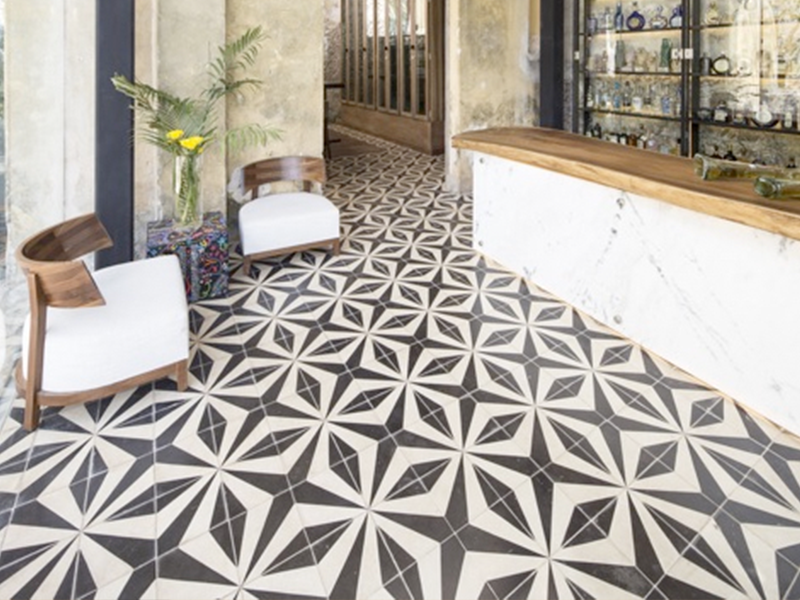
Sealing and Protecting Cement Tiles
For porous materials like our handmade cement tiles, sealing is a non-negotiable step. Think of it like this: an unsealed cement tile is like a beautiful wooden table left unfinished—gorgeous but vulnerable to everyday life. Sealing creates an invisible barrier that guards the tile against stains and moisture, which makes daily cleanup a breeze.
The process for sealing cement tile is surprisingly straightforward:
- Clean the Surface: Start with tiles that are perfectly clean, dry, and free of any dust or grout haze from the installation.
- Apply a Penetrating Sealer: Use a high-quality, low-VOC penetrating sealer made for cement or concrete. Apply it in thin, even coats with a microfiber cloth or an applicator pad.
- Allow Proper Curing: Let the sealer cure fully based on the manufacturer’s directions, usually for at least 24 hours, before walking on the floor.
Sealing doesn’t just protect against spills; it preserves the rich, matte finish and deep colors of the tile, ensuring your floor looks as stunning in twenty years as it does on day one.
Daily Cleaning for a Healthy Home
Once your floor is installed and sealed, keeping it beautiful is simple and fits right in with a healthy-home mindset. The goal is to clean effectively without bringing harsh chemicals into your living space.
Steer clear of acidic or abrasive cleaners like vinegar or bleach. They can eat away at the surface of many eco-friendly materials, especially the sealers on cement tile.
Instead, stick to pH-neutral, non-toxic cleaners. A simple mix of warm water and a few drops of a neutral cleaning concentrate is almost always all you need for routine mopping. By pairing a durable, long-life floor with gentle care, you create a beautiful and healthy foundation for your home that’s truly built to last.
For more detailed instructions, you can check out our guide on cleaning cement tiles.
Your Top Eco-Friendly Flooring Questions, Answered
When you start looking at eco-friendly floors, a few practical questions always come up. Let’s get straight to the answers you need to choose with confidence.
Which Eco-Friendly Flooring Is Best For Bathrooms?
In a wet, humid space like a bathroom, your best bet is a surface that just won’t care about water. That points directly to two great options: properly sealed cement tiles and true linoleum.
Handmade cement tiles, once sealed, become highly water-resistant and are famous for their durability. Linoleum also has natural water resistance, thanks to its linseed oil content. On the flip side, you’ll want to steer clear of materials like natural cork or some reclaimed woods, which can warp or break down with constant moisture.
The Takeaway: For wet areas, a non-porous or perfectly sealed surface is non-negotiable. Floors that can handle daily splashes and humidity will last far longer, which is the whole point of a sustainable investment.
Are Eco-Friendly Flooring Options More Expensive?
It’s easy to focus on the upfront price tag, but the real story is in the lifecycle value. While some green choices have a higher initial cost, they often save you money over time.
For example, ultra-durable materials like handmade cement tiles can last for over 100 years. That completely wipes out the replacement costs you’d face with less durable flooring. At the same time, many popular eco-friendly floors, like bamboo or linoleum, are priced right alongside traditional choices like hardwood or luxury vinyl tile (LVT), making them an affordable switch.
How Can I Be Sure a Product Is Genuinely Green?
This is the big one. The key is to look for proof, not just promises. Be skeptical of vague marketing terms like “natural” if there’s nothing to back them up.
Instead, look for trusted, third-party certifications like GreenGuard (which tests for low VOCs) or Cradle to Cradle (which assesses the entire lifecycle). A reputable manufacturer will be totally transparent about their process, from where they get their raw materials to the energy used to make the final product.
Ready to explore a floor that combines timeless artistry with true sustainability? Original Mission Tile has been crafting handmade cement tiles for over a century, offering a durable, zero-VOC, and beautiful foundation for your home.
Design your own custom cement tile or browse our in-stock collections at originalmissiontile.com