The floor is the one surface in a room that everyone touches, every day. It’s also the surface most designers treat as an afterthought — chosen after the furniture, after the paint, after the fixtures. In 2026, that sequence is reversing.
The most compelling interiors being completed across the United States and internationally this year share a structural quality: the floor came first. The pattern, the palette, the material — specified with intention, and everything else built around it. For interior designers, contractors, and renovators navigating an increasingly sophisticated client base, understanding where floor tile is headed in 2026 isn’t just about staying current. It’s about leading the conversation rather than following it.
This guide covers the floor tile trends defining 2026 — room by room, material by material — and explains why handmade cement tiles from Original Mission Tile are showing up at the center of the specifications that matter most.
The Overarching Shift: From Background to Foreground

The single biggest movement in floor tile for 2026 isn’t a specific pattern or palette — it’s a change in how designers and their clients are thinking about what a floor is for.
For most of the past decade, the dominant specification logic was subtraction: choose a floor that doesn’t compete. Large-format neutral porcelain. Wood-look LVT in greige. Stone-look slabs in colors that exist primarily to not be noticed. The floor as a visual pacifier.
That logic is exhausted. Clients who have lived in those interiors — who have walked across surfaces that ask nothing of them and give nothing back — are ready for floors that do something. Floors that create atmosphere. That cast shadows. That shift with the light. That make a room feel specific to the person who chose them.
For contractors and renovators, this shift is significant: clients are arriving at consultations with reference images of patterned floors, bold geometric combinations, and handmade tile surfaces. The demand is there. The specification skill to meet it is what this guide is designed to build.
Trend 1: Geometric Patterns in Deep, Saturated Color

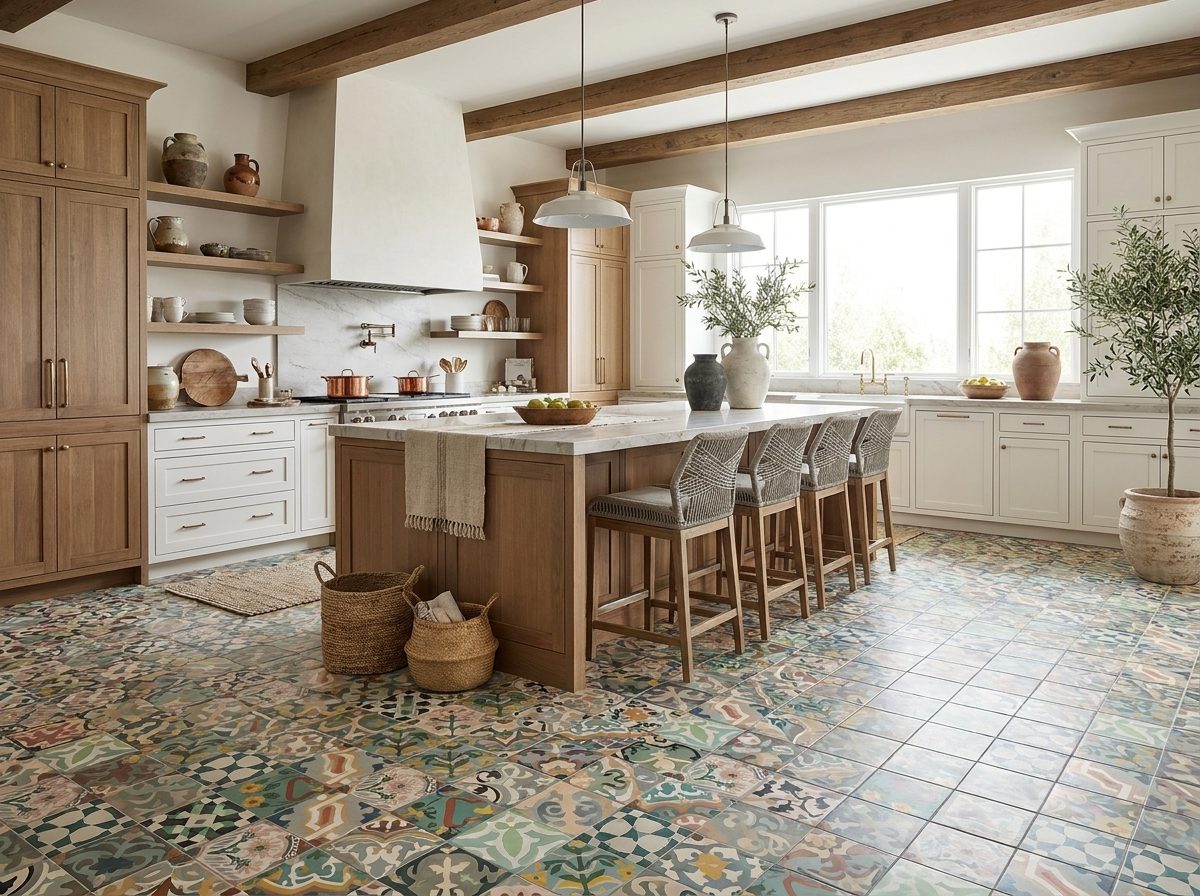
Geometric floor patterns have been building momentum for several years, but 2026 marks the moment they fully arrived in mainstream U.S. residential and commercial specification. The specific shift this year is in color confidence: geometric patterns in deep, saturated colorways — cobalt and cream, charcoal and warm white, forest green and terracotta — are being specified where a year or two ago a designer might have defaulted to black and white.
Why does this matter for specification? Because deep-color geometric cement tile floors are among the most photographic, most shareable, and most client-satisfying specifications available at any budget level. Clients who move into a home with a bold geometric cement tile kitchen floor don’t regret it. They photograph it. They show it to friends. They reference it when describing their home. It becomes the room’s identity.
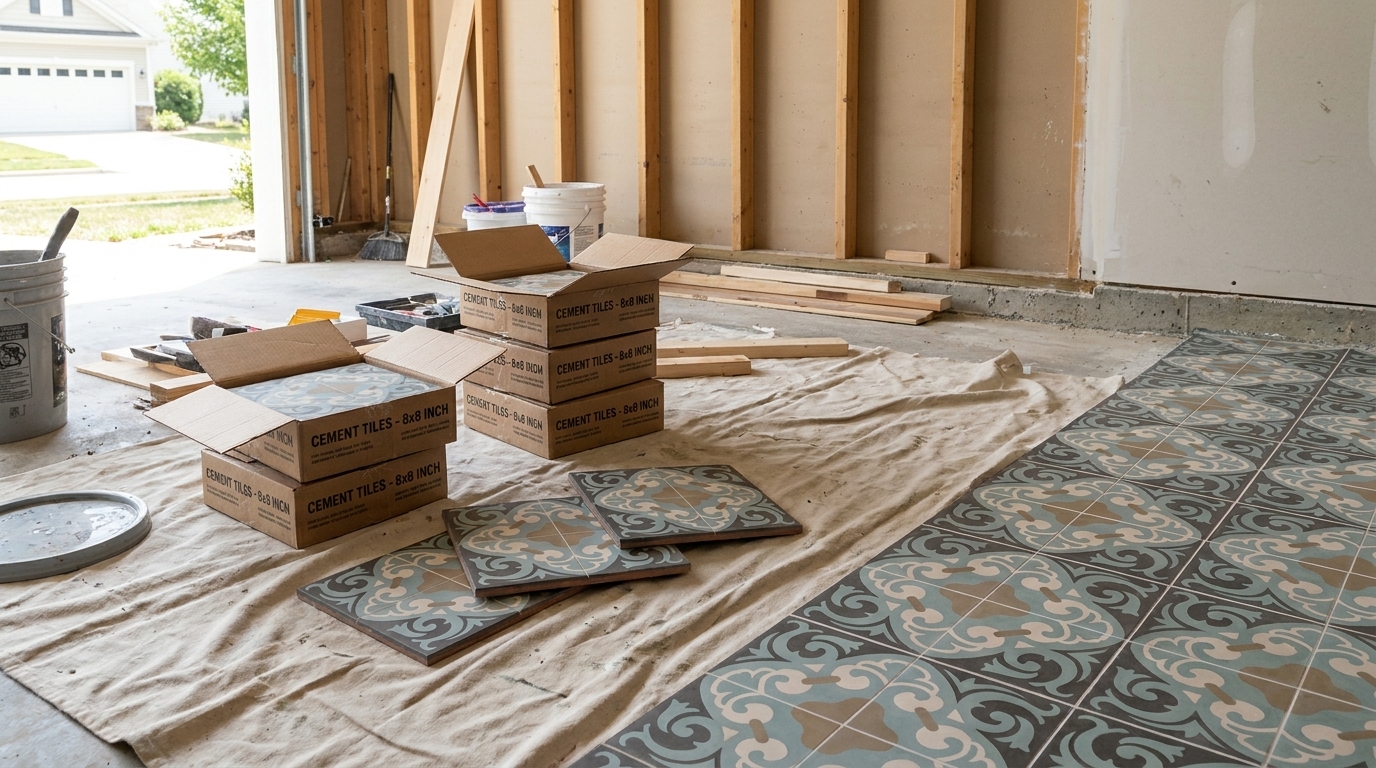
For contractors: layout planning is critical with geometric patterns. The visual center of the pattern must be optically centered in the room — not geometrically centered on the substrate. Mark the room’s optical center before beginning installation, and dry-lay at least one full pattern repeat in each direction before setting in adhesive.
At Original Mission Tile, the In-Stock Collection carries a curated range of proven geometric patterns in deep and neutral colorways — ready to specify, with documented commercial and residential installation references.
Trend 2: Terracotta and Warm Earth Palettes
The palette correction that has been building across interior design for several years has fully arrived in floor tile specification for 2026. Cool grays and clinical whites are being replaced by warm, earthy tones: terracotta, burnt sienna, clay, warm ochre, dusty adobe. These are the floor colors generating the most client enthusiasm across residential renovation categories this year.
Handmade cement tiles in terracotta-adjacent palettes carry a depth and warmth that mass-produced tiles in the same color family can’t replicate. The mineral pigments produce tones that interact with light rather than simply reflecting it — warmer in morning sun, richer under evening artificial light, and always more alive than a printed glaze or digital-ink surface.
For renovators advising clients: The terracotta palette is one of the easiest sells in 2026 because it works with such a wide range of architectural contexts — Spanish Colonial, craftsman, farmhouse, Mediterranean, contemporary new build. It doesn’t fight with natural wood, warm stone, or virtually any cabinetry color. It reads as timeless rather than trendy. And in cement tile, it will continue developing character and warmth for decades.
For contractors: Terracotta-toned cement tiles require the same sealing specification as all cement tiles — penetrating sealer before grouting, topcoat after installation — but the warm palette is visually forgiving in terms of grout haze and minor installation variation. A warm sand or honey-toned grout integrates naturally with these colorways.
Trend 3: Moroccan and Mediterranean Pattern Families

The Moroccan and Mediterranean tile pattern families — eight-pointed stars, interlocking diamonds, arabesque, zellige-adjacent geometric — have been the backbone of cement tile specification for decades, and in 2026 they’re experiencing a specific and significant renewal of interest in the U.S. market.
The driver is cultural: a growing segment of American homeowners and commercial operators is actively seeking design language with geographic and historical depth — surfaces that reference a specific tradition of craft, a specific region’s visual culture, a specific relationship between geometry and beauty that has been refined over centuries. Moroccan and Mediterranean tile patterns carry that depth in a way that contemporary invented patterns simply don’t.
For designers: these patterns are also among the most tolerant of different surrounding material contexts. A classic Moroccan star in black and white works in a 19th-century brownstone, a 1960s ranch house, a contemporary beach house, and a boutique hotel lobby. The pattern’s geometric logic transcends architectural style.
For contractors: Moroccan patterns require careful attention to pattern alignment at joints and corners. A misaligned Moroccan pattern is immediately obvious; a well-aligned one creates a visual field that reads as seamless. Dry-lay carefully, check alignment diagonally as well as orthogonally, and take time at the perimeter cuts.
Trend 4: Mixed Material Floors — Cement Tile and Stone
One of the most sophisticated floor tile trends of 2026 is the mixed-material installation: cement tile patterned field with natural stone border, or a stone-dominant floor with a cement tile inset medallion or rug pattern. These installations use the distinct visual languages of two handmade materials to create floors with compositional depth that neither material achieves alone.
In practical terms, this trend is being driven by clients who want the pattern richness of cement tile and the prestige association of natural stone in the same space. The key to making mixed-material floors work:
- Maintain consistent thickness: Cement tiles and natural stone must be set at the same finished height — use appropriate adhesive thickness to compensate for any dimensional difference between materials
- Establish a visual hierarchy: One material leads; the other supports. Typically the cement tile carries the pattern and the stone provides a grounding border or transition
- Share a palette thread: A stone border that echoes one of the cement tile’s secondary colors creates cohesion; unrelated stone colors create visual conflict
Trend 5: Entryway Floors as Thesis Statements

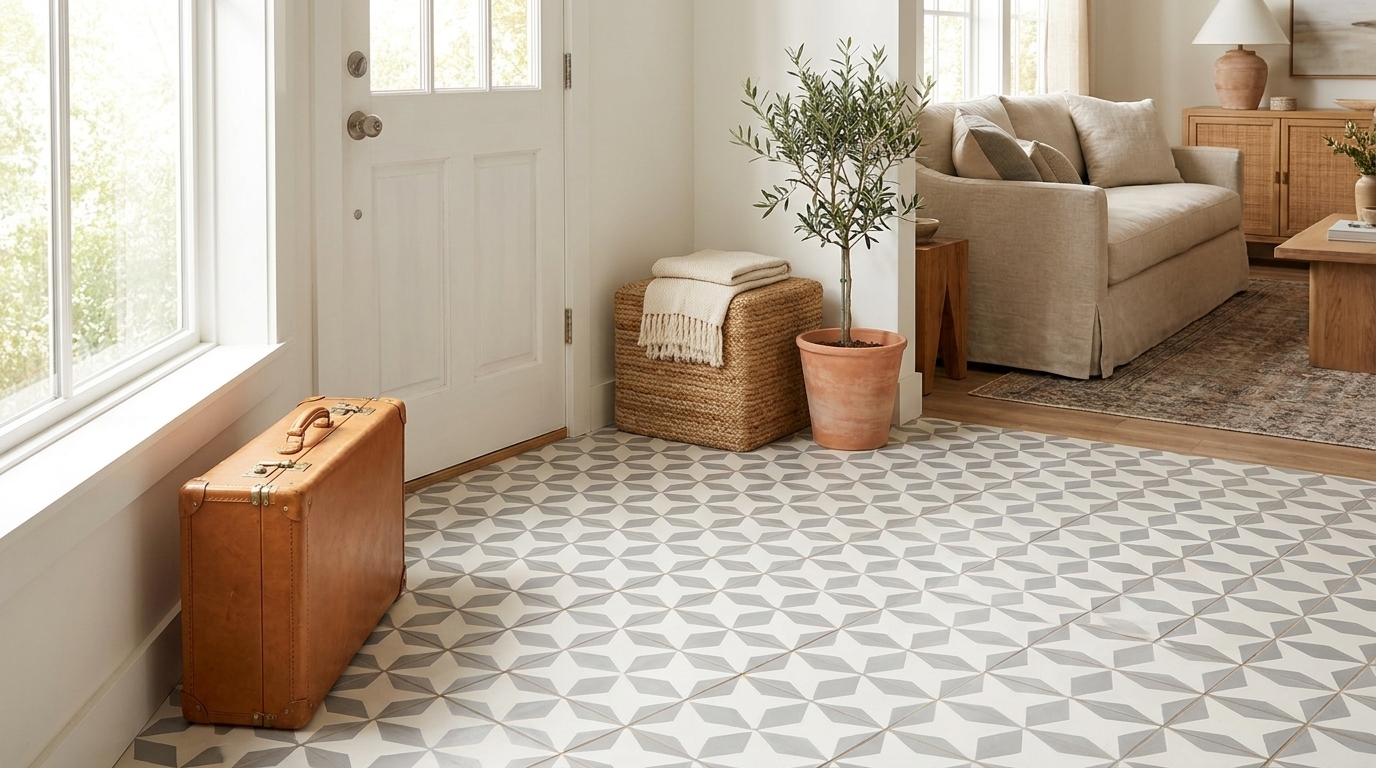
If there’s one room where the floor-first design logic of 2026 is being applied most confidently, it’s the entryway. Designers and renovators are treating entry floors as the home’s opening statement — the surface that tells the story of every design decision that follows before a guest has taken a second step inside.
For renovators, the entryway is the perfect introduction to cement tile specification for first-time clients: the area is typically small (low material cost and installation risk), it’s experienced at close range where the material quality of handmade tile is most legible, and the impact is immediately apparent. A before-and-after of an entryway floor renovation is one of the most reliable pieces of marketing content a contractor or designer can produce.
The patterns generating the most entryway specification activity in 2026: classic Moroccan star and cross, bold two-color geometric diamonds, encaustic floral combinations, and mixed-pattern borders around a simpler field tile center.
Use the Design Studio to visualize pattern and color combinations in the specific proportions of an entryway before ordering samples — it’s the fastest way to build client confidence and move a specification forward.
Trend 6: Outdoor Floor Tile — Terrace and Patio as Primary Space
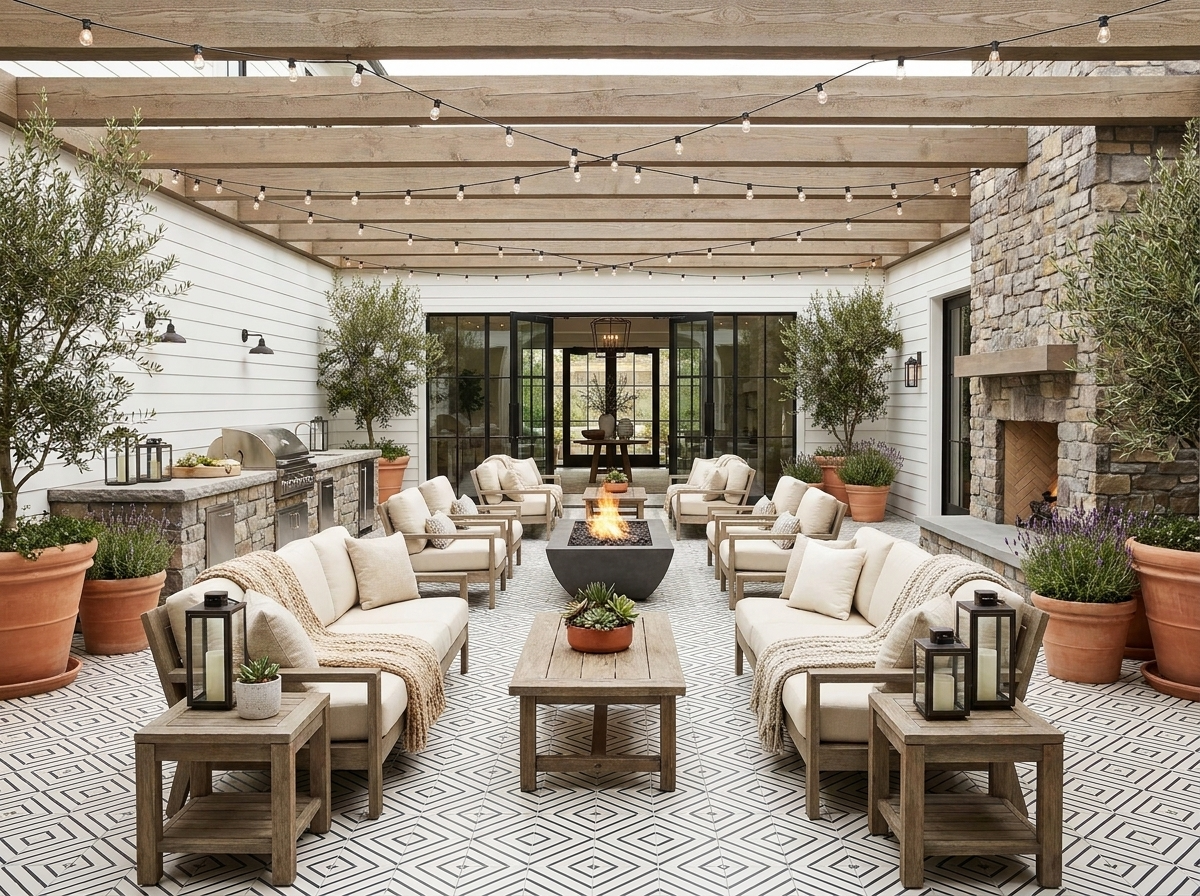
The covered terrace and patio has become one of the most invested floor areas in contemporary residential renovation — and in 2026, it’s receiving a level of design attention previously reserved for interior floors. Patterned cement tile terraces, Moroccan-influenced patio floors, and indoor-outdoor pattern continuity are all significant specification movements this year.
For covered outdoor applications, cement tiles perform well with appropriate sealing and installation specification. The indoor-outdoor continuity trend — running the same or complementary pattern from an interior kitchen or living room onto an adjacent terrace — is one of the most effective ways to visually expand a home’s footprint and create a sense that the outdoor space was designed as part of the home rather than appended to it.
For renovation projects with both indoor and outdoor floor tile scope, specifying from the same Original Mission Tile collection — a geometric kitchen floor and a complementary terrace pattern from the same palette — creates material coherence that elevates both spaces.
Specification Essentials for 2026 Floor Tile Projects
Whether you’re a designer finalizing a specification, a contractor preparing an installation, or a renovator planning a project, these principles apply across every 2026 floor tile trend:
Order samples first, always. Cement tile colors and patterns read differently under different lighting conditions — a pattern that looks perfect in a showroom may need adjustment when viewed in the actual space. Request samples from the In-Stock Collection early in the design process.
Specify 10–15% overage. For cuts, waste, and future repairs. Maintaining dye lot consistency for any future patching is important — especially in bold-pattern installations where a single mismatched tile is immediately visible.
Seal correctly and completely. Penetrating sealer before grouting, topcoat after. For kitchens, bathrooms, and outdoor applications, specify sealers appropriate for the moisture and traffic conditions of each space.
Grout color is a design decision. Not an afterthought. A grout that blends with the tile’s dominant tone creates a continuous, immersive floor. A contrasting grout emphasizes the grid and creates a more graphic, editorial effect. Both are valid — but the choice should be intentional.
For custom needs, the Custom Made Collection supports pattern and colorway development for projects that require something beyond the standard range. Engage the design team early — custom lead times should be built into the project schedule from the start.
FAQ: Floor Tile Trends 2026
Are patterned floor tiles harder to install than plain tiles? Patterned cement tiles require more careful layout planning than plain tiles — particularly centering the pattern optically in the room and maintaining alignment through the field — but they don’t require different tools or adhesives. The key is taking more time at the layout stage, dry-laying the pattern before setting, and using chalk lines to maintain alignment across the full floor area.
How do I help a hesitant client commit to a bold floor tile? The most effective approach is visualization in context — use the Design Studio to show the pattern at scale in the actual room dimensions, and share completed project photography from the Projects Gallery that matches the client’s architectural context. Physical samples in the actual space, under the actual lighting, close the gap between “I love it in the photo” and “I want it in my home.”
Which 2026 floor tile trend has the best ROI for a renovation project? The entryway patterned floor consistently delivers the highest perceived-value return relative to material and installation cost. It requires less square footage than a kitchen or bathroom floor, creates an immediate and dramatic before-and-after, and generates significant referral and word-of-mouth value. For larger renovation scopes, a patterned kitchen floor in a warm geometric or Moroccan pattern is the specification most likely to make the project memorable and photographable.
Can cement tile floors be installed over radiant heat? Yes, with appropriate adhesive selection and installation preparation. Specify a flexible adhesive rated for use over radiant heating substrates, and allow the system to complete an initial heating cycle before beginning tile installation. Consult with the Original Mission Tile team before specifying over radiant heat systems.
Conclusion: The Year the Floor Came First
The floor tile trends of 2026 share a single underlying principle: that a floor is not a background. It’s the foundation of every spatial experience — the first material a visitor reads, the last detail they remember, and the surface that shapes the mood of a room more profoundly than almost anything else.
Designers and contractors who internalize this principle in 2026 are the ones whose projects get published, photographed, and referred. Because the clients who commission a bold geometric entryway, a warm terracotta kitchen floor, or a Moroccan-pattern bathroom don’t keep it to themselves. They show everyone. And the floor is always the first thing anyone asks about.
Handmade cement tiles from Original Mission Tile — with their mineral pigment depth, their infinite pattern range, and their proven longevity across residential and commercial applications — are the material best positioned to meet that moment. Because when the floor comes first, what’s on it matters everything.
Ready to specify for 2026?
Explore proven patterns in the In-Stock Collection, develop something unique through the Custom Made Collection, visualize your project in the Design Studio, and browse completed floor installations in the Projects Gallery.
Contact the Original Mission Tile design team for samples and expert specification support →