
Think of floor tile underlayment as the secret to a professional tile job. It’s the critical layer between the structural subfloor (your home’s bones) and your beautiful new tile, acting like the foundation of a house—you never see it, but everything depends on it. Get this part right, and you get a crack-free finish that stands the test of time.
The Unseen Foundation Your Tile Floor Demands
Most people fall in love with the look of a tile—especially something unique like handmade cement tile—but the real magic behind a forever floor lies beneath the surface. Without the right underlayment, even the most expensive tile is set up to fail. It isn’t an optional upgrade; it’s a non-negotiable part of the system that does several crucial jobs to protect your investment.
First and foremost, underlayment creates a perfect canvas. Your subfloor, whether it’s wood or concrete, is almost never perfect. Underlayment smooths over minor imperfections, giving you a completely flat, stable, and predictable surface for the tile adhesive to grab onto.
Absorbing Movement and Preventing Cracks
Homes are alive. They shift, settle, and breathe with the seasons. Wood subfloors swell and shrink with humidity changes, and concrete slabs can develop tiny stress cracks. An underlayment, especially an uncoupling membrane, acts as a flexible buffer that soaks up all that movement.
It essentially “uncouples” the tile from the subfloor. This means stress from below never transfers upward, which is the #1 reason tiles and grout lines crack. This single function is what keeps a floor looking pristine for decades.
Managing Moisture and Ensuring Durability
Moisture is the ultimate enemy of any tile installation. It can warp a wood subfloor, turn thin-set mortar back to powder, and cause efflorescence (that chalky white residue) on porous tiles like cement. Many underlayments pull double duty as a waterproofing or vapor barrier.
This is a game-changer in bathrooms, basements, and kitchens, stopping moisture from creeping up from below and destroying your floor from the inside out. A smart underlayment choice is the difference between a floor that lasts five years and one that lasts a lifetime.
The industry is taking notice. The global floor underlayment market was valued at around $1.45 billion in 2025 and is expected to hit $2.06 billion by 2033, thanks to a worldwide boom in quality construction. You can see more on this trend over at Business Research Insights.
Understanding what underlayment does is the first step toward a successful project. To see how it fits into the bigger picture, check out our full guide on how to properly tile any surface for pro-level results.
Comparing the Most Common Types of Underlayment
Think of choosing your floor tile underlayment like picking the right foundation for a house. The entire structure relies on it. Get it wrong, and you’re in for a world of headaches. Get it right, and you’ve built a floor that will last for decades.
Not all underlayments do the same job. Selecting the right one is the single most important step in protecting your beautiful tile from moisture, subfloor movement, and the general chaos of daily life. Let’s walk through the heavy hitters in the industry so you can understand why a pro might pick one over another for your project.
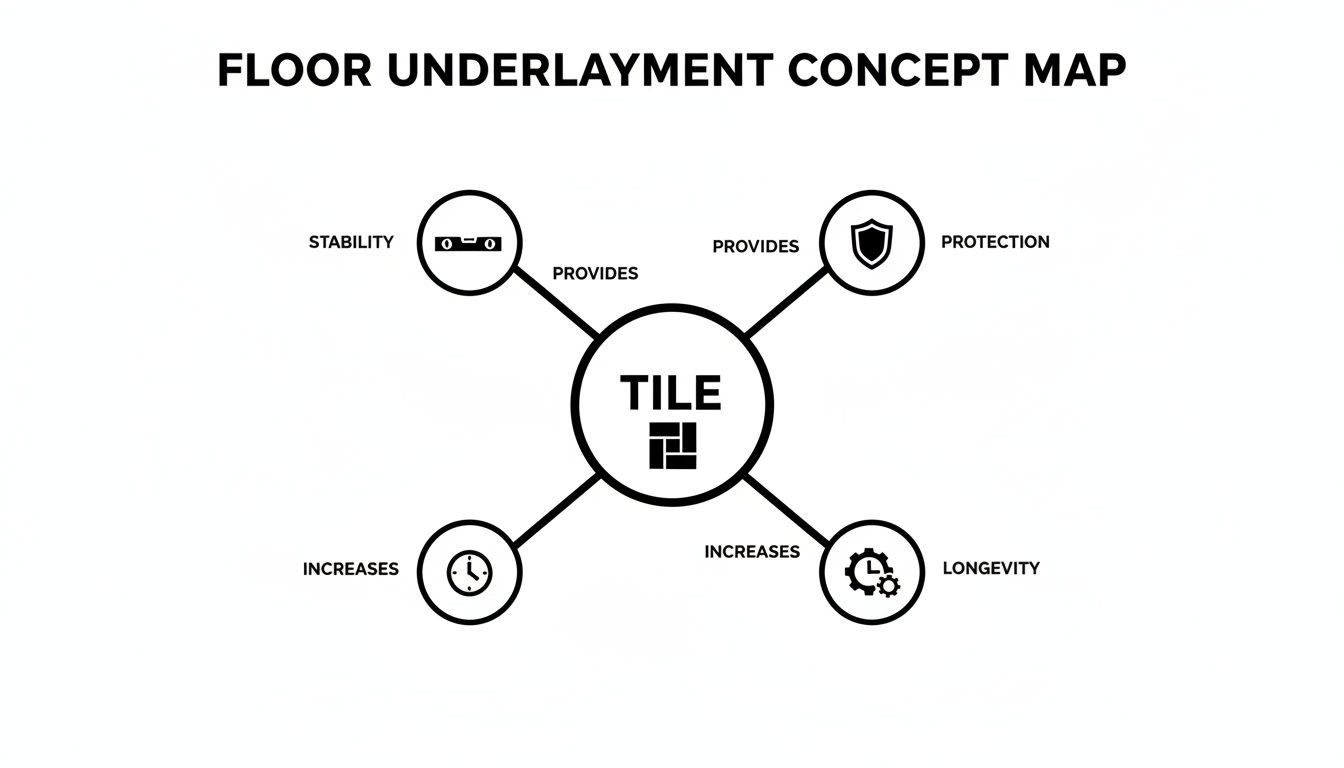
As you can see, a great underlayment isn’t just a simple layer; it’s a high-performance system designed to keep your floor stable, protected, and looking fantastic for years to come.
Cement Backer Board: The Tried-and-True Workhorse
For years, cement backer board has been the go-to choice for tile installers, and for good reason. It’s a dense, heavy sheet made from cement and reinforcing fibers, giving you an incredibly stable and water-resistant surface to work with.
Unlike wood or drywall, cement board won’t swell, rot, or fall apart when it gets wet. This makes it the undisputed champ for damp areas like bathrooms, laundry rooms, and kitchens. It’s basically a thin slice of concrete for your floor, providing a fantastic bonding surface for your thin-set and adding serious strength to the whole assembly.
Just be aware, it’s heavy stuff and a pain to haul around. Cutting it also kicks up a lot of silica dust, so proper safety gear is a must. And while it’s water-resistant, it’s not truly waterproof on its own. The seams and screw heads need to be taped and mortared, and for showers or wet rooms, you’ll still need a liquid waterproofing membrane over the top.
Uncoupling Membranes: The Modern Crack-Prevention Masters
Uncoupling membranes are a true game-changer in the tile world. These are lightweight polyethylene sheets, usually with a waffle-like pattern on top and a fleece layer on the bottom. Their main job is crack isolation, and they are brilliant at it.
Imagine your subfloor and your tile are two separate tectonic plates. An uncoupling membrane acts as a slip layer between them. It allows the subfloor to expand, contract, or shift slightly without transferring that stress up to your tile and grout.
This is absolutely essential when you’re working with large-format tiles, which have very little tolerance for movement. These membranes also manage vapor and provide excellent waterproofing, making them a fantastic all-in-one solution. Plus, they’re so much lighter and easier to handle than heavy backer boards.
Foam Backer Boards: The Lightweight, Waterproof Insulator
Looking for a lightweight alternative to cement board? Foam backer boards are your answer. They’re made from high-density extruded polystyrene foam with a reinforced, cement-like coating. The result is a board that’s 100% waterproof and provides excellent insulation.
Their biggest wins are ease of use and thermal benefits. They are feather-light, cut cleanly with just a utility knife, and create almost no dust. This makes them a favorite for shower walls and for floors over cold concrete slabs or when installing radiant heating systems.
Specialized Waterproofing Layers
When you need absolute, guaranteed water protection, you bring in the specialists. While other underlayments offer some resistance, dedicated waterproofing layers create a truly impenetrable barrier. They typically come in two forms:
- Sheet Membranes: These are flexible sheets rolled out and bonded to the subfloor with thin-set mortar. They’re perfect for creating a seamless, tank-like waterproof system in showers, steam rooms, or commercial kitchens.
- Liquid-Applied Membranes: Think of this as thick, rubbery paint. You roll or brush it on, and it cures into a seamless waterproof skin that’s ideal for tricky layouts with lots of corners and drains.
In situations with significant moisture concerns, such as below-grade installations, looking into specialized basement waterproofing membranes is a smart move, as they are engineered to handle hydrostatic pressure.
A Quick Word on Plywood
Let’s be clear: plywood is not a suitable underlayment for tile. Standard plywood is like a sponge—it soaks up moisture, swells, warps, and will completely destroy your tile installation in short order.
While some exterior-grade plywoods might be used in perfectly dry and stable conditions, it’s a huge risk. For any tile job over a wood subfloor, you must install a proper floor tile underlayment—like cement board or an uncoupling membrane—right on top of that plywood subfloor. Never, ever bond tile directly to standard plywood.
Quick Comparison of Floor Tile Underlayment Types
To make sense of it all, here’s a quick rundown of the most common options. This table should help you quickly see which material fits the bill for your specific project.
| Underlayment Type | Primary Function | Best For… | Considerations for Cement Tile |
|---|---|---|---|
| Cement Backer Board | Stability & Water Resistance | Wet areas (bathrooms, kitchens), floors needing extra rigidity. The traditional standard. | Provides a very stable, flat base. Essential for ensuring tiles don’t crack under load. |
| Uncoupling Membrane | Crack Isolation & Waterproofing | Large-format tiles, installations over concrete slabs, radiant heat systems. | Excellent choice. Protects porous cement tiles from substrate cracks and moisture vapor. |
| Foam Backer Board | Waterproofing & Insulation | Shower walls, floors over cold slabs, radiant heat systems. A lightweight option. | Great for insulating floors, which can make cement tile feel warmer underfoot. |
| Waterproofing Membrane | Total Water & Vapor Barrier | Showers, steam rooms, wet rooms, commercial kitchens. The ultimate protection. | A must-have for wet areas to protect both the tile and the structure beneath it. |
Ultimately, the best underlayment creates a stable, protected environment where your tile—especially handmade cement tile—can live a long and crack-free life.
How to Prepare Your Subfloor for Underlayment
Before you even think about laying down your chosen floor tile underlayment, you have to deal with the surface it’s going to stick to: the subfloor. It’s a common point of confusion, but the difference is simple. The subfloor is the structural foundation of your room—the plywood or concrete slab that’s part of the house itself. The underlayment is the high-performance layer you add on top to get it ready for tile.
Think of it this way: your subfloor is the raw canvas, and the underlayment is the expertly applied primer. You wouldn’t paint a masterpiece on a dirty, warped canvas, right? The same logic applies to tile. A flawless installation starts with a flawless subfloor.

Assessing Your Subfloor for Stability and Flatness
First things first: a thorough assessment. Your subfloor needs to be clean, solid, and completely free of anything that could get in the way of a good bond—old adhesive, paint drips, grease, you name it. But even more importantly, it has to meet some pretty strict industry standards for flatness and rigidity. If it doesn’t, your tile and grout will crack. It’s just a matter of time.
According to the Tile Council of North America (TCNA), a subfloor can’t have more than 1/4-inch of variation over a 10-foot span for most standard tiles. For large-format tiles (any side longer than 15 inches), that tolerance shrinks to a razor-thin 1/8-inch in 10 feet.
This isn’t a suggestion; it’s a requirement. To check, grab a long, straight edge or a laser level and scan the entire surface. Mark any high spots you find for grinding and any low spots for filling with a patching compound. Getting this part perfect is a non-negotiable first step. To see how this fits into the bigger picture, check out our guide on how to install ceramic floor tile.
Understanding Deflection in Wood Subfloors
If your home has wood-framed construction, there’s another critical factor to watch out for: deflection. It’s just a technical term for how much the floor “bounces” or flexes when you walk across it. Tile is completely rigid and has zero patience for a bouncy subfloor. Any significant movement will eventually telegraph through, causing cracked grout and loose or broken tiles.
The industry standard is L/360. The formula might sound intimidating, but the idea is straightforward. “L” is just the length of the joist span in inches. So, for a 15-foot (180-inch) span, the most deflection you can have is 180 divided by 360, which is half an inch. If your floor moves more than that, it needs to be stiffened up with extra bracing or another layer of plywood before any underlayment goes down.
Managing Moisture: The Silent Killer of Tile Floors
Moisture is the number one enemy of a tile installation, especially when you’re working with porous, handmade materials like cement tiles. Water vapor can travel up through concrete slabs or from damp crawl spaces, bringing alkaline salts along for the ride. When that moisture evaporates at the surface, it leaves behind a chalky white residue called efflorescence, which can permanently stain your beautiful tiles and break down the thin-set mortar.
This is why moisture management is such a huge part of subfloor prep.
- For Concrete Slabs: Your slab must be fully cured (give it at least 28 days) and tested for moisture vapor. If the levels are high, a vapor barrier or a waterproofing membrane isn’t just a good idea—it’s mandatory.
- For Wood Subfloors: Make sure any crawl spaces are dry and well-ventilated. Any existing water damage or rot has to be completely repaired before you even think about moving forward.
Skipping moisture control is one of the most expensive mistakes you can make. The right underlayment, particularly a waterproofing or uncoupling membrane, acts as your last line of defense, protecting both your home’s structure and your tile’s beauty for years.
Choosing the Right Underlayment for Any Room
Picking the right floor tile underlayment isn’t a one-size-fits-all job. It’s a strategic choice, and the room itself tells you exactly what you need. The foundation that works perfectly in a quiet bedroom would fail spectacularly in a busy commercial kitchen.
Before you even think about tile, you have to think about the room’s purpose. What will this floor endure every day? We’re talking foot traffic, moisture, potential impacts, and even sound. Matching the underlayment to the room’s unique challenges is the only way to build a floor system that lasts.
Underlayment for Bathrooms and Wet Rooms
In bathrooms, laundry rooms, or any space with constant water exposure, moisture is the enemy. Water is relentless. Without a bulletproof defense, it will find its way into your subfloor, leading to rot, mold, and total failure. Your underlayment can’t just be “water-resistant”—it has to be completely waterproof.
For these high-stakes rooms, a two-part system is often the best bet. A common pro approach is installing a cement backer board and then painting a liquid waterproofing membrane over the top, creating a seamless, tank-like barrier. Newer foam backer boards and sheet membranes can also provide an all-in-one solution that’s both lightweight and 100% waterproof.
When planning a bathroom project, your goal is total water containment. Think of the room as a sealed unit. The right underlayment is what ensures water stays where it belongs, protecting the bones of your home.
Choosing the right materials from day one is how you create durable, low-maintenance bathroom upgrades that truly stand the test of time. A solid waterproofing strategy under your tile is the ultimate insurance policy.
Kitchens and High-Traffic Hallways
Kitchens and hallways are the workhorses of any home. They put up with constant foot traffic, dropped pots and pans, and the daily grind of family life. For these areas, durability, crack isolation, and impact resistance are what matter most.
An uncoupling membrane is an outstanding choice here. These membranes are designed to absorb the stress from tiny shifts in the subfloor, which are common in long, open areas like hallways. This flexibility prevents cracks from telegraphing up through your beautiful tile and grout—a common headache in high-traffic zones.
Plus, the membrane’s structure helps distribute heavy loads from things like refrigerators or kitchen islands, protecting individual tiles from fracturing under pressure. It’s the perfect blend of strength and flexibility for a busy space.
Large Open-Plan Spaces and Commercial Projects
Big, continuous tile installations come with their own set of challenges. Expansive floors are more susceptible to subfloor movement, and in commercial settings like restaurants or retail stores, acoustics suddenly become a big deal. The clatter of footsteps and chairs can kill the ambiance if it isn’t managed.
For these jobs, you need specialized underlayments that offer sound dampening. Cork and high-density rubber are excellent choices for absorbing impact sound, significantly cutting down noise transmission to the floors below. Uncoupling membranes also shine here, providing much-needed movement isolation across those large spans.
This focus on performance is driving huge demand globally, with Asia Pacific becoming the dominant region for floor underlayment thanks to massive urbanization in countries like China and India. For designers on international projects, understanding these trends is key.
If your space also includes in-floor heating, the stakes are even higher. You’ll want to check out our complete guide to radiant heat under cement tiles to see how specific underlayments are designed to work with heating systems, ensuring you get both cozy warmth and rock-solid stability.
Avoiding Common Underlayment Installation Mistakes
Even the best floor tile underlayment is only as good as its installation. I’ve seen it happen time and again: a small shortcut taken to save a few minutes ends up compromising the entire floor. You get cracked tiles, crumbling grout, and a repair bill that’s far more painful than doing the job right the first time.
A beautiful, long-lasting tile floor isn’t just about the tile you see on top; it’s about the meticulous, unseen work that goes into the foundation. Knowing where installers often go wrong is the best way to make sure your project is built to last.
Mistakes with Cement Backer Board
Cement backer board is an industry workhorse for a reason, but its rock-solid reputation depends entirely on how it’s put down. A couple of common slip-ups can turn this sturdy base into your floor’s weakest link.
The absolute biggest mistake is improper fastening. Many people—DIYers and even some pros who should know better—just screw the board straight to the subfloor and call it a day. This is a critical error. The board must be set into a fresh bed of thin-set mortar. That mortar fills every tiny gap and void, ensuring the board is 100% supported and eliminating the flex that cracks tile.
Another common goof is using the wrong screws or spacing them incorrectly. Never use drywall screws; they’ll corrode from the moisture in the mortar and fail over time. You have to use special corrosion-resistant backer board screws, spaced every 8 inches across the board and kept about 2 inches from the edges.
Errors When Installing Membranes
Uncoupling and waterproofing membranes are fantastic, but they require a different kind of precision. Unlike rigid boards, their job relies on achieving a perfect, continuous bond with the subfloor.
The most damaging mistake here is leaving voids or air pockets underneath. This happens when the thin-set isn’t spread evenly, creating little unsupported bubbles. Any pressure from above—a heavy fridge being rolled into place or even years of foot traffic—will eventually crack the tile right over that void.
Pro Tip: Always “key in” your thin-set by pressing the flat side of the trowel firmly across the subfloor before you comb it out. This creates a tenacious initial bond and is the secret to getting that critical, void-free coverage.
Failing to properly overlap and seal the seams is another huge no-no, especially with waterproofing. Every single seam needs to be covered with the manufacturer’s sealing band to create a monolithic, bathtub-like barrier. One tiny gap completely defeats the purpose of the whole system.
Pitfalls with Self-Leveling Compounds
Self-leveling underlayment looks like magic in a bag. You just pour it out and watch it create a perfectly flat surface, right? Well, not exactly. Getting that flawless finish is all about the prep work and respecting the product’s chemistry.
The number one error is improper mixing. Adding too much water seems like it would help it flow, but it actually destroys the compound’s strength, leaving you with a soft, chalky surface that will crumble under your tile. Too little water, and it’s too thick to level out properly. You’re aiming for a smooth consistency, like pancake batter.
The other thing people skip is the primer. You must use the recommended primer to seal the subfloor first. This stops the wood or concrete from sucking water out of the mix too quickly. Without primer, the compound can dry unevenly, crack, and fail to bond. Following the manufacturer’s instructions to the letter isn’t a suggestion—it’s a requirement.
How Underlayment Impacts Long-Term Performance
Choosing the right floor tile underlayment isn’t just about prepping for a tile job; it’s about investing in the future of your floor. The choices you make before a single tile goes down will dictate the beauty, durability, and health of that installation for decades.
Think of it as the ultimate insurance policy against the most common and expensive flooring failures. A great underlayment system is the unsung hero that keeps a beautiful tile floor from turning into a costly headache.
Protecting Grout and Preventing Lippage
The first and most immediate job of underlayment is to protect the tile and grout from the natural movement of your subfloor. Grout is rigid and porous, making it the first thing to crack when the floor beneath it shifts or settles.
A proper underlayment, especially an uncoupling membrane, essentially isolates the tile from that structural stress. This means your grout lines stay stable, clean, and intact, avoiding those ugly spiderweb cracks that scream “installation failure.”
Over time, as a house settles, a weak foundation can also cause tile lippage—that annoying and unsafe condition where one tile edge sits higher than its neighbor. A solid underlayment creates a consistently stable plane, locking tiles in place and helping maintain a perfectly flat, professional surface for years to come.
Enhancing Comfort and Adding Value
The benefits go way beyond just preventing cracks. In modern homes, underlayment is a key player in how a room feels. When you pair a radiant heating system with a specialized underlayment, you’re not just protecting the heating elements—you’re actually improving the system’s thermal efficiency. That means a cozier living space and, often, lower energy bills.
This focus on creating smarter, more resilient flooring systems is a big deal in the industry. The floor underlayment market is expected to grow from $17.94 billion in 2025 to a massive $25.75 billion by 2030, showing just how critical this layer has become. You can discover more insights about the trends in sustainable and smart flooring solutions. This isn’t just about adding a layer; it’s about engineering a better floor from the ground up.
The upfront investment in the correct floor tile underlayment is one of the smartest financial decisions you can make during a renovation. It pays for itself many times over by safeguarding your beautiful artisan tile, ensuring it remains a stunning, trouble-free feature for the life of your home. A floor built on a solid foundation isn’t just laid; it’s engineered to last.
Your Top Questions About Floor Tile Underlayment
We get asked about underlayment all the time. Here are quick, straight-from-the-field answers to the questions designers, contractors, and homeowners ask most.
Do I Really Need Underlayment for Tile Over a Concrete Slab?
Yes, it’s a non-negotiable for a lasting installation. Concrete seems solid, but it moves, cracks, and can wick moisture over time. Think of a quality underlayment—especially an uncoupling membrane—as a shock absorber for your tile.
It creates a buffer that isolates the tile from the slab’s movement, which is the number one cause of cracked tiles and grout. In basements or bathrooms, it also acts as a vital moisture barrier, protecting your beautiful tile from below. Skipping it is a gamble you don’t want to take.
Can I Just Use the Same Underlayment for Floors and Walls?
Not always. While some products like cement backer board are workhorses for both horizontal and vertical surfaces, many specialized underlayments are engineered for one job only.
For instance, most uncoupling membranes are designed specifically for the stresses of flooring and aren’t rated for wall installations. Always check the manufacturer’s specifications to confirm where a product can be used. This is especially critical in high-moisture areas like shower walls, where getting it right is everything.
What’s the Best Underlayment for Radiant Floor Heating?
When you’re installing in-floor heat, you need an underlayment that can handle the thermal expansion and contraction. Modern uncoupling membranes are the gold standard here.
Many are designed with built-in channels or studs that perfectly cradle the heating wires. This design not only secures the system and makes installation easier, but it also protects the tile from thermal stress and creates an ideal surface for the thinset to bond to. It’s a win-win for performance and longevity.
Ready to lay the perfect foundation for your tile? At Original Mission Tile, our handmade cement tiles deserve the best support to ensure decades of beauty. Explore our artisan-crafted collections and find the perfect tile for your next project at https://originalmissiontile.com.