You’re probably here because you’ve ruled out the usual suspects.
Porcelain may be practical, ceramic may be familiar, and natural stone may be beautiful, but none of them quite gives you that mix of pattern, permanence, and human touch you want underfoot or on the wall. You want a surface with character. You also want something that can survive daily life, hold up in a kitchen or bath, and still feel intentional years from now.
That search is what brings many people to patterned cement tile.
For designers, it solves a hard problem. It adds graphic impact without looking printed or synthetic. For homeowners, it offers something even better. A floor or wall that feels made, not manufactured. For builders and installers, it demands respect because it behaves differently from glazed tile and rewards proper handling.
An Introduction to Timeless Surfaces
Patterned cement tile sits in a rare category of building materials. It has a strong decorative voice, but it isn’t fragile. It carries old-world craft, but it can fit a very current interior. It feels artistic up close and architectural from across a room.
People often meet it first through color and pattern. A café floor with a repeating motif. A powder room with a small field of geometry. A kitchen backsplash that reads more like a textile than a hard surface. Then the practical questions begin. How is it made? Is the color on the surface or in the body? Can it go in a shower? What does it need from the installer? How do you clean it without ruining the finish?
Those are the right questions.
A good patterned cement tile project depends on more than choosing a pretty design. It depends on understanding the material itself. This tile has a different structure, a different feel, and a different set of installation rules than fired ceramic or porcelain. That’s why some installations age beautifully and some fail early. The difference usually isn’t the tile. It’s the specification, the prep, and the maintenance plan.
Patterned cement tile rewards people who treat it like a crafted cement product, not like a glazed commodity tile.
The appeal is easy to see. The deeper value is in the combination of history, composition, and performance. When those three line up with the right project, patterned cement tile becomes one of the most memorable surfaces in a building.
The Soul of the Tile What Makes Patterned Cement Unique
A homeowner falls in love with the pattern first. Then the sample goes into their hand, and the actual questions start. Why does it feel more like stone than ceramic. Why is the face matte instead of glossy. Why does one tile have a little movement in tone while the next is not perfectly identical.
The answer is in the construction.

The three layers that matter
Patterned cement tile is made in layers and cured, not fired. The face is a pigmented wear layer, hand-poured into a mold. Beneath that sits a finer cement layer that helps bind and support the surface. The bottom layer is the structural body, usually a sand-and-cement mix that gives the tile its mass.
Those layers are compressed together under high pressure. As noted in Villa Lagoon Tile’s technical data on cement tile, the wear layer is typically 3 to 5 mm thick, the tile is pressed at about 1,700 PSI, and the finished surface has a Mohs hardness of 3 to 4. In practice, that means the pattern has real depth, the tile has good density, and the surface should be specified more like honed marble than glazed porcelain.
That distinction matters on site.
Why the finish looks different from ceramic
A ceramic tile gets much of its visual character from glaze. Cement tile gets it from material. Color lives in the wear layer itself, so the face has depth and softness under light that printed surfaces rarely match.
The surface reads as matte, velvety, and stone-like. It also shows the hand of the maker. Slight variation in tone, edge, and pigment distribution is part of the craft, especially in richly colored or highly patterned designs. Designers who want absolute uniformity usually do better with porcelain. Designers who want warmth, depth, and a surface that feels made rather than manufactured usually choose cement.
If you want a plain-language explanation of the terminology, this overview of what encaustic tiles are is a useful starting point.
What the materials do
Each ingredient has a job.
- White Portland cement creates a clean base that lets pigment read clearly.
- Marble dust refines the face and helps produce that smooth, dense touch.
- Mineral pigments provide color within the surface layer rather than on top of it.
- Sand and cement in the backing layers give the tile structure and weight.
This mix is one reason patterned cement tile feels substantial in the hand and grounded in a room. It is also why installers need to handle it with respect. The face is dense, but it is still an unglazed cementitious surface, so it can absorb moisture and staining if the job is specified carelessly.
Why this construction changes specification decisions
Good results start with understanding the trade-offs. An inlaid face gives long-term visual depth, but the tile needs sealing and the right cleaning products. Hand-craft gives the surface character, but dry-laying and shade blending are part of a professional installation. The same qualities that make cement tile beautiful in a foyer or kitchen can also work in showers, steam rooms, and other wet areas, but only with proper waterproofing, movement joints, compatible setting materials, and a maintenance plan that treats the tile like cement and stone, not like a factory-glazed product.
That is the soul of the material. Patterned cement tile is decorative, yes, but its real value is technical as much as visual. Once you understand how it is built, you can use it with much more confidence, whether you are selecting a quiet two-color floor, a custom 3D field tile, or a brass-inlaid design that asks the installer for real precision.
A Legacy in Layers The Rich History of Cement Tile
A century-old entry hall tells the story better than any showroom sample. The colors sit inside the surface instead of wearing off it. The pattern still holds the room together. The edges show use, but the floor still reads as intentional. That durability of design is part of why patterned cement tile has stayed relevant.
Patterned cement tile began in Catalonia, Spain, around 1850, where makers developed a hydraulic-press method that avoided kiln firing and made detailed ornamental flooring more attainable. The same history of cement tile from Studio Cement Tile traces how the material spread from Spain into wider European use, reached England and America by the turn of the century, and established an early manufacturing foothold in Cuba. For architects and builders, that mattered. They gained a decorative floor with repeatable production, strong visual range, and no need for glazing or firing.

From workshop craft to architectural language
By the late nineteenth century, cement tile had become part of everyday architecture in the Mediterranean and beyond. It suited the period’s appetite for ornament, geometry, and strong floor compositions. You see it in apartment corridors, verandas, hotel lobbies, civic buildings, and churches. In many of those spaces, the floor was expected to frame the room, direct movement, and hold up under traffic.
That point still matters to designers. Historic cement tile was rarely used as a random accent. It was planned as architecture.
Many surviving installations also explain why the material keeps coming back into fashion. The motifs are decorative, but the logic underneath is disciplined. Borders define thresholds. Repeating fields calm large rooms. High-contrast geometry gives energy to narrow passages. Florals and Moorish-inspired repeats soften rigid floor plans without making them feel busy. If you are pairing tile with wallpaper, upholstery, or layered textiles, this guide to interior design patterns is a useful companion.
Why old floors still teach current lessons
Old cement tile floors reward close study because they show both beauty and consequences.
Well-proportioned patterns age gracefully. Poor repairs stand out for decades. A matte cement surface develops character under foot traffic, but it also records neglect if water is allowed to migrate through the assembly or if harsh cleaners attack the sealer. That is one reason historic precedent should not be treated as pure romance. It is a record of what works and what fails.
Several historical themes still shape current specification:
- Catalan origins: The hydraulic-press method changed how decorative floors were made and distributed.
- Architectural use: Cement tile became a serious finish material for residences, hospitality spaces, and public buildings.
- International adoption: The craft traveled well because the production method could be replicated in new markets.
- Renewed interest: Designers returned to it after decades of cheaper mass-produced alternatives because handmade pattern and material depth offer something factory-printed surfaces do not.
The history also helps explain today’s newer expressions of the craft. Custom colorways, relief surfaces, 3D forms, and brass-inlaid work may look contemporary, but they grow from the same old premise. A floor or wall surface can carry pattern, material weight, and handwork at the same time. The tools have improved. The design ambition has widened. The underlying appeal has stayed remarkably consistent.
The best patterned cement tile still follows the old rule. The pattern must belong to the architecture.
Beyond the Square Exploring Patterns Formats and Finishes
A designer walks into the studio with one request. “I want patterned cement tile, but I do not want the room to look predictable.” That usually means the conversation has to move past the standard 8×8 square and into the essential vocabulary of the material: scale, shape, surface, finish, and how each choice behaves once it is installed.
The square field tile still earns its place. It gives you a disciplined grid, reads clearly from a distance, and makes multi-tile patterns easier to set accurately. But cement tile has never been limited to one format, and good design work starts once you decide what the pattern is supposed to do in the room.

Pattern has a job to do
The best layouts solve a spatial problem before they decorate anything.
Geometric repeats can tighten a loose room. Florals and scrolls soften hard architectural lines. Checker-derived patterns help organize circulation. Border systems give a floor an edge condition that feels finished instead of abruptly cut off at the wall. In small rooms, a tight repeat often reads better than a large motif because the eye can understand the whole pattern at once. In larger spaces, a broader motif has enough breathing room to show its full rhythm.
Scale is rarely discussed enough. I have seen beautiful sample boards fail on site because the repeat was too busy for the room size or too timid for the ceiling height. Pattern needs viewing distance. It also needs proportion.
For readers pairing tile with rugs, wallpaper, or upholstery, this outside guide to interior design patterns is useful. It explains the practical relationship between scale, repetition, and visual rest.
Format changes more than appearance
Shape affects layout, waste, cuts, and labor. Those trade-offs matter.
- Square: The most efficient format for many floors. It suits repeating fields, borders, and custom multi-piece patterns with clear registration.
- Hexagon: Less rigid visually, often a good fit for baths and entries. Expect more attention at the perimeter because edge cuts show more clearly.
- Arabesque: Decorative by nature and usually strongest on walls, backsplashes, and focal areas where the silhouette can be appreciated.
- Star and cross: Strong historic character with a formal cadence. It works well in period-minded interiors and courtyards.
- Fish scale: Better on walls than floors in many applications. The curved top line catches light well, but layout discipline matters or the field can drift.
- Pattern mixed with plain field tile: One of the smartest approaches for large projects. It controls cost, reduces visual fatigue, and lets you place ornament exactly where it belongs.
That last option deserves more use. A patterned inset at an entry, vanity, or island zone often has more authority than covering every square foot.
Relief, brass, and custom work expand the craft
Flat printed graphics are only one branch of the category. The more interesting work happening now uses physical surface change.
Relief and 3D cement tile introduce shadow, which means the wall changes through the day as the light shifts. Brass-inlaid tile brings a different kind of precision. The metal line sharpens a pattern and gives a custom installation a distinctive edge, but it also demands careful detailing. In wet areas, every transition, sealer choice, and cleaning product has to be considered before the tile is ordered, not after it is installed.
These formats are compelling because they add depth without relying on loud color. A restrained palette with relief can produce a stronger architectural result than a busy multicolor pattern on a flat face.
For a closer look at available formats, motifs, and custom possibilities, browse patterned cement tile collections and specifications. The practical value is seeing how pattern scale and shape translate into actual product options, not just mood-board imagery.
Finish affects performance
Most patterned cement tile is specified with a matte, honed-looking face, and that soft finish is part of its appeal. It also comes with responsibilities. The surface has enough porosity to require correct sealing and careful cleaning, especially on kitchen floors, bath floors, shower walls, and commercial settings where oils, soaps, or cosmetics can sit on the face.
Textured surfaces raise the maintenance question further. Relief catches light beautifully, but it also creates more edges and recesses to clean. Brass details add elegance, but they need cleaners that will not stain the cement or damage the metal. None of that is a reason to avoid these options. It is a reason to specify them with open eyes.
What tends to work in real rooms
A few layout approaches show up again and again because they solve real design problems well.
Pattern as a full field
Use one repeating pattern across the floor when the architecture is straightforward and the tile is meant to set the room’s rhythm. Entry halls, small baths, cafés, and breakfast areas often benefit from this approach.
Pattern as a framed zone
Set the pattern where activity happens. Under a dining table, at a foyer landing, around a vanity, or inside a shower floor border. This gives the tile a clear assignment.
Pattern on the vertical plane
Backsplashes, stair risers, fireplace faces, bar fronts, and shower walls let patterned cement tile read almost like panel work. Vertical use also reduces abrasion compared with a floor application.
Texture as the main event
If relief or brass is doing the visual work, keep the palette controlled. Shape, shadow, and line can carry the composition without asking color to do too much.
The strongest rooms usually show restraint. One well-scaled pattern, one clear format, and one reason for being there. That is enough to let cement tile do what it does best: bring hand, structure, and lasting visual rhythm to the architecture.
From Showroom to Site A Practical Guide to Choosing Your Tile
Choosing patterned cement tile starts with aesthetics, but the final decision should be made on use, schedule, and installation conditions. A tile that looks perfect on a sample board can be wrong for the room if the substrate is unstable, the maintenance expectations are unrealistic, or the lead time doesn’t fit the construction schedule.
Start with the project type
A residential powder room gives you freedom. A restaurant dining floor asks for discipline. A hotel corridor or bar front demands both visual clarity and tight execution.
The first questions I’d ask are simple:
- Is the tile going on a floor, wall, or both?
- Will the space see water, grease, cosmetics, or heavy traffic?
- Do you need a ready-to-ship design, or is this a custom design project?
- Will the surrounding materials compete with the pattern or support it?
Those answers usually narrow the field faster than browsing style names.
In-stock or custom
There’s no universal right answer. There’s only the right answer for the job.
In-stock collections work well when timing matters, when the design direction is already clear, or when the budget and schedule can’t absorb a longer custom process. Custom work makes sense when the tile needs to tie into branding, historic restoration, a specific color program, or a room whose architecture deserves something unique.
For teams comparing available options, Original Mission Tile’s cement tile collection shows the range between stock patterns and more custom specification paths.
Material comparison where the trade-offs show
The most useful comparison isn’t “Which tile is best?” It’s “Which tile’s strengths match this room?”
| Attribute | Patterned Cement Tile | Porcelain Tile | Ceramic Tile |
|---|---|---|---|
| Visual character | Handmade look, matte face, inlaid pattern | Often more uniform and manufactured in appearance | Can be decorative, often glaze-driven |
| Customization | Strong option for custom motifs, color work, and special layouts | Available in many looks, but less materially expressive | Good decorative range, typically less craft-driven |
| Surface feel | Soft matte, stone-like presence | Usually harder and more factory-finished under light | Varies by glaze and body |
| Porosity | Requires sealing and ongoing care | Lower maintenance in many applications | Depends on type and finish |
| Installation sensitivity | Higher. Batch review, sealing steps, and careful layout matter | Generally more forgiving | Usually simpler than cement tile |
| Pattern depth | Inlaid wear layer rather than surface print | Often printed or glazed | Usually glaze or surface treatment |
| Best fit | Statement floors, feature walls, hospitality, kitchens, baths with proper prep | Utility areas, low-maintenance projects, mimic materials | General residential wall and floor use, depending on product |
A simple selection filter
If the room needs these qualities, patterned cement tile tends to be the better fit:
- Material presence: You want depth, not a printed imitation.
- Design authorship: The tile should feel chosen and composed, not generic.
- Matte character: You prefer a soft finish over a glossy or highly uniform one.
- Pattern as architecture: The floor or wall should actively shape the space.
If the priority is minimal upkeep above all else, porcelain may be the easier answer. If the project wants the personality of handmade work and can support proper installation and care, patterned cement tile earns its place.
Don’t choose cement tile because it photographs well. Choose it because the room benefits from a surface with craft, depth, and a maintenance plan the client will actually follow.
What homeowners and designers often miss
Sample size can mislead. A single tile may look balanced, but the room will read the full repeat. Always look at pattern repeats as a field, not as isolated pieces.
The second thing people miss is edge condition against adjacent materials. Patterned cement tile has presence. It needs clean transitions to wood, stone, or plain companion tile. Think about thresholds, trim decisions, and where the pattern starts and stops.
The third is restraint. The more expressive the floor, the more disciplined the surrounding finishes should be. A strong patterned cement tile usually pairs best with quieter stone, plain paint, simple cabinet profiles, and controlled lighting.
Ensuring Lasting Beauty Installation and Maintenance Essentials
A patterned cement tile floor can look magnificent on installation day and still disappoint a year later if the assembly underneath was careless. I have seen failures blamed on the tile when the actual causes were a damp slab, poor coverage, aggressive grout cleanup, or a sealer chosen without regard for the room.
Cement tile asks for a higher level of discipline than glazed porcelain. The reward is a surface with depth, softness, and a wear face that ages with character instead of printing over it. The price is that installation details matter more, especially in bathrooms, laundry rooms, entries, and other spaces where water and residue are part of daily life.
Installation starts with the assembly, not the pattern
Set expectations early. Patterned cement tile is thicker and heavier than many ceramic products, and manufacturers do not all build to the same dimensions or performance standards. Check the actual product data for the tile being specified before the installer orders setting materials, cuts doors, or resolves transitions to wood and stone.
Flatness comes first. A handmade tile field will telegraph humps, dips, and lippage that a smaller glossy tile might disguise. Full mortar support matters just as much. Voids under the tile can lead to cracked corners, uneven wear, and a hollow feel underfoot.
Mortar choice, grout selection, movement joints, waterproofing method, and cure time all need to match the site conditions and the manufacturer's instructions. For a practical field reference, this guide to installing cement tile is useful for both installers and specifiers.
Wet areas demand stricter decisions
Cement tile can succeed in wet locations, but only if the installer treats the whole system seriously. The tile itself is only one part of that system. The substrate, waterproofing, slope, drain details, sealers, and maintenance plan all matter.
Showers and tub surrounds need extra caution. Some manufacturers approve cement tile for those applications and some do not, or they limit the approved sealer and cleaning methods. Confirm that in writing before the tile is purchased. A beautiful sample board does not answer the hard questions about standing water, shampoo residue, and repeated cleaning.
On floors in baths, mudrooms, and covered exterior spaces, I recommend a simple discipline:
- Confirm the substrate is sound, dry within the required limits, and flat enough for the tile format.
- Dry-lay and blend from multiple boxes so tone variation looks intentional across the field.
- Apply the pre-grout sealer recommended by the tile maker or sealer manufacturer.
- Set carefully with full support and tight control of lippage.
- Grout cleanly, with minimal water and no abrasive scrubbing on the face.
- Apply the final sealer system after grout cure if the manufacturer calls for it.
- Keep the installation out of wet service until the assembly has cured.
That routine prevents many of the failures people assume are unavoidable.
Efflorescence is a moisture signal
Efflorescence is one of the most misunderstood issues with cement products. It is a salt deposit left behind when moisture moves through the assembly and evaporates at the surface. The white haze may appear on the face, in joints, or along edges.
Treat it as a diagnosis problem first. Look for residual slab moisture, water entering from behind, rushed curing, or a shower assembly that was never properly waterproofed. Sealer timing can also play a part. If moisture is still moving and the surface gets sealed too early, the installation can trap problems instead of solving them.
The answer is rarely harsher chemicals. The answer is finding the water path.
Cleaning should protect the finish, not fight it
Cement tile performs best with pH-neutral cleaners and soft maintenance. Acidic cleaners, bleach-heavy products, and abrasive powders can dull the surface, weaken the sealer, or leave the tile looking patchy. That damage often shows first in the traffic lanes or around a toilet and vanity where cleaning is more aggressive.
Routine care is straightforward. Sweep or vacuum with a hard-floor setting, then damp mop with a cleaner made for sealed natural or cementitious surfaces. In bathrooms, soap film and hard-water residue need patience, not harsh chemistry. Homeowners who want practical guidance on tackling dirty bathroom tiles effectively may find that article useful, especially for understanding why stronger cleaners can create more work later.
A sealer is not permanent armor. It is a maintenance layer. Test it periodically, especially in kitchens, bath entries, and commercial settings where water, oils, and grit hit the tile every day. If water no longer beads or the surface darkens quickly when damp, it is time to review the sealer schedule recommended for that product.
Details that separate durable work from expensive disappointment
Pre-grout sealing helps control haze and pigment staining. Clean wash water matters. So does restraint during installation. Cement tile should not be flooded, overhandled, or polished aggressively to chase a factory-perfect look it was never meant to have.
Custom work raises the stakes. Brass-inlaid tiles, relief tiles, and newer 3D cement designs can be stunning, but they demand careful layout, cleaner edge work, and a maintenance plan that respects their texture and mixed materials. Those surfaces collect residue differently than a flat field tile. The installer and owner need to know that before the room goes into service.
Patterned cement tile lasts when the craft continues after the purchase. Good substrate work, correct sealing, patient curing, and sensible cleaning keep the surface honest to what it is. Handmade, porous, durable, and worth doing properly.
Patterned Cement Tile Design Gallery and Inspiration
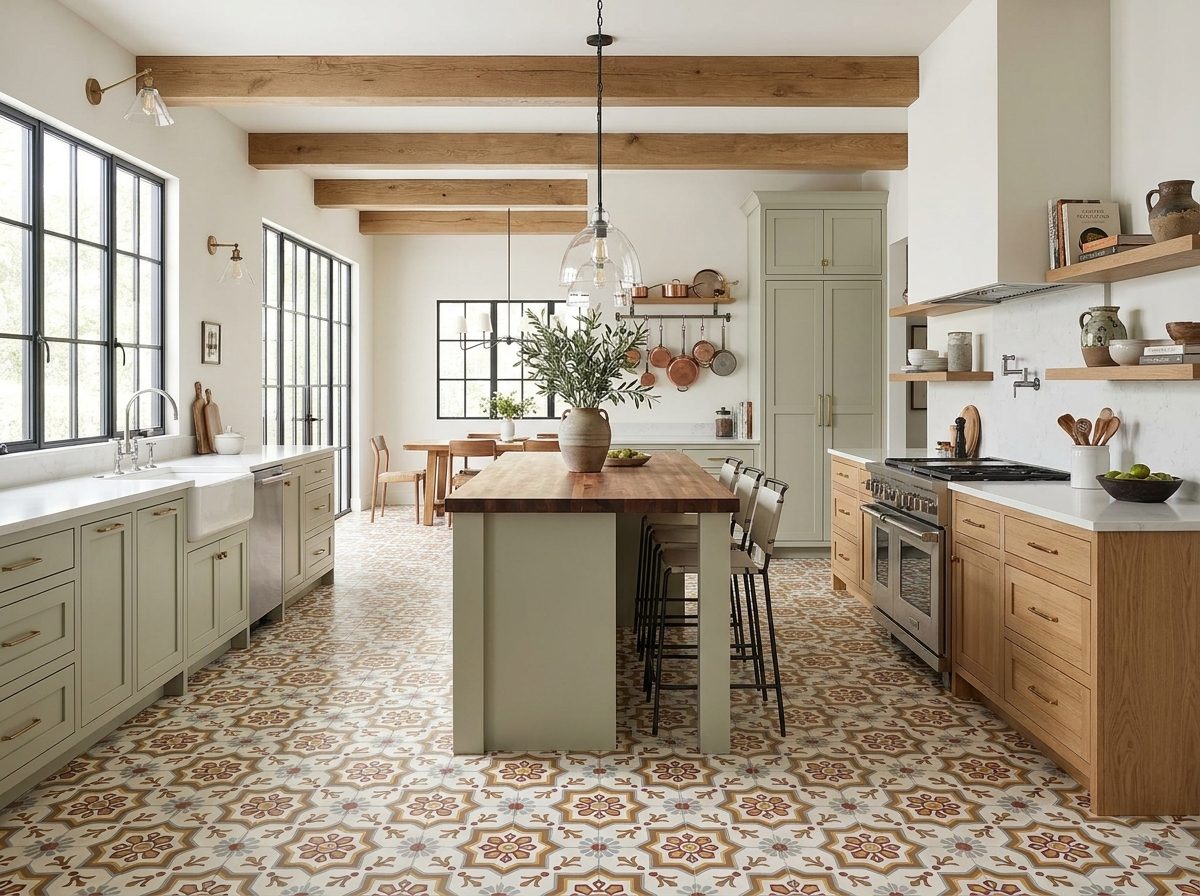
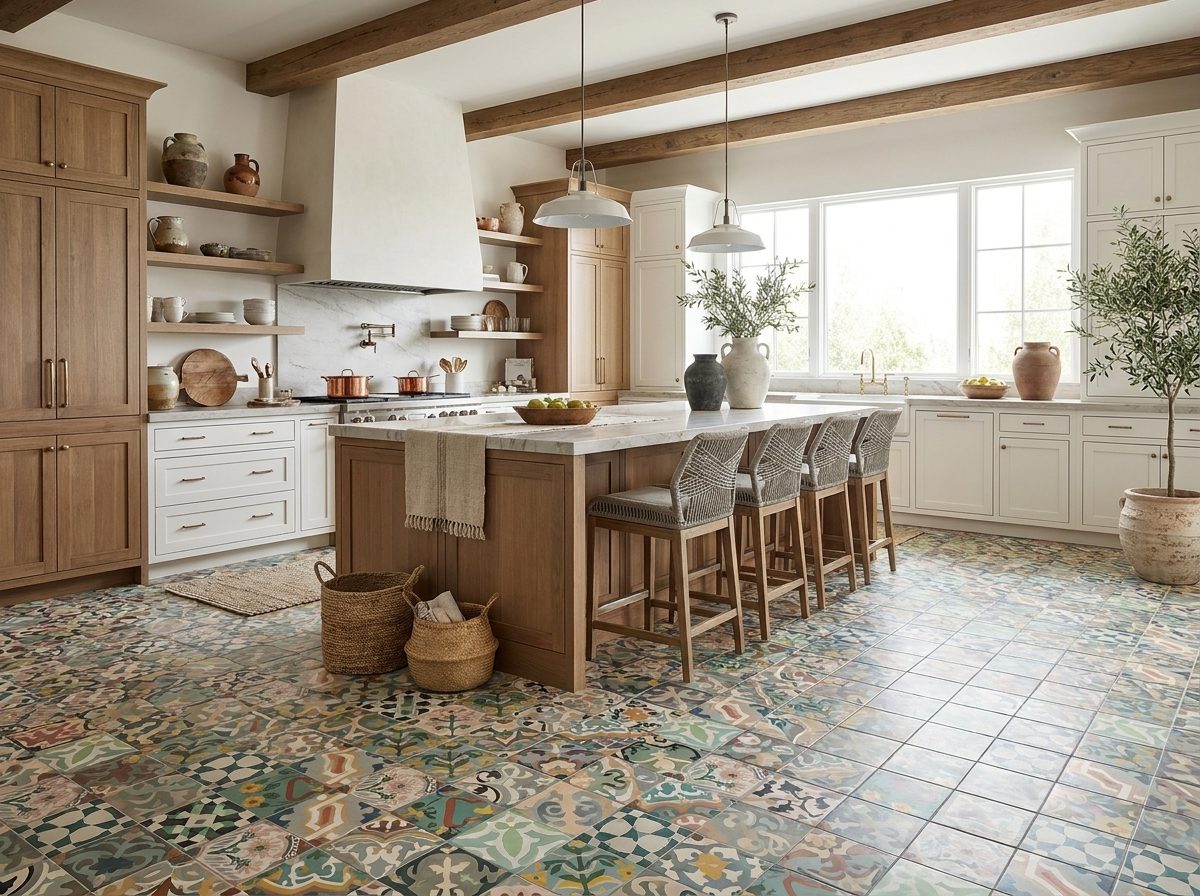
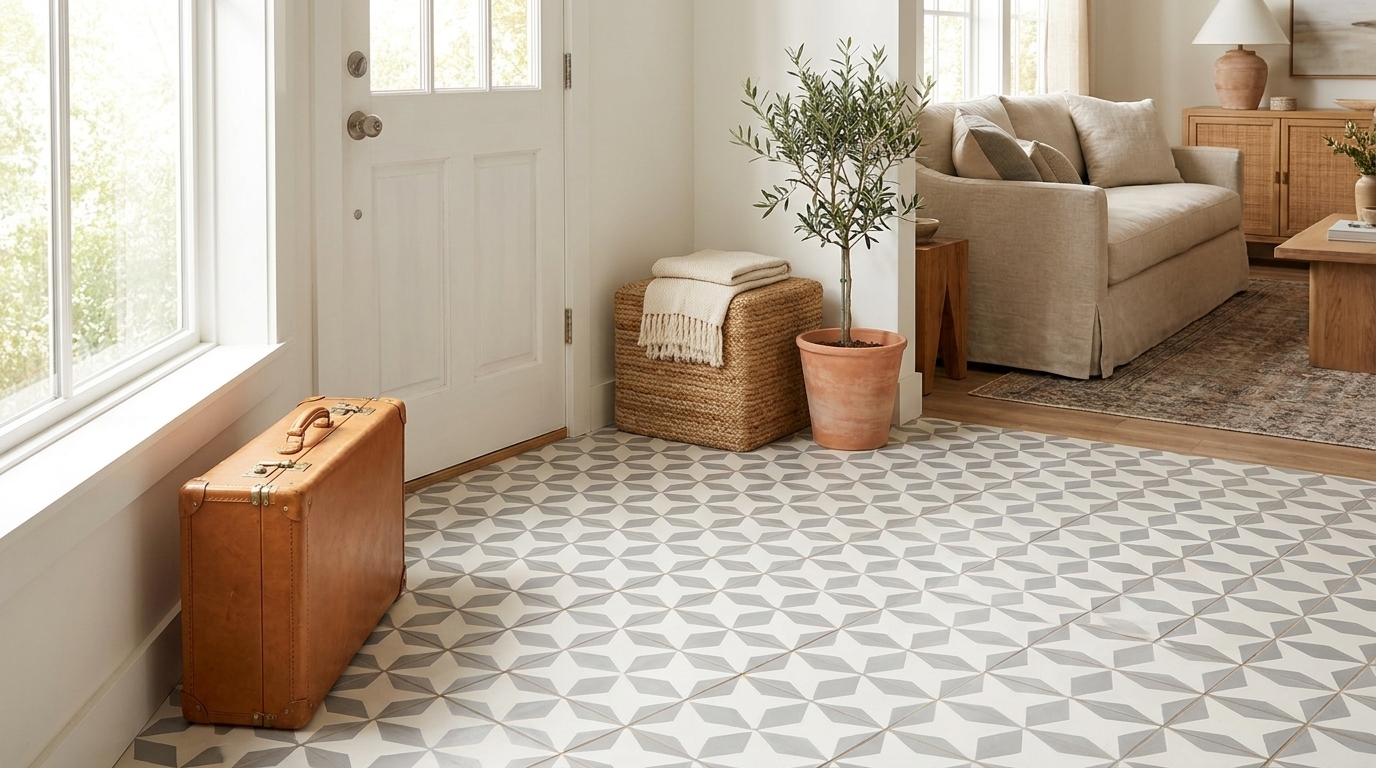
The best way to understand patterned cement tile is to see how differently it can behave from one room to the next. The same material can feel playful, formal, restrained, or richly layered depending on scale, palette, and placement.

A café floor that carries the room
A patchwork-style café floor can do the work of branding without a sign in sight. Repeating motifs bring energy, but the matte surface keeps it grounded. Chairs scrape, sunlight moves, people cross in every direction, and the floor still reads as part of the architecture rather than disposable décor.
A bathroom that feels calm, not busy
Hexagon or small-scale patterned cement tile in a bathroom often works best when the surrounding materials stay disciplined. Plain plaster, simple vanity lines, and restrained metal finishes give the floor room to breathe. The result feels intentional rather than crowded.
That same logic helps in residential design more broadly. If you’re coordinating tile with upholstery, drapery, rugs, and wall treatments, this overview of Critelli's room design patterns is useful for thinking about contrast in scale and repetition across a whole room.
A lobby or entry with custom intent
Large public spaces benefit from pattern when the design is proportioned to the architecture. A hotel lobby, restaurant host stand, or gallery entry can use a custom motif to establish identity at the threshold. In those spaces, cement tile often works best when paired with quiet millwork and controlled lighting so the floor reads with dignity instead of noise.
A kitchen offers another version of this idea. A backsplash in a single patterned field can make standard cabinetry feel bespoke. A floor inset beneath an island can define the working zone without introducing another finish material.
Good tile design doesn’t ask every surface to speak at once. It chooses where the room’s voice should be strongest.
For a closer look at how handmade cement tile is produced and used in real interiors, this video gives helpful visual context:
A few combinations that age well
- Soft neutrals with one strong motif: Good for kitchens and breakfast rooms.
- Monochrome geometry: Strong in hospitality spaces where you want clarity without visual clutter.
- Historic pattern with modern cabinetry: One of the most reliable pairings because the contrast feels intentional.
- Textured wall tile with plain floor tile: Useful when you want depth and shadow rather than a busy pattern field.
Patterned cement tile doesn’t need a themed room around it. In fact, it usually performs better when the rest of the space is edited carefully. Let the tile carry history, craft, and rhythm. Let the architecture support it.
If you’re planning a residential remodel, a hospitality project, or a custom surface program, Original Mission Tile is one place to explore handmade cement tile options, from in-stock patterns to custom designs, along with installation guidance and application details.