Few materials have made a more triumphant return to interior design than terrazzo — and in 2026, it shows no signs of slowing down.
Once found almost exclusively in mid-century public buildings, school hallways, and airport terminals, terrazzo has been fully reclaimed by the design world as one of its most expressive and versatile surfaces. Today it’s appearing in high-end residential kitchens, boutique hotel lobbies, spa bathrooms, and retail interiors that want to communicate craft, quality, and a deep design sensibility. What’s driving this renaissance — and what does it mean for how you specify, install, or choose tiles for your next project?
This guide covers everything: the history that makes terrazzo relevant, the trends defining its use in 2026, where it’s showing up room by room, and how terrazzo-inspired cement tiles from Original Mission Tile bring the warmth and handmade quality of this storied material into contemporary interiors.
What Is Terrazzo — And Why Is It Having Such a Moment?

Terrazzo is one of the oldest flooring traditions in the world. Its origins trace back to 15th-century Venice, where workers discovered they could create beautiful, durable floors by embedding marble chips into cement and polishing the surface smooth. The result was a material that was both utilitarian and genuinely lovely — which is exactly why it spread across Europe, Latin America, and the United States over the following centuries.
The terrazzo revival of the 2020s is being driven by the same qualities that made it great the first time:
Visual complexity that rewards attention. No two terrazzo surfaces are the same. The distribution of chips, the blend of colors, the way the matrix catches light — all of it is inherently varied in a way that manufactured uniformity can’t replicate.
Longevity as a design value. In a design culture increasingly focused on sustainability and material quality, terrazzo’s extraordinary lifespan — properly maintained terrazzo floors last for well over a century — is a genuine specification advantage.
The craft connection. Like handmade cement tiles, terrazzo carries the evidence of its making. It belongs to the family of materials that have been shaped by human hands rather than extruded from a machine — and in 2026, that quality is more valued than it has been in decades.
Pattern and palette freedom. Modern terrazzo and terrazzo-inspired tiles are available in an almost unlimited range of color combinations and chip distributions — from the classic speckled neutral to bold, graphic compositions with large chips in contrasting colors.
Terrazzo Tile Trends Defining 2026 Interiors
Trend 1: Large-Chip, High-Contrast Compositions

The fine-chip, neutral terrazzo that defined the first wave of the revival is evolving. In 2026, the most design-forward terrazzo work is pushing toward larger chips, higher contrast between matrix and aggregate, and bolder color combinations. Cobalt chips in a white matrix. Terracotta and cream in a charcoal base. Forest green and brass-toned aggregate in a warm gray field.
This trend is particularly strong in hospitality and high-end residential design, where the floor is being treated as a composition — a surface that rewards extended looking rather than simply providing a backdrop for furniture.
For homeowners: If you’re drawn to terrazzo but uncertain about scale, larger chips in a controlled two-color palette are actually easier to live with than fine-chip multicolor — they read as more intentional and graphic rather than busy.
For designers and architects: The large-chip trend pairs exceptionally well with minimal furniture and architecture. Let the floor be the statement; keep everything above it quiet.
Trend 2: Terrazzo on Walls and Vertical Surfaces
The floor is no longer the only place terrazzo belongs. In 2026, terrazzo-effect tiles are moving onto bathroom walls, kitchen backsplashes, fireplace surrounds, and retail feature walls with increasing frequency — and the results are some of the most visually compelling surfaces in contemporary interior design.
The logic is simple: terrazzo’s inherent pattern complexity means it reads beautifully at every scale and viewing distance. On a wall, where it’s experienced up close, the variation in chips and matrix becomes even more present and engaging than it is underfoot.
For contractors: Wall installations with terrazzo-effect cement tiles require a high-bond, non-slip adhesive rated for vertical applications. Substrate preparation is essential — any movement or imperfection in the backing will telegraph through over time.
For interior designers: A terrazzo-effect cement tile used simultaneously on a bathroom floor and one feature wall creates a deeply immersive quality — the kind of space that feels like it was designed to be lived in rather than photographed.
Trend 3: Warm, Earthy Terrazzo Palettes

The cool, gray-dominated terrazzo palette that characterized much of the 2010s is being replaced by something warmer. The terrazzo palettes generating the most designer attention in 2026 are earthy and sun-warmed: creamy whites with terracotta chips, soft sand matrices with warm ochre and blush aggregate, dusty limestone tones with coral and rust.
These warmer palettes connect terrazzo’s Venetian and Mediterranean roots with the broader movement toward earthier, more grounded interiors that is defining design across material categories in 2026.
For homeowners: Warm terrazzo palettes are genuinely versatile. They work with natural wood, rattan, linen, and the full spectrum of earthy wall colors — from off-white to deep terracotta — without clashing or competing.
For architects: Warm terrazzo palettes are increasingly being specified as a unifying material in Mediterranean, Spanish Colonial, and contemporary warm-minimalist residential projects — where the floor palette sets the tone for every other material decision in the space.
Trend 4: Terrazzo-Effect Cement Tiles — Handmade Quality, Pattern Freedom
Here’s where the conversation becomes particularly relevant for designers and homeowners who love terrazzo but want more creative control than traditional poured terrazzo allows.
Terrazzo-effect cement tiles bring the visual language of terrazzo — the chip distribution, the varied matrix, the rich surface complexity — into a format that can be specified in patterns, installed like standard tile, and customized in ways that poured terrazzo cannot be. Unlike poured terrazzo, which requires specialized installation and is difficult to repair or replace, cement tiles can be specified in precise quantities, installed by any qualified tile contractor, and replaced individually if damaged.
At Original Mission Tile, the In-Stock Collection includes terrazzo-inspired patterns alongside the geometric and Moroccan designs the brand is known for — all made by hand using the same hydraulic press tradition that has produced cement tiles since the 1870s. And through the Custom Made Collection, designers can develop a terrazzo-effect tile in exactly the chip distribution, matrix color, and format their project demands.
Trend 5: Terrazzo in Outdoor Spaces

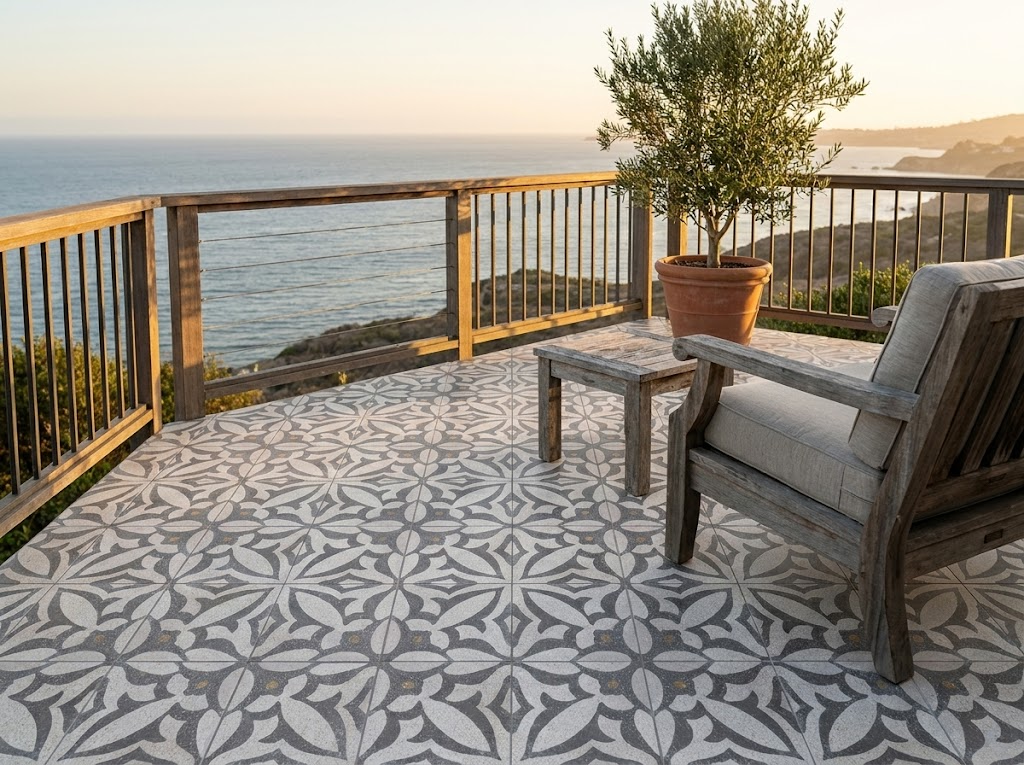
The indoor-outdoor design movement that has reshaped residential interiors over the past several years is extending into terrazzo in 2026. Terrazzo-effect tiles are appearing on covered terraces, pool surrounds, courtyard floors, and transitional indoor-outdoor spaces — bringing the pattern richness of terrazzo into the open air.
The key specification consideration for outdoor terrazzo applications is protection from weather: direct rain, freeze-thaw cycles, and prolonged UV exposure all require specific sealers and substrate treatments. Covered outdoor spaces are the ideal application; consult with the Original Mission Tile team before specifying for fully exposed outdoor areas.
Browse outdoor and terrace applications in the Projects Gallery for real-world installation examples.
Where Terrazzo Tiles Work Best in 2026 Interiors
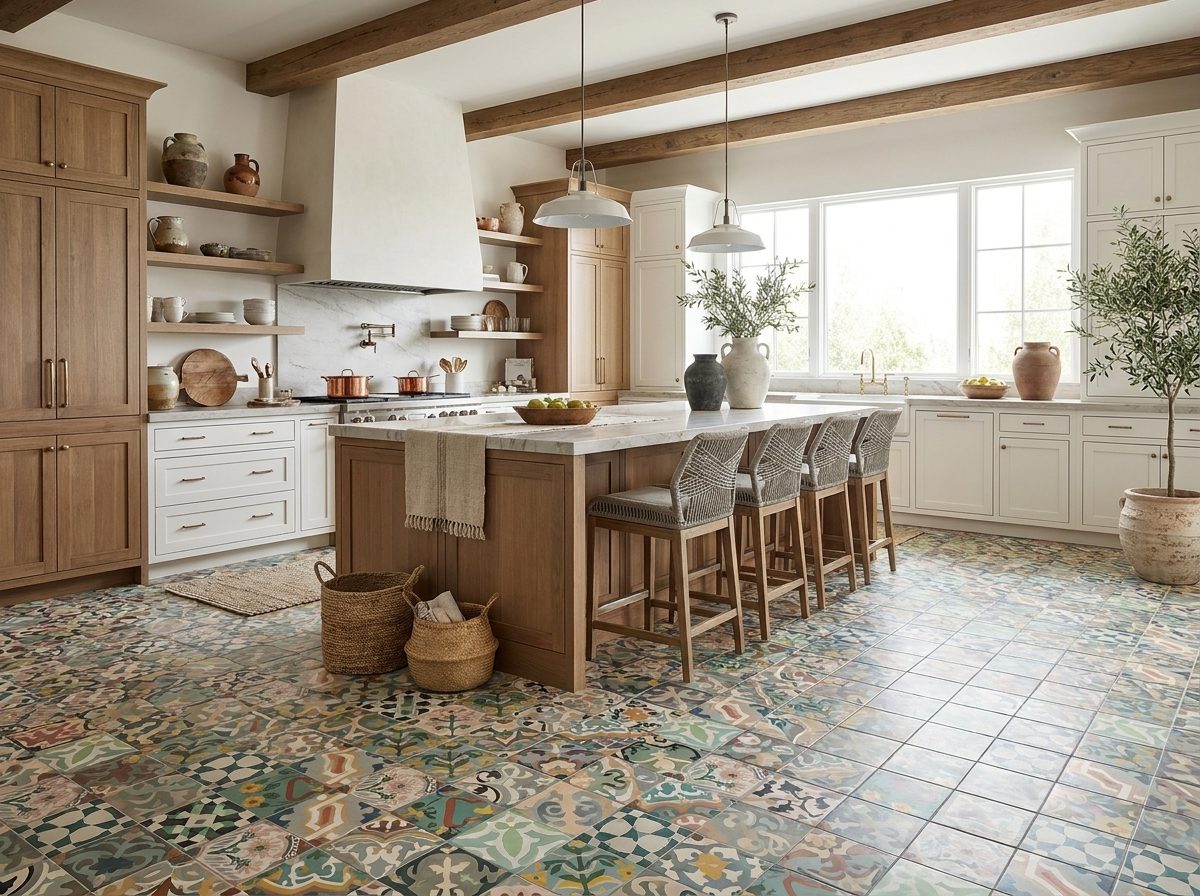
Kitchens: Terrazzo-effect floor tiles bring visual complexity to kitchens without the visual weight of a bold geometric pattern — they work beautifully behind simple cabinetry and natural stone countertops, adding richness without competition.
Bathrooms: Terrazzo is perhaps the most natural material for bathroom floors — its surface variation creates a spa-like quality that resonates deeply with the sanctuary-bathroom trend of 2026. Pair with warm white plaster walls, unlacquered brass, and a freestanding tub for an interior that feels genuinely luxurious.
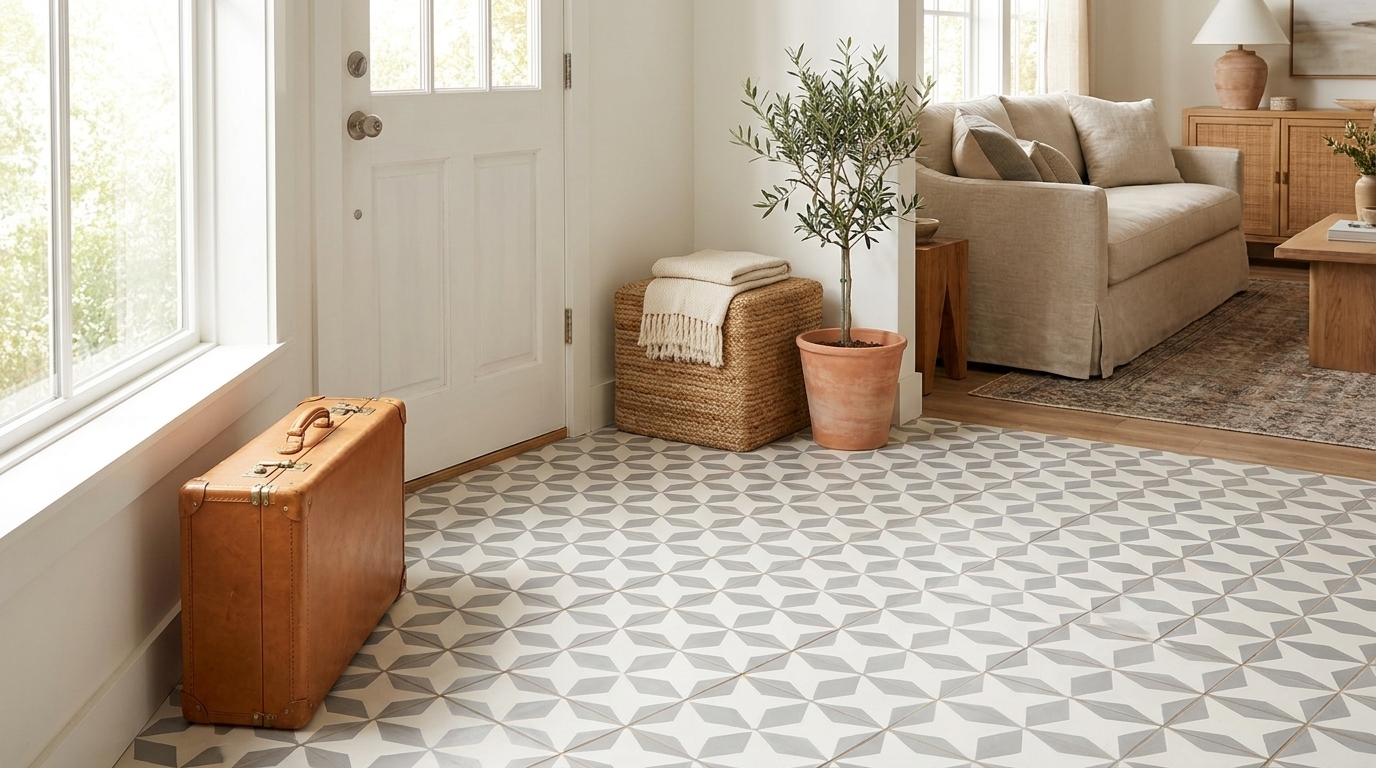
Entryways and hallways: The pattern complexity of terrazzo means it holds visual interest across large expanses — making it particularly well-suited to entryways and corridors where a single-color floor would feel flat.
Commercial and hospitality spaces: Restaurant floors, hotel lobbies, spa reception areas, boutique retail — terrazzo’s combination of visual richness and extraordinary durability makes it one of the most specified materials in contemporary commercial interior design.
Practical Guidance for Specifying and Installing Terrazzo Tiles
For Homeowners
- View samples in your actual space before committing — terrazzo’s chip distribution and color vary meaningfully between production runs, and the surface reads differently in natural versus artificial light
- Plan for sealing: terrazzo-effect cement tiles require a penetrating sealer before and after installation; this protects the surface and preserves the matte quality that makes the material beautiful
- Grout color matters: a grout that blends with the matrix color creates a more continuous, terrazzo-like reading; contrasting grout emphasizes the tile format
For Contractors
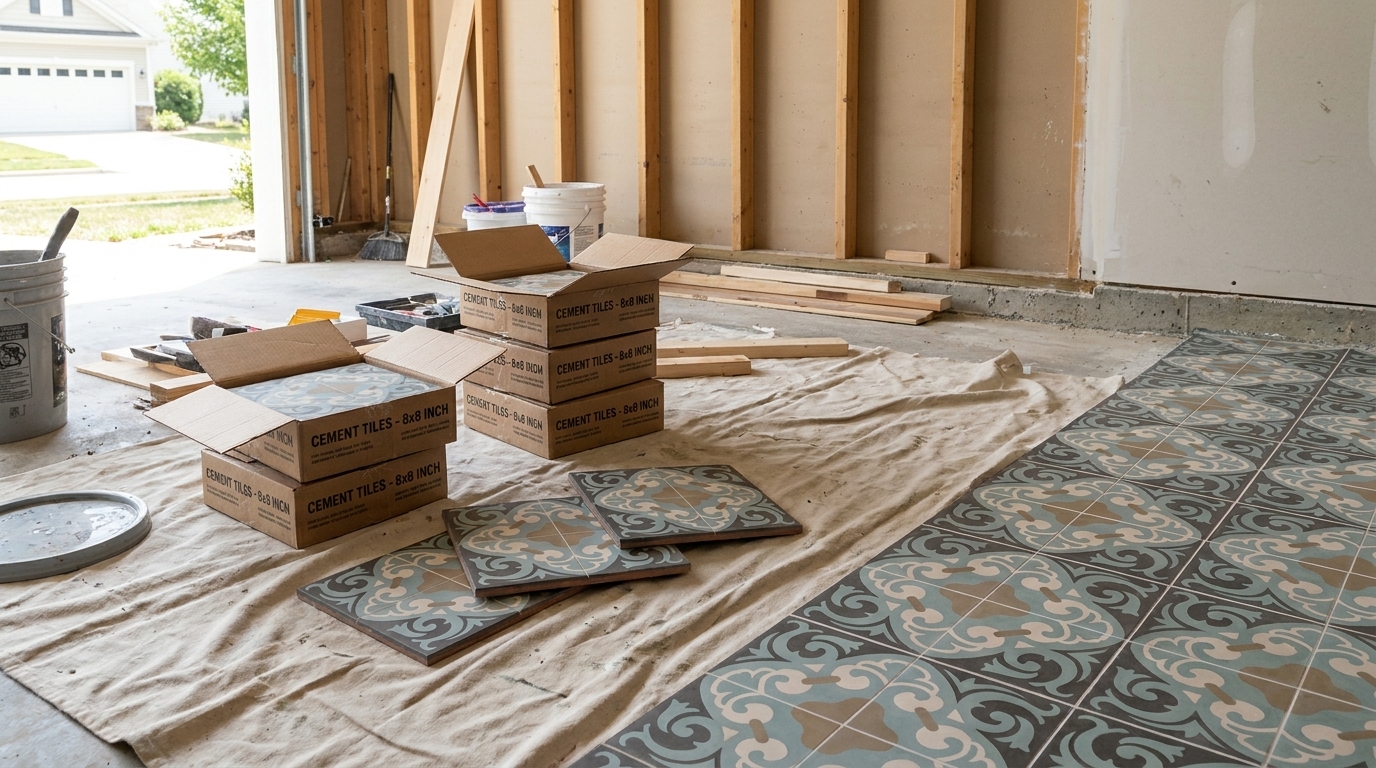
- Terrazzo-effect cement tiles, like all cement tiles, require a flat, stable substrate — lippage is more visible on a varied surface like terrazzo than on a solid color
- Always specify 10–15% overage for cuts, waste, and future repairs
- Use the Design Studio to generate layout previews for client presentations and pre-installation approval
For Interior Designers and Architects
- The Design Studio is your fastest tool for presenting terrazzo-effect options to clients — visualize chip distributions, matrix colors, and layout patterns before samples arrive
- Consider terrazzo-effect tiles as part of a material family alongside solid-color cement tiles: a terrazzo floor with a solid-color border in one of the matrix’s chip tones creates a composed, considered installation
- Develop bespoke colorways for significant projects through the Custom Made Collection — the design team works closely with specifiers to develop tiles calibrated to specific project palettes
FAQ: Terrazzo Tiles in 2026
What’s the difference between terrazzo tiles and poured terrazzo? Poured terrazzo is applied in situ — mixed and spread on-site, then ground and polished once cured. Terrazzo tiles are pre-made units (in cement or other bases) that replicate the visual quality of poured terrazzo and are installed like standard tiles. Terrazzo tiles offer more installation flexibility, easier repair, and the ability to specify exact quantities — while poured terrazzo offers seamless, joint-free surfaces. Both are legitimate design choices; the right option depends on project requirements.
Are terrazzo tiles slippery? Cement terrazzo-effect tiles have a natural matte, micro-textured surface that provides good slip resistance — particularly compared to polished stone or high-gloss porcelain. For shower floors and other wet applications, always specify appropriate wet-area sealers and confirm slip resistance with the supplier.
How long do terrazzo tiles last? Properly installed and maintained cement terrazzo-effect tiles are extremely durable — the mineral pigment runs through the full wear layer, meaning they develop patina rather than wearing through to a different substrate color. The terrazzo tradition has produced floors that have lasted well over a century in continuous use.
Can terrazzo tiles be repaired if damaged? Yes — one advantage of terrazzo tiles over poured terrazzo is that individual tiles can be replaced. Maintaining a reserve of tiles from the same dye lot (part of the standard 10–15% overage recommendation) ensures any future repairs are a seamless match.
Is terrazzo right for a kitchen floor? Absolutely. Terrazzo’s visual complexity is actually a practical advantage in a kitchen — the varied surface absorbs the visual evidence of everyday cooking life (minor scuffs, food debris, casual wear) in a way that a perfectly uniform tile surface highlights. Seal properly and maintain with a neutral-pH cleaner.
Conclusion: A Material That Has Earned Every Comeback
Terrazzo has been beautiful for five hundred years. It was beautiful when Venetian craftsmen first embedded marble chips in cement; beautiful in the grand public buildings of the mid-century; beautiful in the design-forward interiors of the 2020s that rediscovered it; and beautiful in the kitchens, bathrooms, lobbies, and terraces where it’s appearing in 2026 with more creative range and material confidence than ever.
What the best terrazzo tile work of 2026 has in common — across all the different palettes, chip sizes, formats, and applications — is that it treats the surface as worthy of attention. It assumes that the people who live and work in these spaces will notice what’s beneath their feet, and that what they find there should reward the noticing.
That’s what great materials do. And terrazzo — handmade, mineral, endlessly varied — is one of the greatest.
Ready to bring terrazzo into your next project?
Explore terrazzo-inspired and encaustic patterns in the In-Stock Collection, develop a bespoke terrazzo-effect tile through the Custom Made Collection, visualize your project in the Design Studio, or browse real installations in the Projects Gallery.