You’re probably staring at samples right now, trying to answer two different questions at once. First, will black and white cement tile look as strong in real life as it does in the inspiration photos? Second, will it hold up once kids, guests, restaurant traffic, muddy shoes, spilled coffee, and grout haze enter the picture?
That tension is exactly why this material has lasted. Black and white cement tile gives a space clarity. It can read formal in a Victorian foyer, graphic in a cafe, restrained in a modern bath, or playful in a laundry room. The same palette can anchor a historic renovation or sharpen a new build that needs texture and weight.
The catch is simple. Good results depend on understanding the material, not just choosing a pattern. Handmade cement tile rewards thoughtful design, proper layout, careful sealing, and realistic expectations about variation. When those pieces are handled correctly, the finished work feels grounded and permanent in a way printed lookalikes rarely do.
The Enduring Allure of Black and White Tile
A black and white floor usually enters a project at the moment the room still feels unresolved. Cabinets are selected, plumbing is in motion, wall colors are narrowed down, and something still feels flat. Then a patterned tile sample lands on the table and the whole room starts to make sense.
That’s because black and white cement tile does two jobs at once. It provides order through contrast, and it adds character through pattern. A simple checkerboard can calm a room. A dense geometric can energize it. A soft repeating motif can bridge traditional millwork with modern fixtures without making the room feel confused.
Homeowners often come in wanting a floor that feels classic but not dull. Designers often want a material that can handle strong pattern without looking disposable. That’s where this category earns its place. If you’ve been collecting references for timeless black and white floor tiles, you’ve probably noticed how often the strongest rooms rely on restraint in color and confidence in layout.
For those comparing pattern families and application ideas, our own collection of black and white tile designs shows how broad the range can be, from quiet repeats to more architectural graphics.
Black and white isn’t a trend choice. It’s a composition choice. When the pattern is right, the room feels finished before the accessories ever arrive.
The Art and Soul of Handmade Cement Tile
A sample of black and white cement tile tells only part of the story. Its full character shows up when you understand how the tile is made, how it wears, and what that means once it is installed in an actual room.

How the tile is actually made
Handmade cement tile is built in layers and compressed in a hydraulic press. The decorative face is made from fine cement, marble powder, pigments, and water, poured by hand into a metal mold. Behind that face coat, makers add a dry cement layer that helps bind the tile, then a thicker backing layer of sand and cement for body and strength. Riad Tile explains that process well in its overview of black and white cement tile.
That construction affects performance. The pattern is in the wear layer itself, not printed on top, so normal foot traffic does not strip away the design the way a surface-applied finish can. In practice, that means the floor can age with dignity if it is installed correctly, sealed properly, and cleaned with the right products.
Solid wood is the better comparison than veneer. Cement tile has visual depth because the color is part of the material at the face, not a coating added at the end of production.
Why handmade variation is part of the value
No two batches are perfectly identical, and they should not be. Slight shifts in pigment, small changes at the edges, and gentle tonal variation are normal in handmade tile. Those details give a field of black and white tile more life than a machine-flat surface ever will.
I tell clients to judge cement tile in a group, not one piece at a time. A single sample can look quieter or busier than the installed floor. Once the tiles are set together, the variation blends into a rhythm that gives the room depth and keeps a monochrome palette from feeling sterile.
Design teams comparing tile against wood, stone, plaster, cabinetry, and metal finishes often benefit from broader material context. This a comprehensive guide to high-end home finishes is useful for that kind of whole-room planning.
For a closer look at material options, production methods, and project applications, our page on handmade cement tile for residential and commercial projects lays out the category clearly.
What works and what doesn’t
Handmade cement tile rewards the right expectations.
- Works well: rooms that need matte texture, visible craft, and pattern with real visual depth.
- Works well: clients who appreciate natural variation and want a floor that feels made, not manufactured.
- Doesn’t work well: buyers expecting every piece to match with machine precision.
- Doesn’t work well: jobs where the installer treats cement tile like glazed porcelain and skips mockups, sealing strategy, or careful cleanup.
One jobsite mistake causes a lot of avoidable disappointment. Installers who spread grout carelessly or leave pigment-rich residue sitting too long can create staining that homeowners blame on the tile. The material is forgiving in many ways, but it does ask for a methodical installer.
Practical rule: If handmade variation already feels like a defect at the sample stage, choose a different material before the order is placed.
A Legacy in Black and White Patterns
Black and white cement tile didn’t appear out of nowhere as a modern style statement. It came from a strong craft tradition and a period of rapid design experimentation. The material traces its origins to the mid-19th century in Catalonia, Spain, where artisans developed the hydraulic-press process around 1855-1875. By the International Exposition of 1867 in Paris, these tiles were being showcased across Europe, and later French makers pushed the language further through Art Nouveau and Art Deco before mass production reduced their prominence in the 1940s, according to Clé Tile’s history of cement tile.

The classic patterns that never go away
Some motifs stay relevant because they solve design problems cleanly.
- Checkerboard: direct, architectural, and flexible. It can feel grand in a large room or crisp in a small one.
- Victorian geometrics: strong repeats, borders, and field patterns that define entryways and halls with formality.
- Greek key and structured borders: useful when you want the floor to read almost like custom millwork.
- Small repeating motifs: helpful in powder rooms or compact kitchens where a large-scale pattern would feel oversized.
Checkerboard is often misunderstood as the simplest option, but scale and proportion determine whether it feels custom or generic. In a narrow passage, a checker can lengthen the space. In a square room, it can add symmetry and calm.
Art Nouveau and Art Deco still shape current design
The historical movements matter because they still influence how we select pattern today.
Art Nouveau brought flowing lines, botanical curves, and more fluid compositions. These patterns soften a room with lots of hard edges. They’re often a smart choice when cabinetry is linear and fixtures are minimal, because the floor introduces motion without adding more colors.
Art Deco pushed toward sharper geometry, bolder contrast, and graphic repetition. That language still feels current because it pairs naturally with brass, walnut, blackened steel, and custom lighting.
Here’s the useful design insight. Most current black and white cement tile projects are not trying to look historically pure. They borrow a historical vocabulary, then apply it selectively. A modern bath may use an Art Deco-derived floor beneath plain walls. A Spanish revival kitchen may use a more fluid pattern but combine it with restrained slab counters.
The strongest rooms don’t copy a period perfectly. They choose one historical note and let it lead.
Matching pattern to architecture
A quick selection guide helps narrow the field:
| Architectural feel | Pattern direction | What it does |
|---|---|---|
| Traditional or Victorian | Border-based geometrics | Frames the room and adds ceremony |
| Modern minimal | Large-scale graphic repeats | Adds contrast without clutter |
| European eclectic | Fluid or mixed historic motifs | Brings warmth and layered character |
| Hospitality or retail | Bold Deco-inspired geometry | Creates identity and memorability |
If the room already has expressive cabinetry, heavy stone movement, or ornate lighting, choose a more disciplined floor pattern. If the architecture is plain, the tile can carry more visual weight.
Designing With Bold Contrast Room by Room
A client walks into a nearly finished room and the question comes fast. Why does one black and white floor feel composed while another feels restless? The answer is rarely the pattern alone. Room size, sightlines, daylight, cabinet mass, and where the eye stops all matter just as much.

Kitchens
Kitchens need hierarchy. Black and white cement tile should either anchor the floor or claim a controlled area such as the backsplash. If both surfaces carry equally forceful pattern, the room starts to fragment.
On the floor, these tiles can settle a kitchen that already has painted cabinets, open shelving, stone counters, and mixed finishes. On the wall, they do a different job. They sharpen the working side of the room and give plain cabinetry more character. The right choice depends on where the visual weight already sits.
I usually judge kitchens at eye level first. If the cabinetry, hood, and hardware already create plenty of activity, keep the floor pattern disciplined and let the backsplash stay quiet. If the vertical surfaces are simple, a patterned backsplash can carry more of the design load without making the room feel crowded.
Bathrooms and powder rooms
Bathrooms are often the best place to use a stronger pattern. The footprint is smaller, the boundaries are clear, and the room can hold more contrast without feeling scattered. Powder rooms handle the boldest motifs well because the whole experience is brief and contained.
Primary baths ask for more control. A medium or small repeat usually reads better around vanities, tubs, and tight fixture clearances. Large repeats can be beautiful, but only when the layout has been studied before installation so the motif does not break awkwardly at the door, curb, or tub face.
In wet areas, design and performance are tied together. Handmade cement tile has depth of color because the pigment is pressed into the wear layer, not printed on top. That craft detail is part of why black and white patterns keep their graphic clarity over time when the tile is installed and maintained correctly.
Entryways and transition spaces
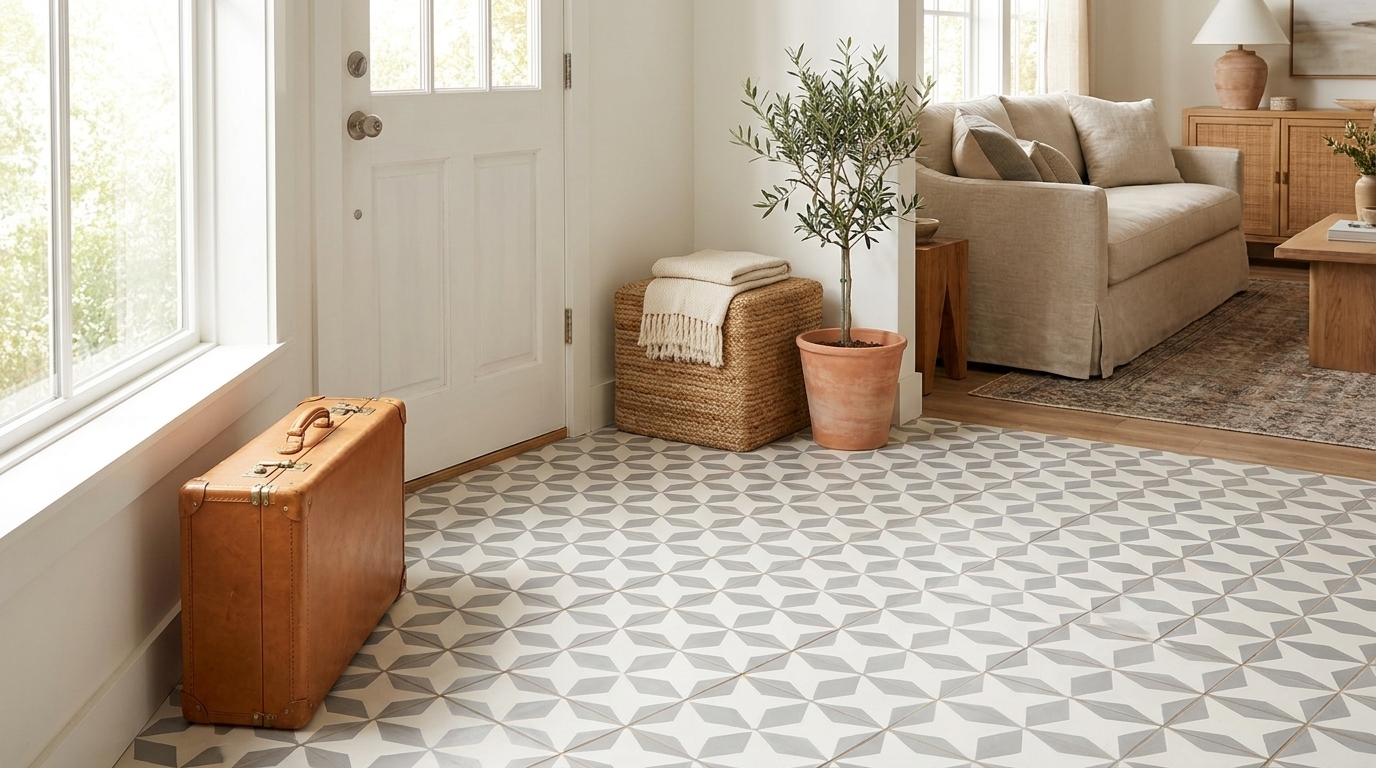
Entryways benefit from ceremony. Black and white tile gives a front door moment immediate structure, and it can define the threshold before furniture or art has a chance to do that work.
A border is useful in some foyers and unnecessary in others. If the space is long or formal, a border can frame the field and keep the pattern from feeling loose. In a compact entry, a full-field layout often looks cleaner. The deciding factor is architecture, not decoration.
Hallways need extra discipline. Repeating motifs can start to drift if the pattern scale fights the length of the run, so I prefer layouts that keep a clear rhythm from one end to the other.
Laundry rooms and utility spaces
Utility rooms deserve the same care as public rooms because they are used hard and seen often. Cement tile gives these spaces permanence. A laundry room stops feeling temporary and starts feeling integrated with the rest of the house.
Restraint helps here. Strong black and white tile already brings enough contrast, so pair it with straightforward cabinetry, durable paint, and lighting that shows the pattern clearly. That balance keeps the room practical and still gives it presence.
Cafes, boutiques, and hospitality interiors
Commercial interiors use black and white cement tile for two reasons. It creates identity fast, and it holds up visually under steady use. In sunlit dining rooms, retail entries, and hotel corridors, integral color matters because the pattern is part of the tile itself rather than a surface image.
Specification work also brings different questions than residential work. Designers need repeatable field layouts, trim decisions that suit traffic, and patterns sized for the pace of the room. A small cafe may need a tighter repeat that reads clearly from the sidewalk. A larger lobby often benefits from a broader motif that can be understood at a distance.
Design teams refining scale and visual balance can get useful outside perspective from this guide on how to work with patterns in designing your room. If you are comparing motif families for a specific application, our gallery of black and white tile pattern ideas for kitchens, baths, entries, and commercial spaces helps connect room type with layout direction.
Mastering Installation Layout and Grout
A black and white cement tile floor can look disciplined and architectural, or slightly off for the life of the room. The difference usually comes down to layout decisions made before the first tile is set.

Start with the layout, not the mortar
On patterned tile, the eye reads the field before it reads the room. That is why installers should begin with control lines, dry layout, and sightlines from the main approach. Check what happens at the doorway, under a vanity, along a kitchen island, and where the pattern dies into a threshold. Those edges decide whether the work feels calm and intentional.
Perfect centering is only one option. In many rooms, the better choice is to favor the primary view so the pattern presents cleanly when someone enters. In older homes, I often prioritize the strongest visual axis over walls that are out of square, because a pattern that looks right matters more than one that measures symmetrically on paper.
Blend tile from several boxes as you go. Handmade cement tile carries natural variation in tone and surface. Mixed across the floor, that variation reads as depth. Left in batches, it looks like a production mistake.
Respect the material tolerances
Cement tile is pressed by hand, cured, and finished differently than printed porcelain. It asks for a flatter substrate, tighter layout control, and an installer who will adjust instead of forcing every piece into a machine-perfect grid.
A few habits separate good results from expensive frustration:
- Check flatness first: Patterned surfaces make lippage easy to spot, especially in raking light.
- Snap true reference lines: Recheck them as the field grows. Small layout drift becomes obvious fast on a repeating pattern.
- Sort and blend while setting: Do not stack similar tiles in one area.
- Plan cuts before committing: Jambs, borders, and transitions should look resolved, not improvised.
Field note: Clients notice the pattern first. Experienced installers notice the perimeter cuts, because that is where craft shows up.
Grout changes the personality of the floor
Grout color can quiet a pattern or sharpen it. A soft gray often lets the field read as a larger composition. A charcoal joint can define each tile more clearly and add rhythm. Bright white grout with black and white cement tile usually creates too much interruption unless the design specifically calls for a hard graphic grid.
Joint width needs the same level of judgment. Handmade tile has slight size variation, so tight joints have to be realistic, not theoretical. If the joint is pushed too narrow, every small difference in tile size becomes visible. A slightly more forgiving joint usually gives a cleaner finished floor.
Pre-sealing before grout is good trade practice with cement tile, especially on high-contrast black and white patterns. The face of the tile is porous. Without that first coat, grout pigment and wash water can stain the surface and leave cleanup work that never fully disappears.
A short installation video helps illustrate the pacing and care the process requires:
Wet areas, traction, and sealing
Bathrooms, entries, and commercial interiors raise the same practical questions. Can cement tile handle water, and how should it be detailed? It can perform well in those settings, but only if the assembly is handled correctly from substrate through sealer.
Use the right underlayment, account for movement, and keep the floor plane consistent so water does not sit where it should drain. Then seal in the proper sequence. One coat before grouting helps protect the face during installation. A final sealer after cure supports stain resistance in service. That sequence matters just as much as the pattern selection.
At Original Mission Tile, heritage manufacturing experience helps. The way a cement tile is made affects how it should be laid, grouted, and finished. Designers and homeowners get better results when the installation method respects the material’s handmade character instead of treating it like a commodity tile.
Caring for Your Cement Tile for a Lifetime
A black and white cement tile floor earns its age in plain sight. In a busy kitchen, an entry that sees grit from the sidewalk, or a bath used every morning, the goal is not to keep the tile looking untouched. The goal is to keep it clean, sealed, and wearing evenly so the surface develops character instead of damage.
That distinction matters.
What routine care actually looks like
Daily maintenance is straightforward. Remove abrasive dirt before it gets ground into the finish, wipe up spills while they are fresh, and clean with a pH-neutral product made for masonry, stone, or sealed cement surfaces.
Avoid harsh acids, bleach-heavy cleaners, and aggressive degreasers. They can break down the sealer and leave the face of the tile more vulnerable to staining. I also tell clients to skip general household cleaners unless the label clearly states they are safe for cementitious or natural stone surfaces. The wrong cleaner causes more long-term trouble than ordinary foot traffic.
Sealing is what gives cement tile a fair chance in real use. A properly sealed floor resists water and common household staining much better than an unsealed one, but sealer is not a permanent shield. It is a maintenance item. In our experience at Original Mission Tile, owners get the best results when they treat resealing the same way they treat other finish upkeep in the home. They check the surface periodically and renew protection before wear becomes obvious.
The maintenance habits that pay off
A few habits make a clear difference over time:
- Use mats at entries: They catch sand and grit before it scratches the finish.
- Clean with soft tools: Microfiber mops and non-abrasive cloths are enough for routine work.
- Wipe spills promptly: Oils, coffee, wine, and strongly pigmented foods are easier to remove before they settle.
- Reseal based on wear: A powder room and a family kitchen do not age at the same rate.
- Avoid acidic or abrasive products: Cement tile does not respond well to harsh chemistry or scrubbing powders.
One simple test helps. If water no longer beads lightly on the surface and begins to darken the tile quickly, it is usually time to inspect the sealer and refresh it.
Patina versus damage
Handmade cement tile should not be expected to behave like a printed porcelain made for visual uniformity. It has natural variation from the start, and over time it takes on a softer, more settled appearance. That mellowing is part of the material’s appeal, especially in black and white patterns where the contrast gains depth as the floor becomes part of the house.
Patina shows up as gentle shifts in tone, minor softening of the surface sheen, and the lived-in look that comes from regular use and proper care. Damage looks different. Etching, deep set stains, residue buildup, and neglected wear patterns usually point back to skipped sealing, the wrong cleaners, or dirt left to grind across the floor.
Owners who understand that difference usually enjoy cement tile more. They stop chasing factory sameness and start appreciating the craft. That is part of working with a handmade material from a heritage manufacturer. How the tile is made affects how it should be maintained, and good care preserves both performance and character for decades.
A cement tile floor should show a life well lived, not signs of neglect.
Begin Your Project with Original Mission Tile
Some projects need speed. Others need a pattern that doesn’t exist yet. The right supplier is the one that can support both realities without turning the process into guesswork.
If your project is on a compressed timeline, ready-to-ship inventory can keep the specification grounded in actual availability. That’s often the right path for remodels with fixed construction windows, hospitality refreshes, and jobs where the layout is set and the finish schedule can’t drift.
Custom work serves a different need. It’s for architects tying tile to brand identity, homeowners matching a historic renovation, or designers refining scale and motif to fit a room exactly. In those cases, the value isn’t novelty for its own sake. The value is precision. A custom pattern can solve proportion, fit the architecture, and prevent the compromise that happens when a stock design is merely close.
What trade professionals usually need
Designers, builders, and showrooms typically aren’t just looking for tile. They need support that reduces friction in the specification process.
That usually means:
- Clear sample access: so material decisions happen earlier and with fewer assumptions
- Pattern guidance: especially when scale, borders, or repeat direction affect layout
- Installation information: because handmade cement tile needs the right prep and sequencing
- A workable path for custom orders: not every project can use off-the-shelf motifs
Trade service matters most when the room is complicated. Multi-room patterns, commercial applications, and renovation work all benefit from coordination early, before the installer is left solving design problems in thinset.
Stock versus custom is a design decision
There’s no prestige rule that says custom is always better. Sometimes the smartest move is choosing a proven in-stock black and white cement tile and focusing your energy on layout, grout tone, and surrounding materials. In other cases, a project has enough architectural identity that a custom motif makes the whole composition click.
The important thing is choosing the route that matches the project, not the fantasy version of the project. A practical schedule, a realistic install plan, and a tile pattern that serves the room will outperform a more ambitious choice that the team can’t execute properly.
Frequently Asked Questions
A few questions come up on nearly every black and white cement tile project. The answers below are the ones I’d want a client, designer, or installer to have before ordering.
Common Questions About Black and White Cement Tile
| Question | Answer |
|---|---|
| Is black and white cement tile slippery? | It can be appropriate for wet zones when specified and finished correctly. Verified technical data notes wet-area performance for cement tile, and traction depends on surface condition, sealing, maintenance, and application. |
| Can I use it in a bathroom? | Yes. Bathroom floors are a common use when the installation is planned properly and the tile is sealed and maintained with the right products. |
| Does it work for kitchen backsplashes? | Yes. It performs well on backsplashes because the surface gets visual impact without the same foot traffic as a floor. Seal it properly and clean spills promptly. |
| Will every tile look exactly the same? | No. Handmade cement tile has natural variation in color and sizing. That variation is part of the material and should be blended during installation. |
| Is cement tile the same as porcelain that looks like cement tile? | No. Porcelain can imitate the look, but genuine cement tile has an inlaid pattern, matte depth, and handmade variation that printed surfaces don’t reproduce in the same way. |
| Can it be used outdoors? | It can be used in some exterior applications when the climate, substrate, drainage, and sealing approach are all appropriate. Exterior work needs job-specific review. |
| How does it feel underfoot? | It has a dense, matte, solid feel. People often notice that it feels more grounded and tactile than glossy factory tile. |
| What’s the biggest installation mistake? | Treating it like ordinary glazed tile. Most failures come from weak prep, poor layout planning, skipping pre-seal steps, or careless grout cleanup. |
| Does black and white cement tile go out of style? | The color palette doesn’t. The pattern choice is what dates a project, so select a motif that fits the architecture rather than chasing novelty. |
If you’re still narrowing down pattern, application, or whether stock or custom makes more sense, the next step is to look at real options with a clear install plan attached.
If you’re ready to move from inspiration to specification, Original Mission Tile offers handmade cement tile options for both in-stock and custom projects, along with design support, installation guidance, and trade-friendly resources for residential and commercial work.