You’re probably standing in one of two places right now.
Either you’ve fallen for a patterned floor in a café, hotel, or old house and want that same warmth at home. Or you’re farther along and already comparing samples, trying to figure out whether handmade cement tile is a romantic decision, a practical one, or both.
It can be both. But only if you understand what this material is asking of you.
I’ve always thought handmade cement tile rewards honesty. It gives you depth, softness, pattern, and a lived-in finish that machine-made surfaces rarely match. In return, it asks for respect during specification, installation, and maintenance. That trade is worth it for many projects. It’s not right for every project.
What follows is the straight version. The beauty, the craft, the technical reality, the installation pitfalls, and the environmental nuance that glossy product roundups often skip.
What Is Handmade Cement Tile An Unfired Art
If you want a floor with memory in it, handmade cement tile is one of the few materials that delivers that feeling from day one.
It doesn’t look printed. It doesn’t look sprayed. It doesn’t look mass-produced. It looks made, because it is.
Not ceramic and not glazed
The first point of confusion is simple. Handmade cement tile is not ceramic or porcelain.
It isn’t fired in a kiln. Its pattern is not a glaze baked onto the face. That difference matters because it explains both its beauty and its behavior.
The color lives in the tile itself. Think of it less like a painted surface and more like an inlaid layer. In spirit, it’s closer to a very refined, patterned concrete surface, or to terrazzo in the sense that mineral ingredients and cement create the visible finish, but with a far more deliberate graphic design.
That’s why the surface reads as matte, soft, and deep rather than glossy and sealed-off.
Handmade cement tile has a human look because the design is built into the material, not printed onto it.
A material with real history
This isn’t a trendy invention with an old-world marketing story attached to it. Handmade cement tiles first appeared in Catalonia, Spain, in the 1850s, and their international rise accelerated after Garret & Rivet showed them at the 1867 Paris International Exposition, where they gained broad attention for being decorative, durable, and unfired. By the early 20th century, they had become the most popular flooring material across the Mediterranean and appeared in thousands of landmark buildings and palaces, as summarized in the history of cement tile.
That history explains why the material still feels architectural rather than merely decorative. It belongs equally in a modest kitchen, a boutique hotel, or a grand entry hall.
Why people still choose it
People choose handmade cement tile when they want a room to feel grounded.
A porcelain floor can be precise. Marble can be stately. But handmade cement tile often feels more personal. The slight shifts in tone, the velvety surface, and the pattern scale all help a room feel designed rather than finished.
If you’ve heard the term encaustic used loosely, it’s worth seeing actual encaustic tiles and related patterned surfaces in context, because many people use the word to describe the look rather than the exact material.
What it brings to a room
A good handmade cement tile floor usually does three things at once:
- Defines the architecture by giving the room a visual foundation
- Adds pattern without clutter because the design is built into a useful surface
- Ages with character instead of trying to stay clinically unchanged forever
If you want a floor that stays visually untouched and identical year after year, this may not be your material. If you want one that develops presence, it might be exactly right.
The Hydraulic Press Method Crafting Tiles by Hand
The craft becomes easier to appreciate once you understand how the tile is made.

A handmade cement tile isn’t a single uniform mass. It’s a layered piece built for both appearance and strength.
The three-layer structure
Traditional production uses three fused layers pressed under 1,700 PSI. The top color layer is 3 to 5 mm, hand-poured into molds, the middle layer reinforces the tile for heavier loads, and the bottom layer provides structural support. After pressing, the tiles cure in a water bath for 24 to 48 hours, and the cement hydration process helps the tile reach compressive strength greater than 20 MPa, according to Villa Lagoon Tile’s technical data on cement tile.
That top layer is the soul of the tile. It carries the pattern and the color. The lower layers support it so the face can remain crisp while the body does the structural work.
How the pattern is formed
This part is often underestimated.
An artisan uses a metal divider mold to separate the design into compartments. Colored cement slurry is poured by hand into each section, one color at a time. If the pattern has four colors, each one is placed deliberately. If the design is intricate, the work slows down and demands a steady hand.
Then the divider is lifted away. The wet design remains in place.
After that, dry and semi-dry backing layers are added. The tile is pressed hydraulically. No kiln. No glaze firing. No shortcut that turns it into a printed imitation.
Why handmade means variation
Every true handmade cement tile carries small signs of the hand that made it. That doesn’t mean poor quality. It means the material has life in it.
You may see minor shifts in pigment density, tiny edge variation, or slight movement from tile to tile within a batch. In a finished floor, those small differences are often what make the installation feel rich rather than synthetic.
Workshop truth: The more perfectly identical a patterned cement tile looks, the more likely you’re looking at something else.
Why the unfired method matters
The absence of firing changes the character of the tile.
The surface stays matte and mineral-rich. The body retains a concrete-like nature. The production process also preserves a very old method that sits somewhere between masonry and decorative art.
Here is a simple breakdown:
| Part of the tile | What it does |
|---|---|
| Top color layer | Holds the visible pattern and wear surface |
| Middle layer | Adds density and reinforcement |
| Bottom layer | Supports the tile structurally |
The method also explains why cement tile needs a different installer mindset than porcelain. A porcelain setter can rely on factory consistency. A cement tile setter has to read the material, sort it, dry-lay it, and handle it with more care.
That extra labor isn’t theater. It’s part of the craft.
A Canvas for Design Patterns Formats and Customization
A room can be technically correct and still feel dead.
Handmade cement tile solves that problem when pattern is used with discipline. It lets you bring movement into a room without adding objects, clutter, or visual noise. The surface itself does the work.

Pattern changes how a room feels
I’ve seen the same small bathroom feel formal with a repeating border, playful with a bold geometric, and calm with a soft two-tone field.
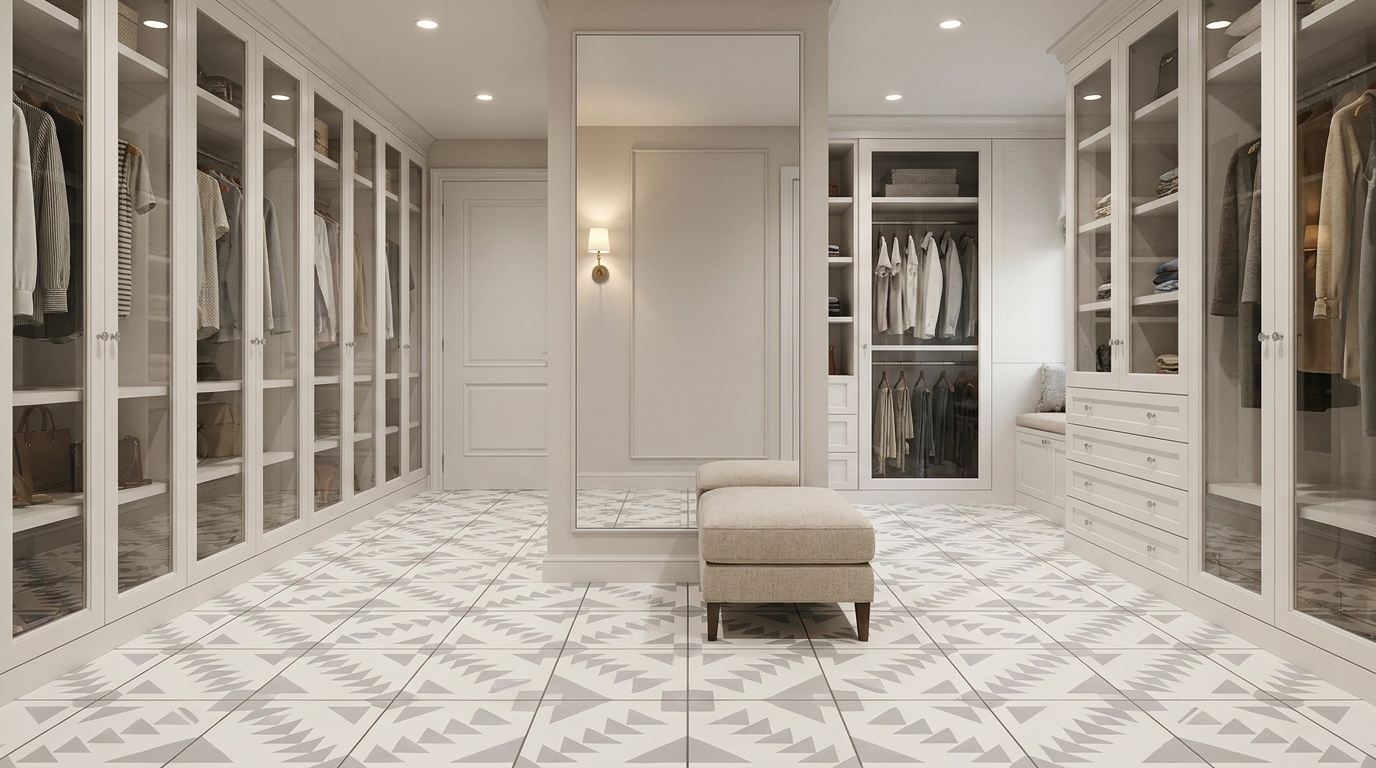
This is the design power. Handmade cement tile isn’t only about old-world motifs. It can be crisp, quiet, contemporary, or exuberant depending on scale and palette.
A few common directions show how flexible it is:
- Historic patterns suit period homes, courtyards, and hospitality spaces that want a sense of permanence
- Modern geometrics work well in kitchens, powder rooms, bars, and retail interiors
- Single-color fields with border accents give you restraint without losing craft
- Patchwork compositions create an informal, collected feel
Format matters as much as color
Many people first meet handmade cement tile in the classic square format. That’s still a staple, and for good reason. It’s easy to lay out and powerful in repetition.
But shape changes the rhythm of a room. Hexagon softens a grid. Arabesque introduces curve. Fish scale brings a lighter, more decorative cadence. Star and cross patterns can feel architectural even before the furniture goes in.
If you’re weighing indoor-outdoor continuity, shape becomes especially important. Rooms that open to patios, sunrooms, or garden spaces often benefit from a format that feels less rigid than standard field tile. For homeowners comparing surface materials in bright transitional spaces, this guide to flooring options for a Florida room is useful because it frames the practical questions that come up when heat, sunlight, and daily use all meet in one room.
Custom work is where the craft shines
The most satisfying projects often start with a simple question: what should this room say?
Sometimes the answer is a faithful historic reproduction. Sometimes it’s a reduced palette from an existing pattern. Sometimes it’s a completely new composition designed around branding, architecture, or a favorite textile.
Custom handmade cement tile works especially well for:
- Restaurants and hospitality spaces that want a memorable floor without relying on signage everywhere
- Residential renovations where an old house needs a new floor that still feels native to the architecture
- Commercial entries and bars where pattern can define a zone
A practical way to choose a design
Don’t choose only from a sample board at arm’s length. View the tile as a field.
A pattern that looks timid in a single sample can become strong across a full room. A dramatic motif can become overwhelming when repeated wall to wall. You have to think in scale.
Ask yourself these questions:
Where will the eye rest
If cabinets, shelving, or furniture already add visual complexity, a quieter floor may do more.
Is the tile the focal point or the framework
In some rooms the tile should be the star. In others it should support lighting, millwork, or a view.
Will you still like this palette after daily use
Handmade surfaces are intimate. You live close to them.
A strong pattern works best when the room around it has enough calm to let it breathe.
Comparing Cement Tile Performance and Characteristics
Once the design phase is over, critical questions begin.
Can it hold up in a busy house? Is it slippery? Will it stain? Is it tougher than porcelain, or just different? Those are the right questions, because handmade cement tile is a performance material with a very specific profile.

What the technical data tells you
The visible pattern in handmade cement tile isn’t a surface film. It sits in a 3 to 4 mm wear layer, and the tile is formed under 1,700 PSI, which is why the pattern doesn’t wear off from normal use. Technical specifications also show unpolished coefficient of friction values of 0.88 dry and 0.92 wet, which is above the DCOF benchmark of 0.42 used for wet areas. Its abrasion resistance is listed at 3 to 4 Mohs, which is comparable to marble, according to Bong Tiles’ cement tile technical specification.
In plain language, that means a few things.
It grips well underfoot when properly specified. It has a durable face. And it behaves more like a dense architectural surface than like a decorative skin.
Where it performs well
Handmade cement tile is a strong fit for spaces where you want texture, pattern, and traction together.
That often includes:
- Bathrooms and powder rooms where the matte surface feels grounded underfoot
- Kitchens where visual warmth matters as much as cleanability
- Restaurants and hospitality floors where pattern helps disguise everyday life better than sterile, uniform finishes
- Entries and hallways where the floor needs presence
Its slip resistance is one reason many designers like it in wet areas. The finish doesn’t have the slick, glossy behavior that worries people with some polished materials.
Where people get surprised
The surprise is usually porosity.
Handmade cement tile is not as carefree as porcelain. It needs sealing. It can react poorly to staining agents if left unprotected. It also doesn’t shrug off acidic spills the way some buyers assume a tile floor should.
That doesn’t make it fragile. It makes it specific.
If you want something that tolerates neglect, harsh cleaners, and random installation shortcuts, porcelain is easier. If you want a surface with more depth and character, handmade cement tile can reward the extra care.
Cement tile compared with other materials
Here’s the simple comparison I give clients and designers:
| Material | Strengths | Trade-offs |
|---|---|---|
| Handmade cement tile | Inlaid pattern, matte texture, strong traction, custom design freedom | Requires sealing, careful installation, more maintenance awareness |
| Porcelain | Low maintenance, high consistency, easy to source | Can look flatter or more manufactured, less artisanal character |
| Ceramic | Wide style range, accessible, suitable for many wall applications | Often less substantial in feel, design depth depends on glaze or print |
| Marble | Natural beauty, prestige, classic appeal | Can scratch and etch, often slippery when polished, usually less pattern flexibility |
The patina question
Some people ask whether the floor will “age badly.”
That depends on what you expect from age. Handmade cement tile doesn’t aim to remain frozen in factory perfection. It develops a patina. In the right home or commercial setting, that’s part of its charm.
If you prefer a pristine, no-change aesthetic, choose something else. If you appreciate materials that become more convincing over time, this is one of the best surfaces available.
Practical decision rules
Use these as a filter before you specify:
- Choose handmade cement tile if you want pattern integrated into the architecture and you’re prepared for sealing and thoughtful care.
- Choose porcelain instead if your top priority is low-maintenance consistency with less installer sensitivity.
- Choose stone if you want natural veining more than graphic pattern, and you understand stone’s own maintenance demands.
Practical rule: Don’t compare handmade cement tile to porcelain as if one is “better.” Compare them by what kind of life you want the room to have.
The right comparison isn’t durability alone. It’s durability, appearance, maintenance behavior, and the kind of atmosphere the surface creates every day.
Planning Your Project Sourcing and Specification
Most problems with handmade cement tile start before the first tile is set.
They start when someone orders too little, decides too late, skips a mockup, or assumes this material behaves like a commodity product. Good planning prevents almost all of that.
Start with the lead time question
The first decision is whether your project needs an in-stock tile or a custom one.
If the schedule is tight, in-stock material keeps the project moving. If the design needs a specific palette, border, logo, or historically appropriate pattern, custom work may be the better route. That choice affects the whole schedule, so make it early.
For browsing available patterned and plain cement tile options, it helps to sort what’s immediately usable from what belongs in a longer custom timeline.
Order enough and then a little more
Handmade tile should never be ordered too tightly.
One verified specification guideline recommends 10% overage for batch variation and project realities, as noted in the earlier technical material from Bong Tiles. That extra material gives the installer room for cuts, selection, and future repairs from the same batch.
A smart order usually accounts for:
- Field tile coverage across the main area
- Cuts and breakage around edges, corners, and penetrations
- Attic stock for future repairs or additions
- Batch continuity so the finished surface feels intentional
Vet the supplier like a craft partner
Not every supplier supports this material equally well.
You want clear technical information, honest discussion of sealing and installation, and visible evidence that the company understands handmade production rather than reselling a look. Ask how the batches are managed, what guidance is provided for installers, and whether the supplier can help with pattern layout.
If the answers are vague, that’s a warning sign.
Specification details that matter
Architects, builders, and serious homeowners should confirm the practical details before the order is finalized.
Check these points early:
- Application area for floor, wall, wet space, or protected exterior use
- Tile format and pattern direction so layout decisions are made before installation day
- Sealing expectations for the installer and the owner
- Substrate requirements so the floor assembly supports the tile properly
A handmade material rewards clarity. The more your drawings, sample approvals, and field expectations align, the better the floor will look once it’s down.
Critical Steps for Installation and Maintenance
Here, romance must meet discipline.
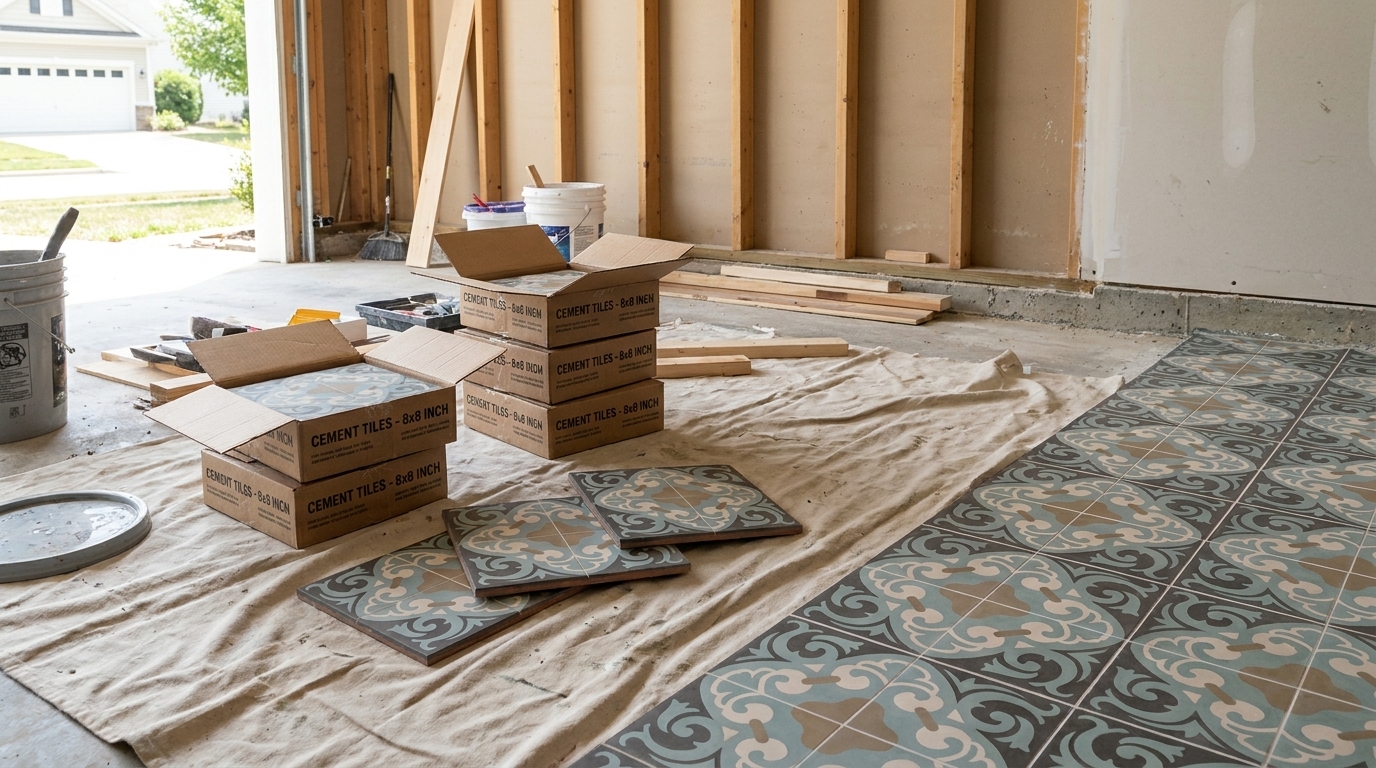
Handmade cement tile can last beautifully, but installation errors show up fast and stay visible. Most of the horror stories people hear about cement tile come from avoidable mistakes. The material wasn’t the problem. The prep was.

Why DIY goes wrong
The technical challenge isn’t only the weight or the setting material. It’s the combination of porosity, handmade variation, and layout sensitivity.
Architessa notes that artisans produce about 80 tiles per day, which contributes to slight size variation of up to 1/16 inch. The same guidance also stresses that tiles must be sealed before and after grouting to avoid permanent grout staining, and that professional installation can cost 20 to 50% more than porcelain because of the handling and layout demands. Those installation realities are summarized in Architessa’s cement tile guidance.
That extra labor cost often surprises homeowners, but it reflects real work.
Get the substrate right first
A cement tile floor can’t make up for a weak or moving base.
The installer should confirm a suitable substrate, proper flatness, and a tile-ready assembly before any setting begins. On framed floors and remodels, underlayment details matter a lot. This overview of underlayment for tile floors is a useful starting point because it frames the support layer as part of the finished system, not an afterthought.
The installation sequence that matters
A careful installer doesn’t rush from box to floor.
The work usually goes more smoothly when it follows a disciplined order:
Sort and dry-lay first
Open multiple boxes. Blend the material. Check tone, pattern flow, and any slight size variation before adhesive is spread.Use the right setting approach
Handmade cement tile needs a mortar and handling method suited to its body and finish. The installer should avoid rough treatment that can chip edges or bruise the face.Seal before grouting
This is not optional. The tile’s porosity can pull pigment from the grout into the surface.Grout carefully and clean promptly
Heavy-handed grouting can turn a beautiful floor into a permanent cleanup problem.Seal again after grouting
The finished surface needs that second stage of protection.
If the installer says pre-sealing isn’t necessary, stop the job and revisit the plan before another tile goes down.
Common mistakes to avoid
I’d watch for these more than anything else:
- Skipping a mock layout because the pattern looked simple on paper
- Treating the tile like porcelain and expecting factory-perfect uniformity
- Using harsh cleaners too early on a newly installed surface
- Leaving grout haze or pigment on the face while assuming it will wash off later
Grout work deserves special care. Homeowners who want to understand what professional cleanup and repair can involve may find this overview of tile grout services helpful, especially when deciding whether a floor needs specialist attention after a difficult install.
Day-to-day maintenance without drama
Once installed properly, routine care is straightforward.
Use gentle cleaners that won’t attack the sealer or the cement-based face. Wipe spills promptly. Avoid acidic products. Don’t assume “tile cleaner” is automatically safe just because the bottle says tile.
A good maintenance rhythm looks like this:
| Task | Best practice |
|---|---|
| Daily or routine cleaning | Use a gentle, non-aggressive cleaner and soft tools |
| Spill response | Clean quickly, especially oils, wine, coffee, and colored liquids |
| Long-term protection | Reassess the sealer as the floor ages and traffic patterns develop |
Who should install it
An experienced tile setter can do beautiful work with handmade cement tile. A great porcelain installer who dismisses the material’s differences can do lasting damage.
That’s the distinction.
Look for someone who understands layout, pre-sealing, careful cutting, and handmade variation. If they speak about the tile as if it were just another standard field tile, keep looking.
The Eco-Friendly Question and Other Common Myths
Handmade cement tile often gets marketed as automatically eco-friendly because it isn’t kiln-fired.
That’s only part of the story.
The honest environmental answer
Yes, the unfired process avoids the energy demands of kiln production. That matters. But the core ingredient is still Portland cement, and that changes the environmental picture.
A more balanced source on the topic notes that Portland cement accounts for 8% of global CO2 emissions, and that calling cement tile unconditionally green is too simple. The same source argues that a 100+ year lifespan can offset some initial impact when compared with surfaces that need more frequent replacement, while still acknowledging that cement remains one of construction’s more carbon-intensive ingredients. That nuance is discussed in Studio Cement Tile’s piece on eco-friendly cement tiles.
So the right question isn’t “Is it green?” It’s “How does it balance production impact, longevity, repairability, and replacement cycles in this specific project?”
Myth and reality
A few common misunderstandings come up again and again.
Myth that cement tile and encaustic tile are identical
People often use the names interchangeably. In everyday conversation, that’s common. In material terms, it can be imprecise.
Historically, encaustic tile refers to a different tradition. Many modern buyers use “encaustic” to describe the look of patterned cement tile. That’s why material clarification matters at the start of a project.
Myth that handmade means delicate
Handmade doesn’t mean fragile. It means the tile asks for a different kind of installation respect and maintenance awareness than porcelain.
Myth that maintenance is impossible
It’s not impossible. It’s just not neglect-proof.
The material is forgiving of age, but not of ignorance.
If you understand sealing, gentle cleaning, and the idea of patina, handmade cement tile is very livable. If you want a surface that tolerates anything without thought, choose something else.
Myth that every project should use it
No material belongs everywhere.
Handmade cement tile shines when design character matters, the substrate is right, and the owner accepts the care it needs. That honesty leads to better projects than any sales pitch ever will.
If you’re weighing handmade cement tile for a home, hospitality space, or commercial project, Original Mission Tile offers handmade cement tile collections, custom design options, and practical guidance on specification, installation, and care so you can make a clear-eyed decision before the first tile is ordered.