You're probably standing in one of two places right now. Either you're staring at a kitchen remodel board full of safe choices that all blur together, or you've already fallen for a patterned floor and want to know whether it can survive real cooking, real spills, and real traffic.
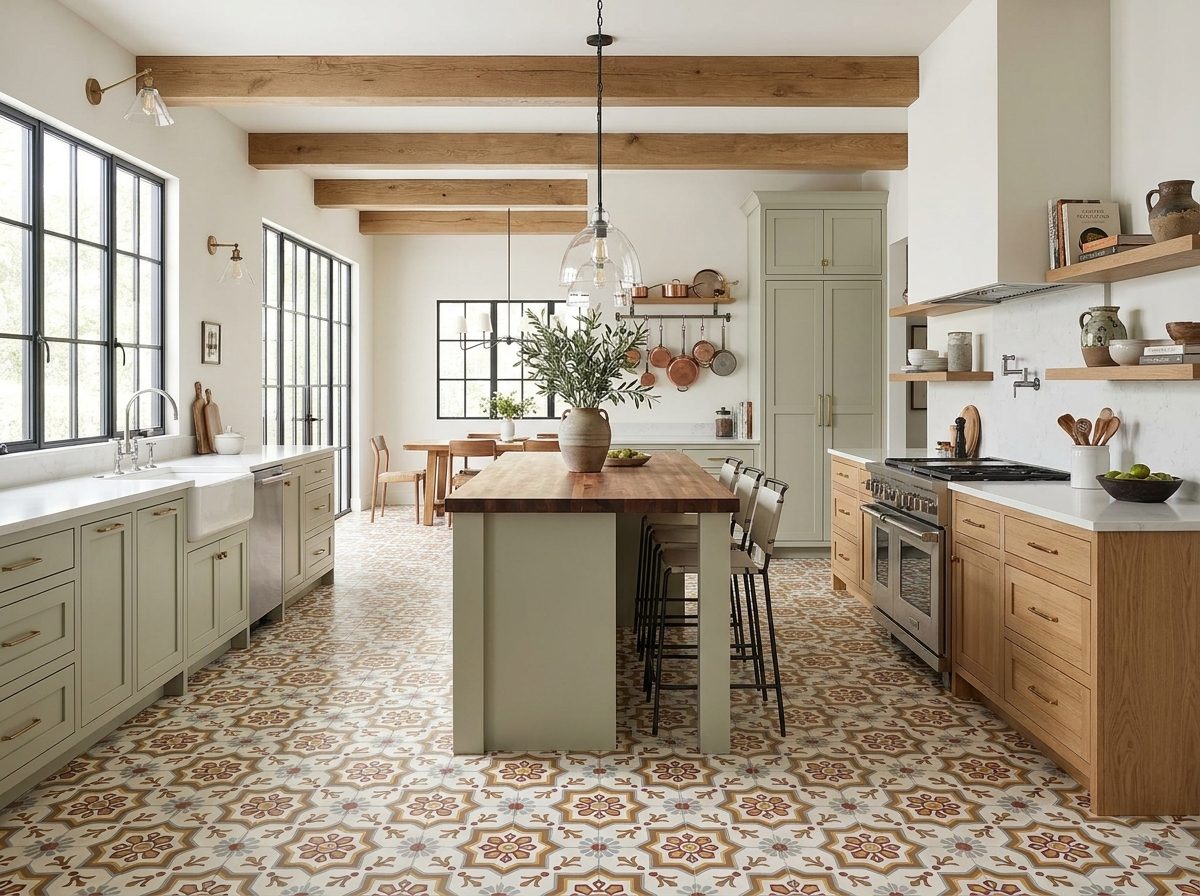
That's where a cement tile kitchen floor changes the conversation. It doesn't read like a generic finish. It reads like a deliberate decision. The right pattern can anchor cabinetry, warm up stone counters, and give a new kitchen the depth older homes seem to have naturally.
It also isn't a casual material choice. Cement tile asks for proper installation, proper sealing, and a clear understanding of long-term care. In return, it gives you something hard to fake with printed surfaces: genuine depth, matte character, and a floor that feels made rather than manufactured.
The Timeless Appeal of a Cement Tile Kitchen Floor
A designer working on a kitchen usually hits the same fork in the road. One direction leads to a floor that blends in and disappears. The other leads to a floor with presence, one that shapes the whole room. Cement tile belongs firmly in the second camp.

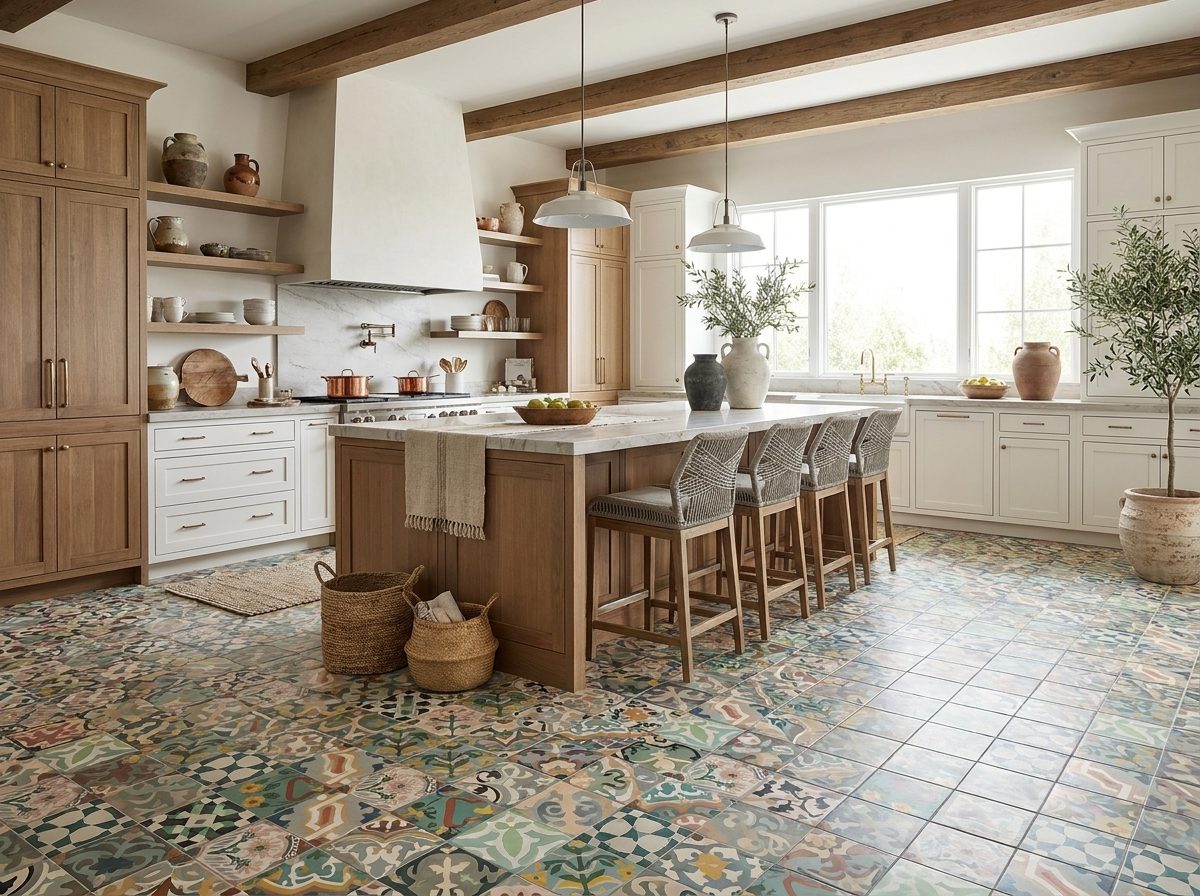
In kitchens with painted cabinets, natural wood shelving, unlacquered brass, or plaster-like walls, cement tile has a way of making the room feel settled from day one. It adds age, but not in a distressed or forced way. The surface has softness. The pattern has rhythm. The floor becomes part architecture, part artwork.
Why this material still feels current
Cement tile doesn't depend on trend cycles because it started as a practical invention, not a styling gimmick. It originated in Catalonia, Spain, around 1855 to 1875 as a kiln-free alternative to expensive fired clay tiles, using a hydraulic-press method that created intricate, inlaid color and durable floors that could last over a century, as documented in the history of cement tile.
That history matters in a kitchen. This is a room that gets tested every day. You don't want a floor that only looks good in a showroom photo. You want one with a track record.
Practical rule: If a floor is going to carry the visual weight of the room, it also has to earn its place under daily use.
What homeowners and designers are really choosing
People often think they're choosing a pattern first. In practice, they're choosing a kind of atmosphere.
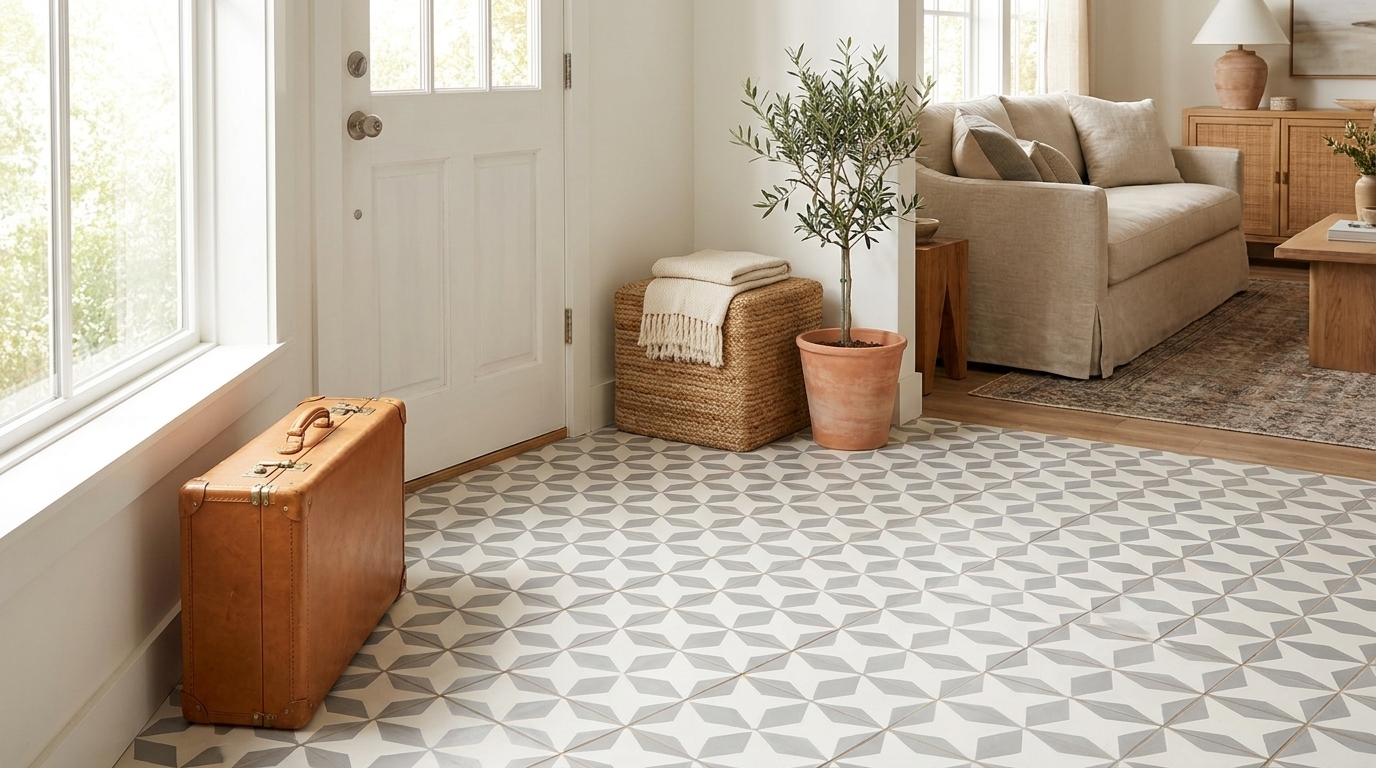
A black-and-white geometry can sharpen a small galley kitchen. A soft green motif can make a painted shaker kitchen feel more relaxed. A warm terracotta-based pattern can tie together wood, limestone, and aged metal in a way plain tile rarely does.
A cement tile kitchen floor also answers a common design problem. Many kitchens have beautiful vertical finishes and forget the horizontal plane. Then the room feels top-heavy. Cement tile solves that by giving the eye somewhere meaningful to land.
This material isn't for someone who wants a completely invisible floor. It's for someone who wants the kitchen to feel authored.
Understanding Cement Tile The Material and Its Magic
Cement tile gets confused with ceramic all the time, and that confusion causes expensive mistakes. A cement tile kitchen floor doesn't behave like glazed tile, doesn't install the same way, and doesn't age the same way.
The first thing to understand is simple. Cement tile is not fired. It's made by combining cement-based materials and pigments, then compressing them under a hydraulic press. That process gives the tile its dense body and matte face.

Inlaid art, not a printed picture
The easiest way to explain cement tile is this. The visible design is inlaid, not just applied to the surface. Think of it as a pattern built into the face of the tile rather than a graphic sitting on top.
That's why wear looks different. On many mass-produced tiles, the image is the trick. On cement tile, the pattern is part of the material itself.
This is also why older floors can still look compelling even after long use. Cement tiles debuted at the 1867 Paris International Exposition, and the method was reportedly 50 to 70 percent cheaper than fired encaustic tiles while still delivering remarkable resilience. Antique kitchen floors from the early 1900s remain vibrant today, as described in this cement tile overview.
Cement tile versus encaustic tile
People use these terms interchangeably, but they aren't the same in the strict material sense. Traditional encaustic tile refers to clay tile with pattern created through different colored clays and firing. Cement tile was developed later as a more affordable, kiln-free way to achieve a similar decorative richness.
That distinction matters because the maintenance logic is different. If someone treats cement tile like porcelain, they'll choose the wrong cleaners. If they assume it's glazed, they'll misunderstand sealing. If they expect it to look static over time, they'll miss one of its best qualities.
Why the surface feels different underfoot
Cement tile has a silky, matte finish. It doesn't throw light around the way glossy ceramic can. In a kitchen, that usually works in its favor. Cabinets, counters, and hardware already create enough visual activity. A matte floor grounds the room.
Here's what gives it that feel:
- Mineral pigments create the pattern layer.
- Cement-based composition gives the tile body and density.
- Hydraulic pressing compresses the materials instead of firing them in a kiln.
- A handmade process introduces slight variation that reads as depth, not defect.
A good cement tile floor doesn't look machine-perfect. It looks composed, balanced, and alive.
The patina question
Many people ask whether cement tile changes over time. It does, and that's part of the appeal. The surface develops a mellowed character that suits kitchens especially well. It doesn't mean the tile is failing. It means the material is behaving like a real, mineral-based surface.
If you want a floor that stays visually identical forever, choose something else. If you want a floor that gains personality as the kitchen gets lived in, cement tile is one of the strongest options available.
Designing Your Dream Kitchen Floor Patterns and Possibilities
Some floors support a kitchen. A patterned cement floor can define it.
That's why the design conversation should start with scale and layout before color. A pattern may look perfect on a sample and feel completely different once it covers the room. In kitchens, cabinets break up the field, islands interrupt sightlines, and sunlight changes how contrast reads across the day.
Start with the room, not the sample board
A small galley kitchen usually benefits from a pattern with a clear repeat and enough movement to distract from narrow proportions. An open kitchen with a dining area can carry a larger motif or a bolder contrast because the floor has more breathing room.
For most projects, the useful questions are these:
- Where will the eye land first
- How much of the floor will stay visible after cabinetry and islands
- Do you want the floor to lead the room or support other statement materials
- Will adjoining rooms need a calmer transition
Those questions matter more than chasing the pattern everyone else is pinning.
Pattern strategies that work in kitchens
Some approaches prove themselves again and again.
- All-over repeating geometry works well in compact kitchens because it gives the room structure.
- Bordered layouts or tile-rug effects can help define a breakfast zone or dining corner within a larger kitchen.
- Organic curves and softer motifs often pair better with natural wood, hand-finished plaster, and rounded hardware.
- High-contrast graphics sharpen a more architectural kitchen with slab fronts or crisp painted millwork.
One smart move is balancing one expressive finish against quieter companions. If the floor carries a complex pattern, the backsplash often benefits from restraint. If the cabinetry color is assertive, the floor pattern may need a simpler rhythm.
Format changes the mood
Classic square formats feel rooted and architectural. Hexagons can lean more playful or more formal depending on the pattern. Arabesque and fish scale shapes soften a kitchen that feels too linear.
The key isn't novelty. It's fit.
A room with many right angles sometimes benefits from a shape that breaks the grid. A room already full of curves may need a more disciplined floor to keep the composition from drifting.
For patterned options in traditional and contemporary styles, the patterned cement tile collection is a useful reference point for comparing repeats, contrast levels, and how motifs behave across larger surfaces.
Custom versus ready to install
Not every project needs a custom drawing. Sometimes an in-stock pattern is the better decision because it keeps the schedule tighter and reduces one more decision point in an already complicated remodel.
Custom work makes sense when:
| Design need | Better path |
|---|---|
| Matching existing architectural character | Custom or adapted historical pattern |
| Tight renovation schedule | In-stock pattern |
| Brand-specific hospitality palette | Custom colorway |
| Small residential kitchen with many other custom elements | Often in-stock for simplicity |
Designers also tend to get the best results when they mock up the room as a whole, not just the floor in isolation. A cement tile kitchen floor should be tested against cabinet finish, grout color, countertop movement, and natural light. It's a systems decision, not a single-product decision.
The right pattern doesn't just look beautiful by itself. It makes the rest of the kitchen look more intentional.
Technical Specifications What Designers and Installers Must Know
A beautiful sample doesn't answer the questions that matter on a job site. For a cement tile kitchen floor, performance comes down to surface grip, body thickness, absorption, sizing, and flatness across the installation.
Slip resistance in a real kitchen
Kitchen floors get wet. That's why surface traction isn't a side issue.
For kitchen applications, cement tiles demonstrate a Dynamic Coefficient of Friction of 0.65, which exceeds the 0.42 minimum for wet, level walking surfaces. That performance is tied to the matte, unpolished surface rather than an added coating, as outlined in this cement tile technical description.
That matters in practical terms. A cement tile kitchen floor doesn't rely on a glossy finish to look finished, so it tends to feel more secure underfoot when the room is active.
Thickness, wear layer, and tolerance
The same technical reference notes several specifications designers and installers should pay attention to:
- Wear layer of 3 to 4 mm
- Typical tile size of 8×8 inches
- Sizing tolerance of +/-0.4 mm
- Thin grout lines of 1/32 to 1/16 inch for properly sized tile
- Abrasion resistance in the 3 to 4 Mohs range
- Water absorption under 10 to 14.94 percent unsealed
Those numbers tell you two things. First, this is a substantial tile with a genuine wear surface. Second, it's still a porous cement-based material, so sealing and substrate prep aren't optional.
Why flatness matters more than people think
Because cement tile often uses tight grout joints, lippage becomes more obvious. The eye reads the floor as a near-continuous patterned plane. Any irregularity breaks that effect fast.
For installers, that means the substrate has to be flatter than many homeowners expect. For designers, it means details on paper need to respect what the material wants in the field.
A quick specification snapshot helps:
| Technical point | What it means for the kitchen |
|---|---|
| DCOF 0.65 | Strong wet-area traction |
| Matte face | Natural grip without gloss |
| 3 to 4 mm wear layer | Inlaid pattern with usable depth |
| Tight grout joints | Clean visual field, but demands precise installation |
| Unsealed absorption | Sealer is part of the system, not an accessory |
Don't specify cement tile as if it were decorative wallpaper for the floor. It's a structural finish material, and the installation details have to match that reality.
The Art and Science of Cement Tile Installation
The biggest mistake people make with cement tile is assuming tile is tile. It isn't. A cement tile kitchen floor can perform beautifully, but only when the installer respects what the material is asking for.

A sloppy substrate, rushed curing, careless grout cleanup, or the wrong setting materials can turn a premium floor into a callback. Most of those failures don't begin with the tile. They begin before the first tile is set.
What has to be right before layout starts
The floor must be sound, clean, and level enough to support tight joints and a flat finished plane. Cement tile doesn't hide prep errors well. If the base telegraphs movement or unevenness, the finished surface will show it.
A careful installer usually pays close attention to these points:
- Substrate flatness because patterned surfaces reveal lippage quickly
- Dry conditions so moisture issues don't get trapped in the assembly
- Clean handling because cement tile can be marked during installation if the crew treats it like glazed porcelain
- Tight layout control to keep repeating patterns aligned through cabinet runs and doorways
One of the most useful field references is the cement tile installation guide, especially for sequencing and job-site handling.
Thin joints and patient sequencing
This material rewards restraint. A narrower grout line keeps the pattern crisp and the floor visually cohesive. The verified guidance for underfloor heating installations specifically calls for 1/16-inch grout lines, which is a good reminder that precision matters here, not speed.
Crews also need to slow down around mixing, curing, and cleanup. Cement's porosity changes the way moisture moves through the installation. That's one reason a good cement tile floor rarely comes from a rushed schedule.
Here's a useful visual demonstration of the process in action:
Underfloor heating is where many projects go wrong
Radiant heat can work with cement tile, but general tile expertise frequently proves inadequate for its specific demands. A key installation pitfall is integration with underfloor heating. Cement's porosity requires precise curing and 1/16-inch grout lines to manage thermal expansion. Slabs must be moisture tested to less than 3lbs/1000sqft/24hrs and paired with compatible latex-modified thinset to prevent failure, according to this underfloor heating and cement tile guidance.
That's the sort of detail that decides whether a floor lasts or cracks.
If radiant heat is part of the kitchen plan, bring the tile installer, builder, and heating contractor into the conversation early. This is not a finish you want coordinated by assumption.
Common failure points
A cement tile kitchen floor usually gets into trouble in the same few ways:
- Skipping moisture testing on slab work
- Using the wrong thinset for radiant conditions
- Letting grout or setting residue sit too long on the face
- Treating sealing as optional or cosmetic
- Allowing too much lippage across tight joints
Installers who do this material well tend to be methodical. That's a good sign, not a red flag. With cement tile, calm, deliberate work usually produces the best floors.
Cost Timeline and Total Cost of Ownership
A kitchen floor budget usually looks straightforward on paper until the cabinetry is ordered, the installer reviews the layout, and someone asks whether the floor needs to last ten years or fifty.
Cement tile changes that conversation. The purchase price is only part of the story. Labor, lead time, sealing, and future upkeep all belong in the same calculation if you want a floor that still makes sense after the renovation dust settles.

Upfront cost versus ownership cost
Cement tile usually costs more to install than standard ceramic or basic porcelain. That premium often comes from the work around the tile as much as the tile itself. Pattern alignment takes time. Surface protection during installation takes time. Sealing and careful cleanup take time. If the kitchen includes borders, custom cuts, or a directional layout, labor climbs again.
That higher first invoice can still be the right value for the project.
A cement tile floor is often chosen the way clients choose good millwork or solid brass hardware. It is a finish with permanence, visual depth, and repairability. In the right house, those qualities matter long after a lower upfront number is forgotten.
For broader planning context across flooring categories, this 2026 flooring costs breakdown is useful when you are building out a realistic renovation budget.
A realistic comparison for kitchen projects
Here is the practical difference.
| Feature | Cement Tile | Porcelain Tile | Hardwood |
|---|---|---|---|
| Upfront installation cost | Higher | Lower to moderate | Moderate |
| Visual character | Handmade, matte, patterned | Broad range, more uniform | Warm, natural grain |
| Water tolerance in kitchens | Good with proper sealing | Strong | More vulnerable |
| Future maintenance | Periodic sealing and gentle cleaning | Usually simpler routine care | Greater sensitivity to moisture and wear |
| Long-term value | Strong if you want enduring design character and long service life | Strong for lower-maintenance utility | Strong in dry spaces, less forgiving in busy kitchens |
Porcelain wins many budget conversations because it is easier to price, easier to replace, and familiar to nearly every tile crew. Hardwood wins on warmth underfoot. Cement tile sits in a different category. It asks for more commitment at the beginning and gives back a floor with far more presence.
Where the money really goes
Homeowners often assume the tile itself is the expensive part. On many jobs, labor is the larger risk.
A low bid can mean the installer has priced the floor like ordinary pressed tile. That is where trouble starts. Cement tile rewards slow setting, clean handling, careful layout checks, and protection from staining during the build. If the kitchen includes underfloor heating, the coordination burden rises again because the assembly below the tile affects performance above it.
The core cost question is simple. Are you paying for a floor to be installed, or are you paying for it to perform well for decades?
Timeline expectations
Stock material can keep a project on schedule. Custom patterns or made-to-order colors need more runway, especially if the design depends on exact scale, border transitions, or coordination with cabinetry and islands.
Installation itself should not be compressed. The floor needs time for proper setting, curing, sealing, and protection from other trades. Rushing those steps is expensive later.
I tell clients to plan the floor early, not after the cabinets are already in production. Cement tile rewards early decisions. It punishes late changes.
Budget for ownership, not just installation
A sensible budget includes three phases. Initial purchase and installation. Scheduled sealing and cleaning. Eventual spot repairs if a heavy impact chips a tile or a renovation alters part of the room.
That does not make ownership complicated. It makes it honest.
Good maintenance is usually straightforward, and a clear guide to cleaning cement tiles helps owners avoid the common mistake of using harsh products that shorten the life of the sealer. Over time, that kind of routine care matters more than shaving a little off the original bid.
Long-Term Care Maintaining the Beauty of Your Floor
A cement tile kitchen floor rewards owners who treat maintenance as routine stewardship, not crisis response. In practice, long-term care is less about constant work and more about doing a few things correctly, especially in a room that sees grease, dropped utensils, acidic spills, and daily foot traffic.
Daily care that protects the surface
Start with dry cleaning. Grit is what does the quiet damage in kitchens. It gets walked across the surface and acts like sandpaper under chairs, stools, and busy feet.
Use a soft broom, dust mop, or a vacuum set for hard floors. Follow with a neutral pH cleaner and a damp, not soaking, mop. Strong degreasers, acidic cleaners, bleach-heavy products, and abrasive pads are common mistakes. They can wear down the sealer and leave the tile more exposed to staining.
Spills need prompt attention.
Blot first, then clean gently. Red wine, tomato sauce, citrus, coffee, and cooking oils all have a better chance of leaving a mark if they sit.
Resealing is part of the real ownership cost
This is one of the trade-offs that should be discussed before the floor goes in, not after. Cement tile can age beautifully, but kitchens ask a lot from any porous material. Resealing is part of owning it well.
The schedule depends on traffic, cleaning habits, the sealer used, and how hard the kitchen works. A lightly used pantry kitchen may hold its protection longer than a family kitchen with children, pets, and constant cooking. I advise clients to watch performance, not just the calendar. If water stops beading and the surface starts absorbing moisture more readily, it is time to reseal.
A sound maintenance routine usually includes:
- removing grit before it gets ground into the finish
- cleaning with pH-neutral products
- wiping up spills before pigments and oils settle in
- avoiding abrasive pads and harsh chemicals
- resealing when the protective layer begins to wear
For practical product guidance, cleaning methods, and what to avoid, this guide to cleaning cement tiles is a useful reference.
Patina should look natural, not neglected
Cement tile does not stay factory-crisp forever, and that is part of its appeal. In a well-kept kitchen, the surface develops a softer, lived-in character that suits the material. Older European floors are prized for exactly that reason. They show use without losing their dignity.
Damage reads differently. Deep staining, etched areas, and worn-through protection are maintenance issues, not patina. That distinction matters. Designers often love the romance of an aged floor, but homeowners still need a finish that can handle breakfast spills on Monday and a dinner party on Saturday.
The good news is that proper care is straightforward. A cement tile floor does ask more of you than porcelain. In return, it gives you depth, softness, and character that printed surfaces rarely match.
Frequently Asked Questions About Cement Tile Kitchens
Is cement tile the same as encaustic tile
Not exactly. People often use the terms loosely, but traditional encaustic tile is clay-based and fired. Cement tile was developed later as a kiln-free alternative that could achieve similarly rich pattern and color through hydraulic pressing.
Can cement tile be used only on the floor
No. Many people use it on backsplashes, islands, bars, and feature walls. The main point is matching the installation method and sealing approach to the application. Floors just demand more from the assembly because of wear and moisture.
Does a cement tile kitchen floor feel cold
Like most tile surfaces, it can feel cooler than wood under bare feet. In return, it performs well in busy kitchens and works with radiant heat when the assembly is detailed correctly. The comfort question is real, but it's usually solved through planning rather than by avoiding the material.
Will the pattern wear off
A properly made cement tile has an inlaid pattern layer, so the design isn't just a surface print. That doesn't mean the floor never changes. It means the change tends to read as patina rather than image loss.
Is it too high-maintenance for family kitchens
Not if expectations are realistic. It does ask for sealing, pH-neutral cleaning, and reasonably quick spill cleanup. If someone wants a floor that can be ignored completely, porcelain may be a better fit. If they want character and are willing to care for it properly, cement tile is a strong kitchen choice.
Is it a good choice for remodels with many moving parts
Yes, provided the project team respects the installation requirements. The floor should be chosen early enough for layout planning, schedule coordination, and proper substrate prep. Problems usually come from rushing, not from the material itself.
If you're weighing a cement tile kitchen floor and want help sorting through pattern direction, installation realities, or whether the material fits your remodel, Original Mission Tile is a practical place to start. The company has worked with handmade cement tile since 1900 and provides both design inspiration and the technical guidance needed to turn a beautiful idea into a floor that lasts.