You're probably in one of two situations right now. You're either staring at a remodel and trying to keep it from feeling flat and generic, or you own a bungalow or early-20th-century house and can tell when a tile choice is close, but not quite right.
That tension is exactly where Craftsman tile earns its keep. Craftsman style tile patterns bring structure without fuss, ornament without showiness, and texture without relying on shiny surfaces or loud color. Done well, they make a room feel settled, grounded, and lived in. Done poorly, they turn into a vague “vintage-ish” mix of motifs that misses both the history and the mood.
The appeal has never been just the pattern itself. It's the logic behind it. Craftsman work came out of a design attitude that favored utility, restraint, natural beauty, and visible hand. That's why a simple border can matter more than a busy centerpiece, and why a matte surface often looks more convincing than a glossy one with the same geometry.
Most homeowners don't need more inspiration photos. They need a filter for decision-making. Should the floor read as period-correct or sympathetic to the house? Should the backsplash disappear into the architecture or become a feature? When does a border sharpen the room, and when does it clutter it?
Introduction Embodying Handcrafted Character
A room starts to feel right when the materials agree with the house. In a Craftsman interior, tile shouldn't feel pasted on as decoration. It should feel built into the architecture, the same way millwork, built-ins, and trim feel integral rather than optional.
That's why generic pattern shopping usually fails. A homeowner sees a hex mosaic, a pinwheel floor, a floral fireplace surround, and a matte subway wall and assumes they all belong together automatically. Sometimes they do. Sometimes they fight each other because scale, color restraint, and placement weren't considered.
The first practical question isn't “What pattern do I like?” It's “What role does this tile need to play?”
- For restoration work: the tile should support the age and proportions of the house.
- For a newer home: the tile can borrow the language of Craftsman design without pretending to be original.
- For a focal area: the tile can carry more visual weight, especially around a fireplace or entry.
- For working surfaces: the pattern usually needs more discipline than drama.
Practical rule: In a Craftsman room, tile works best when the eye notices the whole composition before it notices the individual pieces.
The good news is that the style has clear signals. It favors geometry over flash, texture over gloss, and thoughtful borders over random contrast. Once you understand those signals, the choices get easier. You can tell the difference between a faithful historic layout and a modern adaptation that still respects the same design DNA.
The Soul of Craftsman Tile A Historical Primer
Craftsman tile wasn't born as a trend category. It grew out of a broader rejection of anonymous industrial design and a preference for materials that looked honest in the hand and in the light. That's the part many mood boards skip.
The Arts and Crafts movement valued handcrafted quality, natural materials, and straightforward design. In tile, that translated into surfaces with body, visible texture, earthy color, and geometry that felt disciplined rather than ostentatious. The point wasn't to impress with complexity alone. The point was to make useful surfaces beautiful through proportion, material, and workmanship.

Why geometry mattered
The geometry in Craftsman interiors has a moral quality to it. It feels calm, ordered, and intentional. Squares, rectangles, hexagons, and border bands create rhythm without turning a room into a spectacle.
Historical tile surveys note that Craftsman-style tile patterns emerged in the early 20th century. Those same surveys note that hexagon floor tiles date back to the 1890s, pinwheel patterns became especially popular in the 1920s and 1930s, and subway tile, first introduced in New York in 1904, quickly spread into Craftsman kitchens and bathrooms because it balanced easy maintenance with a clean, geometric look (historic tile pattern overview).
That matters because it places these patterns in a real design lineage. Hex mosaics weren't a nostalgic revival item. Subway tile wasn't chosen because it was trendy. Each answered a practical need while fitting the Craftsman preference for clear shape and visual order.
Why the surface mattered just as much
A glossy tile can carry the same layout and still miss the character. Craftsman rooms prefer light that skims, softens, and reveals texture. They don't usually want a mirror-like flash.
That's one reason textured, handmade-looking surfaces feel so at home here. They acknowledge the hand of the maker, even in a restrained room. If you want to study the vocabulary more closely, this gallery of historic tile patterns is useful because it shows how repetition, border logic, and motif discipline shape the overall effect.
Craftsman tile looks strongest when the material seems truthful. If the finish feels too slick or too perfect, the pattern loses some of its conviction.
The real lesson from the history
The lesson isn't that every Craftsman room needs a museum-level reproduction. It's that the style has an internal logic. Respect that logic and even a modern interpretation can feel grounded. Ignore it and the room starts to read as a collection of vintage references rather than a coherent design.
Hallmark Craftsman Patterns and Motifs
Some patterns show up again and again because they solve real design problems. They organize space, hide visual wear, and give a room a sense of craft without overwhelming it.

Hex mosaics for floors
If there is one floor pattern that immediately signals the period, it's the small hex mosaic. For Craftsman-style floors, small-format hexagon mosaics were historically common because their 1-inch modules let skilled setters build complex borders and accent fields while keeping the main field visually restrained. Period examples were often white with black accent borders (historic floor pattern reference).
That small scale does several things well:
- It keeps the field quiet. The floor has texture and movement, but it doesn't dominate the room.
- It gives borders authority. A simple perimeter line reads crisply because the field is so fine-grained.
- It suits compact rooms. Bathrooms, vestibules, and service spaces benefit from that intimate scale.
What doesn't work is blowing up the same idea into oversized hex pieces and expecting the same effect. The visual language changes. It becomes bolder, more contemporary, and less tied to historic practice.
Pinwheel and related geometric layouts
Pinwheel floors have a different energy. They're still geometric, but they read as more animated than a plain hex field. In the right room, they create a gentle sense of motion underfoot.
They work best where you want a bit more pattern but still want to stay inside the Craftsman family. The mistake is pairing an active pinwheel floor with an equally active wall tile and a loud countertop. Craftsman rooms need one strong tile statement at a time.
Subway tile on walls
Subway tile has staying power because it's disciplined. On a backsplash or bath wall, it creates a clean plane that supports wood trim, built-ins, and fixtures instead of competing with them.
A few placement rules help:
- Keep the color controlled. The calmer the palette, the more architectural the result.
- Watch the edge conditions. Trim pieces, returns, and terminations matter as much as the field.
- Use variation carefully. Slight irregularity can help. Fake distress usually hurts.
If you're coordinating a floor pattern with wall tile and want to see how installation discipline affects the final look, a resource on expert tile installation in Forsyth County is worth reviewing for layout and execution standards, even if your project uses a different pattern family.
Here's a useful visual walk-through of period-minded detailing and pattern use:
Borders, bands, and feature motifs
Borders often determine whether many Craftsman installations come alive or fall apart. They aren't filler. They define territory. They frame a hearth, turn a floor into an inset rug, or give a plain field a finished edge.
A border should make the room feel more resolved, not more decorated.
Fireplace surrounds often carry more expressive motifs, including floral or nature-based ornament. That makes sense. A hearth is symbolic as well as functional. But even there, the strongest examples keep the composition tight. Rich color or botanical detail works because the surrounding woodwork and field tile hold the structure.
Material and Color The Authentic Craftsman Palette
Pattern gets the attention, but material does the heavy lifting. You can choose a historically sympathetic layout and still miss the mark if the surface is too slick, the color too synthetic, or the texture too flat.
Why matte beats glossy
Craftsman rooms favor depth created by shadow, relief, and natural finish. One practical hallmark of the style is the use of dimensional, texture-forward surfaces to add tactile depth without relying on glossy finishes. A good example is a Craftsman-style stone product in a 6" × 12" format that uses carved stripes of varying heights, widths, and textures to create a layered field under raking light (dimensional tile example).
That principle travels well beyond one product. It tells you what to look for:
- Low sheen
- Surface variation
- Readable texture
- Color with mineral depth rather than surface flash

What colors usually hold up
The authentic Craftsman palette tends to sit close to the earth. Warm gray, olive, ochre, terracotta, muted blue, cream, and deep brown all make sense because they relate to wood and masonry rather than fighting them.
A simple way to test a color is to place it mentally against quarter-sawn oak, fir trim, or dark-stained cabinetry. If the tile color makes the wood look sharper and richer, you're probably close. If it makes the wood look accidental, the color is probably too cold, too bright, or too sugary.
Where modern choices can still fit
Modern kitchens often need a little more brightness than a strict historic palette allows. That's fine, as long as the finish and visual weight stay disciplined. For homeowners comparing backsplash options for South Jersey homes, the useful lesson is that the tile's finish and scale often matter more than chasing a fashionable color.
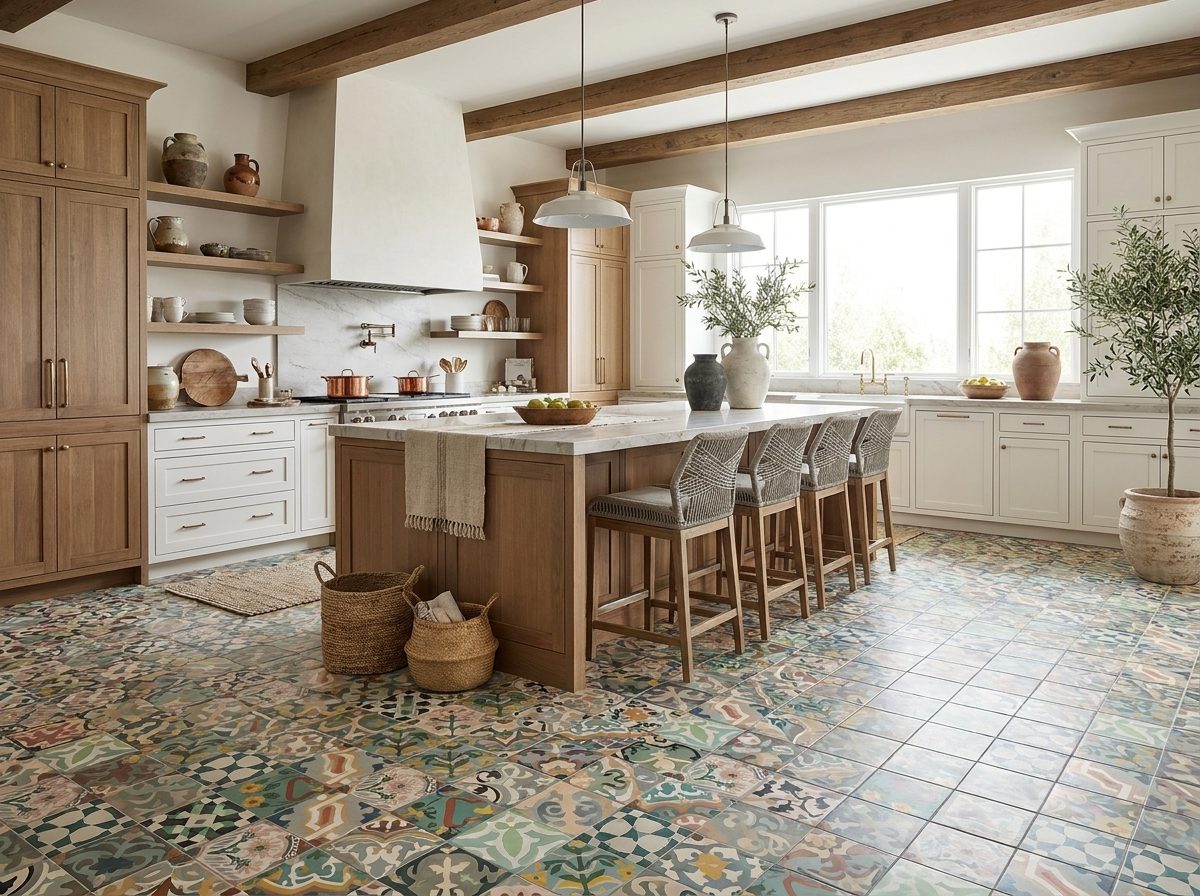
One manufacturer that fits this conversation factually is Original Mission Tile, which produces handmade cement tile using hydraulic-press methods and offers both stock and custom patterns. That kind of matte, inlaid surface aligns well with Craftsman interiors because the material itself carries visual softness without needing a glossy glaze.
The room should feel richer as the light changes. If the tile only comes alive under direct glare, it's probably fighting the style.
Layout and Scale From Floors to Fireplaces
Good Craftsman tile work depends on proportion. A pattern can be historically sympathetic and still feel wrong if its scale ignores the room, the surrounding woodwork, or the visual hierarchy of the space.

Floors that anchor the room
Floors take punishment, so they need visual durability as well as physical durability. Small geometric patterns tend to perform well because they distribute attention across the surface. Scuffs, dust, and daily traffic don't announce themselves the way they do on a large plain field.
For floors, keep these priorities in order:
| Application | What usually works | What often fails |
|---|---|---|
| Entry floor | Small-scale pattern with a defining border | Oversized motif that overpowers the threshold |
| Bathroom floor | Fine-grained mosaic with restrained contrast | Large-format tile that feels too generic |
| Kitchen floor | Structured geometry with a stable field | Competing floor and backsplash patterns |
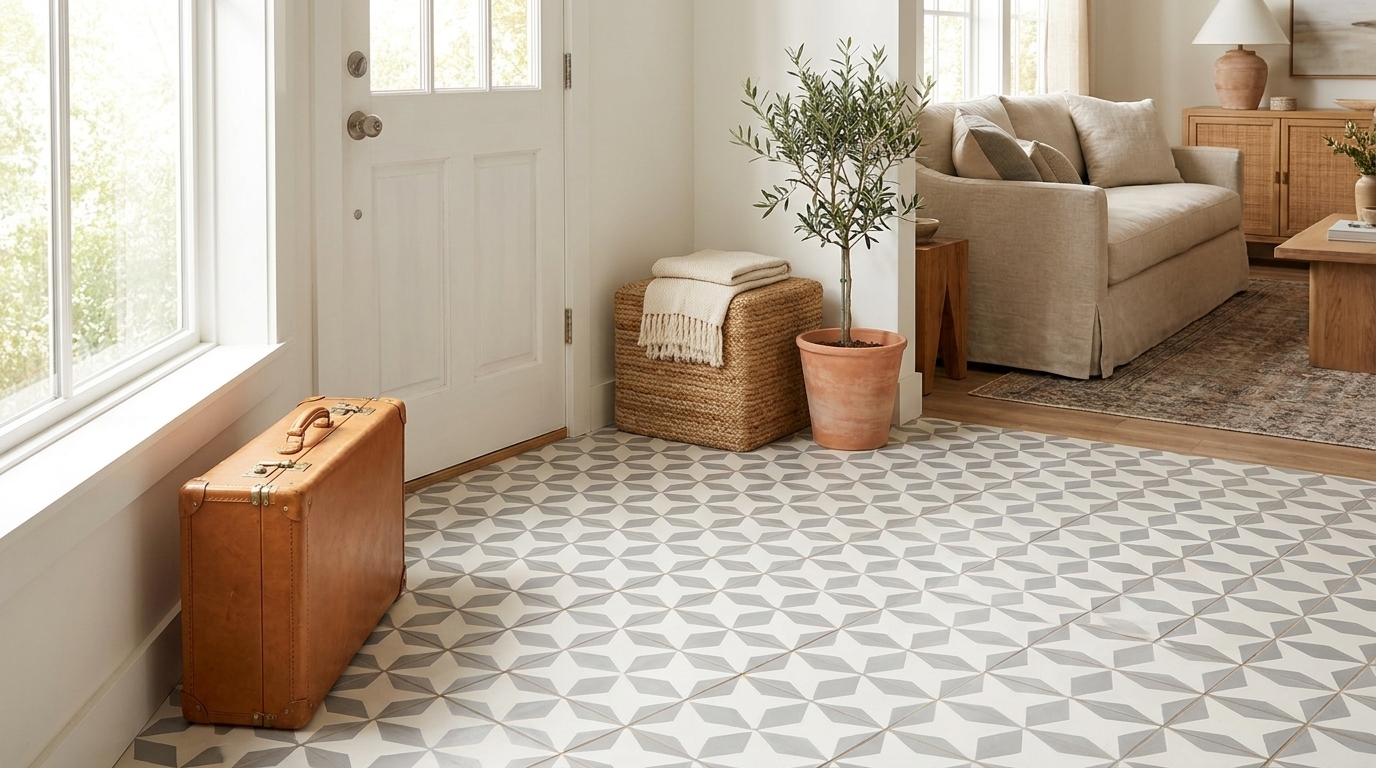
The border matters most where the room needs containment. In a foyer, it can create a tile “rug.” In a kitchen, it can sharpen the footprint of an island zone or transition.
Fireplaces that carry more ornament
A fireplace is where you can allow a little more voice. Decorative inserts, floral reliefs, or a stronger color accent can work because the hearth is already meant to hold attention.
Still, there's a difference between emphasis and overload. If the firebox surround is richly patterned, simplify the adjacent field. If the tile is plain, a more assertive border can supply the definition. For more application-specific guidance, this article on tile for a fireplace surround is useful because it focuses on proportion and visual framing, not just product type.
Backsplashes and wall areas
Backsplashes live close to cabinets, counters, and hardware, so they usually benefit from tighter control. That often means simpler geometry, modest color shifts, and careful termination at shelves, windows, and hood lines.
A few rules hold up well in practice:
- Match pattern density to room size. Smaller rooms can carry finer texture. Large, open rooms often need calmer repetition.
- Let one surface lead. If the floor has a border and active geometry, keep the wall field quieter.
- Use trim deliberately. Endings, corners, and exposed edges separate artisan work from approximate work.
Site habit: Before committing to a layout, dry-lay enough tile to judge the border, the cut pieces, and the relationship to fixed elements like the hearth opening or cabinet legs.
Scale is what keeps the style believable
Many projects drift off course. People copy a motif but not its proportion. Craftsman tile needs to feel connected to the architecture. Small rooms usually want smaller modules. Feature elements can handle more complexity. Large public-facing surfaces often need restraint so the pattern doesn't turn noisy from a distance.
Authentic Restoration vs Modern Inspiration
This is the fork in the road, and it's where many good intentions go sideways. A key gap in available guidance is the difference between specifying for authentic historic restoration versus modern interpretation. Too many sources blur together “Craftsman,” “bungalow,” and generic geometric tile, which misleads renovators trying to make defensible choices (restoration versus interpretation discussion).
If the goal is authentic restoration
Restoration asks for discipline. You're not just choosing a nice pattern. You're preserving the design logic of the house.
Focus on these standards:
- Period-correct pattern families. Use layouts and motifs that make sense for the age and type of room.
- Restrained color relationships. The palette should support woodwork, not compete with it.
- Appropriate grout proportion. Joints affect how fine or coarse the field reads.
- Believable placement. A dramatic feature wall in a location that historically would have been quiet can feel false, even if the tile itself is appropriate.
In restoration work, the best compliment is often that the tile looks as though it has always belonged there.
If the goal is modern inspiration
Modern interpretation gives you more room, but it still benefits from rules. The strongest contemporary Craftsman-inspired rooms borrow the principles, not just the motifs.
That might mean:
- using a classic geometric pattern in a softer, more contemporary palette
- simplifying a traditional border into a cleaner band
- choosing one expressive focal area, such as a fireplace or powder room floor, and keeping everything else calmer
- pairing handmade-looking tile with simpler cabinetry and cleaner hardware lines
This path works especially well in newer homes that want warmth and architectural seriousness without pretending to be historic.
The clearest difference
Here's the simplest way to separate the two approaches:
| Goal | Primary question | Design attitude |
|---|---|---|
| Authentic restoration | Would this choice be defensible in the house? | Preserve pattern logic and restraint |
| Modern inspiration | Does this choice carry the Craftsman spirit? | Adapt material feel and geometry thoughtfully |
If you try to split the difference without deciding, you often get the weakest result. The room won't feel faithfully historic, and it won't feel confidently modern either.
A clear goal solves most specification problems. Once you choose the lane, decisions about scale, finish, border use, and color stop fighting each other.
Installation and Lasting Care for Cement Tiles
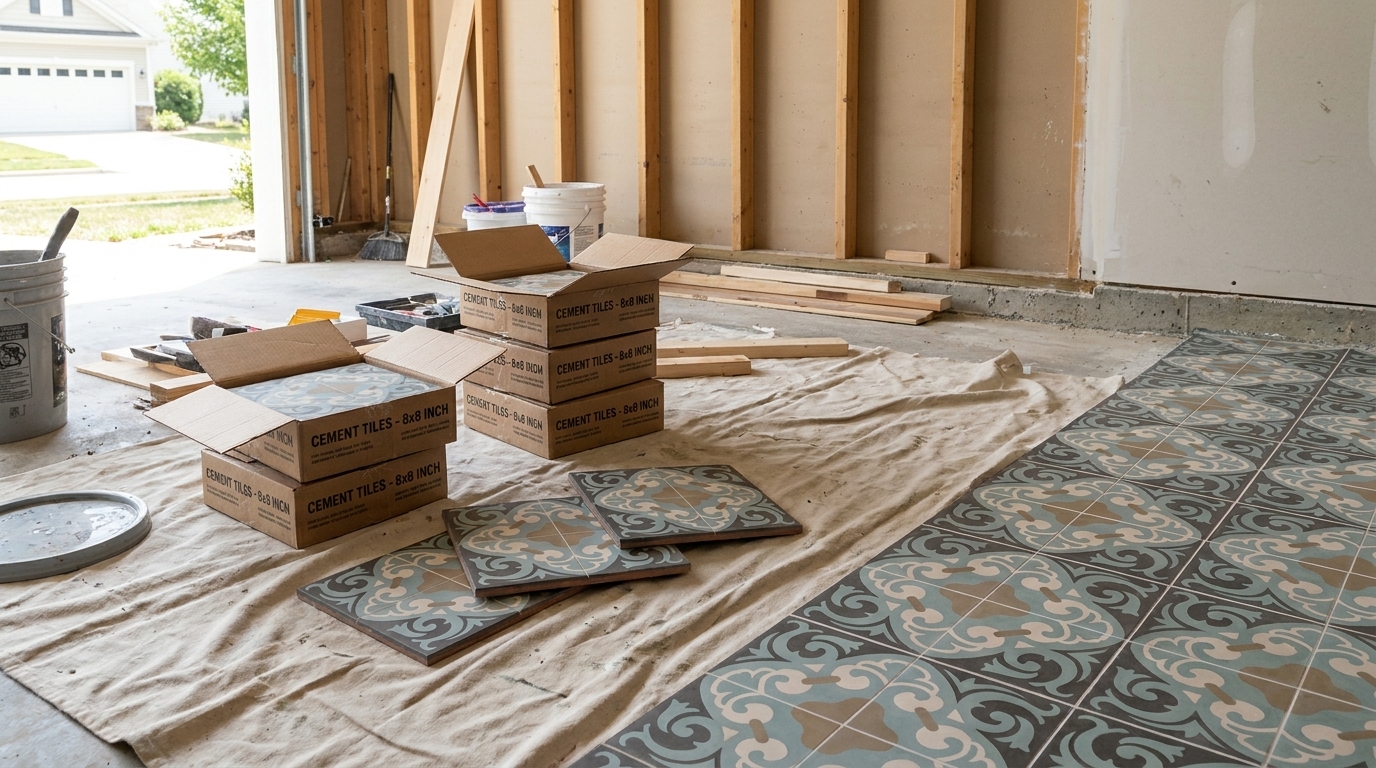
Cement tile suits the Craftsman sensibility because it ages with character, but it does ask for competent handling. The surface is porous, so installation discipline matters. Layout has to be settled before setting begins, especially with borders, directional motifs, or mixed fields.
For installers and homeowners, the practical sequence is simple:
- Seal appropriately: porous tile needs protection suited to the application.
- Use gentle cleaners: acidic or harsh products can damage the surface or alter the finish.
- Expect variation: tonal shifts and patina are part of the material's appeal, not a defect.
- Plan repairs early: keep attic stock from the original batch when possible.
Detailed guidance on installing cement tile is worth reviewing before the job starts, not after. Most installation problems come from treating cement tile like a generic factory-made surface.
This material also makes sense outside private homes. Craftsman-style tile is often discussed as a residential look, but its durability and patterned character also suit high-use commercial and hospitality spaces, where a handmade appearance can add warmth while the patterned surface helps wear read more gracefully over time.
A well-installed cement tile floor won't look frozen in time. It will look used, grounded, and better integrated into the life of the building as the years pass.
If you're specifying Craftsman-style tile patterns and want options that stay close to the handmade, matte character the style asks for, Original Mission Tile is a practical place to start. Their site includes historic pattern references, custom design capability, and installation guidance that can help whether you're restoring an older house or shaping a modern Craftsman-inspired space.