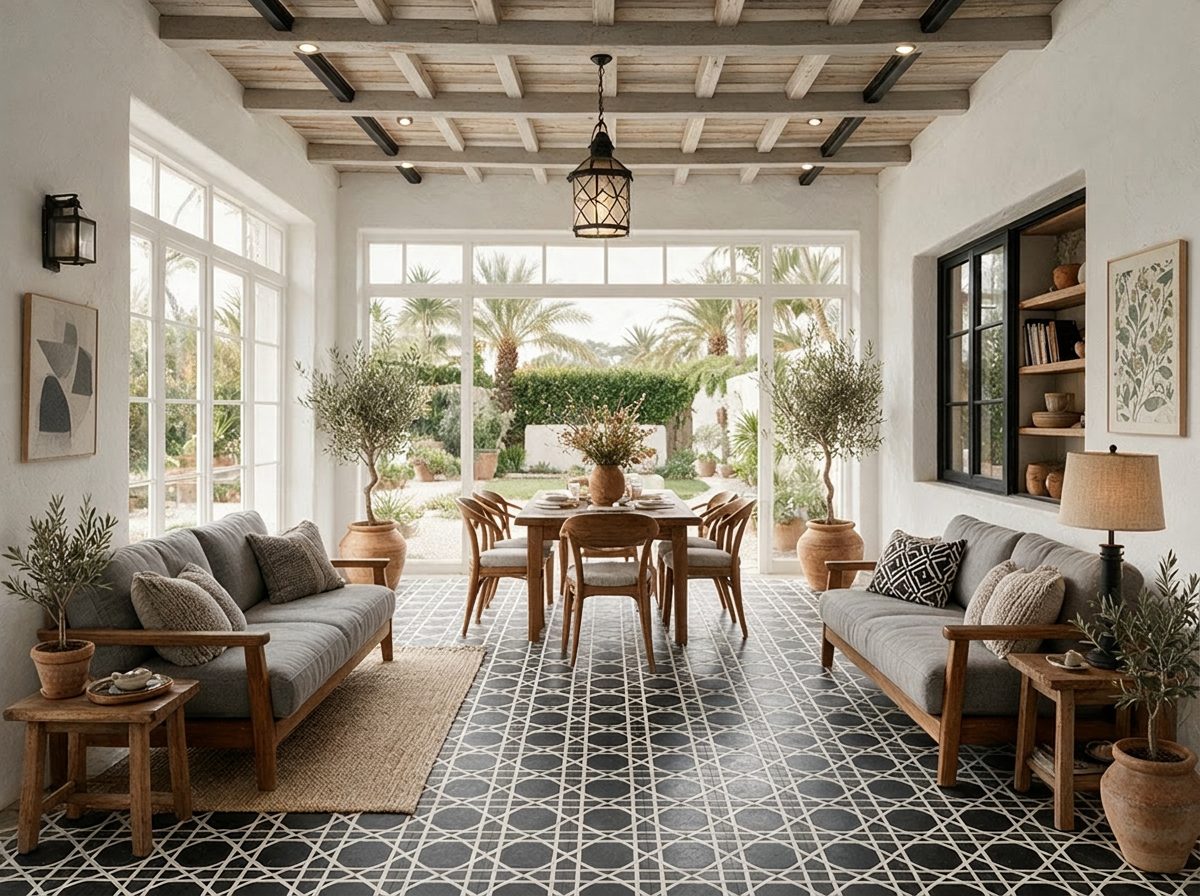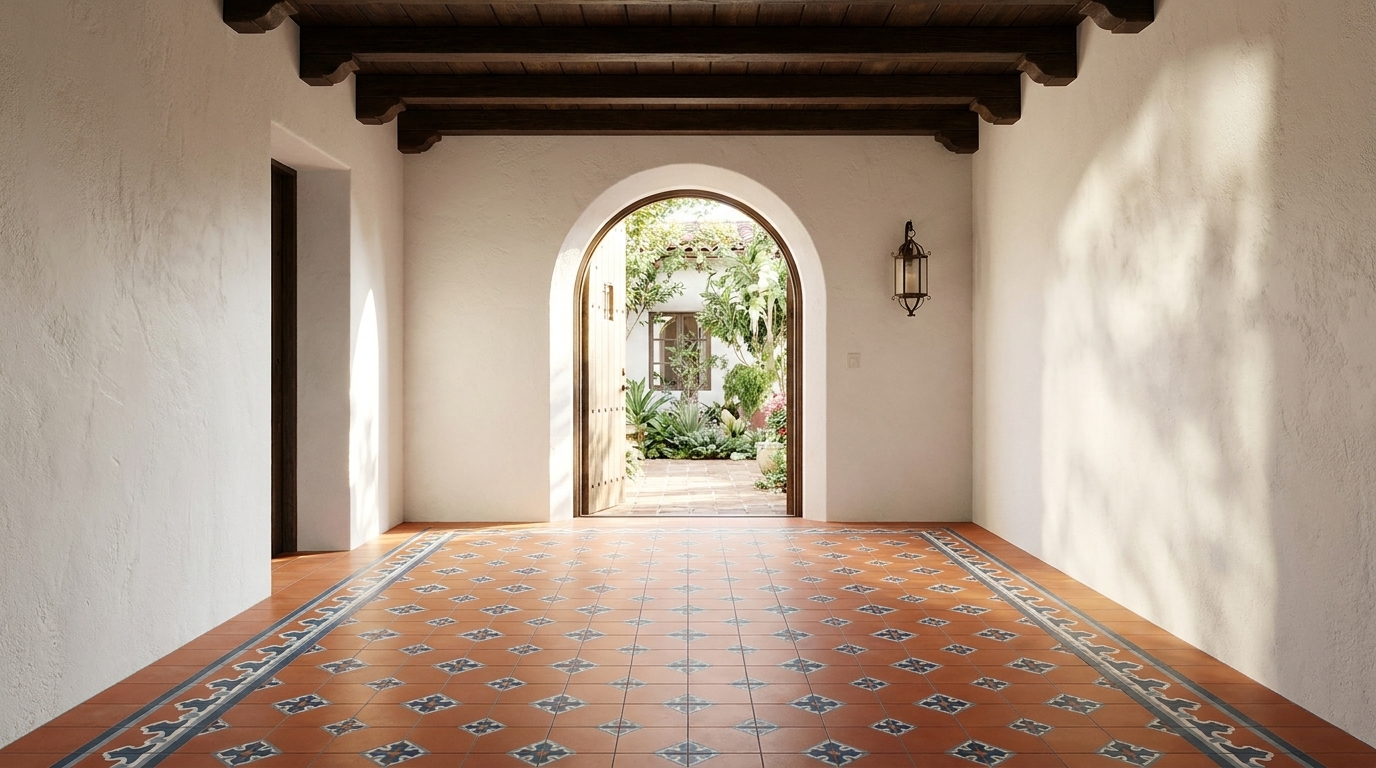
Picture a Parisian café with its bold geometric floor, a tranquil Moroccan riad tiled in intricate stars, or a grand Victorian entryway laid with floral patterns. Historic tile patterns aren’t just decorative flooring; they’re a direct line to centuries of art, culture, and architectural history. They connect modern spaces to a rich past, turning floors and walls into works of art.
The Enduring Appeal of Historic Tile Patterns
This guide unpacks the major families of historic tile—Moorish, Victorian, and Mediterranean—and shows how artisans like those at Original Mission Tile keep these traditions alive. Our handcrafted cement tiles give designers and homeowners the tools to bring authentic, handmade character into today’s projects, making a timeless statement that feels both special and achievable.
A Story Written in Cement
Think of historic tile patterns as a visual language, passed down through generations. Each motif, from the star-and-cross of Moorish Spain to the floral flourishes of Victorian England, carries a distinct cultural fingerprint. They are records of trade routes, new technologies, and artistic movements, all captured in a remarkably durable material.
These patterns didn’t just appear out of nowhere; they evolved with style and demand. Take the Spanish Revival architecture that swept through California and the Southwest starting around 1915. It was defined by an explosion in popularity for classic 8×8 mission tiles. These handcrafted cement tiles, pressed with intricate inlaid designs using natural pigments, were found in over 40% of new luxury homes in Los Angeles by 1925.
Companies like Original Mission Tile, founded in 1900, pioneered this craft. We produced tiles without clay or firing, resulting in a durable, matte finish that beautifully mimicked ancient Mediterranean designs. You can explore more insights on the global antique tile market to understand the full scope of this trend.
Today, that legacy is as strong as ever, with designers specifying these patterns in 60% of high-end hospitality projects, blending history with modern sustainability. It’s no surprise, given these tiles often last over 100 years with minimal upkeep—a true testament to their lasting appeal.
Why Historic Patterns Resonate Today
The modern love for historic tile comes from a deep desire for authenticity and character in our homes. In a world of mass-produced everything, a handcrafted tile floor or wall provides a tangible connection to artistry and history.
A historic tile pattern does more than cover a surface; it infuses a room with soul. It’s the difference between a house and a home, or a building and a landmark.
This guide will help you get to know the core families of these iconic designs. We’ll explore:
- Moorish & Mediterranean: Known for complex geometry, vibrant colors, and flowing arabesques.
- Victorian & Geometric: Characterized by repeating patterns, bold borders, and encaustic-style inlays that took off during the Industrial Revolution.
- Art Deco & Art Nouveau: Marked by stylized florals, sinuous lines, and glamorous, symmetrical compositions.
By understanding the origins and visual language of these historic tile patterns, you can choose and use them with confidence. Whether you’re restoring a period home or adding a touch of timeless elegance to a modern space, these designs offer a powerful way to make an unforgettable impression. Let’s get started.
Identifying the Major Historic Tile Families
Learning to spot historic tile patterns is like learning to read a room’s history. When you can see beyond general labels like “old” or “fancy,” you start to notice the cultural stories, artistic movements, and forgotten technologies baked into every design. This is your field guide for telling a Moorish star from a Victorian geometric with total confidence.
Think of it like identifying architectural styles. Just as you can spot a Craftsman house from its porch or a Mid-Century Modern from its clean lines, you can learn to recognize tile families by their signature motifs, color palettes, and overall feel. We’ll break down the DNA of each style so you can easily spot them in the wild.
This map connects the core elements that give historic tiles their staying power—artistry, history, and pure, simple durability.

As you can see, the appeal isn’t just one thing. It’s the blend of artistic soul, deep roots, and lasting strength that creates their timeless value.
To make spotting these styles easier, here’s a quick reference table.
A Quick Guide to Historic Tile Styles
Use this reference to distinguish between popular historic tile families based on their defining characteristics.
| Style Family | Key Motifs | Typical Color Palette | Era of Origin |
|---|---|---|---|
| Moorish/Mediterranean | Intricate geometrics, stars, crosses, arabesque curves | Deep blues, terracotta, ochre, white, vibrant jewel tones | 8th-15th Century |
| Victorian Geometric | Repeating small-scale geometrics, complex borders, florals | Rich earth tones: deep reds, blues, mustard, black, cream | 19th Century |
| Art Deco | Bold chevrons, sunbursts, fans, strong angles, symmetry | High-contrast black and white, metallics, jewel tones | 1920s-1930s |
This table is a great starting point, but the real magic is in the details. Let’s dive deeper into what makes each family unique.
Moorish and Mediterranean Rhythms
The story of decorative tile really gets going in the sun-drenched landscapes of the Mediterranean and North Africa. Moorish design, born from Islamic art, is a masterclass in geometry and rhythm. Since depicting living things was off-limits, artisans poured their creativity into mind-bendingly complex geometric and calligraphic patterns.
These aren’t just pretty shapes; they’re expressions of order and infinity. Key looks to watch for include:
- Arabesque: Flowing, interlaced lines and stylized botanicals that create a feeling of perpetual motion.
- Star & Cross: An iconic pairing where eight-pointed star tiles lock perfectly with cross-shaped tiles, forming a mesmerizing, seamless surface.
- Zellige: Tiny, hand-chiseled tiles (called tesserae) fit together into intricate mosaics. The beauty is in the subtle imperfections and color shifts from tile to tile.
These designs echoed for centuries. Islamic-influenced arabesques first appeared in 10th-century Moorish Spain and eventually found their way into 80% of Renaissance palaces by the 1500s.
Moorish patterns are basically a meditation in geometry. They use rhythm and repetition to create a feeling of both complexity and perfect harmony, turning a simple surface into a statement of order and beauty.
In a modern home, these patterns bring a dose of worldly sophistication and handmade warmth. They’re just as stunning as a vibrant kitchen backsplash as they are calming on a serene bathroom floor.
Victorian Geometrics and Industrial Artistry
Jump ahead to the 19th century, and a totally different look emerges from the furnaces of the Industrial Revolution. Victorian-era tiles were a product of new technologies that made intricate, colorful tiles available to the public for the first time. The signature look of this era is the encaustic tile.
Though the term is now used more broadly for any inlaid pattern, true encaustic tiles were clay-based. Different colors of clay were inlaid before firing, meaning the pattern wasn’t just on the surface—it went all the way through. Our handmade cement tiles achieve a similar effect by pressing pigmented cement into a mold, creating an equally durable design without the kiln. You can learn more in our detailed guide on what encaustic-style cement tiles are.
Victorian geometric patterns are known for:
- Repeating Motifs: Small, intricate patterns that form a larger, more complex design when installed together.
- Bold Borders: Elaborate, multi-layered borders were a must, used to frame a central “field” of tiles much like you’d frame a rug.
- Rich, Earthy Palettes: Think deep reds, blues, ochres, blacks, and creams.
This style was everywhere, covering 65% of British public buildings like train stations and cathedrals between 1840 and 1900. At their peak, Staffordshire factories churned out a staggering 15 million tiles per year. These patterns feel permanent and orderly, making them a perfect fit for entryways, hallways, and fireplace surrounds that need a touch of history.
Art Deco and the Dawn of Modern Glamour
As the world rolled into the early 20th century, design took a sharp, glamorous turn with Art Deco. Born after World War I, this style was all about celebrating modernity, technology, and luxury. It threw out the floral fuss of the Victorian era and the organic curves of Art Nouveau for a bold, streamlined look.
Art Deco tile patterns have a strong, unmistakable visual language:
- Bold Geometry: Chevrons, sunbursts, sharp angles, and repeating fan shapes are king.
- Symmetry and Order: The designs are often highly symmetrical and structured, reflecting a new machine-age obsession with precision.
- High-Contrast Colors: Classic black and white is the quintessential Art Deco palette, often punched up with metallics or vibrant jewel tones.
These patterns were made to be seen. They bring to mind the glamour of a grand hotel lobby, the sleek lines of an ocean liner, or the buzz of a jazz club. Today, Art Deco tiles are the go-to for creating a dramatic focal point, working especially well in bathrooms, bar areas, and commercial spaces that need a hit of sophisticated energy.
Alright, you’ve spent hours scrolling through gorgeous historic tile patterns. Now comes the hard part: how do you choose the right one for your space without making a costly mistake?
Picking the perfect pattern is more than just finding one you love. It’s about creating a conversation between the tile, the room’s size, and your home’s unique character. Let’s walk through how a pro makes the right call.
Think of a tile pattern as music. A bold, large-scale design is like turning the volume up to 10—perfect for making a statement in a big, open-concept living area or a hotel lobby. But in a tiny powder room, that same pattern can feel like a shout, overwhelming the space. The goal is to match the pattern’s “volume” to the room’s personality.
Consider the Scale of the Pattern and the Room
This is the first and most important rule of tile design. The relationship between the size of the pattern’s repeat and the size of the room is everything.
A small, intricate pattern—like a classic Victorian geometric—can add beautiful texture and detail to a compact space like a mudroom or laundry room without making it feel claustrophobic. On the other hand, a sprawling, grand arabesque might lose all its impact if the floor is too small for you to even see one full repeat of the design.
Here’s a quick gut check for matching scale:
- Large, open spaces (great rooms, restaurant dining floors): Go for it. These areas can handle bold, large-scale historic patterns. Use them to create a dramatic focal point or a stunning “tile rug” that anchors a seating area.
- Medium-sized rooms (most kitchens, primary bathrooms): You’ve got the most flexibility here. Mid-size repeating patterns work beautifully, as does a bold design used strategically on a feature wall or floor.
- Small spaces (powder rooms, entryways, laundry rooms): Stick with smaller geometrics or a single, knockout motif. A pattern that’s too busy will feel chaotic, but a well-chosen one adds incredible character and depth.
There’s a reason our 8×8 cement tiles are an industry go-to. They are the perfect canvas for intricate designs, creating a beautiful rhythm that doesn’t overpower most residential rooms. For bigger commercial spaces, you can combine them into larger “quad” patterns to scale the design up.
Match the Pattern to Your Home’s Architecture
The best tile installations feel like they were always meant to be there. While breaking the rules can be powerful, using your home’s architectural style as your North Star is a surefire way to get it right.
The best historic tile patterns don’t fight a home’s character; they enhance it. Think of it as a conversation between the tile and the architecture, where each one makes the other look better.
For example, a Craftsman bungalow, with its focus on honest, natural materials, is the perfect backdrop for earthy, geometric patterns. A Spanish Revival home practically begs for the vibrant, sun-drenched motifs of Mediterranean and Moorish tiles. Our Star & Cross combinations are a classic choice here, delivering instant authenticity and charm.
But this doesn’t mean you can’t put a Victorian pattern in a modern farmhouse. The secret is finding a common thread. A traditional pattern rendered in a simple, monochromatic color palette can brilliantly bridge the gap between old and new, creating a look that feels both timeless and completely fresh.
Design Strategies for Different Spaces
How you use a pattern is just as important as which one you choose. Remember, your floors, walls, backsplashes, and even ceilings are all blank canvases.
For Homeowners: Your goal is to balance your personal style with the long-term integrity of your home. A super trendy, high-contrast pattern might feel exciting today, but it could look dated in five years. Classic historic tile patterns, on the other hand, have already proven their staying power.
Go bold with a vibrant pattern in a powder room for a delightful surprise. For a kitchen floor that needs to stand the test of time, a more subtle geometric provides enduring appeal.
For Designers & Architects: Use pattern as a problem-solver. In a wide-open floor plan, a distinct tile pattern can clearly define the kitchen area from the living room without a single wall. You can create a “rug” effect with our bordered patterns to give an entryway a formal sense of arrival.
Don’t forget about shape. Using different formats, like our hexagon or fish scale tiles, adds another layer of custom texture that elevates the entire project.
Love these historic patterns? Browse our classic cement tiles in stock, ready to ship from Texas, and order a sample of your favorite.
Mastering Layout and Color in Your Design
The beauty of historic tile isn’t just in the pattern itself—it’s in how you put it all together. Layout and color are the two most powerful tools you have for turning a great tile into a truly breathtaking installation. This is where you graduate from just covering a surface to creating a genuine work of art for your home.
Think of it this way: the way you orient, frame, and color your tiles can create wildly different effects from the exact same pattern. It’s all in the execution.

Creating Definition with Borders and Tile Rugs
One of the most classic and effective layout tricks is the “tile rug.” This technique uses a field of patterned tile as a centerpiece, framed by one or more rows of border tiles and finished with solid-colored field tiles. It’s a designer go-to for a reason.
This layout is perfect for:
- Defining a space: In an open-concept room, a tile rug can visually anchor a dining area or seating arrangement, creating separation without walls.
- Adding formal elegance: An entryway or hallway with a bordered pattern creates a grand sense of arrival, guiding the eye and setting a sophisticated tone.
- Framing a focal point: Use a bordered pattern to outline a kitchen island or freestanding tub, turning a functional object into a deliberate design statement.
This approach gives you total control over the pattern’s impact. It contains the energy of a bold design while adding a layer of polish and intention.
Turning Simple Tiles into Complex Mosaics
You’d be surprised how often the most complex-looking designs are made from the simplest building blocks. By just rotating a single tile design, you can unlock entirely new patterns and add a completely custom touch to your project.
Two classic techniques to know are:
- Quarter-Turn: This involves rotating every other tile by 90 degrees. With an asymmetrical pattern, this can create a stunning pinwheel or woven effect, making the floor look far more intricate than it is.
- Half-Drop: This layout staggers each row of tiles, much like a classic brick pattern. It creates a softer, more organic flow that de-emphasizes the grid lines, making the overall design feel more seamless.
By simply rotating a tile, you become a co-creator of the pattern. You’re not just installing a design; you’re manipulating its geometry to build something entirely new and personal to your space.
To get the most out of these techniques, it helps to have a solid grasp of how to work with patterns in designing your room. Building that foundation will make your tile choices even more impactful.
Using Color to Set the Mood
Color is pure emotion. It has the power to make a room feel energetic, serene, dramatic, or playful. A single historic pattern can take on completely different personalities based on the colors you choose. With a customizable material like cement tile, your options are virtually unlimited.
Just think about how one classic Victorian geometric can transform:
- Monochrome Palette: Using shades of gray, black, and white gives the pattern a modern, graphic feel. It’s a sophisticated look that highlights the geometry of the design.
- High-Contrast Scheme: Pairing bold colors like navy and crisp white, or black and terracotta, creates instant energy and drama. This is a great choice for a powder room floor or bar backsplash.
- Analogous Colors: Using colors that sit next to each other on the color wheel (like blues and greens) results in a harmonious, calm, and cohesive look.
Our Design Studio at Original Mission Tile lets you experiment with these colorways yourself, so you can see exactly how a change in palette alters the character of our historic tile patterns. You can also explore our guide to wall tile patterns to find the perfect complement for your floor. This process puts you in the designer’s seat, ensuring your final installation is a true reflection of your vision.
The Global Story Behind Today’s Most-Loved Tile Patterns
The beautiful, historic patterns you see in kitchens and bathrooms today aren’t just a trend—they’re the result of centuries of travel. These designs journeyed along trade routes, were adopted and reinterpreted by different cultures, and ultimately created the rich, soulful mix we now bring into our homes. Their revival isn’t about nostalgia; it’s about a desire for materials with history, character, and a real human touch.
You can see this design language everywhere, from a modern Parisian bakery to a boutique hotel in Mexico. It tells stories of cultural exchange, like when European floral motifs met the bold geometry of Moorish design. This global cross-pollination created patterns that feel both familiar and exciting, classic and new, all at once.
The Heart of the Modern Tile World
Nowhere is this energy more visible than in the Asia-Pacific region, which has become a true powerhouse in tile production and design. Building on a long heritage of terrazzo and star-cross patterns rooted in ancient Chinese and Indian motifs, the region is now shaping global tastes. In fact, by the early 20th century, China was already exporting 40% of the world’s tiles, often adapting classic European designs for new markets.
That legacy continues today. The region now drives over 50% of the $266 billion global tiles market. With rapid urbanization, experts predict an added demand of 2.5 billion square meters of flooring between 2020 and 2030 alone. You can read the full research on the global tiles market to really understand the massive scale of this movement.
From Global Movement to Personal Masterpiece
So, what does this huge global market mean for your project? First, it confirms that choosing a historic pattern isn’t a fleeting design choice; it’s a durable aesthetic with worldwide appeal. But it also highlights the difference between mass-market trends and authentic craft. While mass production can mimic a look, it can’t capture the soul of a handmade product.
In a world of global trends, choosing a handcrafted tile makes your project personal. It connects your space not just to a style, but to a specific lineage of artistry.
This is where heritage makers like Original Mission Tile come in. We offer a direct link to this global design story through the authentic, time-honored craft of handmade cement tile. Every single tile is made by an artisan—not a machine—using methods passed down since 1900.
This ensures your floor or wall is more than just on-trend. It’s a personal piece of a global history, made with intention and built to last for generations. It proves that even a worldwide movement can feel intensely unique to your own home.
Shop the look: classic cement tiles in stock
Handmade cement tiles, made in Mexico and ready to ship from our Texas warehouse. Each tile is pressed, never fired, and the pattern is a thick layer of pigmented cement, not a surface print. Order a sample to see the colors in your own space before you decide.


Answering Your Cement Tile Questions
So, you’re ready to bring historic tile patterns into your project. It’s an exciting step, but we know it comes with a lot of practical questions. After all, handmade cement tile is a specialized, artisanal material with its own unique character.
Getting clear, straightforward answers is the best way to feel confident about choosing, buying, and enjoying these beautiful surfaces for years to come. Let’s tackle the most common concerns head-on.

We’ll demystify the process and give you the information you need to make your project a stunning success, from start to finish.
Are Cement Tiles Durable Enough for High-Traffic Areas?
Absolutely. In fact, this is one of the greatest strengths of traditional handmade cement tiles. Unlike a ceramic tile where the pattern is just a thin glaze on the surface, the design in a cement tile is inlaid. The color layer is a core part of the tile body itself, often several millimeters thick.
What does that mean for you? As the tile wears down over decades of heavy foot traffic, the pattern stays just as vibrant and clear. This incredible durability is why you can still find original cement tiles looking gorgeous in 100-year-old cafes, hotels, and public buildings across Europe and the Americas.
For any modern project, proper sealing after installation is the key to protecting the tile from stains and moisture. But the tile’s structural strength and pattern longevity are built to last, making it a fantastic choice for busy homes and demanding commercial spaces like restaurants and shops.
What Is the Difference Between Cement Tile and Encaustic Tile?
This is a really common point of confusion, especially since the terms are often used interchangeably today. Knowing the difference helps you appreciate what makes each material special.
Historically, “encaustic” meant a clay tile. The pattern was made by inlaying different colors of clay into the main tile body before it was fired in a kiln.
“Cement” tiles, like the ones we make at Original Mission Tile, are crafted from a mix of pigmented cement, sand, and marble dust. They’re hydraulically pressed in a mold—not fired—and then cure naturally to gain their strength. You can see the results in our cement tile collections.
While the visual effect is similar—a durable, inlaid pattern that won’t wear off—the materials and manufacturing are completely different. True cement tiles offer a silky, matte finish and a handcrafted character that only comes from their non-fired, pressed production method.
Today, you’ll hear “encaustic” used as a style descriptor for almost any tile with a similar intricate look. But understanding the material difference is key to knowing what to expect in terms of feel, finish, and performance.
Can I Use Historic Patterns in a Modern Home?
Yes, and it’s a brilliant way to inject personality and create a compelling focal point in a modern space. The key to making it work is all about balance. In a clean, minimalist setting, a bold geometric or an intricate Moorish pattern acts as functional art.
Try using a pattern in a contained area to get maximum impact without overwhelming the room. Some of our favorite applications include:
- A striking kitchen backsplash that serves as the room’s centerpiece.
- A “jewel box” powder room floor for a dose of drama.
- An inviting and durable entryway that makes a great first impression.
You can also tie a historic pattern to a modern aesthetic through color. A classic Victorian design feels fresh and contemporary when rendered in a simple grayscale or monochrome palette. It’s that contrast that works so well—the handcrafted, historic element brings a warmth and texture that beautifully complements the clean lines of modern design.
How Do I Clean and Maintain Patterned Cement Tiles?
Maintenance is much simpler than most people think, but it does require the right approach to keep the tile looking its best. Because cement tiles are naturally porous, they must be thoroughly sealed right after installation. This sealant creates a protective barrier against stains and moisture.
For day-to-day cleaning, it’s critical to avoid harsh, acidic cleaners. That means no vinegar, citrus-based soaps, or abrasive chemicals. These products can etch the surface and dull the finish over time.
Instead, always use a pH-neutral cleaner designed specifically for natural stone or cement. With a quality seal and the right cleaning routine, your tiles will age beautifully, developing a rich, lived-in patina. Depending on traffic, you may want to reseal them every few years to keep them protected for a lifetime of enjoyment. Follow these simple rules, and your investment will remain as stunning as the day it was installed.
Ready to bring the timeless beauty of authentic handmade tiles to your next project? At Original Mission Tile, we’ve been crafting high-quality cement tiles since 1900. Explore our extensive collections or use our Design Studio to create a one-of-a-kind pattern. Visit us at https://originalmissiontile.com to get started.