

When you hear “high-traffic commercial flooring,” you might picture a drab, purely functional surface. But it’s so much more than that. The best commercial flooring is a complete system, engineered from the ground up to perform under relentless stress. It has to withstand constant foot traffic, heavy loads, and rigorous cleaning—all while keeping people safe and reinforcing a brand’s aesthetic.
What Defines a High-Traffic Flooring System?
Think of the difference between cookware for a home kitchen and a professional restaurant. Both cook food, but one is built for constant, brutal use. It’s the same with flooring. High-traffic commercial flooring is purpose-built for environments where standard materials would quickly wear out, crack, or fade. We’re talking about busy airport terminals, hospital corridors, and luxury hotel lobbies.
This distinction is everything for the key decision-makers—architects, designers, contractors, and facility managers—who have to balance durability, lifecycle cost, and design intent. Getting it right isn’t just about picking a durable tile. It’s about specifying a cohesive system that includes:
- The Wear Surface: The tile, vinyl, or rubber that takes the daily abuse.
- The Substrate: The foundational layer that has to be prepped perfectly to prevent failure.
- Setting Materials: The mortars, grouts, and adhesives that bond everything together into one solid unit.
- The Maintenance Plan: A long-term strategy to protect the investment and keep the floor looking its best.
A Growing Need for Durable Solutions
The demand for flooring that can take a beating is exploding. The global commercial flooring market is projected to hit USD 195.40 billion by 2030, a huge jump driven by new construction in healthcare, education, and public buildings. These are the sectors with the largest market share, and they need floors that are exceptionally durable, safe, and low-maintenance to handle constant use and strict regulations. You can learn more about these commercial flooring market trends and see how the industry is shifting.
At its core, a successful high-traffic flooring specification is about predicting the future. It’s about anticipating the daily abuse a floor will endure and choosing a system robust enough to look and perform its best for decades, not just a few years.
You Don’t Have to Choose Between Aesthetics and Performance
In the past, “durable” often meant “boring.” That’s not the world we live in anymore. The compromise between beauty and brawn is a thing of the past. Today, advanced modern materials and traditional, time-tested products give specifiers a massive palette to create inviting and memorable spaces without sacrificing an ounce of performance.
Take handmade cement tile from Original Mission Tile as a prime example. The color runs through the entire body of the tile, meaning the pattern can never wear away. Instead of fading, it develops a rich, natural patina over time, aging gracefully underfoot. This lets designers weave intricate patterns and brand-specific colors into the most demanding environments, proving that high-traffic commercial flooring can be both a workhorse and a showpiece. This guide will walk you through making these critical selections with confidence.
How to Read Flooring Performance Metrics Like a Pro
Technical data sheets can feel like they’re written in another language. But they tell the most important story of all: how a floor will actually perform day in and day out.
Think of these specs not as jargon, but as your decoder ring. They reveal a material’s true strengths and weaknesses, letting you specify a high-traffic floor with total confidence. Understanding these numbers is the key to moving beyond aesthetics and making data-driven decisions that protect your client’s investment and the integrity of your design.
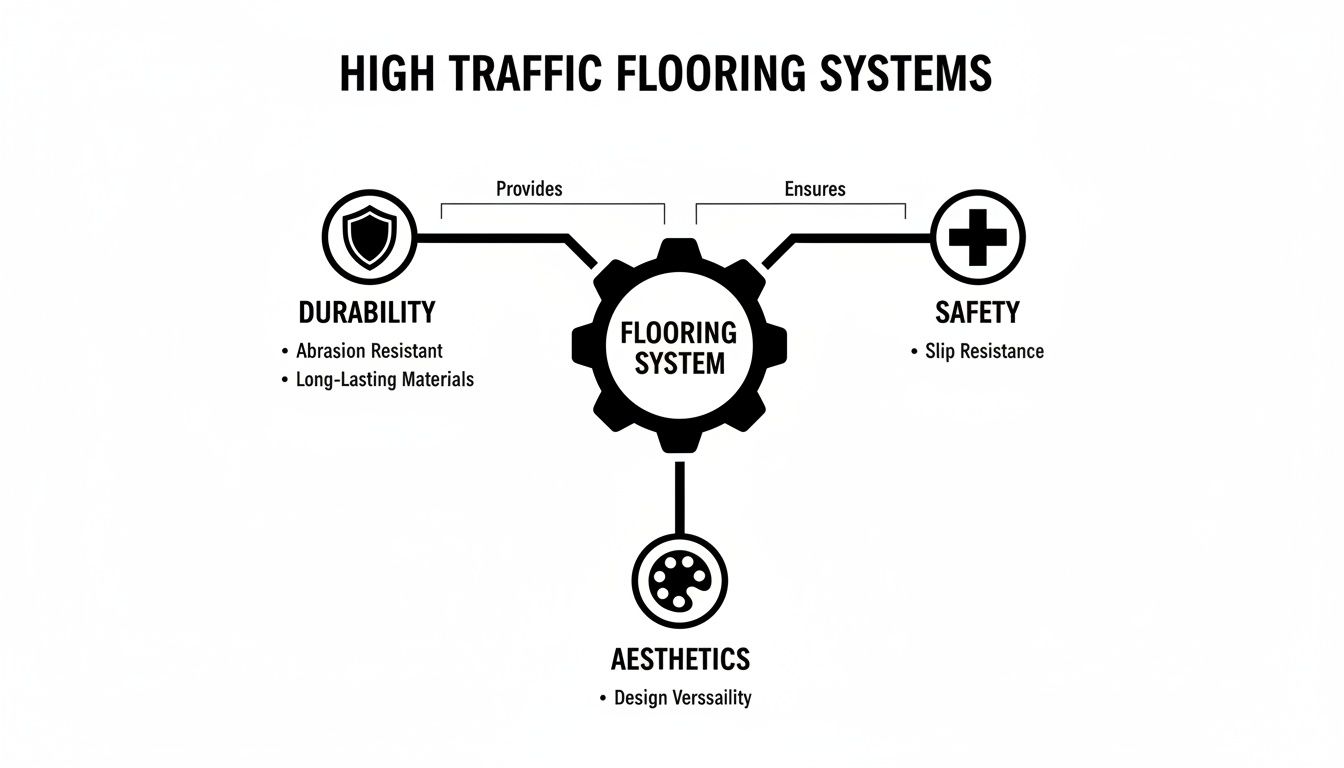
As you can see, durability, safety, and aesthetics aren’t separate goals—they’re interlocking gears. When one fails, the whole system grinds to a halt.
Decoding Slip Resistance and Safety
Nothing torpedoes a great project faster than a safety issue. For flooring, that means slip resistance is non-negotiable, especially in any commercial space that might get wet.
The number you need to know is the Dynamic Coefficient of Friction (DCOF). This test simulates a real-world slip by measuring friction while an object is already in motion. The industry standard, ANSI A326.3, mandates a DCOF value of ≥0.42 for level interior spaces expected to be walked on when wet.
Specifying materials that meet or exceed the DCOF AcuTest® value of 0.42 isn’t just a best practice; it’s your frontline defense against slip-and-fall liability. This single metric is one of the most powerful tools for ensuring a safe, compliant environment.
Understanding Wear Resistance and Graceful Aging
How a floor wears over time is just as important as how it looks on day one. For most ceramic and porcelain tiles, the PEI (Porcelain Enamel Institute) rating is the go-to indicator for abrasion resistance.
- PEI 1-2: Best for light residential traffic only (think bathroom walls).
- PEI 3: Good for most residential floors and light commercial use.
- PEI 4: Recommended for moderate to heavy commercial traffic.
- PEI 5: Built for the toughest jobs—airports, malls, and busy hotel lobbies.
But some of the most durable materials don’t rely on a printed surface layer at all. Materials like handmade cement tile feature a through-body construction, where the color and pattern are an integral part of the tile itself—often a quarter-inch thick.
This leads to a concept we call “graceful aging.” Instead of a printed pattern wearing off to reveal a different-colored core, these materials develop a rich, natural patina. Like well-worn leather or aged stone, they gain character with use, ensuring the design integrity remains for the life of the building.
Beyond the Basics: Acoustic and Fire Ratings
A truly professional spec considers how the flooring impacts the entire building environment, from acoustics to fire safety. You’ll find these critical ratings on the tech data sheet, too.
Acoustic Ratings:
- Impact Insulation Class (IIC): This measures how well a floor/ceiling assembly absorbs impact sounds like footsteps. A higher IIC number means better sound insulation—and happier downstairs neighbors.
- Sound Transmission Class (STC): This tells you how well the floor assembly blocks airborne sounds, like voices or music.
Fire Safety:
Look for compliance with ASTM E648 (Critical Radiant Flux), which tests a flooring material’s tendency to spread flames. Materials are rated as either Class 1 (most flame-resistant) or Class 2. Always double-check that your chosen material meets the specific fire codes for your project’s occupancy type.
Comparing the Top Materials for Demanding Spaces
Choosing the right flooring for a high-traffic commercial space is a huge decision. It’s a careful balance between toughness, upkeep, looks, and what it’s going to cost over the long haul. Every material has its own strengths, and the best pick really depends on the unique pressures of the environment you’re designing.
So, let’s put the most common options under the microscope.
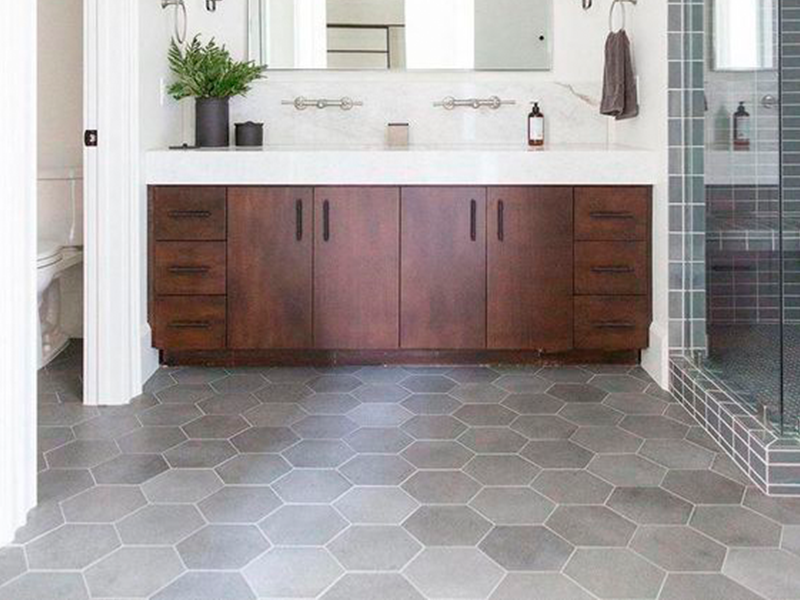
We’re going beyond the surface-level sales pitch to give you the practical insights specifiers actually need. We’ll size up each contender based on what truly matters for performance and keeping clients happy for years to come.
To get started, here’s a quick comparison of the materials we’ll be diving into.
High Traffic Commercial Flooring Material Comparison
| Material | Durability & Lifespan | Maintenance Needs | Design Versatility | Ideal Applications |
|---|---|---|---|---|
| Porcelain Tile | Excellent; highly resistant to wear, scratches, and stains. PEI 5 rated. | Low; easy to clean surface. Grout lines require sealing and regular care. | High; vast range of colors, sizes, and finishes (stone, wood looks). | Airports, malls, lobbies, healthcare, food service. |
| LVT | Good to Very Good; tough wear layer resists scuffs. Can be gouged. | Low; simple daily cleaning. No sealing required. | Very High; convincingly mimics natural materials like wood and stone. | Retail, corporate offices, hospitality, healthcare. |
| Terrazzo | Exceptional; can last the lifetime of the building. Extremely durable. | Low to Moderate; requires periodic polishing to maintain sheen. | Very High; custom colors, aggregates, and patterns are nearly limitless. | Airports, institutions, luxury retail, lobbies. |
| Rubber Flooring | Excellent; highly resilient to impact and heavy loads. | Low; easy to clean, naturally antimicrobial. Can be stained by oils. | Moderate; primarily solid colors or subtle flecked patterns. | Gyms, healthcare, schools, play areas. |
| Handmade Cement Tile | Exceptional; through-body color hides wear and develops a patina. | Moderate; requires initial sealing and periodic resealing with pH-neutral cleaners. | Exceptional; endless custom patterns and a rich, saturated color palette. | Boutique retail, restaurants, hotels, statement lobbies. |
This table gives you the at-a-glance view, but the real story is in the details. The right choice often comes down to the subtle differences in performance and how a material feels in the space.
Porcelain and Ceramic Tile
Porcelain tile is the undisputed workhorse of the commercial world. It’s prized for being incredibly hard and resistant to just about everything—scratches, stains, and moisture. With a PEI rating of 5, it’s built to handle the constant shuffle of feet in airports and shopping malls without batting an eye. Its non-porous surface is also a huge plus for hygiene, making it a go-to in healthcare and food service.
Ceramic tile is similar, but it’s generally less dense and better suited for moderate commercial traffic. The main headache with both? Grout lines. They need sealing and can be a real pain to keep clean in busy areas. Plus, their surface is completely unforgiving—drop something fragile, and it’s gone.
Luxury Vinyl Tile (LVT)
Luxury Vinyl Tile (LVT) has absolutely exploded in popularity, and for good reason. It hits that sweet spot between resilience and design freedom. It’s built in layers, with a tough wear layer on top that can realistically mimic the look of natural wood, stone, or even abstract designs. This lets you get a specific look without the maintenance baggage of the real thing.
LVT is water-resistant, feels quieter underfoot, and has a little more give than tile, which is a nice bonus for employees who are on their feet all day. But while it’s durable, it can still be scratched or gouged by heavy, sharp objects, and it just doesn’t have the same multi-decade lifespan you’d get from stone or terrazzo.
Terrazzo and Rubber Flooring
Terrazzo is a classic for a reason. It’s a composite material—poured in place or precast—made of marble, quartz, granite, or glass chips set in a binder. The result is famous for its incredible longevity and sleek, seamless look. Once a terrazzo floor is installed and polished, it can easily last the life of the building. That makes it a fantastic sustainable option with a low lifecycle cost, even if the initial investment is high.
Rubber flooring is the champion in spaces where comfort, slip resistance, and sound absorption are the top priorities. You’ll see it everywhere in gyms, hospitals, and schools. While it’s extremely tough and resilient, the design palette is often more limited than LVT or tile, and you have to account for a distinct odor when it’s first installed.
A Special Focus on Handmade Cement Tile
This is where things get interesting. Handmade cement tile carves out its own unique niche, blending artisanal beauty with industrial-grade strength. Unlike ceramic tiles that have a pattern printed on a surface glaze, cement tiles have through-body color. The vibrant patterns are made by pouring pigmented cement into a mold, creating a color layer that can be an eighth of an inch thick.
What does that mean in practice? The pattern can never wear off. Instead of looking worn out, the tile develops a beautiful, natural patina over time, gaining character as it ages. This “graceful aging” is what sets it apart and gives it a timeless quality that printed materials just can’t replicate.
Even better, its incredible density means it can be professionally refinished—honed and resealed just like natural stone. This gives it a generational lifespan, making it a smart long-term investment for hospitality, retail, and corporate spaces that want to make a lasting brand statement. For a space as demanding as a restaurant kitchen, a careful specification is critical. You can learn more in our guide on selecting the right commercial kitchen flooring options.
Why a Flawless Installation Starts with the Substrate
You can specify the toughest, most beautiful high-traffic flooring in the world, but it will fail if the foundation underneath it is garbage. It’s like building a skyscraper on sand; it doesn’t matter how strong the steel is if the base gives way. The exact same principle applies to flooring, which is why the single most critical factor for a lasting installation is the substrate.
A perfectly prepped substrate isn’t just a “best practice”—it’s your best insurance policy against premature failure, frustrating callbacks, and a compromised design. It’s what guarantees the floor you specified actually performs as intended for decades.

This foundational work is what prevents the most common—and costly—flooring catastrophes: cracked tiles, crumbling grout, and delamination, where the flooring literally peels away from the subfloor.
Non-Negotiable Substrate Quality Checks
Before a single tile goes down, that substrate needs to pass a tough inspection. This isn’t the part of the job to rush; it’s the quality control gate that dictates whether the project will be a long-term success or a short-term headache.
Here’s what any pro installer looks for:
- Moisture Vapor Emission Rate (MVER): Using methods like the calcium chloride test, the installer has to confirm moisture vapor levels are within the limits set by the flooring and adhesive manufacturers. Too much moisture coming up through the slab will destroy adhesives and lead to catastrophic failure. It’s a silent killer for floors.
- Structural Deflection: The subfloor has to be rock-solid. The industry standard is typically L/360, which means the floor shouldn’t flex more than its span divided by 360. A bouncy, springy subfloor is a death sentence for tile and grout.
- Surface Flatness: The slab must be flat, period. We’re talking a tolerance of no more than 1/4 inch over a 10-foot span. Any high or low spots will create lippage (those uneven tile edges that trip people up) and hollow voids under the flooring.
Getting this right from the beginning is paramount. The quality of the initial pour, including precision in concrete slab shuttering, sets the stage for everything that follows.
Selecting the Right Installation System
Once the substrate is verified as sound, flat, and dry, the focus shifts to the materials that actually bond the floor to it. This is absolutely not the place to try and save a few bucks. Using the wrong setting materials can completely torpedo an otherwise perfect flooring choice.
The installation system—that’s the combination of mortars, grouts, and sealants—is just as important as the flooring itself. It’s the engine that powers the floor’s performance, and every single component must be compatible and right for the job.
This is especially true for dense, heavy materials like our handmade cement tiles or any large-format porcelain. These tiles demand specific polymer-modified thin-set mortars that deliver a stronger, more flexible bond capable of handling their weight.
Choosing the right underlayment is just as vital for a stable, long-lasting floor. For a much deeper dive on this, check out our guide on choosing the proper underlayment for tile floors.
Finally, you absolutely cannot forget movement joints (or expansion joints). These are planned breaks in the floor that allow the building to naturally expand and contract without causing the tiles to crack or buckle under the pressure. Overlooking them is one of the most common and devastatingly expensive mistakes in the business.
Calculating the True Cost of Your Flooring Investment
The price tag on the box is only the first chapter of your flooring’s financial story. For architects and facility managers, the true cost isn’t what you pay upfront—it’s what you pay over the entire life of the building. Making the switch from initial price to Total Cost of Ownership (TCO) is the key to a smart, durable investment in high-traffic commercial flooring.
This long-term view accounts for every single expense a floor will incur down the road. It’s a comprehensive audit that often reveals how a seemingly “expensive” material can actually be the most cost-effective choice over ten, twenty, or even fifty years.

Breaking Down the Lifecycle Cost
Thinking in terms of TCO is a lot like comparing two cars. One might be cheaper to buy, but if it needs constant repairs and gets terrible gas mileage, it will end up costing you far more than the reliable, efficient model. That exact same logic applies to your flooring specification.
A complete lifecycle cost analysis has a few key parts:
- Acquisition and Installation: This is the initial, most obvious expense. It covers the material itself, substrate prep, setting materials, labor, and finishing.
- Daily Maintenance: This includes the ongoing cost of labor and supplies for routine cleaning, like sweeping, mopping, and auto-scrubbing.
- Periodic Restoration: These are the less frequent but more intensive jobs, like deep cleaning grout, stripping and waxing vinyl, or resealing cement tile.
- Repairs and Replacement: This is the big one. It accounts for the expected lifespan of the material and the eventual cost to tear it out and replace it when it fails or looks too worn.
The Value of Durability and Restoration
This is where the financial equation really shifts. Materials with a lower upfront cost, like some forms of LVT or carpet tile, often have a much shorter lifespan and demand more intensive maintenance. They may need to be completely replaced every 7-10 years in a heavy commercial setting, which means you’re restarting the cost cycle from scratch.
In contrast, materials engineered for longevity, like terrazzo or our handmade cement tile, command a higher initial investment but deliver a dramatically lower lifecycle cost. Their incredible durability minimizes daily wear and tear and pushes the need for replacement far into the future.
Instead of being ripped out, heritage materials like cement tile can be professionally restored. A simple honing and resealing can bring the surface right back to a like-new condition, extending its functional life for decades and avoiding the massive expense and disruption of a full replacement.
Think about a bustling hotel lobby. Replacing the flooring isn’t just a material and labor expense; it means shutting down a revenue-generating space, creating noise and dust, and ruining the guest experience. A floor that can be restored overnight or during off-hours offers immense operational and financial value.
By creating a clear maintenance plan that aligns with your material choice, you protect your client’s investment and ensure the flooring performs as promised for years to come. This long-term perspective is the hallmark of a professional specification—one that delivers value far beyond the initial price tag.
Meeting ADA and Critical Safety Standards
When you’re designing a commercial space, picking a beautiful, durable floor is only half the job. Real success means creating a space that’s safe, accessible for everyone, and completely up to code. For high-traffic areas, that means getting serious about the Americans with Disabilities Act (ADA) and other non-negotiable safety standards.
Think of these rules less as a checklist and more as a promise to ensure equal access and prevent injuries. Getting it wrong can lead to serious legal trouble and expensive fixes down the road, which is why compliance should be on your mind from the very first sketch.
Navigating ADA Flooring Requirements
The ADA lays out clear, enforceable rules for accessible design. When it comes to flooring, the big concerns are eliminating trip hazards, creating smooth transitions between surfaces, and providing enough grip underfoot. A misstep in any of these areas can turn a beautiful floor into a dangerous barrier for people with mobility challenges.
Here are the key ADA criteria you need to know:
- Level Transitions: Changes in floor height have to be almost nonexistent. Any vertical change over 1/4 inch must be beveled. If it’s more than 1/2 inch, you’ll need a ramp.
- Stable and Firm Surfaces: The floor needs to be solid. It has to support wheelchairs and other mobility devices without sinking, shifting, or buckling.
- Slip Resistance: Any surface that’s part of an accessible route has to be slip-resistant to prevent falls, especially in places that might get wet. The DCOF rating is your go-to metric here.
ADA compliance is the floor, not the ceiling. It’s the absolute minimum for an accessible environment. Specifying materials that go well beyond these standards shows a real commitment to universal design and putting people’s safety first.
Achieving a compliant space isn’t just about the tile you choose—it’s about how the material, the substrate prep, and the installation all work together. For instance, a tile with a fantastic slip-resistance rating can still become a hazard if the installer creates lippage—uneven edges between tiles that exceed that critical 1/4-inch threshold. To learn more about how the right material choice helps, check out our guide to anti-slip tile options.
Beyond ADA: Air Quality and Fire Safety
While the ADA is a huge piece of the puzzle, other regulations are just as important for commercial floors. Indoor air quality, for one, is a major factor. Flooring materials—and the glues and sealers used to install them—can release Volatile Organic Compounds (VOCs) into the air. Always look for products with low- or no-VOC certifications like FloorScore® to keep the indoor environment healthy.
Finally, fire safety codes are non-negotiable. They dictate how a floor has to perform when things go wrong. The ASTM E648 Critical Radiant Flux test is the industry standard for measuring a floor’s resistance to spreading flames. Materials get a rating of Class 1 (the most resistant) or Class 2. Making sure your specified flooring meets the right fire code for the building’s use—whether it’s a hospital, a school, or an office—is a crucial part of the job that protects both people and property.
Common Questions About High-Traffic Flooring
Even the most seasoned specifiers run into tricky questions when a project demands serious performance. Let’s tackle a few of the most common ones we hear from architects, designers, and facility managers. The answers help reinforce the core principles: durability, performance, and long-term value.
What Is the Most Durable Type of Commercial Flooring?
That’s the million-dollar question, and the honest answer is: it depends entirely on the kind of traffic.
For spaces facing extreme abrasion and heavy rolling loads—think airports, loading docks, or industrial kitchens—you can’t beat the sheer surface hardness of a PEI 5 rated porcelain tile or a poured-in-place terrazzo. These are engineered to take an absolute beating and not fail.
But there’s another kind of durability. For areas defined by relentless foot traffic where unique aesthetics and generational longevity are the goals, handmade cement tile is in a class of its own. Its color isn’t a top layer; it’s baked deep into the body of the tile. That means the pattern can never wear away. Instead of breaking down, it develops a rich patina over time, much like natural stone, and can even be professionally refinished. Its lifespan isn’t measured in years, but in decades.
How Important Is Subfloor Preparation for Commercial Tile?
Let me be blunt: subfloor preparation isn’t just important; it’s everything. It is, without a doubt, the single most critical factor in a successful commercial tile installation. Think of your flooring as a system—the substrate is its foundation. A bad foundation guarantees failure, no matter how tough the tile is.
An uneven, unstable, or moisture-ridden subfloor will lead to cracked tiles, grout failure, and delamination. It’s not a matter of if, but when. A professional job requires a substrate that is clean, structurally sound, and perfectly flat, meeting the industry standard of no more than 1/4-inch deviation over 10 feet. It also has to be tested for moisture and confirmed to be within acceptable limits before a single tile goes down.
Spending time and money on thorough substrate preparation isn’t an optional line item. It’s the best insurance you can buy against the catastrophic cost and disruption of a flooring failure down the road.
Can Decorative Flooring Be Used in High-Traffic Areas?
Absolutely—as long as it’s the right decorative flooring, specified and maintained correctly. The old idea that you have to sacrifice beauty for brawn is long gone.
Materials like high-quality handmade cement tile are inherently durable. Their dense, hydraulically pressed construction and monolithic, through-body color mean intricate patterns stay vibrant even under constant foot traffic. It’s beauty that’s built to last.
The secret to success comes down to two things. First, a professional sealing at installation is non-negotiable. It’s your shield against staining and moisture. Second, a consistent maintenance plan using simple, pH-neutral cleaners will preserve its integrity for years. This is how businesses embed branding and custom designs directly into their busiest lobbies, restaurants, and retail spaces without compromising on longevity.
Ready to specify a floor that blends artisanal beauty with commercial-grade strength? Explore the endless design possibilities with Original Mission Tile and find the perfect handmade cement tile for your next project.