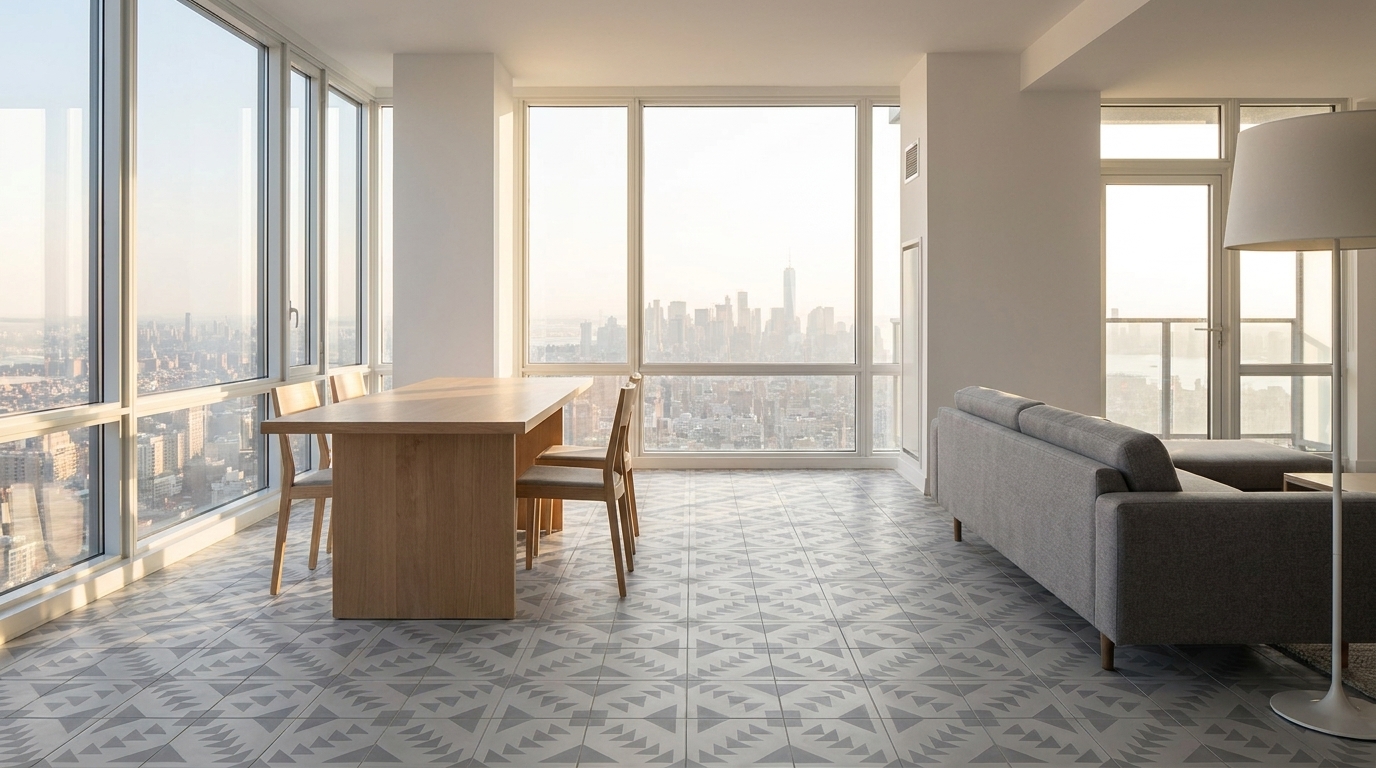
Choosing the right flooring for a commercial kitchen is about so much more than looks—it’s a decision that hits right at the core of safety, hygiene, and how smoothly your operation runs. The top contenders, like classic quarry tile, seamless epoxy resin, and tough commercial-grade vinyl, are all engineered to handle some seriously extreme conditions. These materials aren’t just floors; they’re the foundation of a successful kitchen, striking that critical balance between raw durability and strict safety codes.
Choosing the Foundation for a Safe and Efficient Kitchen

Think of your kitchen floor as the stage for a chaotic, high-stakes performance that happens every single day. It has to endure a relentless storm of challenges—the constant scuff of work boots, the weight of heavy-duty equipment, and the unavoidable spills of hot grease, acidic sauces, and powerful cleaning chemicals. A floor meant for a home would buckle under that kind of pressure in a matter of weeks.
This kind of environment demands a surface built for battle. The right flooring isn’t a passive backdrop; it’s an active player in your kitchen’s success. It needs to provide a stable, safe foundation that keeps your crew moving fast while meeting the health and safety codes that can make or break a business.
The Pillars of Performance
A great kitchen floor is built on four non-negotiable pillars. Get these right, and you have a functional, compliant space. Miss one, and you’ll be paying for it later.
- Durability: Your floor must be able to take a beating. We’re talking dropped pots, rolling carts, and the dead weight of industrial ovens—all without cracking, chipping, or wearing down.
- Slip Resistance: In a world of water, oil, and food spills, a textured, high-friction surface is your first line of defense against the slips and falls that are a leading cause of workplace injuries.
- Sanitation: The surface has to be non-porous. This is huge. It stops bacteria from soaking in and setting up shop. A floor should be seamless or have tight, minimal grout lines to eliminate hiding spots for germs and make deep cleaning actually work.
- Ease of Maintenance: The daily cleaning grind needs to be quick and effective. The floor has to stand up to harsh sanitizers and degreasers day after day without breaking down, so you can keep it hygienic with minimal downtime.
The industry knows how important this is. The global commercial kitchen flooring market was valued at around $2.1 billion in 2023 and is expected to climb past $3.3 billion by 2030, pushed by a growing food service industry and ever-stricter health codes.
Choosing a floor is a long-term investment in your business’s safety and efficiency. The initial cost is only one part of the equation; true value comes from a floor that performs reliably day after day, year after year, with minimal repair and replacement costs.
To get started, it’s essential to have a solid grasp of what’s out there. For a deep dive, this guide on commercial kitchen flooring options is a great resource. It lays out a clear roadmap, helping you navigate the choices to find a floor that delivers on performance, safety, and budget—ensuring your kitchen is built for success from the ground up.
Understanding What Makes a Kitchen Floor Perform
Before we get into the different types of flooring, let’s talk about what actually makes a floor work in a kitchen. Looking at a spec sheet full of acronyms and ratings can feel like reading a foreign language, but those numbers are the secret to knowing how a floor will hold up under real-world pressure. It’s like buying a truck—you need to know what horsepower and towing capacity mean before you can decide if it’ll do the job.
Flooring has its own performance specs for the exact same reason. These aren’t just random numbers; they’re a direct measure of a floor’s ability to survive the daily chaos of a commercial kitchen. Once you understand them, you can cut through the marketing noise and choose based on hard facts.
Decoding Slip Resistance The Coefficient of Friction
The single most important safety number for any kitchen floor is its Coefficient of Friction (COF). Put simply, this is just a measurement of grip. Imagine trying to push a heavy box across an ice rink versus pushing it across a rubber mat. The rubber mat has a much higher COF, meaning it takes more force to get the box moving—that same resistance is what gives your feet traction.
In a kitchen, where floors are constantly slick with water, grease, or dropped food, good grip is non-negotiable. The American National Standards Institute (ANSI) sets the bar here. For any area that can get wet, you need to look for a Dynamic Coefficient of Friction (DCOF) of 0.42 or higher. A floor that meets this standard gives your staff a reliable, safe surface to work on, even when spills happen. To really get a handle on this critical safety feature, you can learn more about how to choose the right anti-slip tile for your space.
Resisting Wear and Tear Abrasion and Impact
A kitchen floor is in a constant battle. Dropped knives, clanking stock pots, and the grinding wheels of heavy carts all take their toll. That’s where abrasion resistance comes in. It’s a measure of how well a floor’s surface stands up to scratching, scuffing, and general grinding wear. A floor with weak abrasion resistance will look dull, tired, and old before its time.
Just as crucial is impact resistance—the floor’s ability to take a hit from a dropped object without chipping, cracking, or denting. A dense, tough material like quarry tile or a properly installed epoxy system is built to absorb these sudden shocks. A softer material, on the other hand, might be permanently scarred by a single accident.
A floor that fails under impact doesn’t just look bad; it creates a serious health risk. Cracks and chips become perfect hiding spots for bacteria, undermining all the hard work you put into sanitation.
Surviving Extreme Temperatures and Chemicals
Kitchens are all about temperature extremes. One minute, you’re mopping with scalding water near a fryer; the next, you’re rolling a cart into a walk-in freezer. These rapid swings cause flooring to expand and contract, which can lead to cracks or delamination—a failure known as thermal shock. A solid kitchen floor has to be engineered to handle these shifts without falling apart.
Finally, there’s chemical resistance. This is the floor’s ability to shrug off daily exposure to everything from acidic tomato sauce and vinegar to industrial-strength degreasers and sanitizers. Many common foods and cleaning agents can literally eat away at a floor’s surface or leave permanent stains. Choosing a non-porous and chemically tough material ensures your floor will keep its integrity and good looks, even after years of aggressive cleaning.
Comparing the Top Commercial Kitchen Flooring Materials
Now that you can read a spec sheet like a pro, let’s talk about what works in the real world. Choosing the right commercial kitchen floor means understanding the personality of each material—its strengths, its weaknesses, and where it truly shines.
We’re going to look at the industry workhorses: classic Quarry Tile, seamless Epoxy, versatile Commercial Vinyl, and minimalist Concrete. We’ll also put a spotlight on an artisan option making waves in high-end, open kitchens: Handmade Cement Tiles.
This isn’t just a list; it’s a head-to-head comparison to see which floor fits your kitchen’s unique demands.
To get started, it helps to see how the three core pillars of floor performance are connected.

This map shows how safety, resilience, and cleanliness all depend on each other. A great kitchen floor has to nail all three.
At-a-Glance Comparison of Commercial Kitchen Flooring Materials
This table offers a quick summary of the most popular flooring options, letting you compare the critical factors at a glance before we dive deeper into each one.
| Material Type | Durability Rating | Slip Resistance | Maintenance Level | Typical Lifespan | Best For |
|---|---|---|---|---|---|
| Quarry Tile | Excellent | Excellent | High (Grout) | 30+ years | High-heat cook lines, traditional kitchens |
| Epoxy Resin | Excellent | Customizable | Low | 15-20 years | High-volume kitchens, food processing |
| Commercial Vinyl | Good | Good | Low | 10-15 years | Prep areas, server stations, budget-conscious |
| Polished Concrete | Very Good | Fair to Good | Low | 50+ years | Modern aesthetics, existing slabs |
| Handmade Cement | Excellent | Excellent | Medium | 50+ years | Open kitchens, design-forward concepts |
Each material has its place, but the devil is always in the details. Let’s break down the pros and cons you’ll actually face on the job.
Quarry Tile: The Time-Tested Classic
Quarry tile is the undisputed veteran of the commercial kitchen. Made from hard-fired clay, it’s incredibly dense and naturally durable. Think of it as the cast-iron skillet of flooring—heavy, tough, and built to last for decades with just basic care.
Its unglazed, slightly rough surface gives it fantastic natural slip resistance, which is a big reason it’s been a go-to for so long. It also handles extreme heat like a champ, making it a safe bet around ovens and fry stations.
But here’s the catch: the grout. While the tiles themselves are nearly bulletproof, the grout lines can soak up grease and become a breeding ground for bacteria if they aren’t sealed meticulously and regularly. Diligent maintenance is non-negotiable.
Epoxy Resin: The Seamless Protector
Epoxy isn’t a tile you lay down; it’s a surface you create right on site. It’s a two-part system—a resin and a hardener—that gets poured over a concrete subfloor. What you get is a completely seamless, non-porous, and incredibly tough floor.
That seamless quality is its biggest selling point. With nowhere for bacteria, grease, or moisture to hide, epoxy floors are a dream to clean and sanitize. They’re also highly resistant to just about any chemical you can throw at them, from acidic spills to harsh industrial cleaners.
To get the right grip, aggregates like quartz or sand are broadcast into the topcoat while it’s wet, creating a customized texture. The main drawback? Installation is tricky. The subfloor has to be perfectly prepped, and you need a skilled pro to apply it.
A poorly installed epoxy floor can delaminate or bubble, leading to hugely expensive repairs. But when it’s done right, it’s one of the most durable and hygienic floors you can get.
Commercial Vinyl: The Resilient Performer
Forget the flimsy vinyl sheets of the past. Today’s commercial options, especially Luxury Vinyl Tile (LVT) and heavy-duty sheet vinyl, are engineered for high-traffic punishment. They offer a bit of cushioning underfoot, which your staff’s backs and knees will thank you for after a long shift.
Commercial-grade vinyl is highly resistant to water and stains, and its seams can be heat-welded to create a nearly waterproof surface. It also comes in a huge variety of looks, from realistic wood grains to simple solid colors, giving you more aesthetic flexibility than old-school quarry tile.
While it’s tough, it is more susceptible to punctures from dropped knives or damage from heavy rolling carts compared to tile or epoxy. It’s a great choice for prep areas or server stations but might not hold up to the intense abuse of a hot cooking line.
Polished Concrete: The Industrial Minimalist
For that modern, industrial vibe, polished concrete is a really compelling option. The process involves grinding an existing concrete slab with progressively finer diamond pads to get a smooth, high-gloss finish. A chemical densifier is then applied, which hardens the surface and makes it less porous.
When sealed properly, polished concrete is extremely durable and a breeze to clean with just a mop and neutral cleaner. It’s also one of the most cost-effective choices if you already have a suitable concrete slab to work with.
However, slip resistance can be a serious concern, especially when it’s wet. Achieving the right finish requires specialized contractors. And it offers zero cushioning, making it one of the hardest and most fatiguing surfaces to stand on all day.
Handmade Cement Tile: The Design-Forward Powerhouse
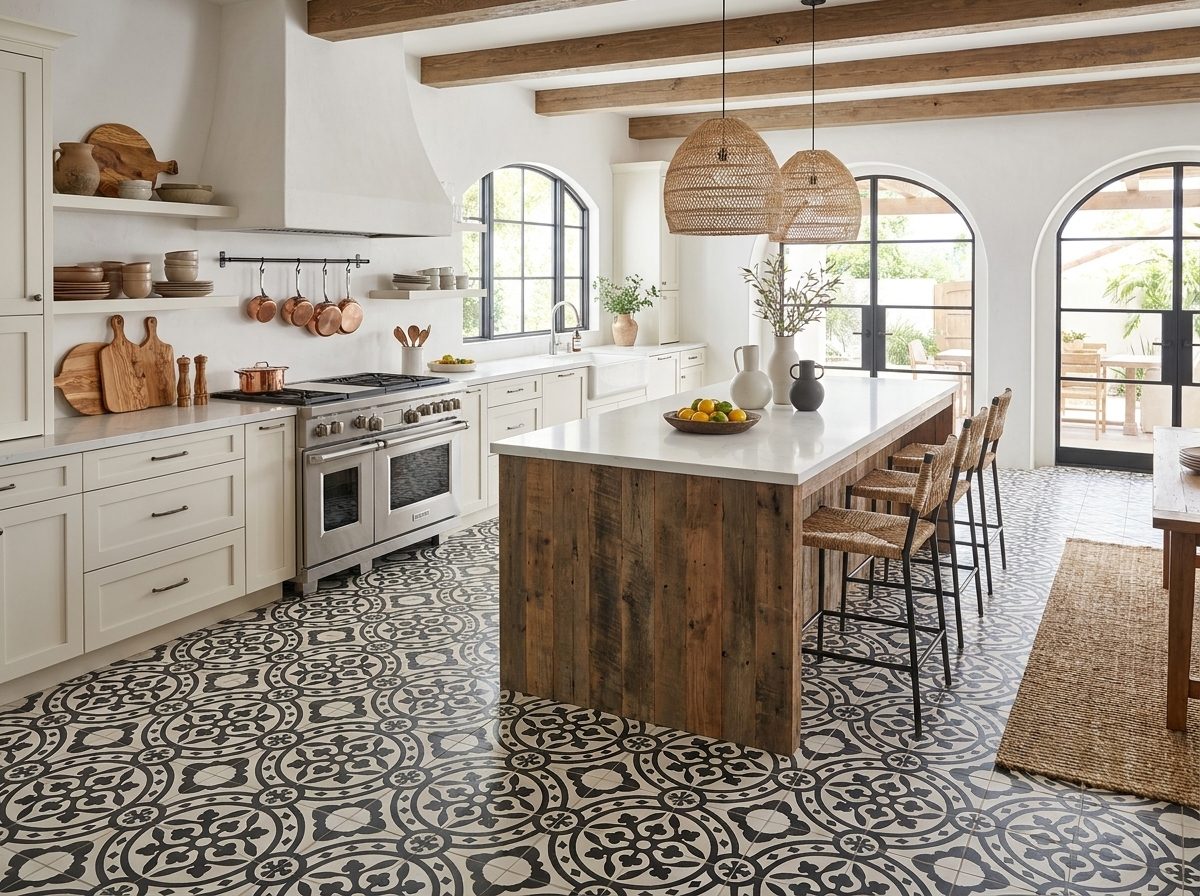
In open kitchens or restaurants where the look is just as important as the performance, handmade cement tiles offer a unique blend of beauty and brawn. Unlike ceramic tiles, the color isn’t a glaze sitting on the surface; it’s an integral part of the tile itself, made by pouring pigmented cement into a mold.
This through-body color means the pattern will never chip, fade, or wear away, even under relentless foot traffic. The hydraulic pressing process creates an incredibly dense and durable tile. Once it’s sealed correctly, it becomes non-porous and stands up to stains and water just like any other high-performance material.
Plus, its natural silky, matte finish provides inherent slip resistance without needing abrasive additives. For those looking to make a statement, there are endless cement tile designs by style to fit any concept. While it’s a higher upfront investment, handmade cement tile delivers a premium, long-lasting surface that makes a powerful design statement without skimping on kitchen-grade durability.
Meeting Health Codes and Sanitation Standards
A commercial kitchen floor that looks clean isn’t good enough—it has to be verifiably sanitary to pass health and safety inspections. This isn’t just a goal; it’s the absolute baseline for staying in business. Failing an inspection because of your flooring can get you shut down, making this one of the most critical decisions you’ll make.
Regulatory bodies like the FDA and local health departments have very clear rules about what makes a floor acceptable. These aren’t suggestions. They’re legally enforceable standards designed to stop foodborne pathogens from growing and spreading, keeping both your staff and customers safe.
The core idea is simple: the floor must be a continuous, non-absorbent, and easily cleanable surface. That means zero cracks, seams, or pores where water, grease, and bacteria can hide and multiply.
The Non-Porous Surface Requirement
The single most important rule for a health-code-compliant floor is that it must be non-porous. Think of a porous material like a sponge. When something spills, the liquid soaks deep inside, making it impossible to truly sanitize. Bacteria love these hidden pockets and will thrive there, creating a serious health risk.
This is exactly why materials like unsealed concrete or wood are strictly forbidden in a commercial kitchen setting. Instead, regulations demand surfaces that liquids simply can’t penetrate.
- Epoxy Resin: This creates a totally seamless and impermeable surface. There’s literally nowhere for germs to hide.
- Quarry Tile: While the tiles themselves are non-porous, the grout lines are a potential weak spot. You must use an epoxy or urethane grout to seal them up and meet standards.
- Commercial Vinyl: When the seams in sheet vinyl are heat-welded, they form a continuous, waterproof barrier that’s a breeze to sanitize.
- Sealed Cement Tile: Dense, handmade cement tiles become non-porous and perfectly suitable for commercial use once they’re properly sealed.
This non-absorbent quality is your first and best line of defense in maintaining a truly hygienic kitchen.
Eliminating Germ Hideouts with Coving and Drains
Even with a perfect floor surface, the spots where the floor meets walls and drains can quickly become sanitation nightmares. Health codes are very specific about these transition points to eliminate any potential dirt traps.
The joint where the floor meets the wall is a classic problem. A sharp 90-degree angle is tough to clean properly, allowing grime and bacteria to build up in the corner. That’s why health codes often require a coved base.
A coved base is a seamless, curved transition where the flooring material continues up the wall for several inches. This eliminates the sharp corner, making it simple to mop and sanitize the entire area without leaving any residue behind.
Proper drainage is the other piece of the puzzle. Standing water is not only a slip hazard but also a breeding ground for bacteria. Your kitchen needs an effective drainage system, which includes floors that are correctly sloped toward grated drains. For a detailed breakdown, it’s smart to review the commercial kitchen floor drain requirements to ensure your setup is fully compliant from the start.
Passing Inspections and Creating a Culture of Safety
Meeting health codes isn’t about checking a box for an inspector. It’s about building a fundamentally safe and clean environment from the ground up. A floor that’s designed for sanitation makes daily cleaning faster and more effective, which cuts down on labor costs and minimizes the risk of cross-contamination.
When you’re choosing your flooring, always ask the supplier for documentation showing that the material meets local health department and NSF International standards. This is your proof that you’re investing in a product that’s not just durable, but also engineered to keep your kitchen compliant and your customers safe. Taking this proactive approach protects your business, your team, and your hard-earned reputation.
Smart Installation and Long-Term Maintenance Strategies

Choosing the perfect flooring material is a huge step, but it’s really only half the battle. Even the toughest commercial kitchen floor will fail if the installation is botched or the maintenance plan is an afterthought. Your floor is a major investment, and protecting it means getting the install right from day one and sticking to a smart care routine.
Think of it like building a house. A weak foundation guarantees problems down the road, no matter how strong the walls are. For your floor, that foundation is the subfloor, and its preparation is the single most important part of any professional installation.
Setting the Stage for Success: The Installation Process
A great installation isn’t about speed; it’s about precision. Cutting corners here is a recipe for expensive repairs and shutdowns you can’t afford.
Before a single tile or drop of epoxy goes down, the concrete subfloor needs meticulous prep. That means it must be perfectly clean, level, and dry. Moisture vapor transmission is a silent killer of commercial floors—when trapped moisture escapes from the concrete, it can destroy adhesives, causing tiles to pop loose or epoxy to bubble. A pro installer will always run a moisture test to make sure the slab is ready.
Once the subfloor is stable and dry, it’s all about using the right materials for the job.
- Adhesives and Mortars: This is not the place to save a few bucks. Using a high-quality, manufacturer-recommended adhesive is non-negotiable. For tile, a robust mortar creates a solid bond that won’t crack under heavy rolling carts.
- Grout: In a tiled kitchen, upgrading to epoxy or urethane grout from standard cement grout is a game-changer. It creates a waterproof, stain-proof barrier that keeps bacteria from finding a home in your grout lines.
- Sealing: For porous surfaces like concrete or handmade cement tiles, the initial sealing is critical. Multiple coats of a high-quality penetrating sealer create an impermeable shield against stains and moisture damage.
A professional installation is an investment in longevity. The shortcuts a cut-rate installer might take—like skimping on subfloor prep or using the wrong adhesive—will almost certainly lead to flooring failure within a few years.
Your Long-Term Maintenance Playbook
With your floor installed correctly, the focus shifts to a consistent maintenance routine. The goal here is simple: prevent small issues from turning into major headaches. Daily cleaning is a must for sanitation and safety, but your approach has to be tailored to your specific flooring material.
One universal rule? Ditch the harsh cleaners. Instead, use a pH-neutral cleaner for daily mopping. These gentle formulas cut through grease and grime effectively without slowly eating away at your floor’s surface or protective sealant. Aggressive, high-alkaline chemicals will strip sealants and can even etch the flooring itself, making it vulnerable to stains and wear.
A proactive schedule makes all the difference in extending your floor’s life.
- Daily Routine: Always sweep first to get rid of loose debris, then mop using a pH-neutral degreaser. Wipe up spills the second they happen to prevent stains and slip hazards.
- Weekly Deep Clean: Use an auto-scrubber or a deck brush to get into grout lines and textured surfaces where grime loves to build up.
- Periodic Re-Sealing: For floors like polished concrete and cement tile, re-sealing is a must. Depending on foot traffic, you’ll likely need to re-apply a top-quality sealer every 1-3 years to maintain that non-porous shield.
By treating installation and maintenance with the seriousness they deserve, you ensure your floor performs exactly as it should for its entire lifespan—protecting your staff, your customers, and your bottom line.
How to Choose the Right Floor for Your Kitchen
Alright, let’s bring it all together. Choosing the right commercial kitchen floor isn’t just about picking a material—it’s about matching that material to the reality of your daily grind and your long-term business goals. This is where we filter all the technical specs through the lens of your unique kitchen.
First, get brutally honest about your operation. A ghost kitchen hammering out orders 24/7 has entirely different flooring needs than a boutique cafe with a polished open kitchen. Think about your real-world foot traffic, the intensity of your cooking (are you sloshing fryer oil or plating delicate pastries?), and even the skill level of your cleaning crew. This quick audit will tell you which specs—like impact resistance versus stain resistance—should be at the top of your list.
Creating Your Final Checklist
To nail this decision, you need to ask a few critical questions. Your answers will create a clear profile of the perfect floor for your space, cutting through the noise.
- What’s my real budget? Don’t just look at the price per square foot. You have to factor in professional installation, any subfloor prep that’s needed, and the cost of specialized sealants or grouts. The sticker price is just the beginning.
- What’s the lifetime value? A cheap floor that you have to rip out in five years is the most expensive mistake you can make. Compare the upfront cost against the expected lifespan and ongoing maintenance to see the true long-term investment.
- How much do aesthetics matter? In an open kitchen, the floor is a massive part of your brand’s story. For these spaces, investing in a design-forward material isn’t an indulgence; it’s a tool for enhancing the customer experience. If you need some inspiration, check out these stunning restaurant interior design ideas to see how a floor can define an entire concept.
Your floor is a strategic asset, not just a building material. The right choice enhances safety, boosts staff efficiency, and reinforces your brand’s commitment to quality and cleanliness.
Ultimately, the best floor is one that solves more problems than it creates. By weighing performance, cost, and design with a clear head, you can pick a surface that will be a silent, reliable partner in your kitchen’s success for years to come. It’s about building your culinary operation on a foundation of true durability and smart planning.
Common Questions, Answered
When you’re spec’ing a kitchen floor, a few key questions always come up. Here are the straight-up answers we give designers, builders, and restaurant owners every day.
What Is the Most Durable Commercial Kitchen Flooring?
If you’re talking about pure, brute-force durability, the industry workhorses are still quarry tile and a professionally installed epoxy resin system. Both can take a beating from heavy foot traffic, rolling carts, and dropped equipment day in and day out.
But when high-end design is just as important as performance, handmade cement tiles are in a class of their own. Because their vibrant color is part of the tile’s body—not just a thin layer on top—the pattern literally can’t chip, fade, or wear away. It’s beauty that’s built to last.
How Do I Make Sure My Kitchen Floor Isn’t Slippery?
Safety starts with a high dynamic coefficient of friction (DCOF) rating. You’re looking for a floor with a DCOF of 0.42 or higher, which is the industry benchmark for surfaces that are frequently wet.
Materials like quarry tile and our handmade cement tiles have a natural, matte texture that gives you great grip right out of the box. If you’re going with epoxy or vinyl, ask for an aggregate additive like quartz. It’s broadcast into the topcoat to create a gritty, reliable anti-slip finish. But remember, even the best floor needs to be clean.
A floor’s slip resistance is only as good as its cleaning protocol. A daily degreasing routine isn’t just a suggestion—it’s a non-negotiable part of keeping your team safe and letting the floor’s texture do its job.
Are Cement Tiles a Practical Choice for a Busy Kitchen?
Absolutely. In fact, high-quality handmade cement tiles are an exceptional choice for demanding kitchens, especially in open-concept restaurants where the floor is part of the customer experience. The hydraulic pressing process creates an incredibly dense, tough tile that was born for heavy traffic.
Once properly sealed, they become completely non-porous, standing up to stains and water damage without issue. Their naturally silky, matte finish provides fantastic slip resistance without feeling rough underfoot, making them a sophisticated choice that perfectly merges elite performance with almost limitless design freedom.
Ready to combine world-class durability with a stunning, custom design? Explore the handmade cement tile collections at Original Mission Tile and find the perfect foundation for your commercial kitchen. Discover your options today!