When it comes to installing terrazzo floors, you’re looking at two main paths: the traditional, seamless poured-in-place method or the more modern, accessible tile method. Your choice here is a big deal—it will set the tone for your project's budget, timeline, and whether this is a job you can tackle yourself or one best left to the pros.
Getting this first decision right is half the battle.
Choosing Your Terrazzo Installation Method
Deciding between poured terrazzo and terrazzo tiles is the first major fork in the road. Each option comes with its own set of pros and cons, and matching your project’s goals to the right material is absolutely essential for a successful outcome. This isn't just about looks; it's a commitment to a specific process, cost, and level of complexity.

Poured-in-Place: A Seamless and Custom Finish
This is the classic, old-world approach. Poured-in-place terrazzo creates a completely continuous, grout-free surface. The process involves mixing a binder (typically epoxy or cement) with aggregates like marble, glass, or granite chips and pouring the mixture right onto the subfloor.
The real beauty of this method is the total design freedom it offers. You can create intricate patterns, custom color blends, and even embed logos directly into the floor. Because it’s so bespoke and requires specialized labor for grinding and polishing, it’s the premium choice for high-end homes and large commercial spaces like airports, museums, and galleries.
This is an investment in unparalleled durability and design potential. A poured terrazzo floor often outlasts the building it's in, making its higher initial cost a smart long-term value.
This method’s growing appeal is a key reason the global terrazzo flooring market hit USD 31.26 billion in 2024 and is projected to reach USD 55.08 billion by 2034. The demand in North America for beautiful, long-lasting flooring in institutional and commercial buildings is a huge factor. You can dig into more data on these market trends and their regional impact.
Terrazzo Tiles: Practicality and Accessibility
For homeowners and smaller-scale commercial projects, terrazzo tiles deliver that iconic speckled look with a far more straightforward installation. Products like our tiles at Original Mission Tile give you the beauty of terrazzo in a pre-made, modular format.
The installation process is very similar to setting standard ceramic or cement tile, which makes it a manageable project for an experienced DIYer or a general tile contractor. You’ll have grout lines, of course, so it's not a truly seamless look. But the trade-off is a significant savings in labor costs and time.
This approach is a perfect fit for:
- Residential Spaces: Kitchens, bathrooms, and entryways where the scale doesn’t justify a full poured application.
- Budget-Conscious Projects: Tiles bring the terrazzo aesthetic to the table at a much more accessible price point.
- Faster Timelines: Installation is quicker because there’s no on-site pouring, curing, or extensive grinding required.
So, which is right for you? It really comes down to balancing your ultimate vision with your practical resources.
Poured Terrazzo vs. Terrazzo Tiles At a Glance
To make the choice even clearer, here’s a quick side-by-side comparison. Use this table to see how each option stacks up against the factors that matter most to your project.
| Feature | Poured-in-Place Terrazzo | Terrazzo Tiles (e.g., Original Mission Tile) |
|---|---|---|
| Look & Feel | Completely seamless, grout-free, monolithic appearance. | Modular look with visible grout lines between each tile. |
| Customization | Infinite. Custom colors, patterns, and embedded logos. | Limited to available tile designs, colors, and sizes. |
| Installation | Highly complex. Requires specialized artisans and equipment. | Standard tile setting. DIY-friendly for skilled individuals. |
| Cost | Premium. Higher material and labor costs. | More affordable. Lower labor costs and accessible material price. |
| Timeline | Lengthy. Involves pouring, curing, grinding, and polishing stages. | Fast. Similar timeline to any other tile installation. |
| Best For | Large commercial spaces, luxury homes, and custom artistic floors. | Residential projects, smaller commercial spaces, and budget-driven designs. |
Ultimately, whether you choose the artistry of poured-in-place or the practical beauty of terrazzo tiles, both paths lead to a durable, stylish, and timeless floor. The key is picking the one that aligns with your specific needs from day one.
Critical Subfloor Prep for a Flawless Finish
The beautiful, durable surface of a terrazzo floor is only as good as the foundation it’s sitting on. Think of the subfloor as the unsung hero of your installation. If it has flaws, I guarantee those issues will telegraph right through to your finished floor, causing cracks, delamination, or an uneven surface.
Let me be blunt: this preparatory phase is, without question, the most important part of installing terrazzo. Skipping or rushing these steps is a recipe for disaster. Whether you're starting with a concrete slab or a wooden subfloor, the goals are the same: get it clean, flat, stable, and dry.
Assessing Your Existing Subfloor
Before you even think about mixing mortar, you need to become a subfloor detective. Your first job is to thoroughly inspect what you're up against to understand the scope of the work.
For a concrete slab, here’s what to look for:
- Cracks: Are they hairline fractures, or are they wider, structural cracks? Each requires a totally different repair approach.
- High and Low Spots: Grab a long straightedge or a laser level to hunt down uneven areas. A terrazzo floor demands a nearly perfect surface, typically within a 1/8 inch tolerance over 10 feet.
- Surface Contamination: Old paint, drywall mud, grease, or oil—it all has to go. These contaminants will kill the bond between your primers, mortars, and the slab.
For a wooden subfloor, the concerns are a bit different. Check for:
- Flex and Deflection: Walk across the entire floor. Does it bounce or feel spongy anywhere? Terrazzo, especially in tile form, is rigid. It will absolutely crack if the subfloor moves too much.
- Damaged or Water-Stained Plywood: Any compromised sections need to be cut out and replaced with new, exterior-grade plywood. No exceptions.
- Seams and Gaps: The joints between plywood sheets must be addressed to create a smooth, monolithic surface ready for the terrazzo system.
The Critical Role of Moisture Testing
Moisture is the number one enemy of any flooring installation, period. Excess moisture vapor rising through a concrete slab will break down adhesives and epoxy binders, causing the terrazzo to fail spectacularly over time. This step is non-negotiable.
You can use a calcium chloride test or a digital moisture meter to get a solid reading. For most epoxy terrazzo systems, the moisture vapor emission rate (MVER) shouldn't exceed 3 pounds per 1,000 square feet over 24 hours. It is absolutely crucial that you address moisture issues before installation begins to head off major problems down the line.
If your readings come back too high, you must install a moisture mitigation system or a vapor barrier before proceeding.
Don’t guess when it comes to moisture. A professional moisture test is a small investment that protects the much larger investment of your entire terrazzo floor. Ignoring this is a costly mistake waiting to happen.
Cleaning and Repairing the Surface
Once you’ve assessed the situation, it’s time to get to work. The subfloor has to be meticulously cleaned. For concrete, this usually means bringing in a mechanical grinder with a diamond-abrasive disc to remove the top layer and any contaminants. This process, often called shot blasting or grinding, aims to achieve a Concrete Surface Profile (CSP) of 2-3, which creates the perfect texture for a strong bond.
Next, fix every imperfection you found.
- Fill Cracks: Use a high-quality epoxy or polyurea crack filler for any non-structural cracks in the concrete.
- Level the Surface: Apply a cement-based self-leveling underlayment to fill low spots and create a perfectly flat plane. You simply pour it on, and it spreads out to create a smooth, level surface as it cures. It's a game-changer.
On wooden subfloors, this stage involves securing any loose panels and applying a leveling compound over the seams. For more in-depth guidance, you can explore strategies for selecting the right floor underlayment for tile to ensure you get maximum stability.
Priming and Final Preparations
The final step before the actual terrazzo goes down is priming. A high-quality epoxy primer does a few critical things: it seals the porous concrete to prevent outgassing (which causes pinholes in your finish), it dramatically improves the bond of the terrazzo system, and it can even act as another moisture barrier. Apply it evenly with a roller, following the manufacturer's instructions to the letter.
For areas prone to movement or over control joints in the slab, installing a crack isolation membrane is a very wise move. This flexible membrane absorbs minor subfloor movement, preventing it from transferring up to the terrazzo and causing cracks. Think of it as a cheap insurance policy for the longevity of your beautiful new floor.
The Terrazzo Installation Process Unpacked
With your subfloor perfectly prepped, you're ready for the main event—turning raw materials into a functional work of art. The next steps all hinge on one big decision: are you working with a poured-in-place system or setting pre-fabricated terrazzo tiles?
Each path demands its own brand of precision and skill, but both start with the same foundation.

This simple workflow—clean, level, and test moisture—is the non-negotiable bedrock of any successful terrazzo installation. Get this right, and you’ll sidestep future nightmares like cracking or delamination.
Mastering the Poured-in-Place Method
Installing poured terrazzo is a true craft, a delicate dance between artistry and material science. The work begins long before a single drop is poured, starting with the careful placement of metal divider strips.
These strips—usually aluminum, zinc, or brass—aren’t just for looks. They serve a critical structural purpose, acting as control joints that help prevent cracks as the building naturally shifts. They're also what allow artisans to create those crisp, clean color changes you see in complex terrazzo designs.
Once the strips are secured, it's all about mixing the matrix. This is where the floor's personality is born. Whether you're using an epoxy or cement-based binder, getting the ratio of binder to aggregate (marble, glass, shell) just right is everything. The goal is a perfectly homogenous mixture where every chip is evenly distributed.
The market for these materials is huge; the industry was valued at USD 25 billion in 2023 and is projected to hit USD 40.72 billion by 2033. Much of that growth comes from modern epoxy systems, loved for their intense colors and fast cure times. You can dig deeper into these market dynamics in this detailed industry analysis.
But traditional cement-based terrazzo—the kind that inspires our handmade cement tiles at Original Mission Tile—is where you see true custom, artisanal motifs come to life.
With the mix ready, the terrazzo is poured onto the subfloor and spread between the divider strips. Installers use a hand trowel to work the mixture, pressing it down firmly to squeeze out any air pockets and ensure a dense, even layer. The target is a consistent thickness, usually around 3/8 of an inch, with a surface that’s as level as possible before the grinders take over.
Pro Tip: Always trowel from the far corner of the room back toward your exit. Use long, smooth strokes to level the mixture and slightly overfill each section. This gives the grinders just enough extra material to work with to beautifully expose the aggregate.
The Art of Setting Terrazzo Tiles
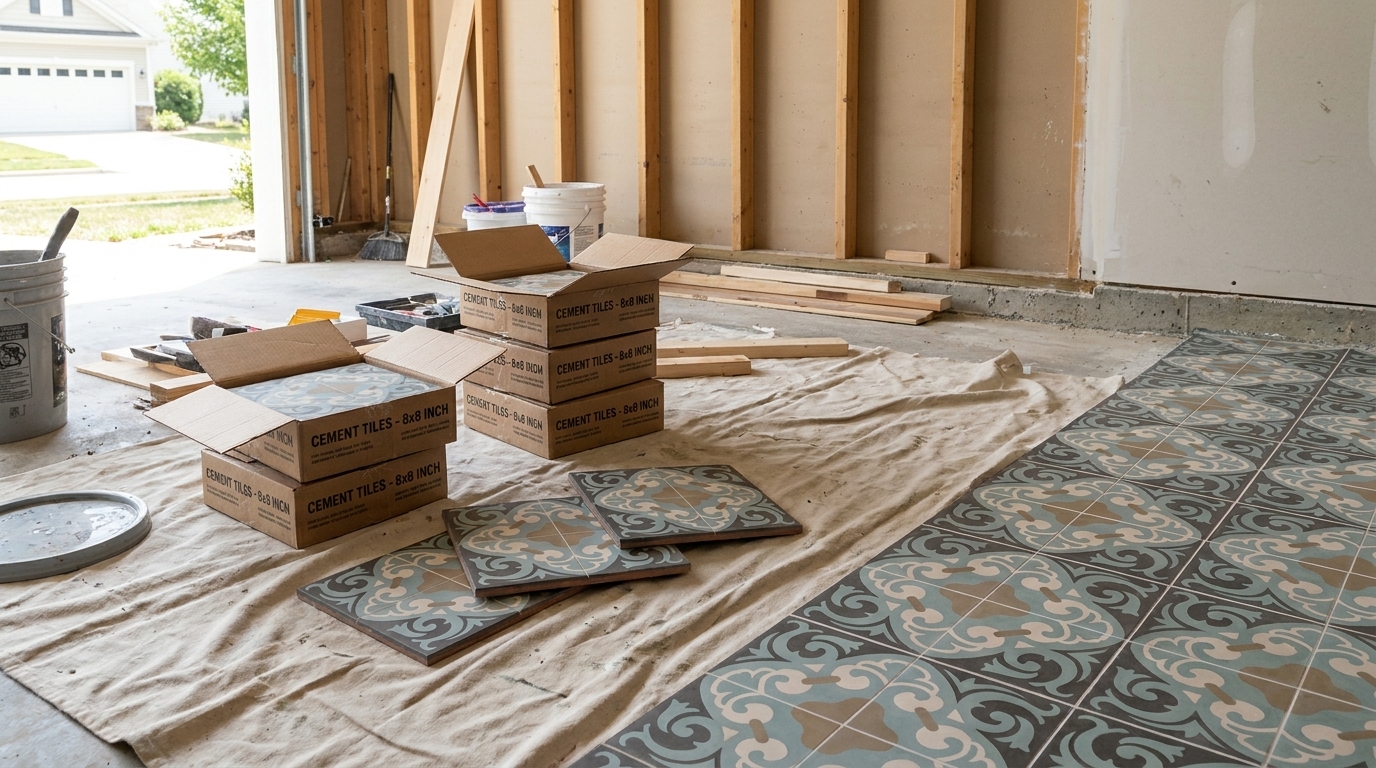
If you've chosen terrazzo tiles, the process will feel much more familiar to anyone with tiling experience. This is a methodical, precise job that rewards careful planning. And it all begins with the layout.
Before you even think about mixing mortar, you need to do a dry layout. Place the tiles on the floor without any adhesive to map out the best starting point and pattern. This is your one chance to avoid ending up with awkward slivers at doorways or in other highly visible spots. Find the room's center, snap some chalk lines, and create a grid to guide your entire installation.
Once you’re happy with the layout, it's time to mix your thin-set mortar.
- Always use a high-quality, polymer-modified thin-set designed for large-format tile.
- Mix it to a creamy, peanut-butter-like consistency that holds its shape on a trowel.
- Let the mortar "slake" (rest) for 5-10 minutes after the initial mix. This lets the chemicals fully activate for maximum bond strength.
Using a notched trowel, spread the thin-set over a small section of the subfloor. The key to a bulletproof installation is "back-buttering" every single tile—that means applying a thin, flat layer of mortar to the back before you set it. This guarantees 100% adhesion and prevents the hollow spots that can lead to cracked tiles down the road.
Press each tile into the mortar with a slight twisting motion to set it firmly. Use tile spacers for perfectly consistent grout lines; it’s a small detail that makes a world of difference in the finished look. Every few tiles, check your work with a level to make sure everything is flat and even.
Dealing with obstacles like corners, pipes, or columns requires patience and the right tools. A wet tile saw with a quality diamond blade is non-negotiable for making clean, precise cuts. The old saying "measure twice, cut once" has never been more relevant than when you're working with beautiful terrazzo tiles. A thoughtful, measured approach is how you achieve a professional-grade finish that truly transforms your space.
Bringing Terrazzo to Life: Grinding, Polishing, and Sealing
Once your terrazzo has fully cured, the real magic happens. This is where we take a rough, matte slab and transform it into the vibrant, glass-smooth surface terrazzo is famous for. This finishing process—a meticulous sequence of grinding, polishing, and sealing—is what unlocks the floor’s beauty, turning a durable installation into a true architectural showpiece.

Honestly, this part is as much art as it is science. It demands heavy-duty planetary grinders, a whole series of diamond-embedded pads, and an experienced hand to guide the machine. You just can't rush this; each step builds on the last to create the final masterpiece.
The First Cut: The Initial Grind
We kick things off with a coarse-grit grind, usually with diamond pads in the 25 to 50-grit range. This first pass is intentionally aggressive. Its job is to shear off the top layer of the terrazzo matrix, slicing right through the aggregates to expose their gorgeous cross-sections.
This step is absolutely critical for a few reasons:
- It exposes the chips: This is what reveals the unique speckled pattern of the marble, glass, or stone aggregates you chose.
- It flattens the surface: Any minor high spots or trowel marks from the pour are ground down, creating a perfectly monolithic plane.
- It preps for grouting: The grind opens up tiny air pockets and voids in the surface, getting it ready for the next crucial step.
Think of it like the rough shaping of a sculpture. It isn’t pretty just yet, but it carves out the perfect form for the detailed work ahead. This stage creates a lot of dust and slurry, so top-notch dust collection is non-negotiable.
Grouting for a Flawless, Pinhole-Free Surface
After that initial grind, the floor has a honed, matte look, but it’s also covered in tiny pinholes. To achieve that completely non-porous, seamless surface terrazzo is known for, we have to grout it.
A matching slurry—made from the same epoxy or cement binder used in the floor—is spread across the entire surface. We use a squeegee or trowel to force the material deep into every pinhole and fill every last void. This step ensures there are no little pockets for dirt or bacteria to hide, a key reason terrazzo is a top choice for hospitals and schools.
Once the grout cures, we fire up the grinders again, this time with a medium-grit diamond pad (around 100-grit). This pass removes the excess grout from the surface, leaving it only where it belongs: deep inside the pinholes.
This grouting step is the secret to terrazzo's legendary hygiene and low-maintenance profile. By creating a truly sealed surface from within, you ensure the floor is incredibly easy to clean and resistant to staining for decades.
The Polishing Progression: From Honed to High-Gloss
With the surface perfectly flat and filled, the real polishing can start. It's a gradual process of refinement, working through progressively finer diamond grits. Just like sanding a piece of fine wood, each pass removes the scratches left by the previous, coarser grit.
A typical grit progression looks something like this:
- 200 Grit: Smooths the surface further and starts to bring out a low-sheen luster.
- 400 Grit: The floor begins to reflect light more clearly, and the colors of the aggregates really start to pop.
- 800 Grit: Now you’ve got a distinct semi-gloss, or honed, finish. Many projects stop here for a softer look.
- 1500-3000 Grit: These final passes are all about honing the surface to a mirror-like, high-gloss shine without using any topical coatings.
The final gloss level is a design decision. A 3000-grit finish is absolutely dazzling, but an 800-grit honed finish is often preferred for certain aesthetics or to improve slip resistance in high-traffic areas.
The Final Step: Sealing and Protecting
The very last step is also one of the most important for the floor's long-term health: sealing. Even though the surface is incredibly dense, both cementitious and epoxy terrazzo benefit from a high-quality sealer to guard against stains and abrasion.
The right sealer penetrates the surface to form an invisible shield. This barrier gives you precious time to clean up spills like coffee, wine, or oil before they have a chance to soak in and cause a permanent stain.
You generally have two choices when it comes to sealers:
- Penetrating/Impregnating Sealers: These soak into the terrazzo to protect it from within, all without changing the look of the surface. They’re a fantastic choice for maintaining that natural, polished appearance.
- Topical Sealers (Coatings): These form a protective film on top of the floor. They can add extra gloss and are very durable, but they will need to be periodically stripped and reapplied down the road.
Application is pretty straightforward but requires a careful hand. The sealer is usually applied with a microfiber mop or a low-pressure sprayer in thin, even coats. For a deeper look into protecting your floors, our guide on choosing the right ceramic and stone tile sealers has valuable insights that apply just as well to terrazzo.
With that final coat of sealer applied and cured, your terrazzo floor is officially done—and ready for a lifetime of use.
Long-Term Care and Troubleshooting Common Issues
Your terrazzo floor is down, polished, and sealed. Beautiful. Now the real work begins: preservation. With the right care, a terrazzo floor isn’t just a surface for a decade; it’s a feature that can genuinely last for a century or more. The secret is a consistent, gentle maintenance routine that protects the sealer—and the floor beneath it.
First things first: forget about harsh, abrasive cleaners. The single most important rule for terrazzo care is to stick to a pH-neutral cleaning solution. Anything acidic (like vinegar) or highly alkaline (like ammonia) will slowly eat away at your sealer, leaving the floor vulnerable to stains and etching.
For daily upkeep, a simple damp mop with clean water or a designated neutral cleaner is all you need.
Identifying and Solving Common Problems
Even with a perfect installation, buildings settle and life happens. Knowing what to look for can help you nip minor issues in the bud before they turn into major headaches.
- Dullness or Etching: If the floor loses its luster in high-traffic zones, it's usually due to surface abrasion or using the wrong cleaners. This is almost always fixable with a professional re-polish and seal.
- Hairline Cracks: Small, non-structural cracks can sometimes appear as a building moves. A specialist can fill these with a color-matched epoxy, making them nearly disappear.
- Staining: If a spill gets through a compromised sealer, it can stain the porous matrix below. The key is to address spills immediately. For set-in stains, a professional may need to use a poultice to draw the stain out.
Understanding how to care for terrazzo is a big deal, especially as its popularity soars. The explosive growth in commercial settings—airports, hotels, and boutiques—is built on its reputation for durability. This segment alone is driving the market from USD 33.93 billion in 2024 to a projected USD 56.95 billion by 2035, simply because terrazzo withstands intense foot traffic while offering endless design flexibility. You can find more details about this impressive market growth at Market Research Future.
Your Long-Term Maintenance Plan
A simple schedule is all it takes to keep your terrazzo floor looking brand new. For a home, cleaning weekly with a pH-neutral product is plenty. In a commercial space, you'll want to dust mop daily and damp mop regularly to manage the grit and dirt that can scratch the surface.
The best long-term strategy is always proactive care. Think of the sealer as your floor's first line of defense. Protect it, and it will protect your investment. A professional deep clean and reseal every few years is far more affordable than a full restoration down the line.
This same philosophy applies to other high-quality surfaces. For instance, our guide on cleaning handmade cement tiles also emphasizes gentle, pH-neutral methods to preserve the material's integrity. The principles are universal: protect beautiful, long-lasting flooring by sticking to a simple care routine and addressing small issues quickly. Do that, and your terrazzo will remain a stunning feature for generations.
Your Questions About Installing Terrazzo Floors, Answered
Even after mapping out the entire process, it's totally normal to have a few questions left. A terrazzo floor is a serious investment in your home, and you want to get it right. We've rounded up the questions we hear most often to give you the straight answers you need to plan with confidence.
What’s the Real Cost of a Terrazzo Floor?
The price tag on a terrazzo floor can swing wildly depending on a few things: the type you choose, how complex your design is, and local labor rates. The two main approaches have very different numbers.
Poured-in-Place Terrazzo: This is the top-tier, premium option. Because it demands highly skilled artisans and specialized equipment, you can expect to pay anywhere from $25 to $90 per square foot. If you’re dreaming of intricate patterns with brass divider strips or exotic chips like mother-of-pearl, you’ll be on the higher end of that range.
Terrazzo Tiles: This route is far more accessible. For terrazzo tiles like the ones we craft at Original Mission Tile, materials and installation usually land between $15 and $40 per square foot. You get that timeless terrazzo look without the marathon labor of a poured system.
Can You Install Terrazzo Over Existing Tile?
The short answer is no—and we strongly advise against it. Trying to install a new terrazzo floor directly over old tile is practically a guarantee for failure. The old tile surface creates huge problems for adhesion and just doesn't provide the stable, solid foundation a new floor needs to stay crack-free for years.
For a successful job, every bit of the old tile and its mortar bed has to go. From there, the concrete subfloor needs proper prep—it has to be ground clean, patched, and made perfectly level before any new terrazzo goes down, whether it's poured or tiled.
How Long Does Installation Actually Take?
The project timeline is another spot where the two methods really differ. Poured-in-place terrazzo is a marathon, not a sprint. A typical residential project can easily take one to three weeks from start to finish. That schedule accounts for the essential curing times and the multi-day, multi-step grinding and polishing that gives it that signature gleam.
Installing terrazzo tile is much quicker. You can often get a standard room done in just three to five days, including the subfloor prep, setting the tiles, and grouting.
A key takeaway on timelines: Don't rush the process. Curing and grinding are stages that simply cannot be hurried without compromising the final quality and durability of your floor.
Is This a Good DIY Project?
Whether you can tackle a terrazzo installation yourself comes down entirely to which type you've chosen.
For a handy person with solid tiling experience, installing terrazzo tiles can be a very doable DIY project. If you're already comfortable setting large-format tile, you’ve got the right skills.
Poured-in-place terrazzo, on the other hand, is not a DIY project. It demands incredibly expensive, heavy-duty gear like planetary grinders, a deep understanding of chemical binders, and a true artisan's touch to get a flawless finish. For any poured terrazzo job, hiring a specialized professional is the only way to go.
Ready to bring the timeless beauty of terrazzo into your space? Explore the handcrafted, artisan-quality terrazzo tile collection at Original Mission Tile. Our tiles offer the perfect blend of authentic style and practical installation for your next project.
Discover our full terrazzo collection at https://originalmissiontile.com.