A lot of fireplace projects start the same way. The room feels finished except for the hearth, and that blank surround keeps pulling the eye for the wrong reason. You want something with age, texture, and pattern, but you also need it to hold up to heat, ash, cleaning, and everyday use.
That’s where a moroccan tile fireplace earns its place. Done well, it doesn’t read like a surface treatment. It reads like architecture. The catch is that most inspiration pieces stop at the pretty part. They show glossy handmade tile, a styled mantel, and a warm fire, but they skip the decisions that determine whether the surround still looks good after years of use. Material choice matters. Substrate matters. Joint width matters. Sealer matters even more than is often realized.
The Enduring Allure of a Moroccan Tile Fireplace
A fireplace already acts as the center of gravity in a room. Add Moroccan tile and it takes on a different kind of presence. The surface catches light, frames the fire, and gives even a simple box surround a sense of craft. That’s why these installations work in so many interiors. A restrained room gets depth from the texture. A layered room gets a focal point that can carry pattern without feeling disposable.

The appeal isn’t new. Moroccan tile, known as zellige, originated around 711 AD. By the 14th century, the palette expanded with vibrant green, blue, and yellow hues, enabling complex starbursts and arabesques that symbolized harmony according to Riad Tile’s history of Moroccan tile. That long design lineage is part of why these fireplaces feel grounded rather than trendy.
Why this style still works
Some surfaces look dated once the room around them changes. Moroccan tile usually doesn’t, because it brings a few qualities that age well:
- Pattern with structure keeps the surround decorative without turning chaotic.
- Handmade variation softens the geometry and keeps the installation from looking factory-flat.
- Historic roots give the fireplace a sense of permanence.
- Material depth makes the surround look intentional even when the rest of the room is quiet.
A fireplace is one of the few places where ornament still feels natural. Fire, masonry, and pattern belong together.
The practical side matters just as much as the romance. If you’re designing or building one of these surrounds, the key questions aren’t only color and motif. You need to know which material belongs near heat, which setting methods prevent voids, and how to finish porous tile so soot and residue don’t become permanent. That’s where many otherwise beautiful jobs go wrong.
Beauty only works if the install does
A Moroccan fireplace can be glossy and irregular with traditional zellige, or matte and graphic with handmade cement tile. Both can be excellent choices. Both can also fail if they’re installed like ordinary decorative wall tile.
The best results come from treating the surround as both a design element and a heat-adjacent assembly. That means respecting expansion, choosing the right substrate, and matching grout and sealer to the actual tile body. Get those details right, and the fireplace becomes the part of the room everyone remembers.
Designing Your Signature Fireplace Look
Many find themselves wanting “Moroccan tile” before they know what that should mean on their fireplace. That’s normal. The term covers a wide range of looks, from lustrous handmade squares to bold cement patterns with crisp geometry. The right choice depends less on what’s fashionable and more on how the room already behaves.

Start with the room, not the sample
A maximal room can handle a dense pattern climbing from hearth to mantel. A quieter room often benefits from a simpler field tile with a border or a concentrated panel above the firebox. I’ve seen homeowners fall in love with a complex starburst in the showroom, then realize at home that the mantel, rug, art, and drapery are all competing for the same attention.
A better sequence is to decide what role the fireplace should play.
- Anchor piece if the room needs a clear focal point
- Textural layer if the architecture is already strong
- Color bridge if you need to tie together upholstery, wood, and wall color
- Historic accent if the house wants old-world detail without a full stylistic shift
Three layout approaches that work
Tile rug on the hearth
This approach keeps the surround cleaner and puts the pattern where you can appreciate it up close. It works well in homes where the firebox wall is narrow, or where a mantel shelf and art already create enough activity above.
A tile rug can be bordered in a darker solid, or left as a simple framed field. For cement tile, this is a strong use case because matte surfaces tend to ground the fireplace visually rather than reflect every change in light.
Full surround to the mantel or ceiling
This is the dramatic version. It suits taller rooms, especially if the wall around the fireplace feels underscaled. Repeating pattern over a larger area can be striking, but scale matters. Small-format shapes can look rich and elegant. The same shapes can also look busy if the room is already full of linework.
Practical rule: The larger the tiled area, the more disciplined the pattern should be.
Bordered panel
A bordered panel gives you the old-world character people want from Moroccan design without covering every square inch. It’s a good answer for transitional interiors where you want authenticity but not visual overload. A plain field with a patterned frame also lets you highlight a mantel profile or arch without obscuring it.
Shape changes the whole mood
Tile shape does more work than color in many fireplace projects.
| Shape | Best use | Visual effect |
|---|---|---|
| Square | Full surrounds, stacked layouts, patterned cement fields | Orderly and architectural |
| Arabesque | Statement panels and niche-like surrounds | Romantic and ornamental |
| Hexagon | Contemporary rooms needing softened geometry | Modern with craft character |
| Star and cross | Historic and Spanish-inspired interiors | Rhythmic and rooted |
A square tile in a stacked layout can look almost modernist, even with handmade variation. A star-and-cross layout reads much more historical. Arabesque forms make the fireplace feel decorative fast, so they need restraint elsewhere in the room.
Color choices that age well
The oldest Moroccan palettes still guide the safest fireplace schemes. Deep green, blue, warm white, earthy neutrals, and sunbaked yellow all have enough history behind them that they don’t feel borrowed from a short-lived trend cycle. Red can be beautiful too, but it asks more from the room around it.
A few pairings I reach for often:
- Green with warm plaster or cream paint for a classic Mediterranean feel
- Soft blue with oak or walnut when the room needs coolness without going stark
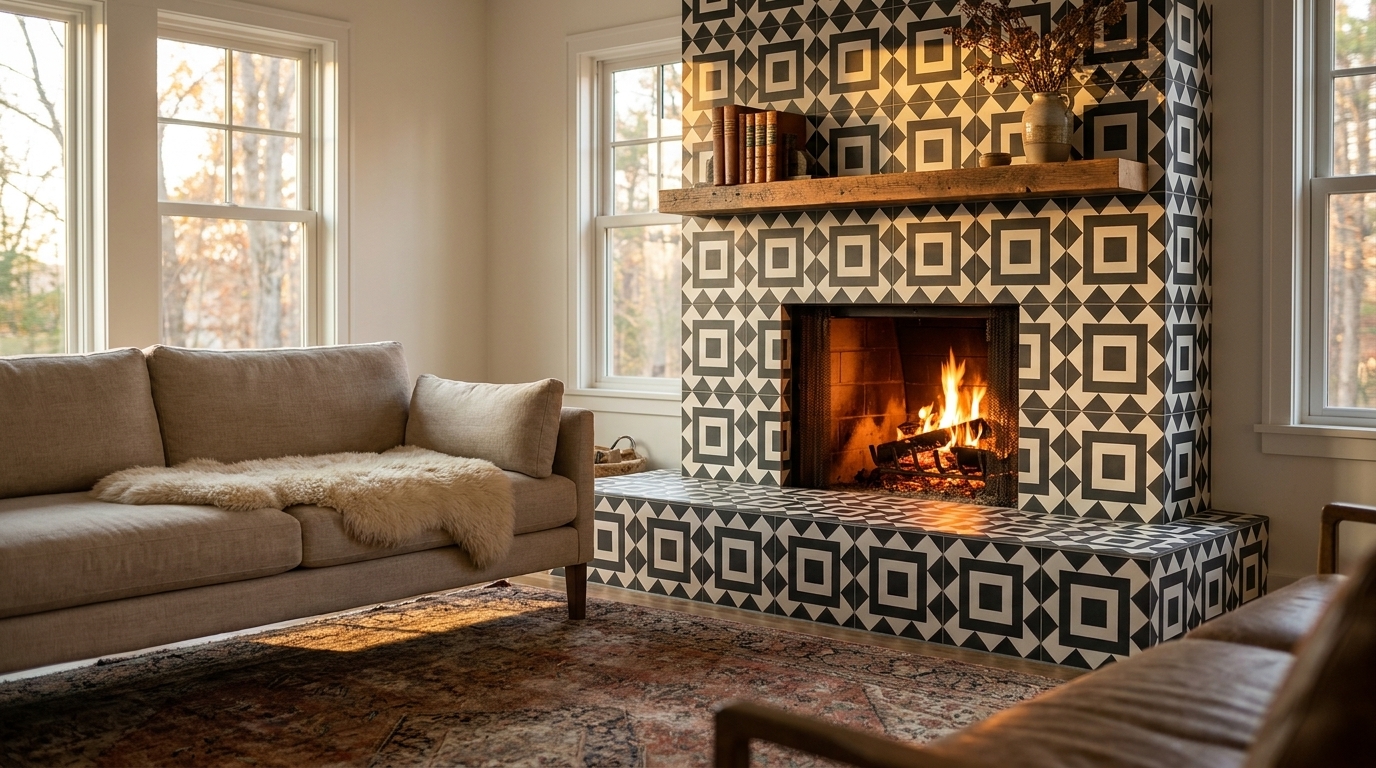
- Black and off-white pattern for strong geometry in a restrained space
- Sand, ivory, and tobacco tones where the goal is depth without contrast
Mixing plain tile and pattern
One of the smartest ways to design a moroccan tile fireplace is to let pattern do only part of the work. A patterned face framed by plain border pieces looks more custom than an all-over motif. So does a hearth in solid color with a patterned riser, or a simple field tile punctuated by corner details.
This is also where a design tool helps. If you’re working through combinations of pattern and plain color, or comparing a square field against a border layout, a visual mockup saves expensive indecision. Heritage makers with custom and stock options often offer a way to test layouts before ordering, which is especially useful when you’re balancing mantel scale, grout line, and tile orientation.
What usually doesn’t work
Some mistakes are design problems, not installation problems.
- Too many motifs at once makes the surround look pieced together instead of composed.
- Pattern that fights the mantel can flatten both elements.
- High-contrast tile in a small dark room can make the firebox feel harsh.
- Tiny busy pattern on a huge chimney breast often reads weaker than expected from across the room.
The best fireplace designs feel edited. They don’t need to shout. They need to hold attention from six feet away, and still reward a closer look.
Choosing Your Tile Material Heat Safety and Durability
This is the decision that determines whether your fireplace stays beautiful or becomes a maintenance problem. Many homeowners start with zellige because they love the gloss and irregular edges. That can be the right call. But if the fireplace sees regular heat and heavy use, cement tile deserves a harder look than it usually gets.

The real trade-off between cement and zellige
Zellige is handmade clay tile. It brings gloss, depth, and edge variation that machine-made products can’t fake. On a fireplace surround, that shimmer can be stunning. The downside is that handmade clay also asks for more tolerance from the installer and more acceptance from the owner. Faces vary. Thickness varies. Edges vary. That’s part of the charm, but it’s also part of the challenge.
Cement tile is different in character. It’s matte rather than glossy, more graphic than luminous, and often better suited to patterned applications. It also fills a practical gap that many style-first guides miss. According to Mosaic Morocco’s discussion of Moroccan tile fireplace applications, encaustic cement tiles can withstand temperatures up to 200-300°F, while some brittle ceramics risk cracking above 150°F. For a heat-adjacent surround, that matters.
Fireplace tile comparison
| Feature | Handmade Cement Tile (Original Mission Tile) | Traditional Clay Zellige |
|---|---|---|
| Heat behavior | Better suited to higher-heat hearth applications when installed correctly | Suitable for surrounds, but material irregularity calls for careful setting |
| Surface look | Matte, inlaid color, graphic pattern | Glossy, reflective, varied glaze |
| Variation | Controlled handmade variation | Strong handmade variation in face, edge, and thickness |
| Maintenance | Needs sealing because the body is porous | May need sealing depending on product and location |
| Best visual use | Patterned surrounds, hearth panels, border work | Luminous fields, tonal walls, artisanal texture |
If you’re sorting through room-wide materials at the same time, this is also a good moment to think about coordination beyond the fireplace. A practical guide on selecting your tile backsplash can help you avoid choosing a surround that fights the kitchen or built-ins nearby.
When cement tile is the smarter choice
For a working fireplace, especially one in a family room, hospitality setting, or high-traffic living space, cement has several advantages. It handles pattern beautifully. It doesn’t rely on gloss for interest. Small scratches and patina often read as part of the material rather than damage. And on a surround that sits close to active use, a matte face can feel calmer and more architectural.
A heritage cement maker can also give you more control over motif, border, and color balance than most handmade clay lines. That matters when the fireplace needs to relate to floor tile, stair risers, or adjacent built-ins. One resource that lays out material considerations for hearth applications is this guide on tile for fireplace surrounds.
Cement tile is less forgiving of careless finishing, but more forgiving of daily life once it’s installed and sealed properly.
When zellige is worth the extra effort
Choose zellige when the project needs movement more than graphic clarity. It’s especially effective on smaller surrounds, narrow chimney breasts, and rooms where natural light can skim across the glaze. If the fireplace is more decorative than high-output, and if you want the handmade irregularity to be visible up close, clay zellige can be the right answer.
The material choice in plain language
If you want glow, reflection, and rustic irregularity, pick zellige and hire someone who knows how to set handmade tile tightly and cleanly.
If you want pattern, durability, and a more heat-focused performance profile, cement is often the stronger answer.
Neither material is plug-and-play. The fireplace doesn’t care what looked good on a mood board. It rewards sound prep, full coverage, and the right finishing system.
Preparing the Fireplace for a Flawless Tile Job
Most failed fireplace tile jobs start before the first tile is set. The pattern gets blamed. The grout gets blamed. The tile gets blamed. In reality, the substrate was dirty, the wall wasn’t flat, or the installer tried to work over a surface that had no business receiving handmade tile.
Check the surround like a setter, not a decorator
Before you open a single box, inspect the entire surround and hearth face.
Look for bowing, loose material, soot buildup, old paint, glossy sealers, and anything crumbly at corners or around the firebox opening. Moroccan tile, especially cement or handmade zellige, won’t hide a bad surface. Tight joints and handmade edges make substrate flaws more obvious, not less.
Use this preflight checklist:
- Confirm the base is sound. If anything moves, flakes, or sounds hollow, correct it first.
- Check flatness carefully. Lippage starts with a wall that isn’t plane.
- Inspect heat-adjacent areas. Don’t set tile onto questionable patchwork near the opening.
- Dry-lay your edge conditions. Returns, hearth transitions, and mantel legs need to be solved before mortar is mixed.
Clean like adhesion depends on it, because it does
For fireplace work, grease, soot, dust, and residue are common. The verified installation guidance for Moroccan cement and zellige work calls for cleaning the substrate with TSP degreaser, and specifically warns against dish soap because it can leave residue that compromises bond.
That step gets rushed all the time. It shouldn’t. Wash the area properly, rinse if needed, and let it dry as required by the cleaner and substrate condition. A clean wall is the baseline for everything that follows.
If the wall still feels slick, dusty, or chalky in your hand, it isn’t ready for adhesive.
Use cement board where heat is part of the assembly
For fireplace surrounds, cement board is the dependable substrate. It gives you a stable, heat-appropriate base for thin-set and handmade tile. If the existing wall isn’t suitable, remove it and rebuild the surface correctly rather than trying to patch your way into a finish installation.
If the fireplace sits near a wet-area transition or another unusual condition, some installations also call for a membrane at adjacent areas, but the main requirement around the surround is a firm, compatible tile backer.
Strike a true starting line
The fireplace may look square. Don’t trust it. Mantels, old masonry, and even newer framing can drift enough to ruin a tight Moroccan layout.
Mark a perfectly level horizontal line for your first visible course. A laser level makes this easy and accurate. Once that line is set, measure up and down from it to avoid ending with a sliver cut where everyone will see it, especially under the mantel shelf or across the hearth face.
A good setup usually follows this order:
- Clean and degrease the substrate.
- Repair or replace unsuitable backing.
- Install cement board where needed.
- Confirm flatness and edge conditions.
- Mark the level control line.
- Dry-lay key rows before mixing mortar.
That groundwork doesn’t show in the finished photos, but it decides whether the finished photos look good.
The Art of Setting Moroccan Cement Tile
Setting Moroccan cement tile on a fireplace is not ordinary wall tiling. The material is dense, porous, and unforgiving of sloppy adhesive coverage. The jointing is tight. The face can stain during installation if you work carelessly. And every alignment error becomes more visible because patterned tile broadcasts drift faster than plain tile does.

Blend first, then set
Handmade cement tile has natural shade variation. That’s part of the appeal, but only if it’s distributed well. Pull from multiple boxes and mix pieces before installation so one darker batch doesn’t collect on one side of the surround.
For handmade tile in general, batch blending is one of the simplest ways to make the final job look intentional instead of patchy. Lay out enough material to preview the rhythm of color and pattern before the first row locks you in.
Choose the adhesive for a heat-adjacent application
For fireplace surrounds, the verified installation guidance calls for heat-resistant thinset like LFT mortar on cement board. The same guidance also notes the importance of keeping the surface temperature of the surround at no more than 49°C (120°F) and avoiding direct flame contact.
For cement tile specifically, professionals recommend applying thin-set mortar to both the surface and the dampened tile back for full coverage. According to the Moroccan tile installation guidance at The Smart Tiles, this double-buttering approach, used with 1/16-inch spacers and hand-pressing, produces a professional-grade installation with a success rate exceeding 95%.
Set for coverage, not speed
Double-butter every piece
Use a suitable notched trowel on the substrate, then coat the back of the dampened tile as well. The point is simple. You want 100% coverage, especially near heat and at the edges of patterned tile where voids can later telegraph as weakness.
A dry back on cement tile can rob moisture from the mortar too quickly. Dampening the back helps control that. It should be damp, not dripping.
Press by hand
Handmade cement tile should be pressed in by hand. Don’t use a rubber mallet. Verified guidance specifically warns against it because the surface can be damaged, and cement tile cannot be ground after installation to erase mistakes.
Keep joints tight and controlled
Moroccan cement tile looks strongest with butt-joint installation or extremely tight spacing. The verified guidance allows 1/16-inch spacers and stresses a perfectly leveled surface. On a fireplace, that matters even more because the eye is naturally pulled to the surround.
A few habits keep the work clean:
- Check every row for drift instead of assuming the previous row carried true.
- Clean mortar residue immediately with a damp sponge so pigments don’t stain.
- Stop and correct lippage early before the pattern multiplies the mistake.
- Dry-fit edge cuts before setting adjacent full tiles.
Corners, returns, and visible edges
Visible edges make or break the finish. If the surround wraps an outside corner or returns into a niche-like opening, plan those edges before field tile starts climbing. In many custom fireplace jobs, 45° mitered edges give the cleanest result and avoid introducing a trim that feels out of character with Moroccan work.
That detail takes skill. A rough miter will look worse than a simpler exposed edge strategy. For many fireplaces, the best approach is the one your installer can execute consistently, not the one that sounds most refined on paper.
A more detailed manufacturer-oriented resource on setting cement tile can be found in this guide to installing cement tile.
Here’s a useful visual reference for handling the process and pacing of a fireplace tile install:
A sequence that keeps the job under control
- Dry-lay the first courses and confirm centering.
- Blend tiles from multiple boxes before setting.
- Spread thin-set on the substrate with the proper notch.
- Dampen and back-butter each tile for full coverage.
- Press tiles in by hand and hold the joint consistently.
- Monitor level constantly across the field and at edges.
- Clean residue as you go so you’re not scrubbing cured mortar off porous tile.
- Let the work cure fully before grouting.
The installer’s job is to make a handmade surface look intentional, not machine-perfect.
That difference matters. A good moroccan tile fireplace has variation, but it never looks accidental.
Grouting Sealing and Finishing Your Fireplace
The setting work gets the attention, but the finish work decides how the fireplace will wear. Cement tile can look rich and velvety when it’s grouted and sealed correctly. It can also look cloudy, blotchy, or permanently stained if the last steps are rushed.
Grout lightly and clean thoroughly
For handmade Moroccan-style tile, especially with tight joints, non-sanded grout is the right choice. The verified installation guidance for authentic Moroccan aesthetics says joints should be filled at less than 1mm with non-sanded grout using a rubber float, followed by meticulous cleaning. That same guidance notes this avoids surface scratching, a pitfall seen in 40% of amateur installs, according to Imports from Marrakesh installation instructions.
Pack the joints fully. Don’t smear grout all over the face and hope to wash it off later. Work in manageable areas and wipe with a damp sponge multiple times as needed, then rub dry to keep haze from setting.
Let curing time do its job
Verified guidance for fireplace tile work calls for 24-48 hours of curing before grouting. Respect that window. If you grout too early, you risk disturbing the bond and trapping moisture where you don’t want it.
A surround isn’t a race. Give the adhesive time to stabilize before you add the next layer of material.
Seal porous cement tile properly
Cement tile needs sealer because the surface is porous. The verified guidance for Moroccan cement tile calls for 2-3 wool roller coats, with rubbing dry between coats for tone equalization. That process is what gives properly finished cement tile its silky matte look instead of a patchy one.
Use a sealer intended for tile and appropriate for the application. Apply thin, even coats. Don’t flood the surface. Don’t leave puddles along edges or in corners. If one coat looks uneven, that doesn’t mean you should panic and over-apply the next one. It means you should let the system work in stages.
If you’re comparing products and trying to understand finish options, this reference on ceramic tile sealers is a useful starting point.
Heavy-handed sealing is one of the fastest ways to make handmade tile look artificial.
Final finishing details
Before the fireplace goes back into service, check these points:
- All grout haze is removed
- Edges are clean and crisp
- Sealer is even across the field
- No residue remains in corners or on the mantel line
- The surround stays within the intended heat limits for the material and assembly
A beautiful finish on handmade tile should never look plastic, gummy, or overworked. It should look calm, dry, and settled.
Long-Term Care and Simple Troubleshooting
A well-finished moroccan tile fireplace doesn’t need complicated maintenance. It needs steady, gentle care. The simplest routine is also the one that preserves the finish best.
Keep the cleaning mild
Use pH-neutral cleaners for routine maintenance. Harsh products can strip sealer, dull pigments, or leave residue that catches soot faster the next time. Dust the surround regularly, wipe soot before it builds, and avoid abrasive pads on handmade surfaces.
For everyday upkeep:
- Dry dust first so grit doesn’t drag across the surface
- Use a soft cloth with pH-neutral cleaner for regular wiping
- Blot stains early instead of scrubbing aggressively
- Reassess sealer if the tile starts absorbing moisture unevenly
Solve the common problems calmly
A white powdery film can appear on masonry and cement-based installations from time to time. If you see that kind of deposit, don’t attack it with harsh chemicals right away. Confirm the source first and address the moisture or curing issue behind it.
If one tile chips or cracks, a skilled installer can usually remove and replace a single piece without redoing the whole surround. That’s one reason it’s smart to keep extra tile after installation, especially with handmade material where matching later can be difficult.
Soot staining, minor residue, and isolated damage usually look worse than they are. The fireplace doesn’t need dramatic intervention. It needs patient, material-appropriate care.
If you're planning a custom fireplace surround and want handmade cement tile options with stock and custom patterns, Original Mission Tile offers materials and project support for residential and commercial applications. A good fireplace starts with the right tile, but it lasts because the design, substrate, setting method, and finish all work together.