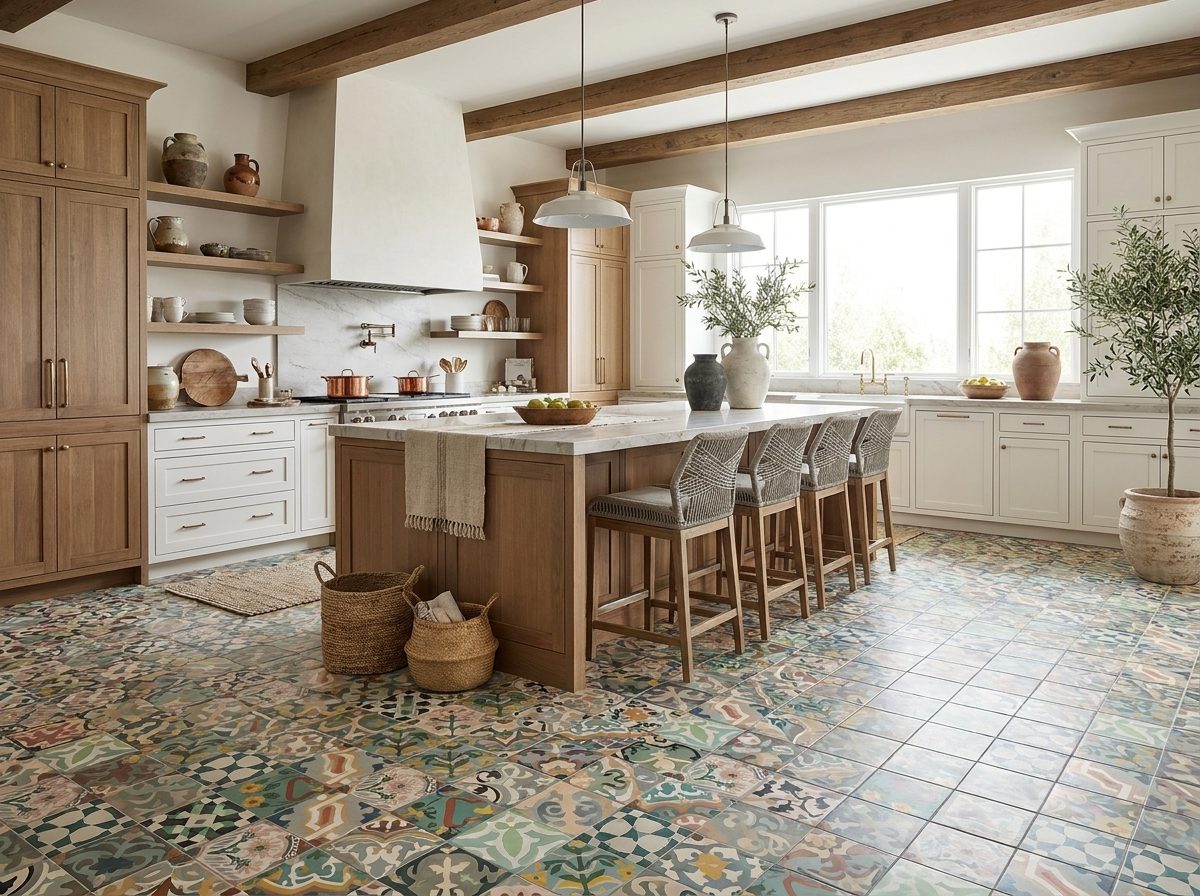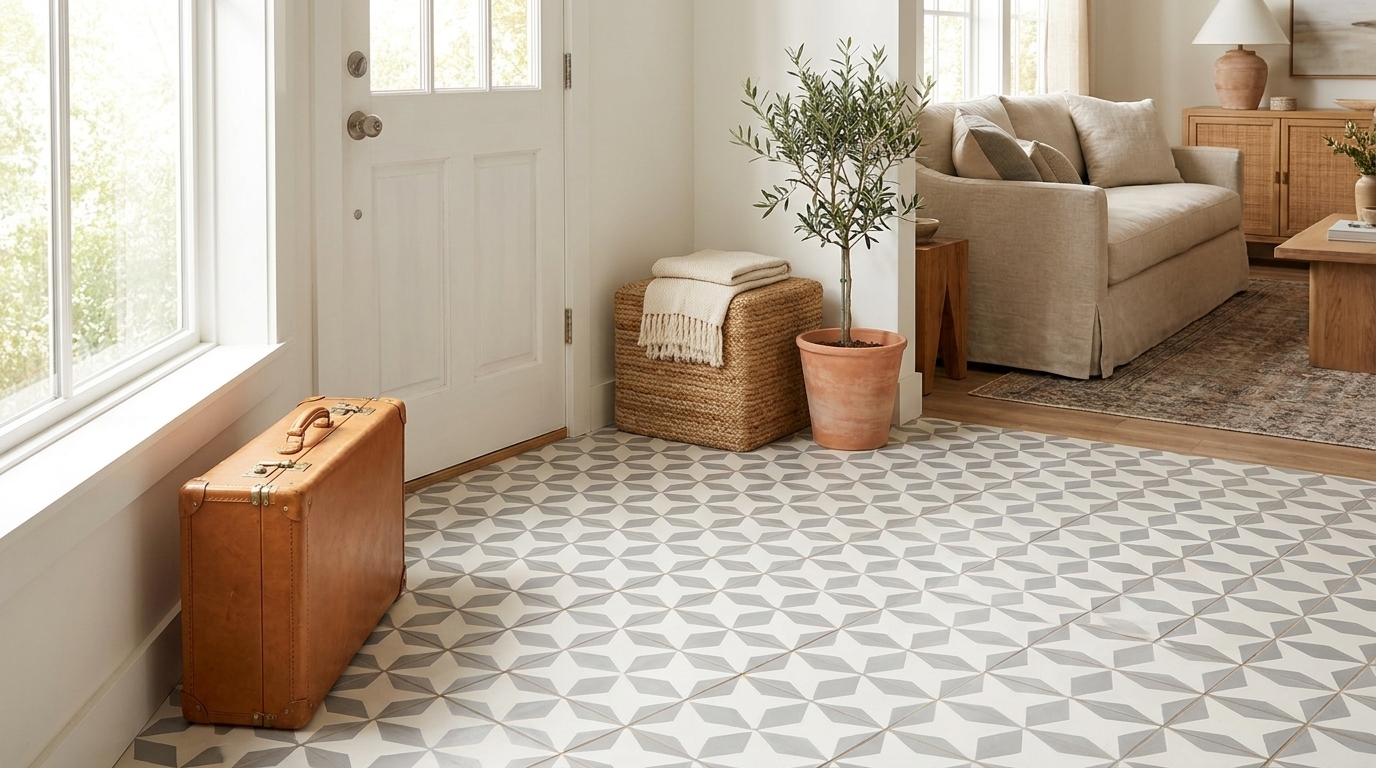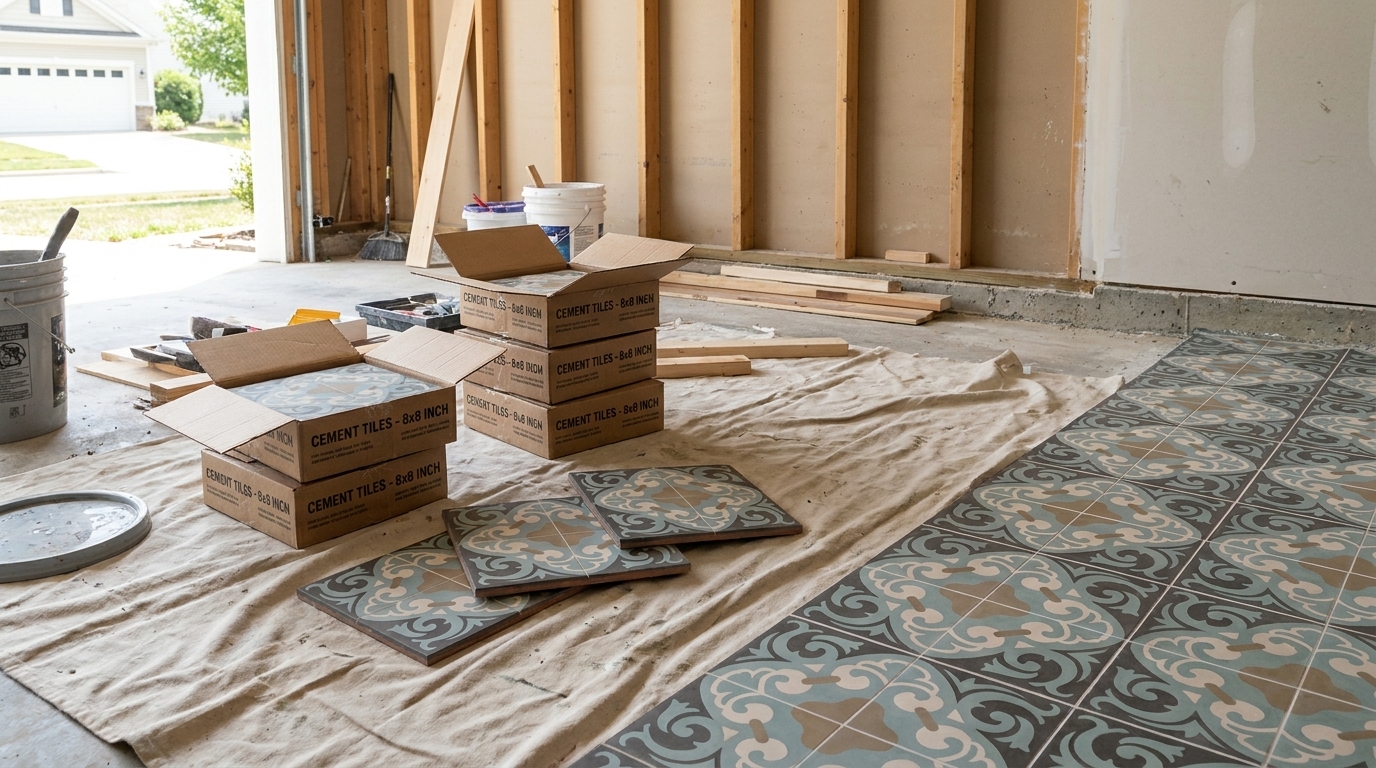
You're likely reviewing a room, or a set of plans, and feeling the same friction common at this stage. You want a surface with character, but the market keeps offering two extremes. One side is slick and generic. The other is full of beautiful imagery but thin on practical guidance.
That's where concrete decorative tiles deserve a clearer conversation.
In practice, that phrase often gets used for two very different materials. One is the authentic handmade cement tile, pressed and cured by artisans, with color built into the surface itself. The other is a factory-made porcelain or ceramic tile designed to imitate concrete or cement. Both can work. Both can fail when they're specified for the wrong reason.
Determining which option sounds more romantic is not the primary concern. The priority is identifying which one belongs in the space you are building.
A restaurant floor, a bathroom wall, a quiet entry, a hospitality bar front, and a family kitchen don't ask the same things from a tile. Some projects need patina and tactile depth. Others need speed, low maintenance, and a forgiving surface. Good specification starts there.
An Introduction to Concrete Decorative Tiles
Concrete decorative tiles appeal to people who are tired of flat finishes that look perfect on day one and forgettable by day ten. They have body, softness, and visual depth. Even before furniture goes in, they give a room a point of view.
For designers, they solve a familiar problem. You want pattern, but not something disposable. You want a surface with history, but not one that feels stuck in the past. Handmade cement tile sits in that sweet spot. It can ground a modern interior just as easily as it can restore an old house with integrity.
These tiles also carry a different kind of presence from glazed products. The finish is matte. The color reads as part of the material, not a print laid on top of it. Light falls across the surface differently, which is why a simple floor in a restrained palette can feel richer than a louder material.
Concrete decorative tiles work best when the design and the use case agree with each other. Beauty alone isn't enough. Neither is pure practicality.
That balance matters now because the term itself has become blurry. Many people searching for concrete decorative tiles are shown concrete-look porcelain, cement-look ceramic, or broad industrial-style collections that share an aesthetic but not a construction method. If you're choosing by image alone, you can end up with the wrong product for the room.
The value of knowing the difference is simple. You'll make better design decisions, avoid installation mistakes, and choose a surface that still feels right after the first trend cycle has passed.
What Are Cement Tiles and How Are They Made
A client walks into the showroom with screenshots of "cement tile" from three different websites. One is genuine handmade cement. One is printed porcelain with a cement look. One is glazed ceramic in a muted palette. They may share a color family, but they are not made the same way, and that difference shows up in wear, maintenance, and the way the surface ages.
Handmade cement tile sits in the older craft tradition behind many of the decorative floors people now group under concrete decorative tiles. It developed in the 19th century as a way to make richly patterned tile without firing, with Catalonia and southern France closely tied to its early production according to this history of cement tile. That cold-process method still defines the material.

The tile is built in layers
A true cement tile has a wear layer and a structural body. That matters.
The decorative face is made from a fine pigmented cement mixture. Beneath it sits a coarser backing that gives the tile its mass and strength. Because the color is part of the tile's upper layer rather than a printed image or fired glaze, the surface reads softer and deeper under light. That is one reason authentic cement tile never looks quite the same as concrete-look porcelain, even when the pattern is similar.
The construction also explains the material's trade-offs. Cement tile can develop patina with use, especially in busy kitchens, entries, and sunlit rooms. Many architects and old-house owners want exactly that. Clients who expect the floor to look unchanged year after year usually do better with porcelain.
How artisans make the pattern
The process is hand-guided from the start. A metal divider, often called a mold or color tray, is set inside the tile form. Each section of the pattern is filled by hand with liquid pigmented cement. Once the divider is removed, the design stays in place as an inlaid surface layer.
A dry mix is added to absorb moisture from the face layer. Then the body mix goes in. The tile is pressed under high pressure, released from the mold, and cured with water and time rather than kiln heat.
That sequence is why the pattern feels embedded instead of printed. It also explains the small variations that experienced specifiers expect. Slight shifts in tone, edge softness, and surface movement are part of handmade production. On the right project, those variations give the floor life.
If you want to see how that craft translates into finished patterns, handmade cement tile options from Original Mission Tile show the range from historic geometry to quieter contemporary layouts.
Why the process changes the result
The method of manufacture affects more than appearance. It affects specification.
Cement tile is dense, substantial, and visually rich, but it is also more porous than porcelain and asks for proper sealing, careful installation, and realistic expectations about aging. Printed porcelain is easier in wet rooms, rental properties, and high-turnover projects where maintenance tolerance is low. Cement earns its place when the brief calls for mineral depth, a matte surface, and the kind of wear that adds character instead of looking like damage.
Bathrooms are a good example. Cement tile can work beautifully there, but only when slip resistance, sealing, and cleaning habits are addressed early. For a practical renovation perspective, this London renovator's bathroom tile guide is a useful companion read.
One more point deserves clarity. Cement tile and concrete-look tile are not interchangeable terms. One describes a handmade material with an inlaid wear layer and a living finish. The other usually describes an aesthetic applied to porcelain or ceramic. If you specify by photo alone, you can get the look and miss the substance.
A short factory-style overview helps if you want to see the pressing logic in motion.
Choosing Your Surface Cement vs Porcelain vs Ceramic
Most confusion happens at this stage. A client says they want “cement tile,” but what they often mean is one of three different goals: a matte look, a handmade look, or a low-maintenance hard surface in a muted palette. Those goals don't always point to the same material.
Porcelain, especially concrete-look porcelain, dominates many searches because it answers practical concerns cleanly. Cement tile answers aesthetic and tactile concerns in a way porcelain usually can't. Ceramic often lands in the middle, depending on whether you're using it for walls, light-duty floors, or decorative applications.

Tile Material Comparison Cement vs Porcelain vs Ceramic
| Attribute | Handmade Cement Tile | Concrete-Look Porcelain | Ceramic Tile |
|---|---|---|---|
| Visual character | Matte, handcrafted, nuanced | Uniform to lightly varied, often sleek | Often glazed, decorative, broad style range |
| Surface feel | Soft, mineral, tactile | Dense, crisp, more controlled | Depends on glaze and body |
| Pattern potential | Excellent for custom motifs and heritage geometry | Strong for printed looks and concrete aesthetics | Strong for color and decorative glazing |
| Maintenance | Requires sealing and attentive care | Lower maintenance | Moderate, varies by product |
| Water behavior | More porous | Very low absorption in practical use | More variable than porcelain |
| Best-fit projects | Statement floors, feature walls, hospitality identity, historic or crafted interiors | Busy family homes, commercial floors needing easy upkeep, wet zones, contemporary minimalism | Walls, backsplashes, secondary floors, budget-sensitive decorative work |
| Installation sensitivity | Higher | Moderate | Moderate |
The central trade-off is straightforward. Porcelain is fired at extremely high temperatures and is denser and lower-maintenance, while cement tile offers a handmade matte surface and decorative versatility, as noted in Daltile's overview of concrete-look tile. The right choice depends on the use case.
When cement tile is the better answer
Choose handmade cement tile when the project depends on material presence, not just pattern.
That includes:
- Hospitality floors with identity: A restaurant entry or boutique floor often benefits from a surface that feels authored, not stock.
- Feature areas with close viewing distance: On a powder room floor, bar face, stair landing, or framed backsplash, the hand of the material reads clearly.
- Custom design work: If you need a motif tied to a brand, a historic reference, or a specific palette, cement tile gives you more room to shape the result.
- Spaces where patina is welcome: Some owners want a floor that settles in rather than staying clinically uniform.
Cement tile is also the stronger design move when replacement over time matters visually. In patterned compositions, patchwork layouts, and custom runs, an individual tile can contribute to the overall field rather than disappearing into a perfect factory repeat.
When porcelain is the smarter specification
Porcelain wins when the owner's first questions are about cleaning, staining, and day-to-day forgiveness.
Use porcelain when:
- You need easier maintenance in a hard-working room
- The look matters more than the craft method
- You're specifying for a client who won't keep up with sealing
- You want concrete aesthetics in areas where density and stain resistance matter most
For many family bathrooms, mudrooms, and high-traffic kitchens, concrete-look porcelain is the safer decision. If you're weighing bathroom-specific considerations such as slip, maintenance habits, and room size, this London renovator's bathroom tile guide is a useful companion read because it frames the material choice around lived use, not just display-board appeal.
Where ceramic fits
Ceramic is often overlooked in this conversation because it doesn't carry the same aura as handmade cement or the technical confidence of porcelain. But it still has a place.
Ceramic is sensible for wall applications, decorative backsplashes, lighter-duty areas, and projects where a glazed finish is part of the design language. If your priority is a clean decorative surface at a friendlier price point than handmade tile, ceramic may be enough.
What ceramic usually doesn't give you is the mineral depth of cement tile or the high-density practicality that makes porcelain such a workhorse.
If the room needs soul, look hard at cement. If the room needs indifference to daily chaos, look hard at porcelain.
For a deeper side-by-side on category differences, cement tile vs ceramic tile is worth reviewing before final specification.
A quick decision filter
If you're stuck between samples on a table, ask these five questions:
Will this surface be touched and seen up close?
If yes, the tactile quality of cement tile matters more.Does the owner accept sealing and maintenance?
If no, move toward porcelain.Is custom pattern part of the architectural idea?
Cement tile usually gives you more design latitude.Does the project benefit from patina?
If wear should add character, cement makes sense.Will visual uniformity matter later?
If the client wants each tile to look nearly identical, porcelain is the safer path.
Designing with Concrete Decorative Tiles
The best concrete decorative tile installations don't begin with the pattern book. They begin with the room's job. A floor can anchor circulation, calm a bright interior, carry a brand story, or make a small space feel composed instead of busy.
That's why some of the most successful cement tile work is surprisingly restrained. Not every project needs a full-room pattern explosion. Often the stronger move is one concentrated gesture.
Start with placement, not motif
A tiled “rug” in an open plan can define the dining zone without adding partitions. A quiet border can frame a vestibule and make a modest entry feel intentional. In a kitchen, a patterned pantry floor can carry more personality than the main work area, where visual calm helps the room age better.

The market has clearly moved toward low-gloss, tactile finishes, and the harder design question is which motifs will still feel right after a few years. That's where guidance on bold patterns versus quiet solids, and on using custom motifs to reduce trend risk by tying the surface to architectural or brand identity, becomes useful, as discussed in this concrete-look trend overview.
What tends to age well
Some pattern families have remarkable staying power. They usually share one trait. They belong to architecture more than to fashion.
These approaches tend to hold up:
- Geometry with discipline: Repeating stars, crosses, grids, and restrained florals often last because they read as structure.
- Limited palettes: Two or three well-chosen colors usually outlast complicated palettes fighting for attention.
- Quiet fields with one accent area: A strong statement feels stronger when it has breathing room.
- Motifs tied to place or brand: In hospitality work, custom pattern works best when it reflects the project's identity rather than a passing social-media look.
What dates fastest is usually not boldness itself. It's boldness without context.
Format changes the mood
An 8×8 square gives you the classic language of encaustic and cement tile. It's orderly and architectural. A hexagon loosens the grid and works well where you want movement without visual clutter. Arabesque and fish scale shapes bring softness and can work beautifully on walls or niche applications. 3D tiles shift the conversation from pattern to shadow, which is useful when you want texture more than color.
A pattern doesn't need to dominate a room to define it. Often one well-placed field of tile does more than an entire house full of statements.
Designers working in warm-climate transitional spaces often face another challenge. They need a floor that feels connected to outdoors, light, and casual living without slipping into resort cliché. Material choices in adjacent rooms matter there, so a reference such as this guide to flooring for Florida rooms can help align the tile palette with the broader indoor-outdoor sequence.
How to avoid the trend trap
Use bold pattern where people pause. Use solids or low-contrast motifs where people live daily.
That usually means:
- patterned powder rooms
- expressive entries
- restrained kitchen fields
- hospitality thresholds with memorable geometry
- calmer private baths and bedroom-adjacent spaces
When in doubt, let architecture carry some of the drama. If the room already has strong millwork, exposed beams, or highly figured stone, a quieter cement tile often produces the more durable result.
From Specification to Installation A Professional Guide
A cement tile floor can leave the studio looking perfect and still fail on site for ordinary reasons. The slab is out of plane. The crew reaches for the same mortar and grout routine they use on porcelain. Cleanup gets rushed as the shift concludes. By the time the room is photographed, the problem gets blamed on the tile.
In practice, specification does most of the heavy lifting.

Start with the right material in the right setting
This is the point where market confusion causes expensive mistakes. Handmade cement tile and concrete-look porcelain can share a color family, but they do not ask the same things of a jobsite.
Cement tile has a porous, hand-finished face. It develops character with use, and it rewards careful installation. Porcelain arrives harder, less absorbent, and more forgiving during grout and cleanup. If the project needs the visual depth, matte mineral surface, and gradual patina of authentic cement, specify it with full awareness of the maintenance and installation sequence it requires. If the space calls for low absorption, faster turnover, or outdoor use in freezing conditions, porcelain is often the better specification.
That decision should be made before samples become a mood board favorite.
Pre-installation checks that save projects
The best installers I work with are methodical before they are fast. They check the room, the tile, and the sequence before mortar is mixed.
- Confirm the exposure: Cement tile should not be specified for exterior freeze-thaw conditions.
- Review all cartons together: Blend from multiple boxes so natural variation reads intentional across the field.
- Inspect the substrate for flatness: Handmade tile shows lippage quickly, especially with strong geometry and low-angle light.
- Dry-lay key areas: Test repeats, directional motifs, borders, transitions, and cut locations before the pattern is locked in.
- Control contamination: Keep unsealed tile away from grout dust, metal filings, muddy traffic, and other site residue.
A good dry layout also settles one issue that drawings often miss. Border cuts that look acceptable on paper can look clumsy once the pattern meets a doorway, island, or stair.
Installation sequence that respects the material
Cement tile asks for a disciplined sequence because the face is absorbent and the edges are part of the visual result.
Establish control lines and dry-lay the field
Set the pattern from the room, not just from one wall. Check where the eye lands first and where cut pieces will be most visible.Use the correct setting material
White thin-set mortar is commonly preferred. It helps avoid discoloration and gives better control under lighter tile bodies.Set for consistent joints and a flat plane
Handmade tile has slight variation. The installer needs to manage that variation, not fight it, so the finished surface reads intentional rather than uneven.Seal before grouting
Cement tile can take in pigment and residue during grouting. A pre-grout sealer reduces that risk and makes cleanup more controlled.Grout carefully and clean with restraint
Use as little water as practical. Do not wash the floor aggressively or use abrasive pads that can mark the surface.Apply the final sealer after cure
Match the sealer to the room and how it will be used. A kitchen, mudroom, and powder room do not all ask for the same level of stain protection.
Sealing is part of installation. It is not a task to postpone until after the furniture arrives.
Common specification and jobsite mistakes
Failures tend to come from predictable assumptions.
| Mistake | What happens |
|---|---|
| Specifying cement tile where a porcelain body would be more practical | Higher maintenance demands and avoidable owner frustration |
| Treating cement tile like glazed porcelain during grouting | Pigment staining, haze, and difficult cleanup |
| Skipping the dry layout | Broken repeats, weak border conditions, and awkward cuts |
| Setting over a substrate that is only marginally flat | Lippage that becomes obvious across patterned fields |
| Using harsh post-grout cleaning methods | Surface scratching, uneven appearance, and sealer problems later |
| Ignoring climate exposure | Premature failure in freezing exterior conditions |
For designers and contractors coordinating the work
Good results come from alignment between specification, installer, and owner. The installer needs clear layout intent. The designer needs approval of variation, joint size, and border treatment. The owner needs realistic expectations about sealing, curing, and the way an authentic cement surface will age.
Mockups help. Written installation and care instructions help. So does a frank conversation about whether the project wants handmade cement tile, or only the look of it.
If the answer is handmade cement, coordination matters even more on custom patterns, mixed shapes, and large visual fields. Some manufacturers, including Original Mission Tile, provide design support, installation guidance, and stock or custom handmade cement tile options so the drawings, samples, and field layout stay aligned. That does not replace a skilled installer. It gives the installer a clearer target.
Bringing Your Vision to Life Custom Tiles and Trade Support
The strongest tile projects usually aren't built from whatever happens to be available in a showroom that week. They come from a clearer match between the architecture, the palette, and the way the space will be used.
That's where custom work becomes valuable.
A custom cement tile program lets designers adjust motif scale, refine color relationships, and build a pattern that belongs to the project instead of borrowing someone else's language. In hospitality, that might mean tying the floor to a brand identity. In a residence, it might mean drawing from historic trim, ironwork, or a regional palette already present in the home.
For trade professionals, support matters just as much as design freedom. Architects, interior designers, builders, and showrooms often need help with layout review, sample coordination, finish selection, lead-time planning, and communication with installers. Those details are what keep a distinctive material from becoming a difficult one.
Original Mission Tile operates in that lane as a heritage manufacturer of handmade cement tile, with both in-stock collections and custom design capabilities through its Design Studio. For trade teams, that kind of partnership is useful when a project needs custom pattern development, patchwork planning, or straightforward coordination across residential and commercial applications.
Good tile work still depends on judgment. Custom support gives that judgment better tools.
Caring for Your Cement Tile Investment
People often overcomplicate cement tile maintenance. The truth is simpler. Cement tile doesn't need exotic treatment. It needs consistent, appropriate care.
Treat this material similarly to other natural-feeling finishes. Respect the surface, clean it correctly, and renew protection when needed.
Daily care
Routine cleaning should be gentle. Dust and grit are more harmful than most owners realize because they act like fine abrasives under foot traffic. Sweep or vacuum regularly, then clean with a pH-neutral product that won't attack the sealer or the cementitious surface.
Avoid acidic cleaners, bleach-heavy products, and abrasive pads. Those can dull the finish, weaken the sealer, or create uneven spots that are difficult to correct.
Periodic sealing
Sealer is what helps a porous decorative surface resist everyday staining. It won't make the tile invincible, and it isn't a substitute for wiping spills promptly, but it is part of long-term performance.
How often a floor needs resealing depends on use, cleaning habits, and the environment. A powder room floor and a busy kitchen won't age at the same pace. The practical approach is to monitor how the surface behaves. If water no longer beads or the tile seems to darken quickly with moisture, it may be time to renew the protection.
For a detailed care routine, cleaning cement tiles properly is a good reference to keep on hand for owners and maintenance staff.
The goal of maintenance isn't to freeze the tile in time. It's to preserve the finish while allowing the surface to mature gracefully.
Spot treatment and household reality
Spills should be wiped up quickly, especially oils, wine, coffee, and strongly pigmented foods. Don't let them sit and don't “clean harder” with harsh chemistry. That usually makes things worse.
Homes with children and pets can still use cement tile successfully, but cleaning products matter. If you're trying to avoid harsh residues in a family environment, these pet-safe tile cleaning methods are a helpful general reference for choosing gentler routines around tile and grout.
A well-maintained cement tile floor won't look factory-new forever. That isn't the point. The point is that it continues to look grounded, cared for, and appropriate to the life around it.
Why Concrete Decorative Tiles Endure
Materials last in design for a reason. Cement tile has stayed relevant because it gives a room authorship.
That matters most in projects meant to age with dignity, not just survive the first installation photos. The best cement tile floors and walls pick up a lived-in depth that suits older houses, serious renovations, and hospitality spaces with a clear point of view. They do not read as generic surface finish.
Endurance also comes from clarity. Handmade cement tile and concrete-look porcelain serve different jobs. Projects hold up better, visually and practically, when that distinction is respected at the specification stage.
Choose cement tile when the goal is craft, surface richness, and a finish that gains character over time. Choose porcelain when the brief calls for lower absorption, simpler maintenance, or a harder-wearing answer for demanding conditions. Good design starts by being honest about that trade-off.
If you're weighing handmade cement tile for a residential renovation, hospitality project, or custom design concept, Original Mission Tile offers in-stock and custom handmade cement tile collections, along with design, installation, and care resources that can help you specify the material with confidence.