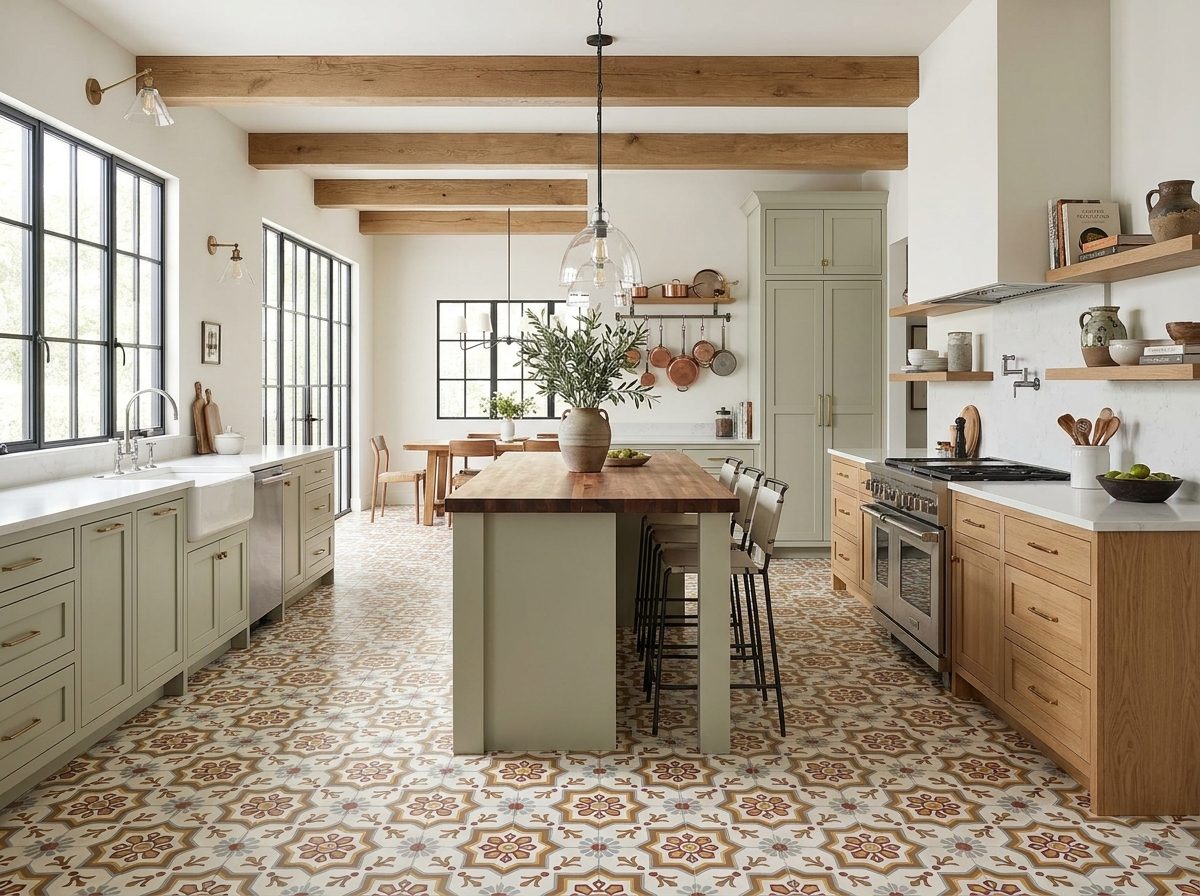
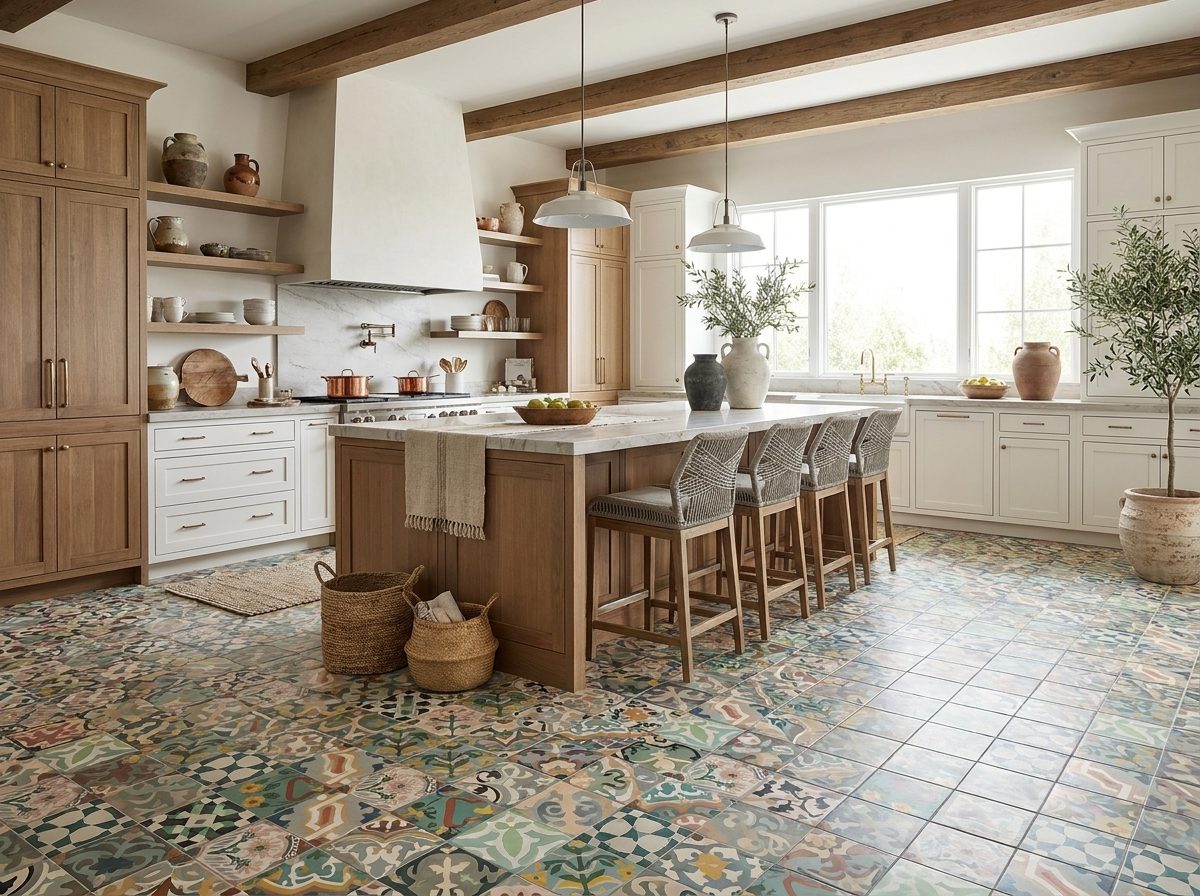
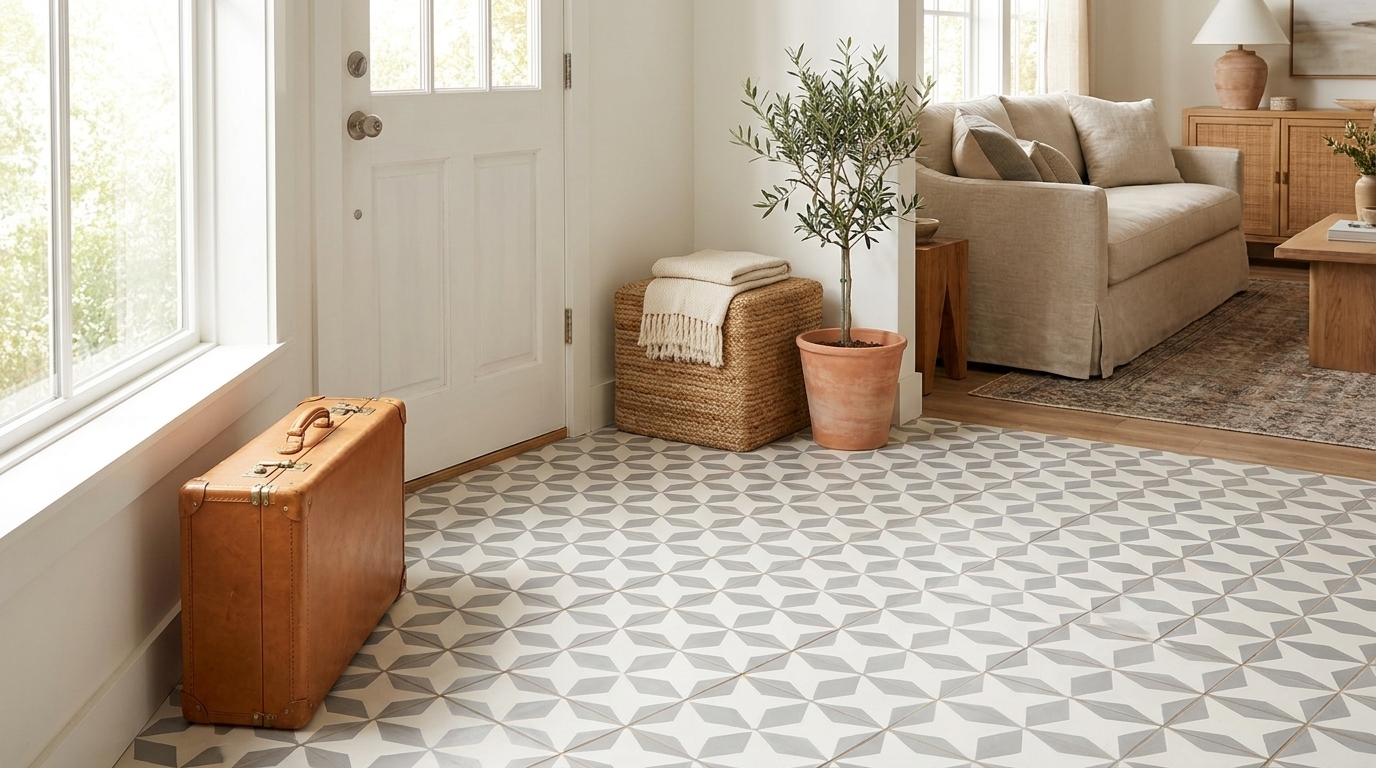
You’re probably standing in one of two places right now. You’re either looking at a plain patio, pool surround, courtyard, or outdoor kitchen and thinking it needs character, or you’re already drawn to Moroccan tile and trying to figure out whether it can survive outside where you live.
That’s the right question to ask.
Moroccan outdoor tiles can turn a hard, ordinary surface into something layered, tactile, and memorable. A small fountain wall starts to feel collected over time. A patio floor stops reading like a slab and starts reading like a room. Even a narrow garden path can feel intentional when the material has depth, variation, and pattern instead of flat uniformity.
But romance alone won’t carry an exterior tile project. Outdoor work is unforgiving. Water sits where it shouldn’t. Sun bakes glazes. Winter punishes weak installation. Homeowners often fall in love with the look first, then discover too late that handmade clay, cement, and porcelain behave very differently once they’re exposed to rain, heat, and frost.
That’s where many guides stop short. They show pretty surfaces. They don’t explain the why behind the material, or the practical decisions that keep a beautiful tile job from becoming a repair job.
Your Guide to Moroccan Outdoor Tiles
A good Moroccan tile project usually starts with a feeling. You want the patio to feel traveled, not generic. You want the pool area to feel like a retreat, not just a code-compliant deck. You may want color, but not something loud. Or texture, but not something rustic in the wrong way.
Shop our Moroccan cement tiles for outdoor spaces, handmade in San Luis Potosí, Mexico, and shipped from Laredo, TX.
That instinct makes sense. Moroccan outdoor tiles bring two things at once: ornament and atmosphere. They can be glossy and hand-hewn, soft and chalky, or crisp and engineered, depending on the material you choose. The important part is matching the look you love to the weather, traffic, and maintenance reality of your project.

I’ve seen this play out in three very different outdoor spaces. A homeowner used handmade clay tile on a covered courtyard where texture mattered more than uniformity. A designer chose patterned cement tile to define an outdoor dining zone like a rug. A contractor used Moroccan-style porcelain near a wet pool edge because traction and freeze-thaw performance mattered more than hand-chiseled variation.
All three were right.
Practical rule: Don’t ask which Moroccan tile is best. Ask which one fits your climate, surface conditions, and tolerance for maintenance.
If you’re a homeowner, you need clarity on what will age gracefully and what will ask more of you. If you’re a designer, you need a material palette that supports the story of the space without creating avoidable failure points. If you’re a contractor, you need specs that hold up after the photos are taken.
That’s where the true craft begins.
The Soul of Moroccan Tile A Timeless Legacy
Moroccan tile isn’t just a style category. It carries a long design lineage shaped by craft, religion, climate, and architecture. That’s why it feels so different from a printed pattern trying to imitate it.
Zellige originated around 711 AD, when Muslim inhabitants of North Africa and the Mediterranean, especially the Moors, introduced this handmade art form using clay from the Fez region. Fez became the center of the craft because of that clay. Early examples from the 10th century were simple white and brown, and by the 14th century the palette expanded to include green, blue, and yellow, with red added in the 17th century, allowing more elaborate geometric compositions. That history is described in this account of zellige’s development and enduring design appeal.

Why the patterns look the way they do
Many people see Moroccan tile and only think “geometric.” The deeper reason matters. Islamic artistic traditions often avoided depicting living beings, so artisans developed intricate arrangements of stars, polygons, tessellations, and repeating fields. The pattern wasn’t filler. It was the language.
That’s why authentic Moroccan tile work has a certain discipline even when it feels lush. The color can be vivid, but the structure beneath it is precise. The surface may shimmer, but the pattern holds it together.
If you’re using Moroccan motifs outdoors, that history helps you make stronger design decisions. A repeated field of bejmat or zellige around a fountain feels grounded because that’s close to how the material lived historically. A random patchwork can still be beautiful, but it tells a different story.
Beauty and performance grew together
Moroccan outdoor tile also developed in response to climate. These tiles appeared on courtyards, pools, fountains, and public streets, where they helped regulate temperature by providing thermal insulation. In practical terms, they helped interiors stay cooler in hot weather and warmer in colder months, which is one reason the material became so embedded in outdoor architecture.
That functional side often gets overlooked today. Designers focus on the glaze, the color shift, the hand-cut edges. Those details matter, but they were never the whole point. The tile had to work in daily life.
Some of the oldest examples still standing show that good tilework isn’t decoration applied to architecture. It becomes part of the architecture.
What that legacy means now
The legacy is still visible in monumental work, including the 20th-century Hassan II Mosque in Casablanca, and in structures that demonstrate durability over 1,300 years in outdoor applications, as noted in the same history of Moroccan tile and zellige craftsmanship. Today, the look has spread far beyond Morocco, but the strongest projects still respect the original balance of utility and artistry.
That’s the useful takeaway for outdoor design. Moroccan tile works best when you don’t treat it like wallpaper for the ground. Think of it as a building material with cultural memory. The pattern, sheen, irregularity, and layout should all support the architecture around it.
Choosing Your Moroccan Tile Material Zellige vs Cement vs Porcelain
This is where many projects succeed or fail. People say “Moroccan tile” as if it names one material. It doesn’t. It often refers to a visual language applied through very different products.
A simple analogy helps. Zellige is like linen, natural, irregular, and full of character. Cement tile is like heavy woven canvas, matte, substantial, and artisan-made in a different way. Porcelain is like technical outdoor fabric, controlled, high-performing, and easier to predict in demanding conditions.
Those aren’t value judgments. They’re behavior clues.

Authentic zellige clay tile
Zellige is often the material that comes to mind first. It’s handcrafted clay, often glazed, cut and sorted by hand, and prized for tonal variation and slight surface irregularity. Light doesn’t hit every tile the same way, which is exactly why a zellige installation feels alive.
Outdoors, that charm comes with responsibility. Handcrafted clay is less forgiving than engineered porcelain. It can be a strong choice for courtyards, vertical surfaces, fountains, and protected patios where the point is atmosphere and handwork.
Use zellige when you want:
- Surface movement: Slight unevenness and glaze variation that changes through the day
- Historic character: A material that reads old-world rather than manufactured
- Small-format flexibility: Great for borders, water features, and detailed layouts
Where readers get confused is this: handmade doesn’t mean weak, but it does mean variable. You can’t specify it the way you’d specify a highly standardized commercial porcelain.
Handmade cement tile
Cement tile often carries Moroccan and Moorish pattern language beautifully, but it’s not the same craft as zellige. It isn’t fired clay. It’s typically made with cement, sand, marble dust, and mineral pigments, using pressure rather than kiln firing. The visual result is usually flatter, softer in sheen, and more graphic.
For outdoor design, cement tile occupies a useful middle ground. It can deliver strong pattern and artisan presence without the glossy irregularity of zellige. It often suits patios, porches, outdoor kitchens, and hospitality spaces where designers want decoration underfoot but not a reflective glaze.
Its personality is different:
- Matte finish: More grounded and velvety than shiny
- Pattern clarity: Excellent for repeating motifs and border work
- Aging character: It develops patina rather than maintaining a crisp factory look
Cement tile asks for sealing and thoughtful maintenance. That doesn’t make it impractical. It just means it’s a material you work with, not a material you ignore.
Porcelain in Moroccan style
Porcelain is the performance-minded option. It can mimic terracotta, patterned encaustic looks, or Moroccan-inspired color and geometry while delivering tighter dimensional control and lower water absorption. If your project includes snow, standing water, heavy traffic, or clients who don’t want a fussy surface, porcelain deserves serious attention.
Porcelain versions of Moroccan tiles can reach a Dynamic Coefficient of Friction of at least 0.60 for wet exterior floors, with water absorption below 0.5% and Mohs scratch hardness of 7, making them well suited to wet areas and freeze-thaw conditions according to Marazzi’s Moroccan Concrete product data.
That set of properties tells you a lot. Low absorption means less water entering the tile body. Better traction ratings matter at pools, showers, and exposed patios. Hardness helps in spaces where furniture moves and grit gets tracked across the surface.
Moroccan Outdoor Tile Materials Compared
| Feature | Authentic Zellige (Clay) | Handmade Cement Tile | Porcelain Tile |
|---|---|---|---|
| Visual character | Glossy, hand-chiseled, varied | Matte, patterned, artisan-made | Uniform, controlled, often printed or molded |
| Surface feel | Irregular and lively | Velvety and substantial | Consistent and precise |
| Best outdoor use | Courtyards, protected patios, fountains, walls | Patios, porches, outdoor kitchens, decorative zones | Pool decks, exposed patios, wet zones, freeze-thaw areas |
| Water behavior | More moisture-sensitive | Needs sealing and care | Very low absorption |
| Installation difficulty | Higher, due to variation | Moderate, depends on pattern and substrate | Lower, due to consistency |
| Maintenance style | More attentive | Routine sealing and gentle cleaning | Low-maintenance |
How to choose like a pro
If you’re choosing for a homeowner, start with habits. Are they the type who’ll notice and appreciate irregularity, reseal when needed, and accept patina? If yes, handmade materials stay on the table. If not, steer toward porcelain.
If you’re specifying for a designer-led project, start with the architectural role of the tile. Is it the jewelry of the space, or is it the workhorse walking surface? Jewelry can be more delicate. Workhorses need tighter technical performance.
For contractors, ask an even simpler question first: what will this tile forgive? Porcelain forgives more. Handmade clay forgives less. Cement sits in the middle and rewards careful prep.
Choose the tile by the exposure first, then by the mood you want. Doing it in the opposite order is how beautiful samples become expensive callbacks.
A practical split often works well. Use handcrafted material where people see and touch it. Use a higher-performance material where water, ice, and foot traffic are relentless.
Will Moroccan Tiles Survive Your Climate
A lot of people ask the wrong version of this question. They ask whether Moroccan tiles can handle cold. The better question is which Moroccan tile, installed how, over what substrate, in what exposure.
The myth says all Moroccan tile cracks in winter. That’s too broad to be useful. The actual issue is water inside the tile or assembly, then a freeze-thaw cycle that turns that trapped moisture into pressure.
What actually causes failure
Handcrafted clay tiles can have porosity in the 5 to 10 percent range and need breathable sealers and wider grout lines to reduce the risk of spalling in cold weather, according to Riad Tile’s freeze-thaw discussion of thin terracotta zellige. The same source notes more than 200 unanswered forum posts since 2024 from homeowners dealing with cracked patios and similar concerns.
That tells you two things. First, the concern is real. Second, the problem usually isn’t “Moroccan design.” It’s moisture management.
A tile can be beautiful and still fail if water gets in, can’t get out, and then freezes. In freeze-thaw regions, the assembly matters as much as the face of the tile. Drainage, slope, substrate prep, grout spacing, and sealer choice all become structural decisions, not cosmetic ones.
Material choice by region
If you’re in a warm or dry climate, you have more latitude. Handcrafted clay can perform well in the right application, especially in covered courtyards or spaces with less saturation.
If you’re in the US Northeast, upper Midwest, mountain regions, or parts of Northern Europe, be more selective:
- For exposed wet zones: Porcelain is usually the safest path.
- For decorative field areas with maintenance planning: Cement tile can work with proper detailing and sealing.
- For handmade clay outdoors: Reserve it for better-protected applications unless the installer has direct experience with freeze-thaw assemblies.
For projects where you want a handmade look but need a material intended for outdoor settings, it helps to review options such as cement tiles for outdoor use.
The details that matter more than people think
I’ve seen clients focus on the tile body and ignore the joints. In cold climates, that’s backwards. A too-tight layout, trapped moisture, or a non-breathable surface treatment can do more harm than a bold pattern ever could.
Pay close attention to:
- Drainage under the tile: Water needs a path away from the assembly.
- Breathable sealing approach: Especially important with porous clay bodies.
- Joint design: Wider joints can help accommodate movement and moisture behavior.
- Exposure level: A covered loggia and an open snow-covered patio are not the same application.
In freeze-thaw work, the tile is only one part of the system. The system survives, or the system fails.
Don’t let fear flatten the design
The answer isn’t to abandon Moroccan outdoor tiles in cold places. The answer is to match the romance of the material with the discipline of exterior detailing.
If your client wants a courtyard mood in a winter climate, you can still get there. Use handcrafted clay on vertical accents. Use cement tile in selective decorative zones. Use Moroccan-style porcelain where saturation and frost are unavoidable. The strongest outdoor projects in cold regions rarely rely on one material everywhere. They use each material where it makes sense.
That’s not compromise. That’s mature specification.
Installation and Sealing Best Practices
Good outdoor tilework starts before the first tile is set. Most failures I’m asked to look at don’t begin with a bad pattern choice. They begin with rushed prep, the wrong mortar, poor movement planning, or sealing that was either skipped or misunderstood.

Start with the substrate, not the tile
An exterior tile assembly needs a stable, properly prepared base. If the slab holds water, if the surface varies too much, or if movement isn’t anticipated, no premium tile will rescue the job.
For handcrafted outdoor tile, proper installation includes a minimum 1/8-inch grout joint, use of medium-bed thinset mortar, and expansion joints every 20 to 25 square meters to help prevent cracking from thermal expansion, as described in Moorish Tiles’ outdoor installation guidance. That same guidance warns that improper methods can lead to 30 percent delamination rates in humid climates.
That’s the kind of specification detail contractors need to treat as mandatory.
The sequence I trust outdoors
Verify slope and drainage
The surface must shed water. Exterior tile that invites puddling is starting from a losing position.Choose the right setting material
Medium-bed thinset helps support tile more evenly, which matters with thicker handmade pieces and surfaces that aren’t perfectly uniform.Lay out for movement
Expansion joints aren’t a technical afterthought. Outdoors, surfaces heat up, cool down, and move.Respect the tile’s variation
Handmade materials need sorting, dry layout checks, and a setter who understands that visual balance matters.Grout with intention
On handcrafted work, the joint isn’t just a filler. It helps with traction, spacing, and tolerance of variation.
Where sealers fit in
Sealing confuses people because they think of it as a magic shield. It isn’t. A sealer supports the assembly. It doesn’t correct bad installation.
For porous handmade materials, a breathable penetrating sealer is usually the safer direction outdoors than a film-forming topical finish. You want to reduce unwanted absorption without trapping moisture beneath the surface. On glazed handmade tile, the tile face may behave differently from the edges and back, so the installer needs to think beyond the visible glaze.
A helpful installation walkthrough is below, especially if you’re coordinating with a tile setter or reviewing sequence with a client.
Jobsite reminder: Exterior tile doesn’t fail all at once. It starts with one hollow corner, one hairline crack, one area that stays wet longer than the rest.
Practical handling tips for handmade tile
If you’re working with zellige or another handcrafted clay tile, slow down the pace of installation. Open more than one box at a time. Blend pieces. Check thickness. Expect variation instead of fighting it.
A few habits make a big difference:
- Dry-lay sample areas: This reveals tonal clustering before the mortar is down.
- Use leveling spacers where appropriate: They help control lippage, especially with varied handmade stock.
- Avoid harsh cleaners after install: Acidic products can damage delicate finishes and glazes.
- Keep maintenance simple: pH-neutral cleaning is usually the safest routine for preserving appearance.
For professionals, the biggest mindset shift is this: handmade Moroccan tile should be installed with precision, but not forced into factory expectations. Respect the variation while still honoring exterior performance rules.
Design Inspiration for Outdoor Spaces
The nicest Moroccan outdoor tile projects don’t always use the most tile. They use it where it changes the experience of the space.
A broad patio covered wall to wall in pattern can be stunning, but so can a restrained field with one concentrated focal area. Sometimes the smartest move is to let the tile play the role of a rug, a border, a stair accent, or a water feature surround.
A patio that feels furnished
On large outdoor slabs, tile can define zones the way furniture does indoors. A patterned rectangle beneath a dining table makes the area feel anchored. A quieter border around it gives the eye somewhere to rest.
This works especially well with cement tile or Moroccan-style porcelain, where repeating motifs can create order across a larger field. If the architecture is modern, choose a tighter geometric pattern and a smaller palette. If the setting is Mediterranean or Spanish revival, warmer tones and more layered motifs often feel natural.
Pool edges and water features
Water changes the conversation. Around a pool, I like to separate decorative ambition from safety requirements. You might use a Moroccan-inspired porcelain for the walking surface, then bring handcrafted texture to a nearby fountain wall, raised planter, or outdoor shower backdrop.
That division lets each material do what it does best.
For fountains, basins, and courtyard walls, smaller formats are especially expressive. A glossy handmade surface catches moving light beautifully. It gives water something to talk to.
A good outdoor tile design has rhythm. One area shimmers, another area grounds the composition, and a third area stays quiet so the whole space can breathe.
Paths, steps, and outdoor kitchens
Garden paths are a great place to use Moroccan influence without overwhelming the outdoor area. A border detail, repeated inset, or patterned landing can lead the eye through the garden without turning every step into visual noise.
Steps need extra discipline. Pattern is fine, but readability matters. If the risers are decorative, keep the treads practical and secure.
Outdoor kitchens are another strong use case. A backsplash in Moroccan tile can add depth and color to stone, stucco, concrete, or wood cabinetry. This is often where handmade materials shine, because the tile sits vertically and gives all of its beauty without taking the same abuse as a floor.
Matching pattern to architecture
Different formats produce different moods:
- Star and cross layouts often feel rooted and traditional
- Hexagons can lean modern or playful depending on color
- Arabesque shapes soften harder architectural lines
- Herringbone with elongated pieces adds movement without requiring a loud pattern
The right choice depends less on trend and more on proportion. If the house already has strong arches, wrought iron, or textured plaster, the tile can be quieter. If the building is spare and minimal, the tile may need to provide the ornament.
How to Buy and Specify Moroccan Outdoor Tiles
Buying outdoor tile is part design decision, part risk management. Samples can seduce you into looking only at color and pattern. The smarter move is to evaluate the product the way an architect, installer, and owner all would.
If you’re a homeowner, start by asking where the tile will live. Fully exposed? Covered? Near a pool? Subject to winter ice? Those answers narrow the field faster than style boards do. Order samples, wet them, view them in morning and late-day light, and ask what kind of maintenance the material expects from you.
For designers and architects, request the technical information that fits the application. If the project includes wet walking surfaces, ask for traction data. If the site sees frost, ask about absorption and exterior suitability. If the material is handmade, ask how much dimensional variation to expect and how that affects layout, grout, and labor. For broader patio planning, this guide on the best tile for outdoor patio applications is a useful reference point.
Contractors should inspect shipments before the schedule gets tight. Open cartons. Confirm shade blend, size consistency, thickness variation, and breakage. Handmade tile always has variation, but there’s a difference between expected character and a supply issue.
A short buying checklist helps:
- Ask about exposure first: Don’t choose a tile before defining the climate and moisture conditions.
- Review the installation method: The right tile with the wrong assembly is still the wrong system.
- Clarify lead times and replacement strategy: Handmade and custom work may require more planning if future repairs are needed.
- Coordinate with adjacent materials: Coping, concrete, drainage planes, and grout color all affect the final result.
If your project also includes exterior flatwork or integrated site paving, a practical resource like this checklist for Florida concrete projects can help you ask better questions about the surrounding substrate and contractor coordination.
One manufacturer option in this category is Original Mission Tile, which produces handmade cement tiles and custom designs that can be specified for outdoor projects when the assembly and sealing approach fit the application.
The best buyers aren’t the ones who ask for the prettiest tile. They’re the ones who ask the clearest questions before the order is placed.
If you’re planning a patio, courtyard, pool surround, or hospitality project and want guidance on materials that balance Moroccan character with outdoor performance, Original Mission Tile is a practical place to explore handmade cement tile options, custom patterns, and project support.