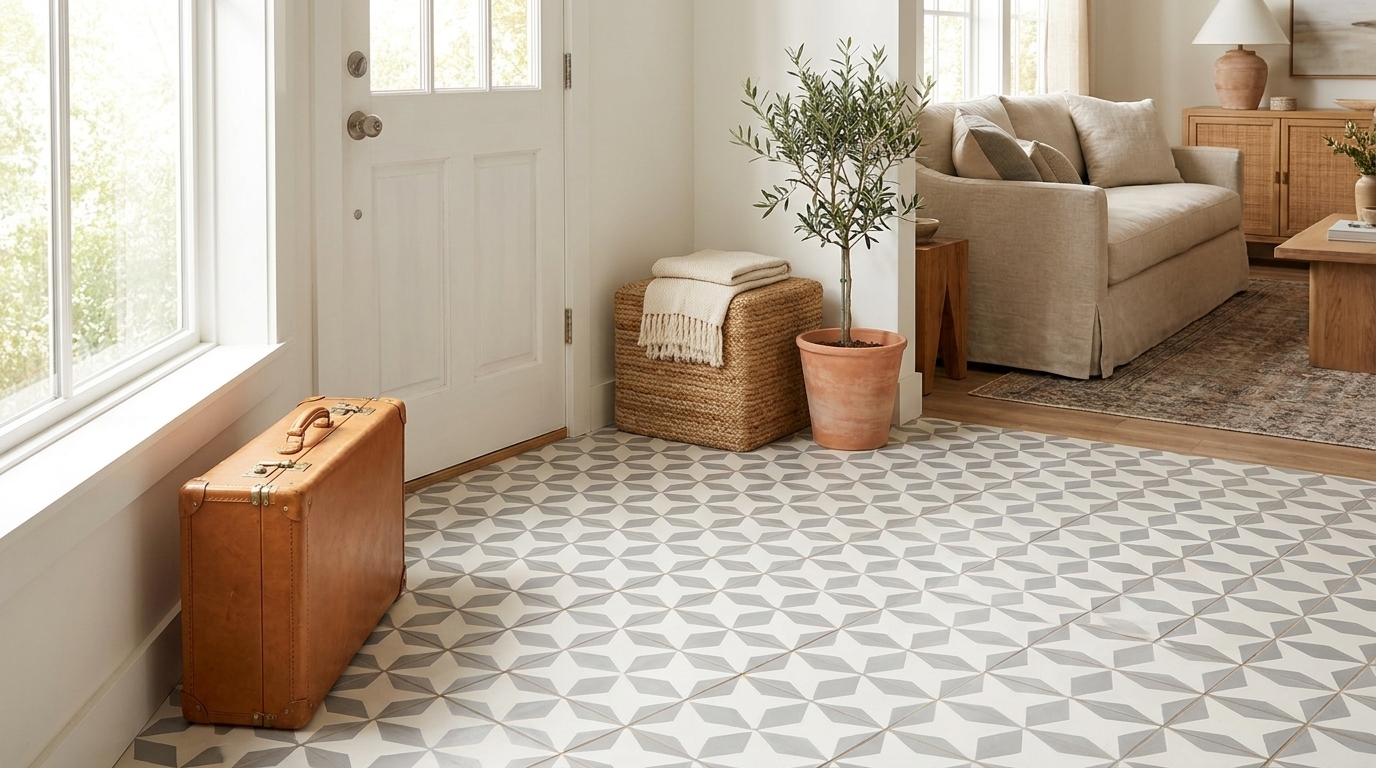
You’ve fallen for a pattern. Now comes the question nobody warns you about: how much does cement tile weigh, and can your floor, your cabinets, or your delivery truck actually handle it? Cement tile weight isn’t a footnote. It’s a real number that affects second-floor framing, countertop substrates, and even your freight bill. This guide breaks down that number, then shows you exactly where it matters and where it doesn’t.
How Much Does Cement Tile Actually Weigh?
Cement tile is denser than most people expect. Unlike fired ceramic, it’s poured from a sand-cement mix and hydraulically pressed, not baked. That process packs more mass into the same footprint.
A standard 8×8 handmade cement tile, roughly 5/8″ thick, typically weighs about 3 to 3.5 pounds. Spread across the tile’s face, that works out to around 6.5 to 7.5 pounds per square foot before you add any setting materials. Compare that to standard porcelain, which usually runs 3.5 to 6.5 pounds per square foot, and you can see cement tile sits noticeably heavier.
Because our 8×8 boxes cover 5.17 square feet at 12 tiles per box, a single box lands somewhere around 35 to 40 pounds. That’s useful math to keep in your back pocket, because it drives everything else in this guide: how many boxes you can carry up a ladder, how a delivery truck routes your order, and how a structural engineer sizes a floor.
If you want to see the full range of patterns at this weight class, our in-stock cement tiles collection lists every size and finish we keep on hand, so you can plan quantities before you ever pick up a phone.
What Adds Weight Once the Tile Is Installed
The tile itself is only part of the story. Once it’s set, mortar and grout add their own load, and that load depends heavily on installation method.
Modified thin-set mortar, the standard method for cement tile, adds roughly 1 to 2 pounds per square foot at a typical 3/16″ to 1/4″ bed thickness. Grout adds a little more, though usually under half a pound per square foot for standard joint widths. Add it up, and a finished thin-set cement tile floor generally lands in the 8 to 10 pound per square foot range.
That number changes fast if someone reaches for a traditional mortar bed instead. A 1″ to 1.25″ mud bed, sometimes still used to level uneven subfloors, can add another 12 to 15 pounds per square foot on its own. That’s why we always recommend checking our installation guidelines before choosing a setting method, especially anywhere weight is a concern.
- Tile alone: about 6.5 to 7.5 lbs/sq ft
- Tile + thin-set + grout: about 8 to 10 lbs/sq ft
- Tile + traditional mortar bed: 20+ lbs/sq ft
For almost every residential job, thin-set keeps the assembly light enough that weight stops being a concern. Save the mortar bed for situations where you genuinely need it to correct slope, and budget the extra load accordingly.
Second-Floor Installations: What the Codes Actually Allow

Here’s where the math gets real. Most wood-framed second floors in the US are designed under residential building codes to carry a live load of 40 pounds per square foot in living areas, and 30 pounds per square foot in bedrooms. That live load covers people, furniture, and everyday use.
Dead load, meaning the permanent weight of the floor assembly itself, is a separate number. Framers typically design a floor’s dead load allowance around 10 to 20 pounds per square foot for the subfloor, finish material, and ceiling below. A thin-set cement tile installation at roughly 8 to 10 pounds per square foot usually fits comfortably inside that standard allowance.
However, “usually” isn’t “always.” A few situations push cement tile weight from a non-issue to a real structural question:
- Older homes with undersized joists or long, unsupported spans
- Tiling over existing tile, which stacks two finish layers instead of one
- Large rooms where the total tonnage adds up even if the per-square-foot number looks fine
- Mortar bed installations, because that method roughly doubles the finished dead load
If any of those apply, don’t guess. A structural engineer can check your specific joist size, span, and spacing in about the time it takes to schedule a coffee. That’s a small cost against the alternative: a bouncy floor or, worse, cracked tile from deflection. For everyday second-floor bathrooms and kitchens on standard framing, though, cement tile at thin-set thickness is a well-established, safe choice.
Cement Tile Countertops: Weight Meets Cabinetry
Countertops flip the structural question. Instead of joists, you’re asking whether your cabinet boxes and substrate can carry the load, and whether the front edge can hold up under its own weight plus daily use.
A cement tile countertop, tiled over 3/4″ plywood with thin-set, generally runs in that same 8 to 10 pound per square foot range once grout is factored in. That’s meaningfully lighter than a solid stone slab, which can run 15 to 20 pounds per square foot or more. Standard kitchen cabinets built to modern specifications are rated well beyond what a tiled cement countertop demands, so weight capacity typically isn’t the limiting factor.
The edge is where things get more specific. A tiled edge, especially one finished with a dedicated bullnose piece, adds cantilevered weight right at the point where support is thinnest. Our Bullnose S-101 Black 4×8 is built for exactly this application, giving you a finished, load-appropriate edge instead of a mitered cut that concentrates stress along a thin seam.
Two practical rules keep countertop weight in check. First, don’t skip the plywood substrate thickness your fabricator specifies, because a thinner deck flexes under grout lines and cracks tile over time. Second, keep unsupported overhangs modest. Twelve inches or less without corbels is a reasonable ceiling for a tiled surface, since cement tile doesn’t flex like a stone slab and needs consistent backing beneath it.
Comparing Cement Tile Weight to Other Materials
Numbers mean more with context. Here’s how cement tile stacks up against the materials it’s most often compared to, all measured as installed weight including setting materials.
- Ceramic tile: about 4 to 6 lbs/sq ft installed, generally lighter than cement
- Porcelain tile: about 5 to 8 lbs/sq ft installed, close to cement but usually a touch lighter
- Cement tile: about 8 to 10 lbs/sq ft installed at standard thin-set thickness
- Natural stone (marble, granite): about 10 to 20 lbs/sq ft installed, often heavier than cement
Pattern and finish shift these numbers slightly too. Metallic-inlay pieces like our Brass Traverser 01 carry actual brass in the surface, which adds a bit more weight than a standard cement tile of the same size. On the lighter end, smaller-format or thinner-profile shapes shave a little weight per box, though the difference rarely changes a structural decision on its own.
The takeaway: cement tile sits in a comfortable middle ground. It’s heavier than ceramic and most porcelain, but generally lighter than solid natural stone, which is exactly why it works well in applications where stone would be structurally risky.
Shipping Weight: What to Expect When Your Order Arrives

Weight doesn’t stop mattering once the tile leaves the factory. It shapes how your order ships, and what you should expect on delivery day.
Full pallet orders of cement tile typically move by LTL freight, meaning your shipment shares truck space with other freight rather than getting an exclusive parcel truck. Tile as a category is commonly rated freight class 60, a mid-weight classification that reflects density more than fragility. Expect each 8×8 box to weigh in that 35 to 40 pound range we calculated earlier, which means a modest 10-box order already tips the scale past 350 pounds before packaging.
A few practical points make delivery day smoother:
- Plan for curbside delivery. LTL drivers typically unload to the curb or driveway, not into the house.
- Have help ready. Boxes in the 35 to 40 pound range are manageable solo but easier with two people, especially for larger orders.
- Check access. Narrow driveways or tight turnarounds can affect whether a standard freight truck can reach your delivery point.
Samples, by contrast, ship light and fast, since a single tile weighs just a few pounds and ships by standard parcel with free shipping. That’s worth remembering if you’re still narrowing down a pattern before committing to a full order.
Custom orders carry the same per-tile weight as in-stock patterns, since the manufacturing process doesn’t change. What changes is lead time, typically 4 to 6 weeks instead of days, because each tile is still made and pressed to order. Browse our custom made tiles collection if you need a size, color, or pattern outside our in-stock range, and factor that lead time into your project schedule alongside the weight calculations above.
Frequently Asked Questions
Is cement tile too heavy for a normal second-floor bathroom?
No, not for a standard installation. Thin-set cement tile at roughly 8 to 10 pounds per square foot fits within the typical dead load allowance builders already plan for. The concern arises mainly with older framing, long spans, or a traditional mortar bed setting method, not a standard thin-set bathroom floor.
Do I need a structural engineer before tiling a second floor with cement tile?
Usually not for a standard bathroom or kitchen on modern framing. However, it’s worth a quick consult if your home has older joists, a large open span, or if you’re tiling over existing tile instead of removing it first. That extra layer stacks weight your original floor design may not have accounted for.
How much does one box of 8×8 cement tile weigh?
Expect a box of 12 eight-inch tiles, covering 5.17 square feet, to weigh roughly 35 to 40 pounds. That figure includes the tile only; packaging adds a small amount more. It’s a useful number for planning both delivery logistics and how many boxes to carry at once.
Are cement tile countertops too heavy for standard kitchen cabinets?
Generally, no. A tiled cement countertop over properly specified plywood runs lighter than a solid stone slab and falls well within what standard cabinet construction supports. The bigger consideration is unsupported overhang length and edge detailing, not overall cabinet load capacity.
See the tile in person before you commit
Photos only tell you half the story. Colors, texture and the handmade character of cement tile are best judged in your own light. Order a sample of any in-stock pattern for $20 (additional samples $10, free shipping) — or tell us about your project and we’ll help you narrow it down.
Browse in-stock cement tiles →
Talk to us about your project →