Walk into any tile showroom and you’ll face the same overwhelming question: which tile is actually right for your project?
Porcelain promises durability. Ceramic promises value. Natural stone promises prestige. And cement tiles — handmade, patterned, mineral-pigmented — promise something the others rarely can: a surface with genuine soul.
But promises are easy. What you need are facts. This guide cuts through the noise with a clear, honest comparison of the four most specified tile types in residential and commercial design today — cement, porcelain, ceramic, and natural stone. By the end, you’ll know exactly what each material offers, where each one belongs, and how to make the decision that’s right for your space, your project, and your life in it.
The Short Version: How the Four Tile Types Compare

Before diving into the details, here’s how the four materials stack up at a glance:
| Cement | Porcelain | Ceramic | Natural Stone | |
|---|---|---|---|---|
| Made from | Portland cement + mineral pigments | Refined clay, fired at high heat | Clay, fired at lower heat | Cut from quarried stone |
| Surface | Matte, micro-textured | Glazed or unglazed, very dense | Glazed, smooth | Polished, honed, or natural |
| Pattern/Color | Hand-poured, infinite variety | Printed or glazed | Printed or glazed | Natural variation only |
| Durability | Very high (with sealing) | Extremely high | Moderate–high | High (varies by stone) |
| Maintenance | Seal + neutral cleaner | Very easy | Easy | Seal + careful cleaning |
| Slip resistance | Excellent (matte) | Variable | Variable | Variable |
| Eco footprint | Low (no kiln firing) | High (kiln-fired) | Moderate | Low–moderate |
| Best for | Character, pattern, craftsmanship | High-traffic, wet areas | Budget-conscious projects | Luxury, natural texture |
Now let’s go deeper — because the right choice depends on much more than a comparison table.
Cement Tiles: Character, Craft, and Color That Goes All the Way Through

Cement tiles — also called encaustic tiles, hydraulic tiles, or Moroccan tiles — are the oldest material on this list and the only one made entirely by hand. Each tile starts as a metal mold into which mineral pigments mixed with white cement are carefully poured to create the pattern. A layer of sand and cement follows, then the whole assembly goes under a hydraulic press. No kiln. No firing. No glaze.
The result is a tile where the color runs through the full thickness of the wear layer — not printed on a surface coating. That means cement tiles chip and wear into patina rather than through to a foreign substrate. A sixty-year-old cement tile floor, properly maintained, looks richer and more beautiful than it did when it was new.
What cement tiles do better than anything else:
- Pattern depth and visual complexity — the mineral pigment has a warmth and dimension that printed surfaces can’t replicate
- Infinite design range — geometric, Moroccan, botanical, custom — no pattern catalog can exhaust the possibilities
- Natural slip resistance — the matte, micro-textured surface performs well in wet areas without anti-slip treatments
- Character over time — they age beautifully, developing patina rather than simply showing wear
- Environmental footprint — no kiln firing means significantly lower energy use than porcelain or ceramic
Where cement tiles require attention:
- They need sealing — a penetrating sealer before and after installation, refreshed every one to two years
- They’re not recommended for direct freeze-thaw outdoor exposure without specific preparation
- Acidic cleaners (vinegar, citrus, bleach) will etch the surface — neutral-pH cleaners only
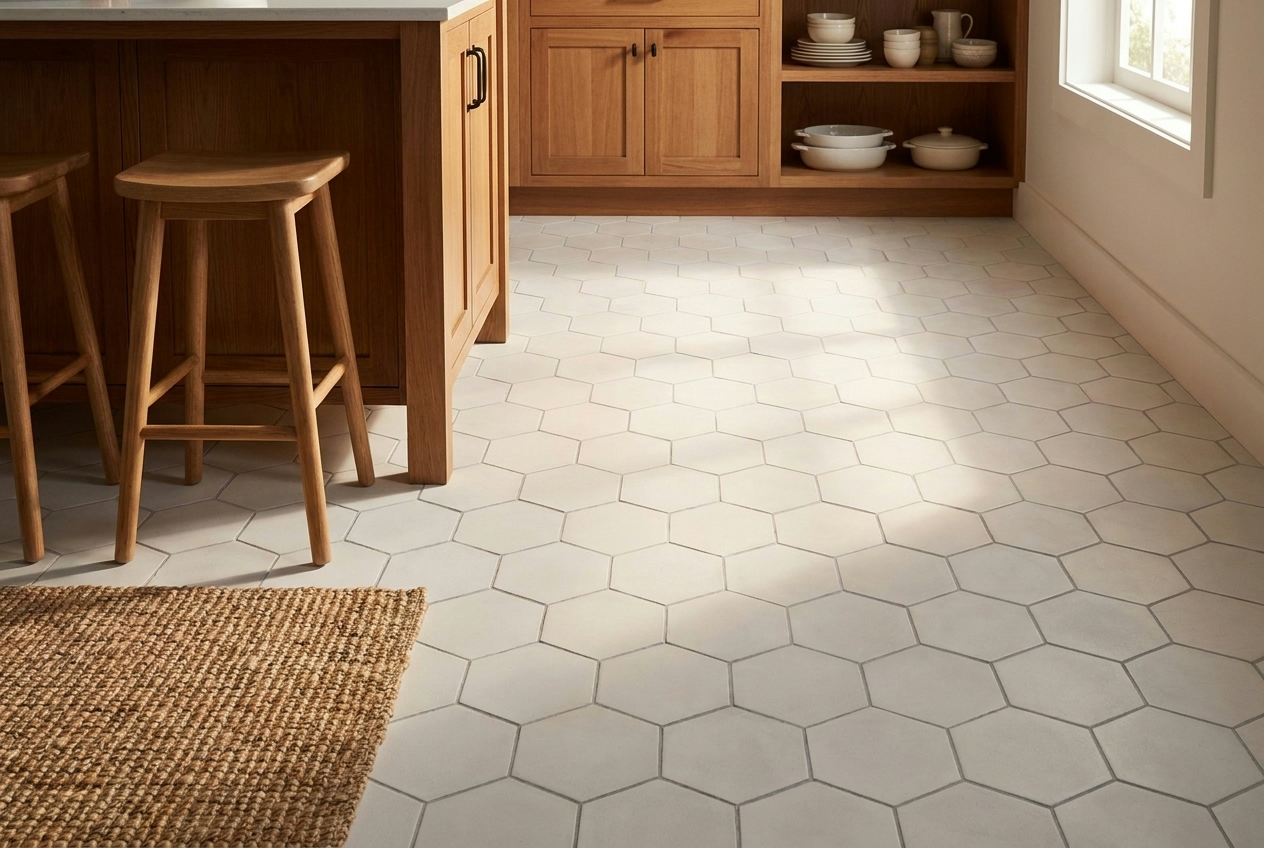
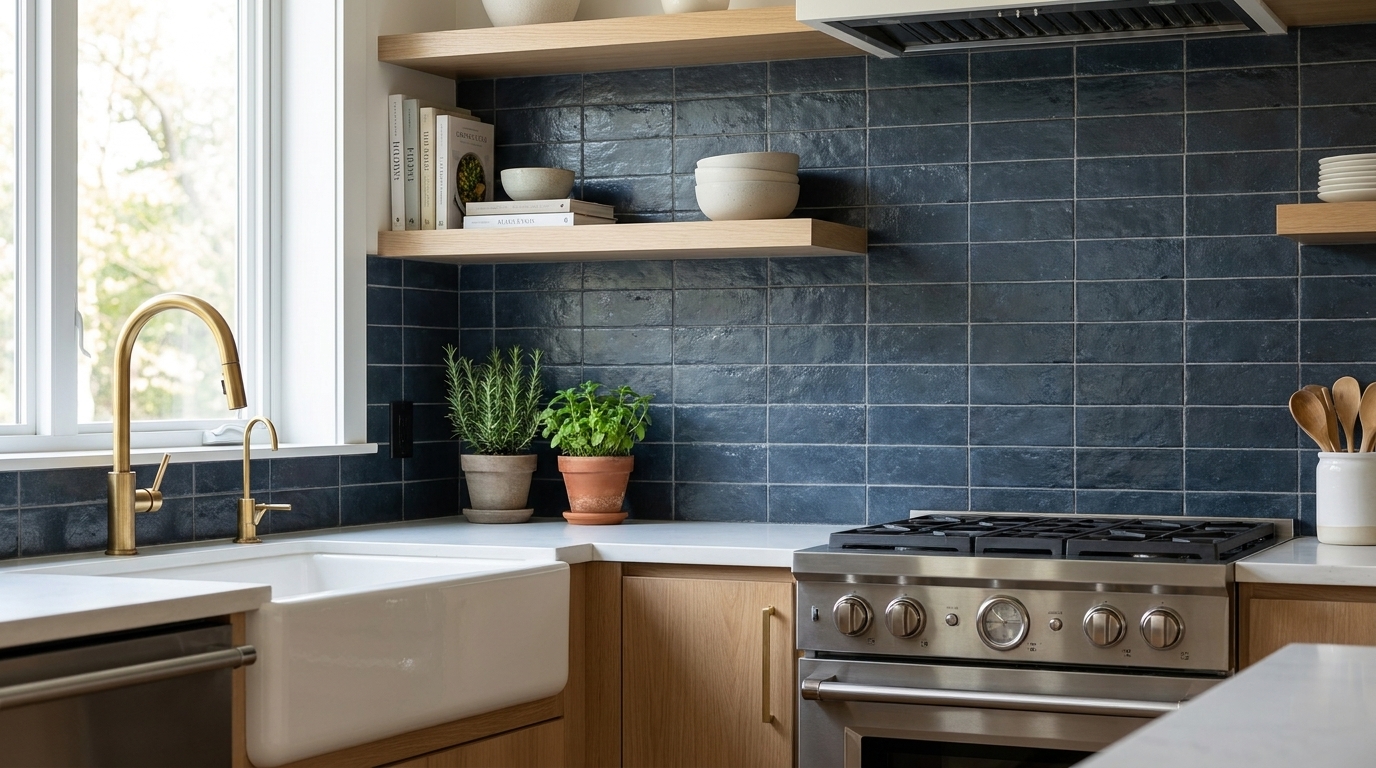
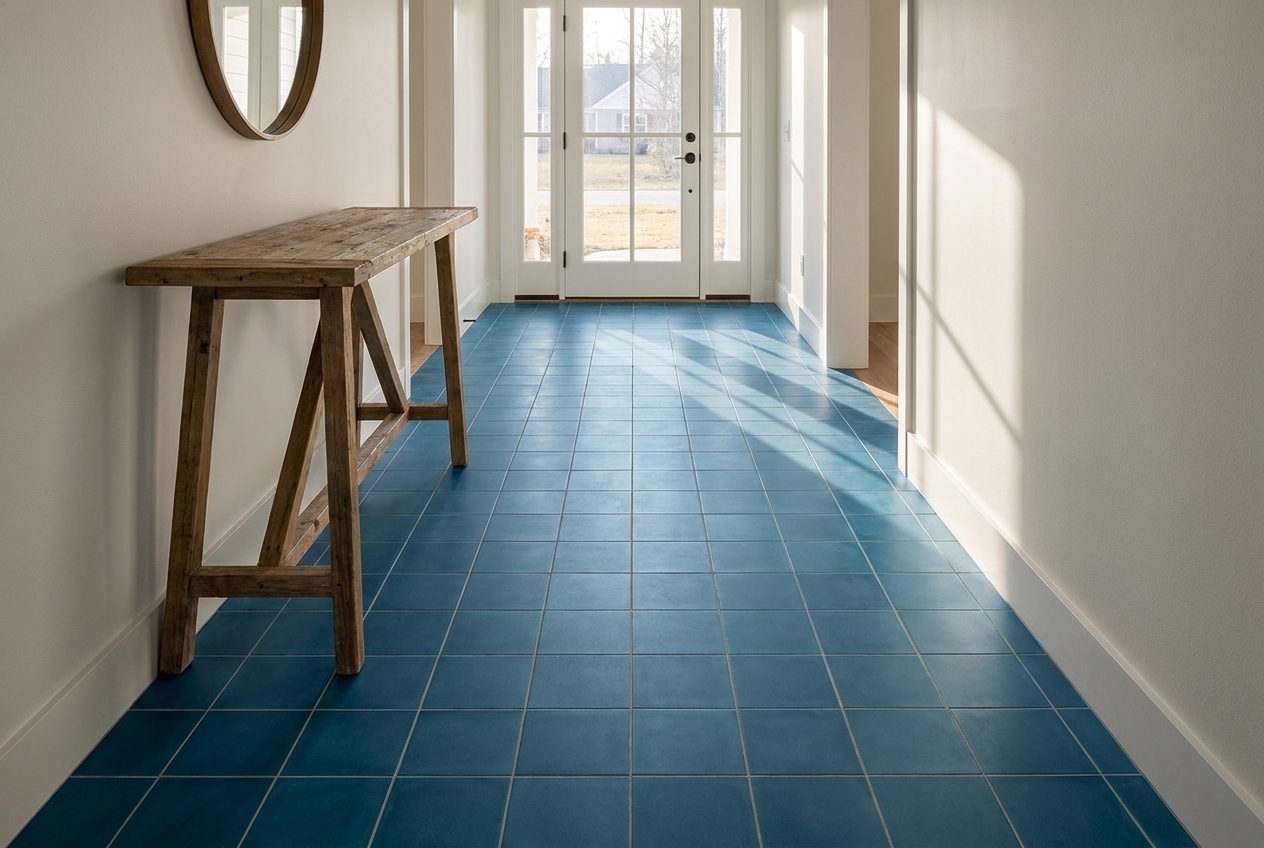
Best applications: Kitchen floors and backsplashes, bathroom floors and feature walls, entryways, staircase risers, covered terraces, hospitality and commercial interiors, anywhere pattern and craftsmanship matter.
Explore handmade cement tile patterns in the In-Stock Collection, or develop something entirely your own through the Custom Made Collection.
Porcelain Tiles: The Workhorse of Modern Interiors

Porcelain is the most widely specified tile in contemporary residential and commercial construction — and for good reason. It’s made from highly refined clay fired at extremely high temperatures, producing a tile of exceptional density, very low water absorption, and remarkable durability.
The trade-off is this: porcelain’s technical performance comes at the expense of the visual qualities that make cement and stone tiles special. The pattern on a porcelain tile is printed — a digital image applied to the surface. The result can be beautiful and convincing, but it remains a photograph of a material rather than the material itself.
What porcelain does best:
- Hardness and scratch resistance — porcelain has a very high Mohs hardness rating and resists scratching and impact well
- Water resistance — its extremely low water absorption rate (less than 0.5%) makes it ideal for wet areas, showers, and outdoor exposed applications
- Maintenance simplicity — sealed or glazed surfaces clean easily and rarely require re-sealing
- Large-format capability — porcelain can be manufactured in very large slabs (up to 120″ × 60″ or larger) for seamless, joint-free looks
Where porcelain falls short:
- Visual depth — even the most convincing wood-look or stone-look porcelain reads as printed at close range; it lacks the materiality of the real thing
- Slip resistance in larger formats — large-format polished porcelain can be extremely slippery when wet; anti-slip treatments add complexity and cost
- Repairability — cracked porcelain tiles often require full-field replacement, as matching dye lots years later is difficult
- Emotional resonance — porcelain is efficient and practical, but it rarely makes a room feel special
Best applications: High-traffic commercial floors, wet areas (showers, pool surrounds), exterior applications subject to freeze-thaw cycles, projects where maintenance minimization is the primary brief.
Ceramic Tiles: The Practical All-Rounder

Ceramic tiles share a family resemblance with porcelain — both are fired clay — but the clay body in ceramic tiles is less refined and fired at lower temperatures, producing a softer, more porous tile that’s less dense than porcelain. Most ceramic tiles have a glazed surface that provides color, pattern, and water resistance.
Ceramic has been the default tile for bathroom walls and kitchen backsplashes for decades — reliable, widely available, and more affordable than the alternatives. The classic subway tile that’s appeared in every renovation show of the past twenty years is almost always ceramic.
What ceramic does well:
- Affordability — ceramic is the most cost-accessible option of the four, making it the natural choice for large projects with tight material budgets
- DIY-friendly installation — ceramic’s softer body is easier to cut than porcelain or stone, making it more forgiving for non-professional installers
- Wide availability — every tile supplier and big-box store carries an extensive ceramic range
- Wall applications — ceramic’s lighter weight makes it well-suited to wall applications where heavy tile formats would require additional substrate reinforcement
Where ceramic has limitations:
- Durability — ceramic’s softer body scratches, chips, and wears more readily than porcelain, making it a poor choice for heavy-traffic floor applications
- Water resistance — the glaze is water-resistant, but the body beneath it is not; if the glaze chips or cracks in a wet area, the porous body beneath can absorb moisture and lead to problems over time
- Design ceiling — while ceramic glazing technology has improved enormously, the printed surface still has a visual flatness compared to the natural variation of cement or stone
- Longevity — ceramic floors in high-traffic areas typically show wear within 10–15 years; cement tile floors last for decades
Best applications: Bathroom walls, kitchen backsplashes, laundry rooms, low-traffic decorative applications, renovation projects with tight tile budgets.
Natural Stone Tiles: The Prestige Choice

Natural stone — marble, travertine, limestone, slate, quartzite, granite — is the material against which all other flooring has always been measured. No two slabs are alike. The veining in a marble floor is the result of minerals deposited over millions of years; no printing process can replicate what geological time produces.
Stone carries a weight of association — with grandeur, with permanence, with quality — that is entirely its own. In the right project, the right stone floor is simply extraordinary.
What natural stone offers:
- Unmatched visual uniqueness — every slab is different; a stone floor is genuinely one of a kind in a way that no manufactured tile can be
- Prestige and perceived value — natural stone signals quality in a way that is immediately legible and broadly understood
- Thermal mass — stone floors absorb and radiate heat, making them a sensible choice in climates suited to passive solar design and radiant floor heating
- Longevity — well-maintained stone floors in historic buildings have lasted for centuries
Where natural stone requires consideration:
- Maintenance intensity — most stone requires regular sealing and very careful cleaning; acidic substances (including many common cleaners, red wine, citrus juice) can permanently etch polished stone surfaces
- Cost — natural stone is the most expensive option on this list, both for material and for installation (which requires skilled setting in most cases)
- Consistency challenges — natural variation, while beautiful, can make large-area installations with demanding design requirements difficult to execute; matching pieces for repairs years later is nearly impossible
- Weight — stone tiles are heavy, requiring reinforced substrates in many applications
- Slip risk — polished marble and limestone are famously slippery when wet; honed or textured finishes mitigate this but alter the aesthetic
Best applications: Primary bathrooms, entryways, feature floors in residential projects where budget allows, commercial lobbies, architectural landmark spaces.
How to Choose: A Practical Decision Guide

The right tile is never just about technical performance — it’s about what you want your space to feel like and what you’re willing to invest in maintaining it. Here’s a framework for making the decision:
Choose cement tiles when:
- Pattern, color, and visual depth are central to the design concept
- You want a surface that develops character and improves with age
- The project calls for a handmade, artisan, or culturally resonant material quality
- You’re working on a kitchen, bathroom, entryway, staircase, or hospitality space where the tile will be the design focal point
- Sustainability and low-energy manufacturing matter to the client
Choose porcelain when:
- The application is a fully exposed outdoor space subject to weather
- The project is a high-traffic commercial floor where maintenance minimization is the priority
- Large-format, joint-free installation is the design goal
- The shower or wet area brief requires zero water absorption
Choose ceramic when:
- The application is a bathroom wall or kitchen backsplash with a standard budget
- The client wants a straightforward, low-maintenance tile at an accessible price point
- The design concept centers on a classic subway tile or simple field tile format
Choose natural stone when:
- Budget supports the material and installation premium
- The project is a primary bathroom, architectural lobby, or prestige residential space
- The client values uniqueness, natural variation, and the irreplaceable quality of geological material
A note on mixing materials: Some of the most compelling contemporary interiors use more than one tile type in the same space — a cement tile floor paired with a simple ceramic wall tile, or a stone countertop surface alongside a patterned cement backsplash. The skill is in knowing which material carries the design concept and which one supports it.
Use the Original Mission Tile Design Studio to visualize cement tile patterns in context, and browse the Projects Gallery to see how cement tiles work alongside other materials in real completed projects.
FAQ: Cement vs. Porcelain vs. Ceramic vs. Stone
Are cement tiles as durable as porcelain? In most residential applications, yes — with proper sealing and maintenance, cement tiles are extremely durable and last for decades. Porcelain has a technical edge in water absorption and scratch hardness, which makes it the better choice for fully exposed outdoor applications and very high-traffic commercial floors. For kitchens, bathrooms, and most residential uses, cement tiles perform beautifully over the long term.
Which tile is easiest to maintain? Glazed porcelain and ceramic tiles are the easiest to maintain day-to-day — they require no sealing and clean with almost any household cleaner. Cement and stone tiles both require periodic sealing and neutral-pH cleaners, but the maintenance is simple and infrequent once properly established. The investment in maintenance is the cost of having a surface with genuine material depth.
Can cement tiles go in a shower? Yes — with proper waterproofing behind the substrate and a penetrating sealer formulated for wet environments. Cement tiles’ natural matte surface offers better slip resistance than polished porcelain or stone. Always specify professional installation for wet-area applications.
Are cement tiles more expensive than porcelain? Cement tiles are typically priced at a premium over standard porcelain, reflecting the handmade production process and the quality of mineral pigments. The comparison changes, however, when you’re looking at high-end large-format porcelain slabs or premium natural stone — in those contexts, cement tiles are often comparable in price. And unlike any manufactured tile, cement tiles appreciate in perceived value over time rather than simply aging.
What tile is best for a kitchen floor? Cement tiles are one of the best choices for kitchen floors — the mineral pigment runs through the full wear layer, the matte surface is slip-resistant, and the warm color family of most cement tile palettes absorbs the visual evidence of everyday cooking life gracefully. Porcelain is the alternative for clients who want zero maintenance above all else. Ceramic is generally too soft for heavy kitchen floor traffic.
Conclusion: The Tile That Tells the Right Story
Every tile material on this list is capable of producing a beautiful floor or wall. The question isn’t which one is objectively best — it’s which one is right for this space, this client, and this story.
Porcelain and ceramic offer reliability and ease. Natural stone offers prestige and geological uniqueness. And cement tiles offer something that none of the others can fully replicate: the combination of craft, pattern, color depth, and authentic materiality that transforms a surface from a specification into the soul of a room.
If you want a tile that your clients will still be talking about in twenty years — that will photograph beautifully on day one and keep getting better with age — cement tiles deserve a place at the top of your consideration list.