You're probably in one of two situations right now. Either you're detailing a restaurant kitchen for the first time and discovering that floor finish decisions affect safety, health inspections, schedule, and long-term operating cost more than the owner realizes. Or you're trying to reconcile two conflicting demands in one project: a back-of-house floor that can take abuse every day, and a front-of-house surface that still supports the design story.
That's where commercial kitchen tile gets tricky. The wrong choice doesn't usually fail on day one. It fails slowly, through slippery grease films, stained grout, cracked transitions, tedious deep cleaning, and repair work that has to happen while a restaurant is trying to stay open.
Most specifications focus too heavily on the tile price and too lightly on the system around it. In practice, owners feel the cost later through labor, shutdowns, replacement cycles, and sanitation risk. Smart selection means assigning the right material to the right zone, then detailing the assembly so operations stay stable long after opening day.
The High Stakes of Specifying Commercial Kitchen Tile
A commercial kitchen floor has to do several jobs at once. It has to resist slips under grease and water, hold up under carts and dropped equipment, tolerate aggressive cleaning, and stay cleanable at the edges and joints. At the same time, it has to fit the budget and the construction schedule.
That tension is one reason tile decisions matter so much in restaurant work. In the United States, the ceramic tile market is projected to grow from USD 5.28 billion in 2026 to USD 6.76 billion by 2031 at a CAGR of 5.07%, with a significant share tied to renovation and replacement in spaces like kitchens that need durable, easy-to-clean surfaces, according to U.S. ceramic tile market projections from Mordor Intelligence. Renovation-driven demand tells you something important. Owners keep coming back to these decisions because surfaces wear out, operations change, and old specifications don't always age well.
What usually goes wrong
On paper, many tile options can look acceptable. On site, a few common mistakes create most of the headaches:
- Choosing by appearance first: A handsome surface can still become a maintenance burden if the grout stains, the texture traps soil, or replacement pieces are hard to source.
- Ignoring transitions and edges: Floors rarely fail in the field tile first. They fail at drains, coved bases, thresholds, and movement points.
- Treating the kitchen as one uniform zone: Prep, cook line, dish area, service corridor, bar back, and open kitchen all ask for different things.
- Underestimating downtime: A repair that seems minor on a drawing set can become a major operational problem once the kitchen is running.
Practical rule: If you can't explain how the floor will be cleaned, repaired, and kept open during maintenance, the specification isn't finished.
The defensible approach is simple. Start with performance, then hygiene, then installation, then life-cycle cost, and only then refine the aesthetic layer. That order protects both the operator and the design team.
Decoding Performance The Language of Tile Specification
Before you compare products, you need to read the data sheet like someone who will be blamed if the floor fails. Technical terms aren't filler. They're how manufacturers tell you what the tile can and can't do.
Start with slip resistance
Think of DCOF as the tread pattern on a tire. A kitchen floor doesn't need to be rough in a random way. It needs a surface profile that still provides traction when water, oil, and food residue show up.
For commercial kitchen tile, don't stop at marketing words like “slip resistant” or “non-skid.” Ask for the actual test data, the test method used, and whether the tile's texture is appropriate for greasy service areas rather than dry retail floors. Also ask the rep what happens after repeated cleaning cycles. Some textures lose practical slip performance because they either polish in traffic lanes or become hard to clean thoroughly.
Check abrasion and wear realistically
PEI rating is often discussed for glazed tile wear. It matters most when you're reviewing glazed ceramic or porcelain products for traffic exposure. But it's not the whole story in a kitchen. A floor can score well for abrasion and still perform poorly if the surface gets slick, the grout system fails, or the body of the tile chips under impact.
For back-of-house work, I treat abrasion data as one input, not the deciding input. Kitchens punish assemblies in multiple ways at once.
Read water absorption as a maintenance clue
Water absorption tells you how porous a tile body is. That affects staining risk, chemical tolerance, freeze-thaw suitability in some settings, and how forgiving the product is during daily washdown and deep cleaning.
A lower-absorption body usually gives you a tighter maintenance profile. But don't let that create false confidence. A low-absorption tile paired with weak grout, poor drain slope, or bad perimeter detailing can still become a sanitation problem.
Ask one question every time you review a sample: “What part of this system is most likely to hold dirt, grease, or moisture?” It's usually not the tile face. It's the joint or transition.
Don't ignore breaking strength
Breaking strength is the plain-language measure of how much abuse the tile can absorb before it fractures. In a restaurant kitchen, that means carts, rolling racks, dropped stock pots, and point loads from equipment. A tile that looks dense in hand can still fail if the substrate flexes or the installation leaves voids beneath the corners.
This is why technical review can't happen in isolation from the floor assembly. The tile, mortar, grout, slope, movement joints, and substrate prep all work together.
What to verify on every data sheet
Use this quick review list when a manufacturer sends cutsheets:
| Specification item | Why it matters in a kitchen |
|---|---|
| Slip resistance data | Helps you judge traction in wet or contaminated conditions |
| Water absorption | Signals porosity, stain behavior, and maintenance implications |
| Breaking strength | Indicates resistance to impact and load stress |
| Surface texture | Affects both safety and ease of cleaning |
| Recommended setting materials | Tells you whether the manufacturer treats the tile as part of a full system |
| Trim and cove availability | Determines whether you can detail hygienic transitions properly |
A junior designer's mistake is assuming a tile is a finish. In food-service work, it's infrastructure.
Comparing the Workhorses Quarry vs Porcelain and Other Options
When teams discuss commercial kitchen tile, the comparison usually starts with quarry tile versus porcelain. Those are the two materials that come up most often because they solve different problems well.

Quarry tile for hard service floors
Unglazed quarry tile, often in a 6" x 6" format, remains a long-standing favorite for commercial kitchen floors because of its inherent slip resistance, strength, and ease of installation, as noted in Metro Ceramics' overview of unglazed quarry tile. The same source notes broader kitchen tile demand, with the global kitchen tile market estimated at USD 29.79 billion in 2023 and projected to reach USD 39.4 billion by 2032, reflecting demand for both durable and visually appealing kitchen spaces.
That 6-by-6 format works for practical reasons, not nostalgia. It's large enough to build a durable floor and small enough to handle slope, drains, and quick replacement more gracefully than oversized units. It also tends to suit back-of-house crews who care more about traction and serviceability than visual continuity.
Quarry tile is usually the safer default for these zones:
- Cook lines
- Dish rooms
- Service corridors
- Production kitchens
- Janitorial and utility spaces
Its weak point isn't usually durability. It's that some clients and designers don't want the look in visible guest-facing areas.
Porcelain for cleaner visual lines
Porcelain earns its place when the project needs a tighter visual language, larger formats, or a more refined transition into public zones. In open kitchens, coffee bars, bakery counters, and hybrid service spaces, porcelain can bridge performance and aesthetics better than quarry tile.
That said, porcelain isn't automatically the better kitchen floor. It depends on the finish, edge condition, grout system, and installer discipline. A smooth porcelain that looks elegant in the showroom can become a problem in a greasy environment. Large-format porcelain can also complicate drain layout and replacement work.
For a broader review of assemblies and use cases, this guide to commercial kitchen flooring options is a useful reference point when you're weighing visible design goals against back-of-house demands.
Other materials people ask about
Natural stone comes up more often in concept presentations than in well-run kitchens. It can work on feature walls, bars, or selected front-of-house surfaces, but in active food prep areas it usually creates avoidable maintenance and sanitation concerns. The issue isn't whether stone can be sealed. The issue is whether the owner will maintain it correctly under commercial conditions.
Commercial-grade vinyl products also enter the conversation when budget pressure is high or the client wants fast installation. They can make sense in some ancillary spaces, but they don't deliver the same long-term heat tolerance, edge durability, or repair logic as a properly detailed tile assembly in the harshest wet zones.
If the kitchen is the revenue engine, specify the floor like equipment, not decor.
A practical comparison
| Material | Where it fits best | Main strengths | Main trade-offs |
|---|---|---|---|
| Unglazed quarry tile | BOH wet and greasy areas | Traction, durability, easy spot replacement | Limited aesthetic range |
| Porcelain tile | Open kitchens, bars, transitional zones | Broad design options, low absorption body | Finish selection is critical, large formats can complicate slope |
| Natural stone | FOH feature areas, walls, selective accents | Rich character, premium visual effect | Ongoing sealing and stain risk |
| Commercial-grade resilient flooring | Secondary support spaces | Faster install, softer underfoot in some cases | Not ideal for the harshest kitchen exposures |
The right answer on most restaurant projects isn't one tile. It's a zoning strategy.
Meeting Health Codes and Ensuring Hygiene
Health inspectors don't care whether the tile looked good in the presentation. They care whether the finished assembly can be cleaned thoroughly and whether it leaves places for moisture, food waste, and bacteria to collect.

The floor is only half the system
The most common hygiene failure in tiled kitchens is not the field tile. It's the joint, corner, base, or drain connection. A beautiful specification can still produce an unsanitary room if the wall-to-floor intersection is sharp, cracked, or impossible to mop clean.
That's why coved bases matter. They remove the dirt-catching inside corner and create a cleanable transition from wall to floor. If the project has frequent washdown, wet mopping, or chemical cleaning, that radius becomes even more important.
Grout and transitions carry most of the risk
Grout choice affects sanitation more than many owners understand. Wider, more absorbent joints can mean more scrubbing, more discoloration, and more maintenance over time. Even a strong tile body won't rescue a poor grout decision.
The same logic applies to sealers. In front-of-house decorative areas and certain porous materials, a sealer may be part of the protection strategy. In service areas, though, don't treat sealers as a substitute for an appropriately designed material system. If you're evaluating that part of the specification, this overview of ceramic tile sealers is helpful for understanding where sealers fit and where they don't.
What inspectors and operators both want
Use this checklist when reviewing details with the architect, kitchen consultant, and installer:
- Coved base at perimeter: Eliminates hard-to-clean corners and supports washdown conditions.
- Proper slope to drains: Standing water turns a durable floor into a safety and sanitation problem.
- Non-porous or high-performance grout selection: Reduces staining and simplifies cleaning protocols.
- Tight detailing at penetrations: Pipe escutcheons, equipment legs, and transitions should not create inaccessible pockets.
- Repairable layout logic: A hygienic floor also needs a plan for replacing damaged pieces without wrecking adjacent work.
A health-compliant kitchen isn't defined by material labels. It's defined by whether every surface can be cleaned consistently by the staff who actually work there.
Owners sometimes spend heavily on visible finishes and then try to save money on the least visible kitchen details. That's backwards. Hygienic detailing is one of the few specification choices that protects safety, operations, and inspections at the same time.
Best Practices for Installation and Long-Term Maintenance
The most expensive commercial kitchen tile is the one that has to be repaired during service. Installation quality decides whether the owner gets a durable floor or a recurring maintenance line item.
Installation choices that affect operations later
Substrate prep is where many problems start. If the slab is out of tolerance, contaminated, cracked, or improperly sloped, the tile installer ends up compensating in ways that weaken the finished assembly. Hollow spots, lippage near drains, and cracked corners often trace back to prep, not tile quality.
Movement joints matter too. Restaurant projects often involve hot washdowns, refrigeration areas, direct sun near entries, and structural movement from active service loads. If the tile field has nowhere to relieve stress, something else gives first.
Grout selection is another long-term decision disguised as a line item. Industry analysis highlighted in GS Tile's discussion of commercial kitchen tile notes that many specifiers focus on upfront price while missing the bigger question: what flooring minimizes downtime and maintenance labor over the life of the kitchen? The same discussion points out that systems with narrower grout joints can reduce long-term grout maintenance and deep-cleaning labor, which directly affects total cost of ownership.
Think in labor hours and closure risk
A kitchen operator experiences flooring costs in very practical ways:
- How long the closing crew spends scrubbing joints
- Whether stains trigger extra deep-cleaning cycles
- How often isolated failures need patching
- Whether repairs can happen overnight or force a shutdown
That's why a higher upfront grout or installation cost can still be the better value. If the joint stays cleaner, the floor is easier to maintain. If replacement is simpler, operations recover faster when damage happens.
For maintenance protocols, cleaning chemistry matters as much as the material. Teams managing hard-surface hygiene in regulated settings often prioritize cleaners that won't degrade finishes unnecessarily. That same thinking shows up in resources on preventing VRE infections in healthcare facilities, where surface compatibility and cleanability are treated as operational concerns, not housekeeping trivia.
The specification question I'd ask the owner
Ask this before the finish schedule is locked:
“Would you rather save money at install, or save labor and disruption every month the kitchen is open?”
Most owners answer too quickly until you translate the trade-off into real operations. A floor that cleans faster, needs fewer aggressive interventions, and allows targeted repair is often the stronger financial choice even if it doesn't win the first bid comparison.
For commercial kitchen tile, total cost of ownership comes from the whole assembly. Tile body, format, grout width, grout chemistry, slope, drain detailing, and maintenance protocol all show up later in payroll and downtime.
Where Handmade Cement Tile Fits in Commercial Design
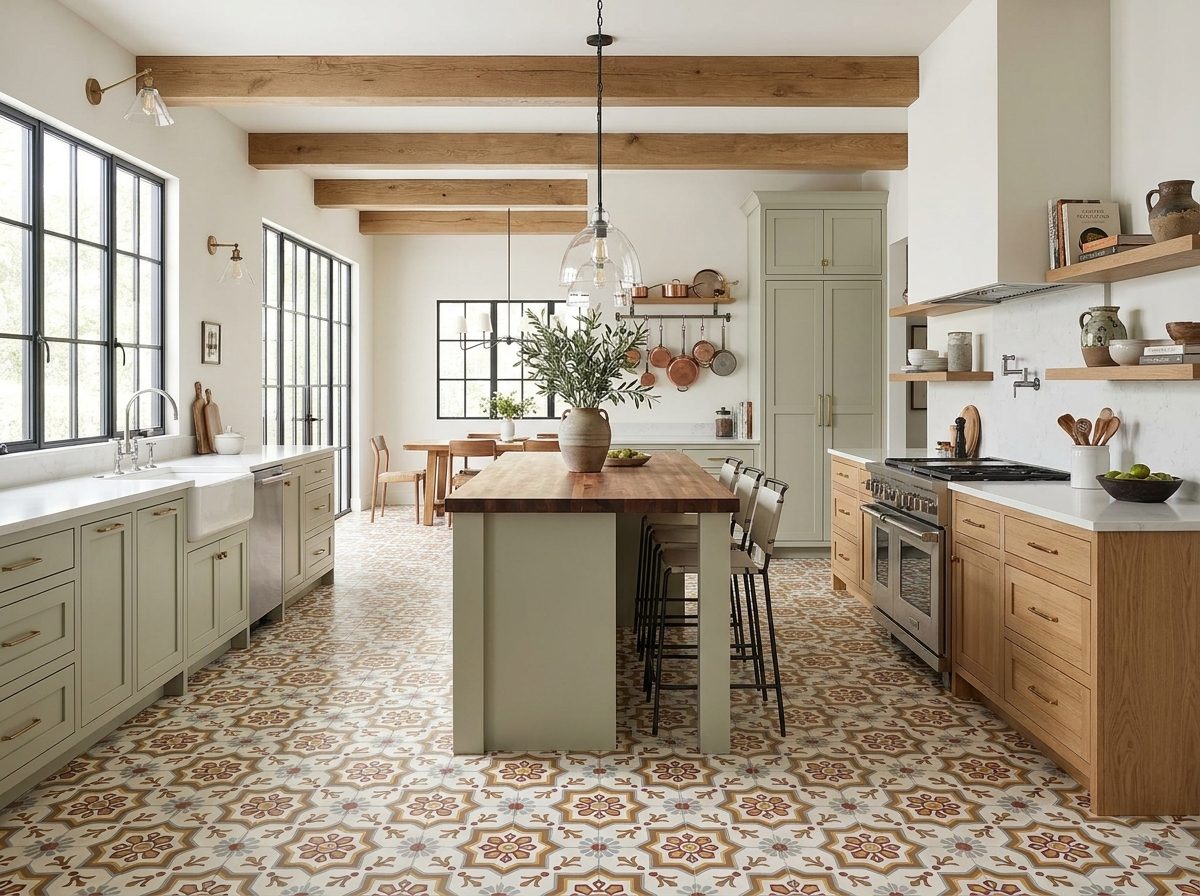
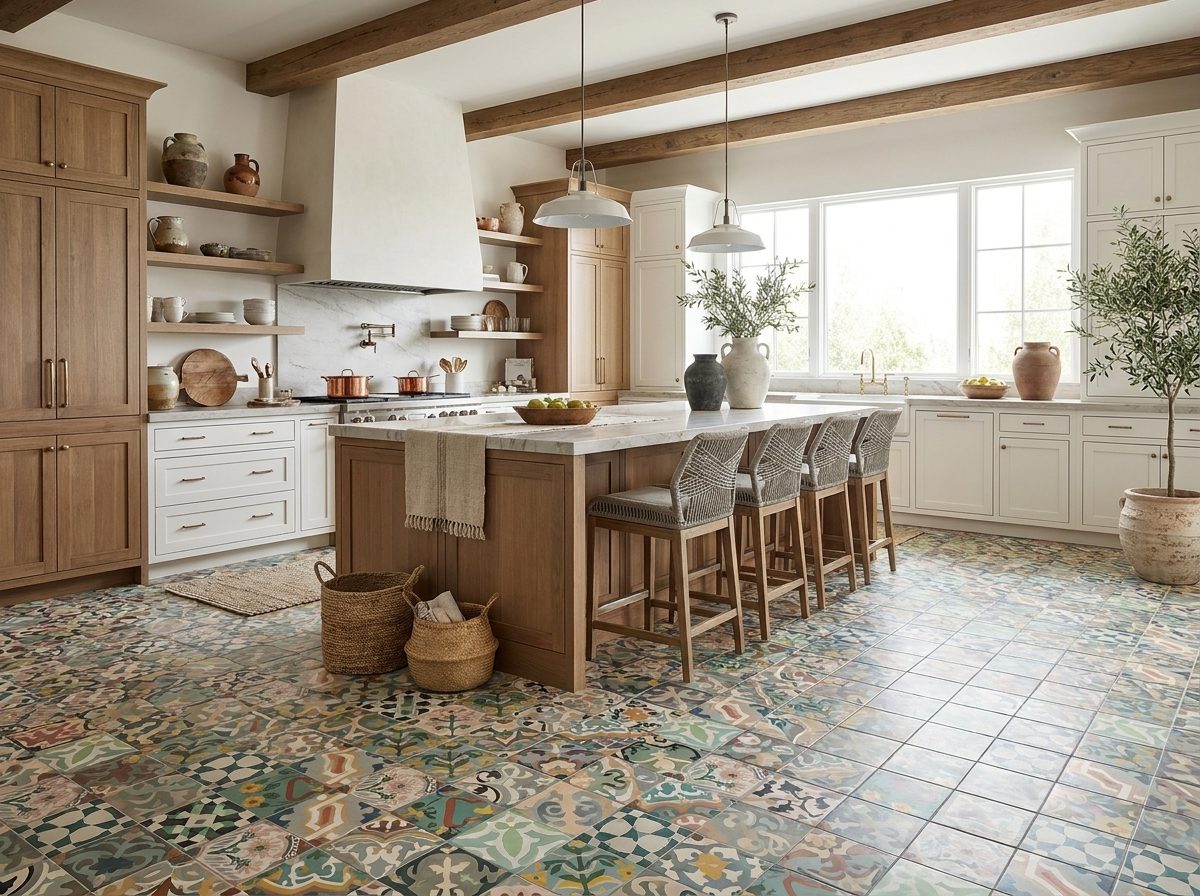
Handmade cement tile belongs in the conversation, but not as a direct substitute for quarry tile in greasy back-of-house production areas. That distinction matters. Used in the right zone, cement tile can add character and durability. Used in the wrong one, it creates unnecessary maintenance risk.

Where cement tile makes sense
Cement tile performs best where the design needs more visual weight and the exposure is controlled compared with a heavy-duty cook line. Good placements include:
- Restaurant entry floors
- Bar fronts and bar-adjacent floors
- Open kitchen boundaries visible to guests
- Restrooms
- Host stands and waiting areas
- Feature walls
In those settings, the matte surface and through-body pattern give a project something porcelain often doesn't. The floor reads crafted rather than manufactured. That can be a major asset in hospitality work where guests notice texture, pattern, and material depth.
Where it does not belong
Cement tile is not my first choice for high-grease back-of-house floors, dish pits, or harsh utility zones. Its porosity means sealing and maintenance discipline matter more, and many restaurant operators won't maintain those surfaces with the consistency required in the most punishing service areas.
That doesn't make it a weak material. It means the designer has to match the material to the operational reality. A floor can be durable and still be wrong for one particular exposure.
How to use it without creating a maintenance problem
The strongest strategy is mixed-material zoning. Use quarry or appropriately specified porcelain where the floor takes daily punishment. Use cement tile where guests experience the brand and where maintenance can be controlled more predictably.
If you're specifying decorative patterned surfaces for hospitality work, handmade cement tile is one category worth considering for those front-of-house and transitional applications. Original Mission Tile, for example, manufactures cement tile for floors, walls, and custom commercial designs. That makes it relevant when the project needs a bespoke visual element rather than a purely utilitarian back-of-house finish.
The right hospitality floor often uses two materials well instead of asking one material to do everything poorly.
The design value is real, but so is the responsibility
Cement tile asks more of the design team upfront. You need to plan sealing, cleaning methods, spare stock, and pattern transitions carefully. But in the right location, it solves a real design problem. It gives restaurants a memorable surface without resorting to a disposable-looking finish.
That's especially useful in open-plan concepts where the guest sees part of the working kitchen. In those projects, the best outcome often comes from separating true production zones from visual kitchen zones, then assigning materials accordingly.
Design Inspiration From Real Commercial Kitchens
The easiest way to understand commercial kitchen tile is to look at it by concept, not by product category. Good projects rarely use one surface everywhere.

Fast-casual with a visible prep line
A high-volume fast-casual concept usually wants simple maintenance and fast turnover. In that case, I'd keep the true prep and dish areas on quarry tile for traction and serviceability. Then I'd shift to a cleaner-looking porcelain in the customer-facing queue and beverage pickup area, where the visual standard is higher and grease exposure is lower.
The key move is not the material swap itself. It's placing the transition where staff can still clean it and where guests don't read it as accidental.
Neighborhood pizzeria with an earthy interior
This is a project type where quarry tile often works in both practical and aesthetic terms. The kitchen benefits from its toughness, and the dining room can pick up related earthy tones through brick, terracotta, or other warm surfaces without forcing an exact material match.
That kind of project doesn't need polished visual perfection. It needs cohesion. Quarry tile in the back and more expressive rustic finishes in front can feel intentional if the palette is handled carefully.
Modern café with an open bar and pastry display
In a sleek café, oversized visual moves matter more. I'd usually keep the hidden production area on a durable, heavy-duty floor, then specify a refined porcelain or patterned decorative tile in the guest zones. If the bar front or pastry counter needs a focal point, that's where a handmade patterned surface can justify itself.
The lesson from all three examples is the same. Don't ask one tile to satisfy every condition in the building. Use zoning to make the operations team happy and the design concept legible.
Frequently Asked Questions about Commercial Tile
Can you tile over an existing floor in a restaurant renovation
Sometimes, but I treat that as an exception, not a shortcut. The existing surface has to be structurally sound, properly bonded, and compatible with the new assembly. You also have to think through finished floor height, door clearances, equipment bases, and drain conditions. In kitchens, hidden substrate problems usually become your problem later.
What grout color is smartest in a high-stain area
Mid-tone grout usually ages better than very light grout in active service zones. It hides normal discoloration better without making the floor look perpetually dirty. But color doesn't solve chemistry or hygiene. The grout type and joint design matter more than the shade.
How much spare tile should the owner keep
Enough to handle future repairs from the same production run when possible. Restaurants damage floors in localized areas, so attic stock is practical insurance. Make sure the owner stores field tile, trim, and any specialty pieces, not just the easiest box to grab.
Is large-format tile a bad idea in a commercial kitchen
Not automatically. It can work in selected zones, especially visible ones. But large-format tile becomes less forgiving around drains, slopes, and isolated repairs. In wet back-of-house areas, smaller modules often give the installer and operator a more workable floor.
What's the first sign that a tile specification is failing
It's often not cracked tile. It's chronic dirty-looking grout, standing water, recurring slip complaints, or edge deterioration at transitions. Those symptoms usually tell you the problem is with the system, not just the surface finish.
If you're balancing back-of-house performance with front-of-house design, Original Mission Tile is a practical resource to review for decorative and custom cement tile applications in hospitality projects. Their catalog is most relevant where you need visual impact in entries, bars, restrooms, feature walls, and other guest-facing zones, while keeping harder-duty kitchen areas on more utilitarian tile systems.