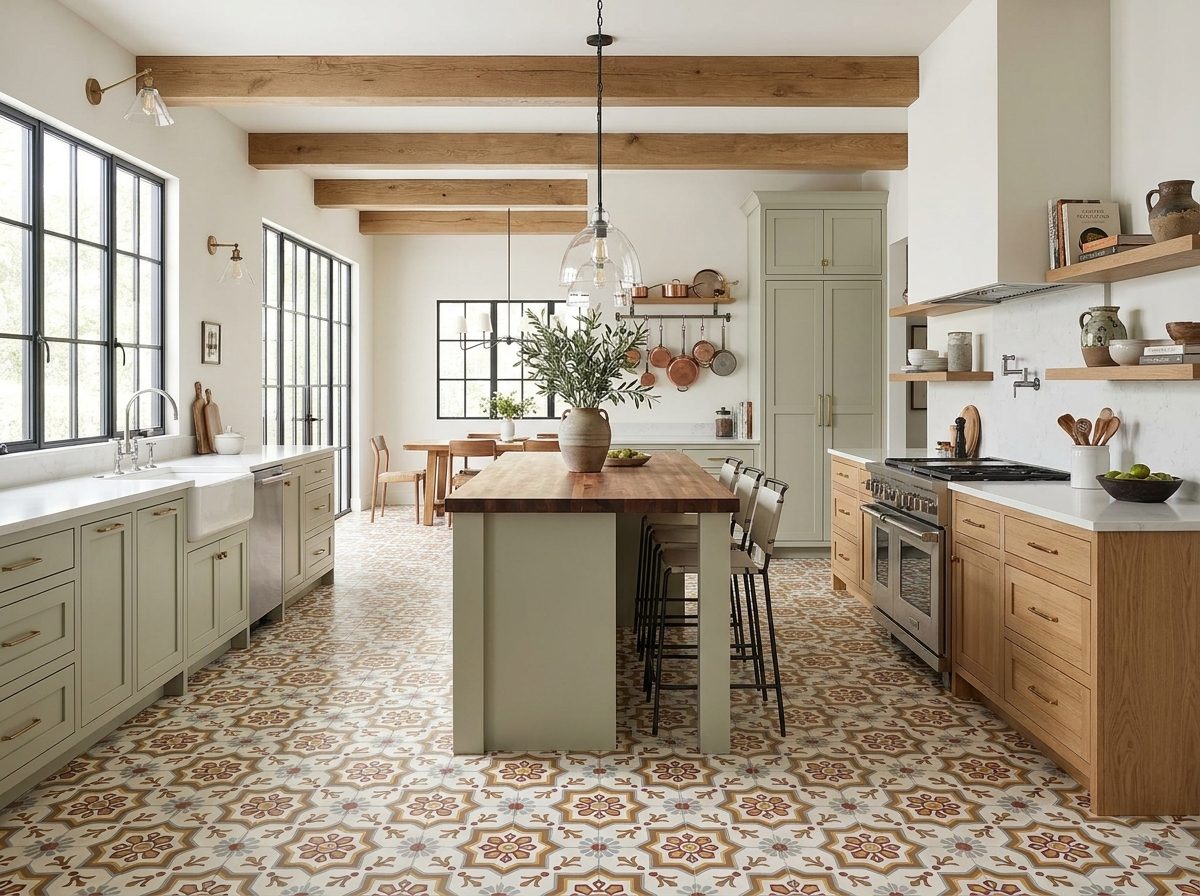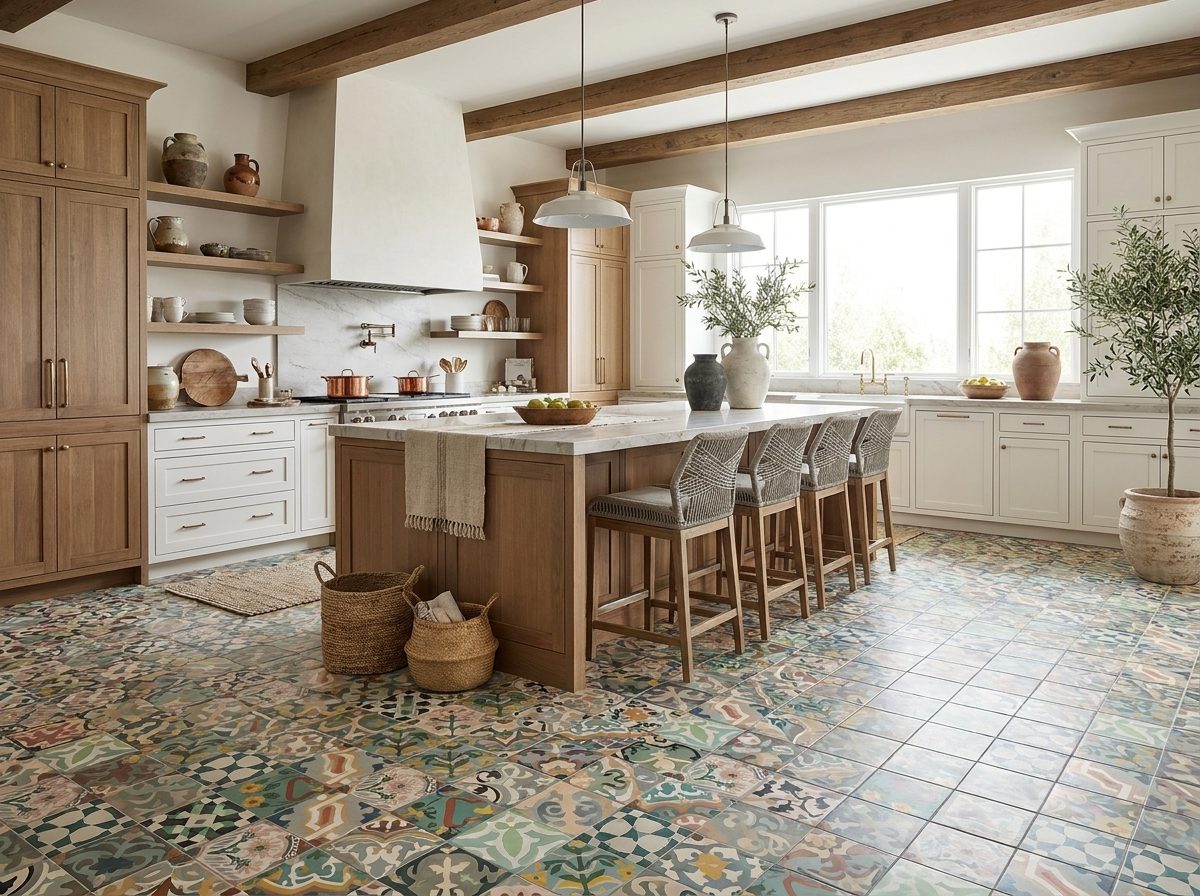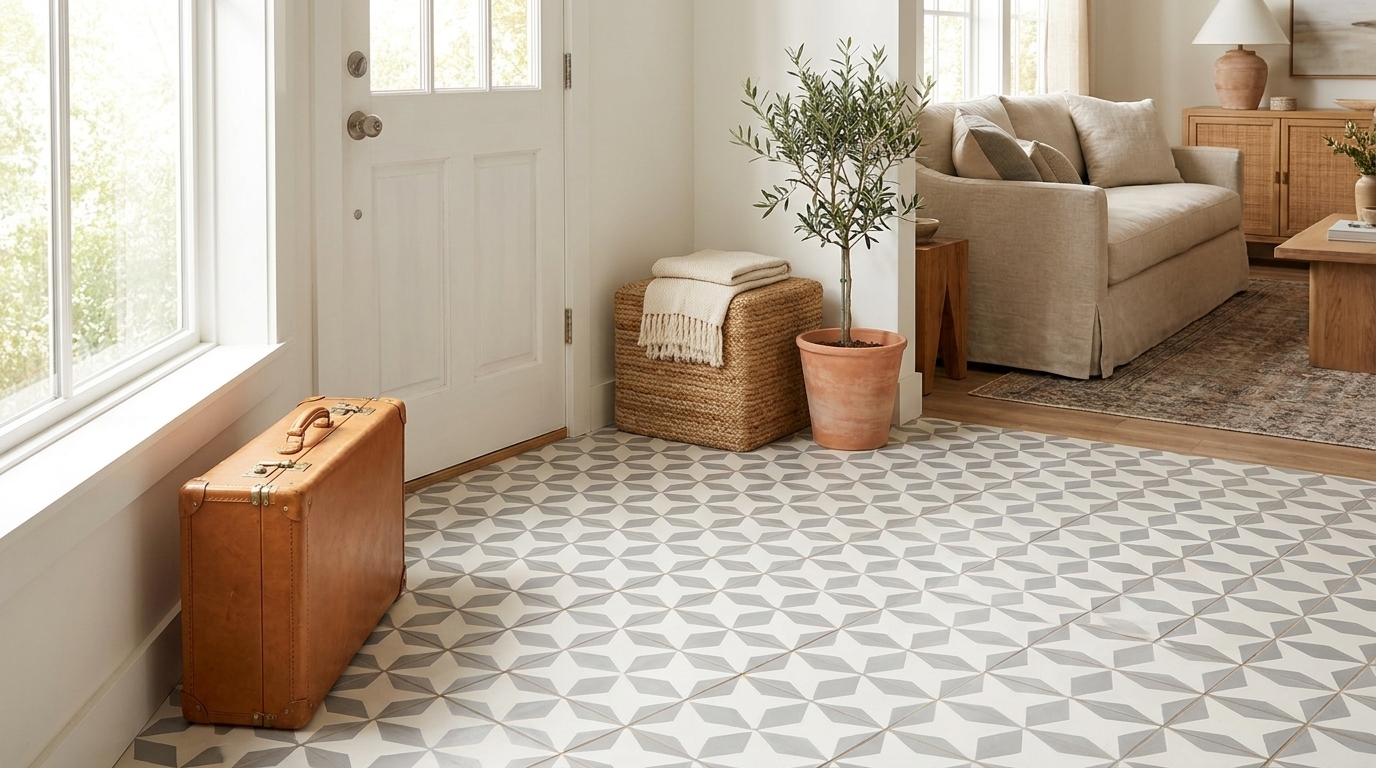
You're probably here because a project needs more than a pretty field tile. It needs scale. A hotel lobby that can't feel busy. A kitchen floor that wants craft without reading rustic. A restaurant entry that has to look custom from the threshold but still survive traffic, mopping, and hard use.
That's where large format cement tile gets interesting. Not because it copies porcelain's oversized slab look, but because it gives you a broader visual field with the depth, matte character, and through-body pattern that only handmade cement tile delivers.
For designers and architects, that distinction matters more now than it did a few years ago. The North American cement tile market is projected to reach $30.3 billion by 2035, growing at +2.5% CAGR, driven by demand for durable, aesthetic, and sustainable materials in residential, hospitality, and commercial work, according to IndexBox's North America market overview. In practice, that means more clients are asking for surfaces that feel authentic, not just efficient. On renovation teams, that often shows up early in planning, especially when architects coordinate with a modern home renovation company in Florida or any builder trying to balance clean lines with durable finish choices.
The Rise of Large Format Cement Tile in Modern Design
Large format cement tile sits in a useful middle ground. It offers the calm, expansive look designers want, but it doesn't flatten a room the way some highly uniform surfaces can. You still get material variation, hand-pressed depth, and a finish that feels grounded instead of slick.
That's why it works so well in spaces that need both restraint and identity. A minimal foyer can stay minimal. A hospitality floor can read bespoke without becoming fussy. A monochrome room can pick up shadow, texture, and pattern without needing contrast from five other finishes.
Why specifiers are paying attention
Cement tile has moved back into serious design conversations because it answers three pressures at once.
- Visual scale: Fewer interruptions across the floor create a broader reading of the room.
- Material honesty: The finish isn't printed on. The color and pattern are part of the tile itself.
- Sustainability alignment: Designers looking for kiln-free materials keep coming back to cement tile as a credible option.
Practical rule: If the room needs presence more than shine, cement tile usually outperforms polished look-alikes.
Where it fits best
Large format cement tile makes the most sense when the project wants one or more of these outcomes:
- A quieter floor plane: Especially in open layouts where too many joints create visual chatter.
- Architectural pattern: A large-scale motif can organize a room without adding extra materials.
- A heritage feel in a contemporary space: The surface has history, but the layout can still feel current.
The demand is real, but so is the confusion. Most online discussions of “large format tile” are still porcelain-centric. Handmade cement tile follows different rules. If you specify it with porcelain expectations, you'll almost always create problems in detailing, procurement, or installation.
Redefining “Large Format” for Handmade Cement Tile
The phrase large format causes trouble because many people borrow the porcelain definition and apply it to a different material. That's the wrong starting point.
In handmade cement tile, large format isn't about chasing the biggest slab possible. It's about pushing visual scale within the limits of a traditional hydraulic-press product. That may mean 12×12, larger custom pieces, hexagons, or layouts that read bigger because the pattern spans multiple tiles instead of ending on each one.
Cement tiles originated in mid-19th century Spain and France as a kiln-free alternative to expensive fired encaustic tiles, and they were showcased at the 1867 Paris International Exposition, as noted in this history of cement tile. That history matters because the manufacturing method hasn't changed in the way porcelain manufacturing has. Handmade cement tile is still shaped by the press, the pigments, the curing process, and the tolerance that comes with handcraft.
Why handmade size behaves differently
A porcelain specifier often thinks in terms of giant, rectified panels. Handmade cement tile doesn't come from that world.
The hydraulic press gives cement tile its density, matte surface, and inlaid wear layer. It also places practical limits on size, repeatability, and edge precision compared with mass-produced porcelain. That's not a flaw. It's the trade that gives the material its depth and character.
Here's the useful shift in thinking:
- Porcelain large format often means oversized dimensions first, design second.
- Cement tile large format often means visual scale first, dimensional strategy second.
That strategy might involve larger individual tiles. It might also involve a repeating patchwork, broad-band geometry, or a motif that expands across a field so the floor reads as one composition.
Think in pattern scale, not slab scale
If you're designing with handmade cement tile, the better question isn't “Can I get this in a giant slab?” It's “How do I make the room read larger and calmer with an authentic material?”
That usually leads to smarter solutions:
- Single-color fields that reduce visual interruption
- Two-tone geometry laid across a broad area
- Large-repeat patterns that unfold over many pieces
- Hexagons or other shaped formats that create movement without clutter
One of the best ways to understand that design language is to study a dedicated handmade cement tile collection rather than comparing it to porcelain catalogs. The vocabulary is different. So are the opportunities.
Handmade cement tile doesn't need to imitate a porcelain slab to feel expansive. It needs the right size, the right repeat, and the right room.
What designers usually get wrong
The common mistake is expecting oversized dimensions to do all the work. In handmade cement tile, oversized dimensions can indeed make a design weaker if the substrate, joint planning, and pattern logic aren't there.
A well-composed 12×12 field can read larger than a poorly detailed oversized tile. A multi-tile motif can feel more architectural than a plain giant square. In other words, large format cement tile is as much about composition as measurement.
That's the mindset that leads to better specifications and fewer jobsite surprises.
Large Format vs Standard 8×8 Cement Tile Compared
The actual decision usually isn't “large format or not.” It's which format best serves the room, the budget, the installer, and the visual goal.
Standard 8×8 cement tile remains the baseline for a reason. It's versatile, easier to handle, and ideal for many traditional patterns. But larger formats and larger-reading layouts can deliver a calmer floor plane and a more architectural effect when the project supports them.

A useful industry reality check comes from a source discussing the category gap around authentic materials. Handmade cement tiles are not typically mass-produced in oversized slabs like porcelain due to the hydraulic press curing process, and a 2025 TCNA report noted that 68% of architects see “size limitations in authentic materials” as a barrier, according to this large-format category page discussing the issue. That barrier is real, but it usually points to a design strategy problem, not a material dead end.
Side-by-side comparison
| Attribute | Large Format Cement Tile (e.g., 12×12, Hexagons) | Standard Cement Tile (e.g., 8×8) |
|---|---|---|
| Visual read | Broader, quieter field with fewer interruptions | More rhythmic, more visibly tiled |
| Pattern scale | Better for oversized geometry and expansive repeats | Better for intricate, dense motifs |
| Grout presence | Reduced visual interruption | Grout becomes part of the pattern language |
| Installation tolerance | Less forgiving of substrate issues | More forgiving on mildly imperfect surfaces |
| Handling on site | Heavier feel, more care during placement | Easier to move, cut, and set |
| Best use cases | Open rooms, feature floors, hospitality, clean-lined interiors | Baths, kitchens, entries, classic and ornamental work |
| Design flexibility | Strong for contemporary compositions and enlarged motifs | Strong for traditional repeats and patchwork variety |
| Risk if poorly specified | Lippage and visual irregularity show fast | Busier look, but fewer dramatic failures from minor flatness issues |
What works visually
Large format cement tile works best when the room wants calm. You're reducing the number of interruptions, so the eye reads area before detail. That's especially useful in long corridors, open-plan kitchens, and commercial floors where a smaller module can create too much texture.
Standard 8×8 works differently. It gives you more cadence. In a patterned installation, those more frequent joints can sharpen the drawing and make a classic design feel crisp rather than crowded.
What works on the jobsite
Installers usually feel the difference before anyone else does.
Larger handmade pieces magnify every issue in the substrate and every inconsistency in setting technique. If the floor is out, the tile tells on you immediately. An 8×8 can absorb small flaws more gracefully. A larger piece can bridge, rock, or telegraph lippage.
That doesn't mean avoid larger formats. It means use them when the project team is prepared for them.
- Choose larger formats when the substrate can be corrected, the layout is disciplined, and the room benefits from longer visual lines.
- Choose 8×8 when the pattern is the star, the schedule is tighter, or the jobsite conditions are less controlled.
- Mix formats when you need hierarchy. A large quiet field with a tighter inset often solves both visual and practical problems.
The larger the handmade tile, the less room you have for jobsite improvisation.
Cost and planning trade-offs
Even without assigning exact budget numbers, the planning pattern is consistent. Larger format work tends to cost more in labor attention because layout, prep, setting, and handling all become less forgiving. It can also require more coordination between designer, contractor, and installer earlier in the process.
Standard 8×8 often gives you more flexibility late in the job. That matters on remodels, phased hospitality work, and any project where field conditions may drift from the drawings.
The right choice depends on which compromise you'd rather make. If you want the broadest visual effect, you'll need tighter technical control. If you want the easiest path through installation, a standard module usually gives you more margin.
Design Strategies for Large Format Tile Layouts
The best large format cement tile floors don't rely on size alone. They rely on layout discipline. A larger tile with a weak pattern plan just looks under-resolved. A thoughtful layout can make a moderate-size handmade tile feel expansive and intentional.

Use field logic before accent logic
Designers often start by chasing a statement motif. That's understandable, but the room usually reads the field first. Establish the broad visual order before you worry about the flourish.
Three layout approaches work especially well:
Monolithic field layouts
Use a single tone or very restrained tonal variation across a broad area. This is the cleanest way to make a room feel larger without making it feel slick or synthetic.Expanded repeat patterns
Build a motif that unfolds across multiple tiles. The floor reads as one composition rather than as many individual pieces.Framed zones
In open spaces, create a “tile rug” for seating, reception, or dining areas. This gives structure without adding a physical transition in material.
Match the scale to the room
A common mistake is using a bold large-repeat pattern in a room that doesn't have enough distance to read it. If the viewer never sees enough of the repeat, the pattern feels chopped up.
Try this rule of thumb in design review: stand where a person will first enter the room and ask what reads first. If the answer is grout or cuts, the layout needs work. If the answer is geometry, rhythm, or a calm field, you're on the right track.
Small rooms
In a compact bath or entry, larger-reading layouts still work. The trick is restraint.
- Keep the palette narrow.
- Let grout blend rather than contrast.
- Avoid a motif that requires too many perimeter cuts.
Large rooms
In larger rooms, don't assume a plain grid is enough. Bigger spaces can swallow subtle pattern.
You may need one of these moves:
- Increase the scale of the motif.
- Use shape, such as hexagons, to create motion.
- Break the field into zones with borders or directional changes.
A large room usually needs either a stronger repeat or a quieter surface. The in-between option often feels indecisive.
Use grout as a visual tool
With large format cement tile, grout isn't just a technical necessity. It's part of the drawing.
A close-value grout minimizes interruption and lets the tile surface carry the room. A contrasting grout emphasizes geometry and can make even a simple layout feel sharper. Neither is automatically right. The better choice depends on whether you want the floor to recede or announce itself.
For hospitality and commercial work, it's smart to decide that in the mockup stage, not on install day. A grout color that looked subtle in a sample board can read much stronger across a broad floor.
Critical Installation and Substrate Requirements
Large format cement tile either succeeds or fails depending on critical aspects. Most problems blamed on the tile arise from substrate and installation problems.

Per ANSI A137.1, large format cement tiles require at least 90% mortar contact, and substrates must be flat to 1/8 inch over 10 feet to reduce lippage and shear failure risk, as outlined in this large-format tile setting specification. That's the number to keep in front of everyone on the team. Not close. Not “good enough.” Flat.
Substrate flatness is not negotiable
Large handmade tiles amplify irregularity. If the slab or underlayment has dips, crowns, or waves, the tile bridges those defects. Once that happens, you get unsupported corners, hollow spots, lippage, or stress that shows up later as cracking.
Consider setting a long dining table on an uneven floor. A small stool might still sit solid. The longer piece starts rocking immediately.
Before tile arrives, verify the substrate. Don't rely on assumption or old floor claims.
- Check with straightedges: Measure the slab, don't eyeball it.
- Correct low and high spots early: Floor prep is cheaper before tile work starts.
- Coordinate transitions: Large format tile doesn't hide bad threshold planning.
For wet-area projects, the logic is the same. If you're balancing longevity, traction, and maintenance expectations, this broader guide to long-lasting bathroom tiles is a useful planning reference alongside your tile specification.
Mortar choice and coverage
Large format cement tile needs support, not just adhesion. A non-sag, medium-bed mortar helps control the tile while keeping enough body under it to avoid voids. Back-buttering is part of that system, not an optional extra.
Coverage matters because cement tile is dense but still vulnerable to concentrated stress when unsupported. A void under a corner may survive light residential use and fail quickly in a commercial setting with rolling loads or repeated impact.
What installers should insist on
- Back-butter every piece: This improves contact and reduces hidden voids.
- Use a medium-bed mortar: It supports the tile thickness better than a thin application intended for smaller units.
- Lift and check coverage: Especially early in the install.
- Respect joint width: Handmade tile needs room to breathe and align.
Field note: If the crew is trying to “pull it tight like porcelain,” stop the install and reset expectations.
For project teams that want a deeper technical reference before work begins, a dedicated large format tile installation guide is worth reviewing with the installer and superintendent together.
Handling and sequencing on site
A larger handmade cement tile asks for a slower rhythm on site. More dry layout. More checking. More protection once set.
That's why sequencing matters. Don't rush a larger format install into a cluttered schedule where other trades still need the floor as a work platform. Cement tile can last beautifully, but early abuse leaves marks the material didn't cause.
A short visual walkthrough helps crews align on technique before the floor starts moving fast:
What doesn't work
Some failures repeat often enough to call out plainly.
- Trying to set over a wavy floor: The installer can't fix major flatness with mortar alone.
- Skipping back-buttering: Coverage drops where you most need support.
- Running overly tight joints: Handmade tile isn't rectified porcelain.
- Using the wrong crew: A good tile setter isn't automatically experienced with handmade cement tile.
The installation should feel deliberate from the first line snapped on the floor. If it feels rushed, the finished work usually looks rushed too.
Sealing Grouting and Ensuring Long-Term Durability
Cement tile earns its reputation through the wear layer, not through a factory glaze. That's why it ages differently from many ceramic and porcelain products. It can look better with time, but only if the sealing and grouting sequence respects the material.

Cement tile rates at 3 to 4 Mohs, similar to marble, and its water absorption of 9.5% to 10.5% is why sealing matters. Proper sealing helps prevent efflorescence and staining, and supports a wet DCOF of 0.65 for high-traffic commercial floors, according to this cement tile technical data reference.
Why porosity changes the workflow
Porosity is not a defect in cement tile. It's part of the material. But it means you can't treat grouting and cleanup casually.
Without sealer, grout pigment and site dirt can lodge in the surface. Moisture can also move into the body and bring salts toward the face, creating efflorescence. That's why experienced installers seal before grouting and then build protection after installation rather than waiting until the floor already looks vulnerable.
A practical sequence that holds up
The long-term winners tend to follow a disciplined order:
- Install on a properly prepared surface
- Allow the tile to set and cure as required by the installation materials
- Apply an appropriate pre-grout sealer
- Grout carefully, avoiding heavy smearing and dirty wash water
- Finish with post-grout sealing
- Use pH-appropriate maintenance products
If you want a companion reference on moisture-sensitive joints in wet areas, this expert advice for sealing shower grout is a useful read for project teams dealing with bathrooms and shower detailing.
Grout joints and edge protection
For larger handmade cement tile, grout joints are part of durability, not just appearance. Wider joints help absorb slight variation and reduce edge stress. Trying to force an ultra-tight, porcelain-style look can lead to chipping, crowding, and alignment problems.
A good joint width also gives the floor a more honest finish. Handmade tile should look refined, not machine-forced.
Maintenance that actually helps
- Use gentle cleaners: Harsh acids can damage the cementitious surface.
- Re-seal on a sensible schedule: Especially in wet or commercial areas.
- Protect during construction turnover: Cardboard and dirt are not protection if moisture gets trapped.
- Train the client or facility team: The wrong maintenance crew can undo careful installation fast.
Sealers don't make cement tile indestructible. They make a porous, beautiful material perform the way it's supposed to.
For teams comparing products and treatment options, a focused review of ceramic tile sealers and related surface protection guidance can help clarify what type of protection strategy fits the application.
Ordering Your Tile Custom vs In-Stock Options
Once the format and layout are settled, the next decision is procurement. At this stage, many good concepts either become practical or fall apart.
In-stock tile works when the schedule is driving the job. The palette is already resolved, the pattern doesn't require a custom drawing, and the team needs a finish that can move into submittal and install planning quickly. For remodels and phased commercial work, that simplicity can be the difference between a smooth rollout and a chain of avoidable delays.
When in-stock is the better call
Choose in-stock when the project needs certainty more than novelty.
- Fast-moving schedules: You need to lock finish selections early.
- Established palettes: The room already has enough complexity elsewhere.
- Repeatable specifications: Multi-unit or repeat hospitality work benefits from consistency.
When custom is worth it
Custom becomes the better decision when the tile is carrying architectural identity. That could mean adjusting scale, refining a motif, matching a branding language, or building a field that no stock pattern quite resolves.
The sustainability case also gets stronger as clients pay more attention to what's behind the finish. A future-facing trend note worth watching is that “sustainable cement tile” queries are up 45% year over year, and policy pressure around recycled content is increasing. Handmade cement tile's zero-firing process, use of marble dust waste, and 50+ year colorfast surface make it a strong fit for that conversation, according to this discussion of concrete-look tile and sustainability comparisons.
The trade-off in plain terms
Custom gives you more authorship. In-stock gives you more speed.
Neither is automatically better. The right choice depends on what the tile is supposed to do in the project. If it's the main architectural statement, custom usually pays back in coherence. If it's supporting a broader material palette, in-stock may be the cleaner move.
For design teams, the smartest approach is to decide early whether you're buying a product or building a composition. That single distinction usually clarifies the whole ordering path.
Frequently Asked Questions
Can large format cement tile be used outdoors
It can, but only with caution. Large handmade cement tile doesn't belong in every exterior condition. Freeze-thaw exposure is the main concern. In climates with regular freeze cycles, exterior use needs very careful evaluation, and many designers choose other surfaces for fully exposed areas.
Is it good for shower floors
Usually, smaller formats are the better choice for shower floors. They conform to slope more easily and create more joints for drainage control and footing. Large format cement tile can work in some wet-area applications, but it demands careful detailing, proper sealing, and realistic expectations about maintenance.
What counts as large format in handmade cement tile
In this material category, it usually means larger-than-standard handmade sizes or layouts that create a larger visual read. Think custom dimensions, 12×12, shaped formats, and multi-tile patterns that read at a broader scale. It doesn't usually mean the giant slab sizes common in porcelain.
Can it go over radiant heat
In many projects, yes, provided the full floor assembly is designed correctly and movement considerations are respected. The key is coordination. Tile, mortar, substrate, and heating system all need to be compatible, and the installer should follow the heating manufacturer's guidance as well as the tile-setting specification.
Does large format cement tile make a small room look bigger
It can. Fewer visual interruptions often help a room read as more open. But the effect depends on layout, grout contrast, pattern choice, and perimeter cuts. A restrained design with a calm field usually works better than a busy motif forced into a tight footprint.
What's the biggest mistake specifiers make
Treating handmade cement tile like rectified porcelain. That single assumption causes most of the issues: wrong joint expectations, weak substrate prep, unrealistic size requests, and rushed installation details.
If you're selecting handmade cement tile for a residential, hospitality, or commercial project, Original Mission Tile is a strong place to start. Their heritage manufacturing background, in-stock options, and custom design capabilities make them especially useful when you need real guidance on pattern scale, format selection, and the practical realities of specifying cement tile well.