You’re probably staring at cabinet samples, stone slabs, paint chips, and a dozen tabs full of tile options that all claim to look “Moroccan.” Some are glossy and irregular. Some are matte and patterned. Some look soulful in the showroom and risky in a working kitchen.
That confusion is normal.
In a real moroccan tiles kitchen, the success of the design doesn’t come from picking the most exotic pattern. It comes from matching the right material to the right surface, then using color, layout, and craftsmanship with restraint. After generations in tile, that’s the lesson that holds up. The kitchens with lasting character aren’t built from impulse purchases. They’re built from informed choices.
The Soul of the Style Understanding Moroccan Tiles
“Moroccan tile” isn’t one single product. It’s a design language shaped by craft, geometry, surface variation, and color. In kitchens, the choice often comes down to two related but different looks. One is the graphic, matte presence of cement tile. The other is the shimmering, imperfect surface of Zellige-inspired glazed tile.
That distinction matters because the eye reads them differently, and so does the kitchen.

Two visual families
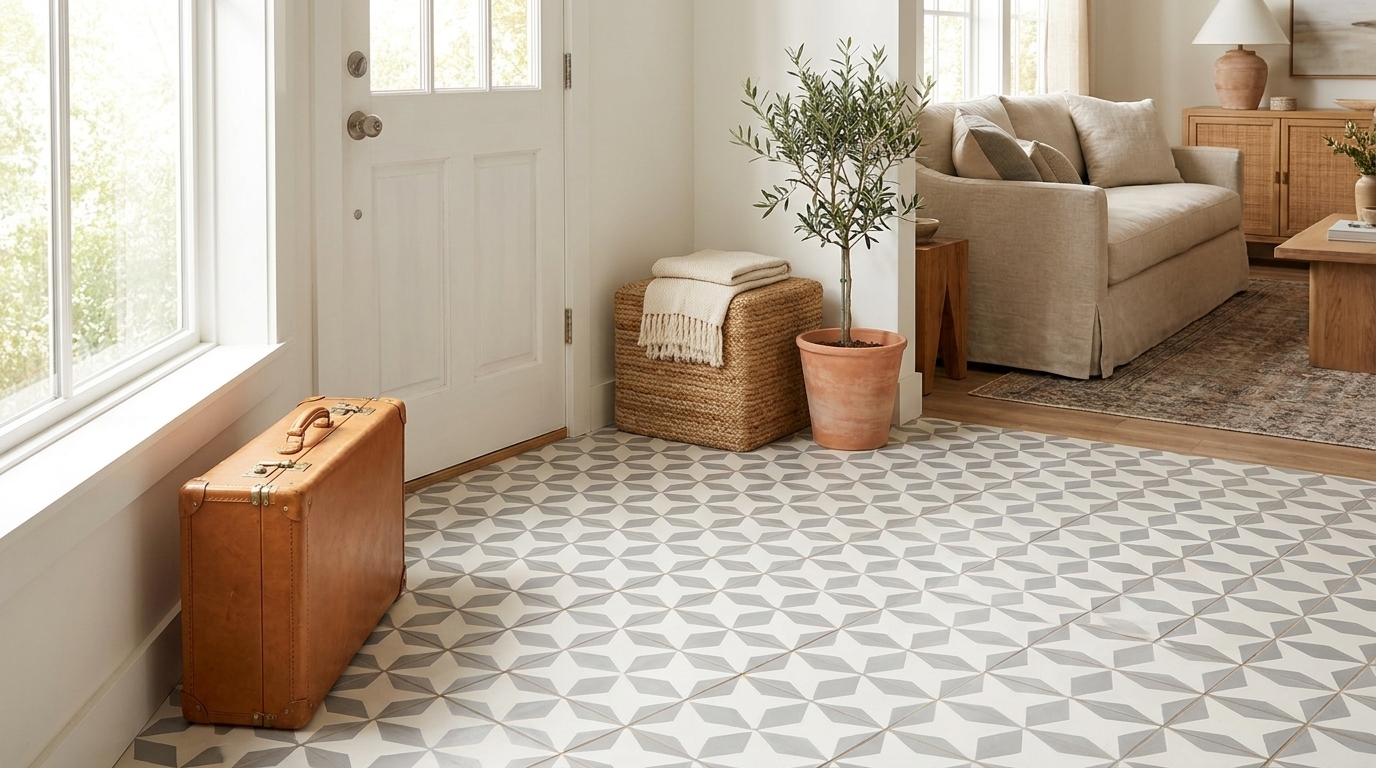
Cement tiles bring pattern forward. They tend to feel grounded, architectural, and composed. The surface is usually silky-matte rather than reflective, so the pattern carries the design instead of the shine.
Zellige-inspired tiles do the opposite. They often use simple shapes and let the glaze do the talking. Light skips across the surface, catches the uneven edges, and gives even a quiet color a lot of life.
Both belong comfortably in a moroccan tiles kitchen. They just create different moods.
- Cement tile effect: graphic, rhythmic, old-world, refined
- Zellige-inspired effect: luminous, handmade, relaxed, textural
- Shared DNA: geometry, artisan variation, and a sense that the surface was made by people rather than machines
Why the style has depth
This isn’t a passing decorative trend. The roots are old, and that history explains why the style still feels substantial. Moroccan tiles, particularly Zellige, originated around 711 AD with the arrival of Muslim inhabitants in North Africa. Early tiles from the 10th century were limited to plain white and brown, but by the 14th century, the palette expanded to include vibrant green, blue, and yellow, enabling the intricate geometric mosaics seen in historic structures like the Alhambra and modern masterpieces like the Hassan II Mosque (history of Moroccan tile and Zellige).
That heritage still shows up in today’s kitchens. Not because most homeowners want a historical reproduction, but because the principles remain powerful. Repetition. Pattern. Handwork. Imperfection with structure.
Practical rule: If you love bold pattern, choose a quieter cabinet and countertop package. If you love movement and shine, let glazed tile carry the wall and keep the rest disciplined.
What gives the room its soul
A kitchen with soul usually has one of two things. It has a surface that rewards close looking, or it has a pattern that organizes the whole room. Moroccan-style tiles can do either.
That’s why off-the-shelf imitations often fall flat. They copy the motif but miss the handmade irregularity, the mineral color, or the visual cadence that makes the surface feel alive. Good Moroccan-style work never feels printed on. It feels built in.
When clients say they want warmth, character, or something less generic, this is usually what they’re responding to. They want a kitchen that looks designed, not assembled.
Choosing Your Canvas Cement vs Zellige Inspired Tiles
The right choice starts with the surface you’re tiling. Floors, backsplashes, island faces, and niche walls don’t ask the same thing from a tile. A material that performs beautifully behind a range may not be the one I’d choose under daily foot traffic.
The biggest dividing line is the finish. Glazed Zellige tiles offer an impervious surface resistant to water and heat right out of the kiln. In contrast, unglazed cement or clay tiles are porous and require proper sealing to prevent staining, though their inherent density makes them exceptionally durable for floors (kitchen performance of Moroccan tile finishes).

Cement vs Zellige-Inspired Tile at a Glance
| Attribute | Handmade Cement Tile | Zellige-Inspired Tile |
|---|---|---|
| Visual character | Matte, patterned, graphic | Glossy, varied, light-reflective |
| Surface feel | Soft-looking, substantial, grounded | Lively, uneven, jewel-like |
| Best use in kitchen | Floors, statement backsplashes, island cladding | Backsplashes, feature walls, wet and splash-prone zones |
| Pattern language | Strong geometry, decorative repeats, custom motifs | Simpler layouts with surface variation doing the work |
| Moisture behavior | Porous, needs sealing | Impervious glazed surface |
| Heat and splash resistance | Good when specified and maintained properly | Strong fit near cooking areas because of glazed finish |
| Installation look | Crisp pattern alignment matters | Variation is part of the visual appeal |
| Maintenance profile | Needs sealing and thoughtful cleaning | Easier daily wipe-down |
When cement tile is the better answer
If you want the pattern to define the kitchen, cement is hard to beat. It excels when you want a floor that acts like a rug, a backsplash with repeat and symmetry, or an island face that reads like furniture rather than cladding.
It also opens the door to custom color work in a way many glazed lines do not. You can shift from a high-contrast black and cream composition to a dustier palette that feels inherited rather than loud. That flexibility matters when you’re designing around cabinetry, stone veining, and natural wood tones.
Cement also feels right when the room needs visual weight. In large kitchens, especially, a matte patterned surface can anchor the architecture better than a highly reflective wall tile.
When Zellige-inspired tile wins
If the room already has enough pattern, Zellige-inspired tile brings movement without crowding the eye. That’s why it works so well with veined stone, fluted wood, unlacquered brass, and painted cabinetry. The tile gives you variation and richness, but it doesn’t demand a complex motif to do it.
For splashes, steam, and routine kitchen mess, glazed surfaces are practical. A cooktop wall, prep sink backsplash, or coffee station usually benefits from that easier wipe-down behavior.
For readers comparing options, a dedicated range of Zellige-inspired tile styles for kitchen and wall applications can help clarify what that finish looks like across color families and formats.
Cement asks you to commit to pattern. Zellige-inspired tile asks you to commit to texture. That’s the cleanest way to choose.
What doesn’t work
A few combinations create trouble fast.
- Busy stone plus busy tile: If both surfaces have strong movement, neither one reads clearly.
- Highly irregular wall tile on a floor: The look may be appealing, but the application is often wrong for the material.
- Pattern without scale control: A small repeat in a large open kitchen can look fussy. A large repeat in a tight galley can feel cut off and restless.
- Choosing by showroom panel alone: Handmade materials need to be judged in field, not just as a single sample.
If you want one sentence of trade advice, it’s this. Put cement where pattern should lead, and put glazed Zellige-inspired tile where light, moisture resistance, and surface variation should lead.
Designing Your Moroccan Kitchen Layout
Layout decides whether Moroccan-style tile feels elegant or overworked. The same tile can read as refined in one location and chaotic in another. Placement is design.
The most successful kitchens use Moroccan tile as a focal plane, not as decoration scattered around the room. One strong move usually outperforms four small ones.

Full-height backsplash
A full-height backsplash is often the cleanest way to use Moroccan tile in a kitchen. Instead of stopping at the upper cabinet line or creating a short band behind the counter, take the tile all the way up. That gives the pattern or glaze enough visual field to feel intentional.
In a kitchen with quiet slab fronts, this move can carry the entire room. Cement tiles create a mural-like backdrop when the repeat is aligned carefully. Zellige-inspired tiles build a wash of color that changes through the day as the light shifts.
A lot of homeowners searching for a moroccan tiles kitchen are really after this effect. If you want examples of how that application can work around sinks, ranges, and open shelving, this guide to a Moroccan tile backsplash in kitchens is a useful reference point.
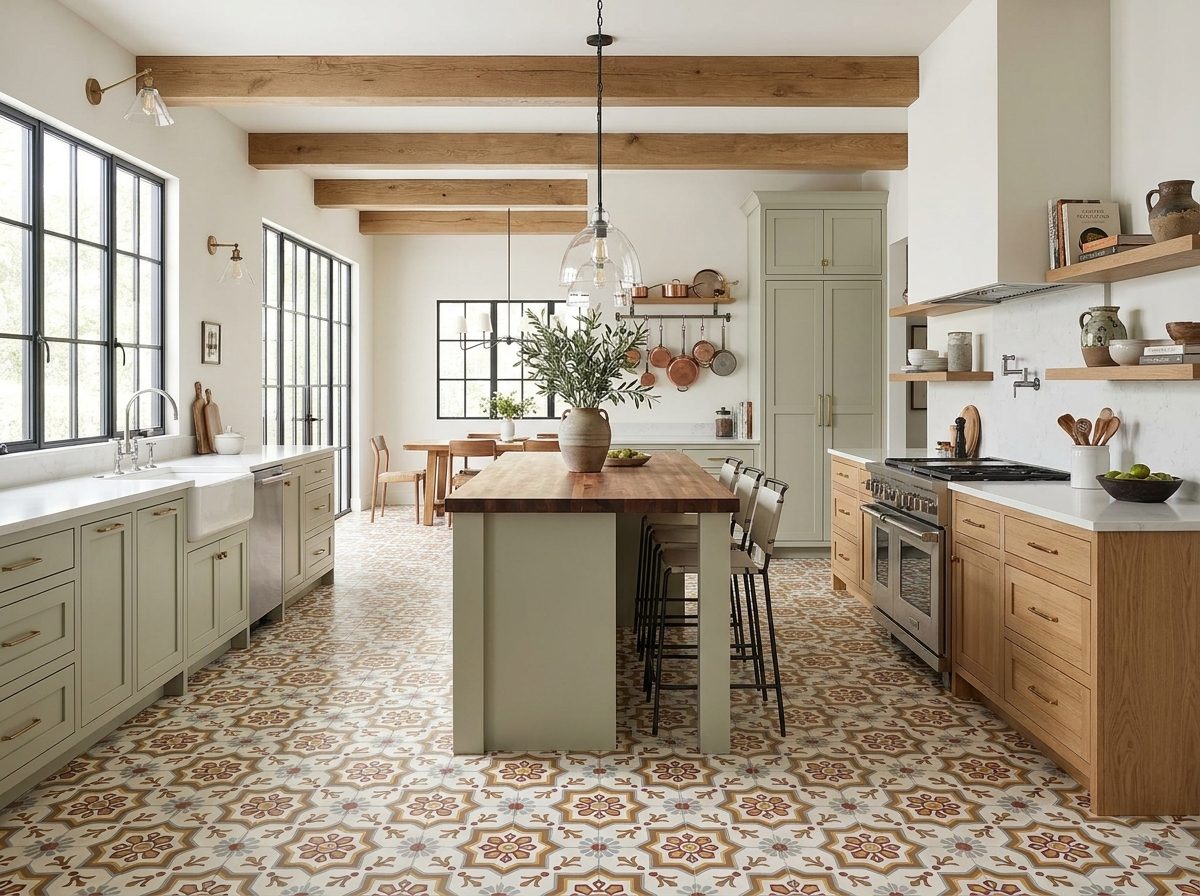
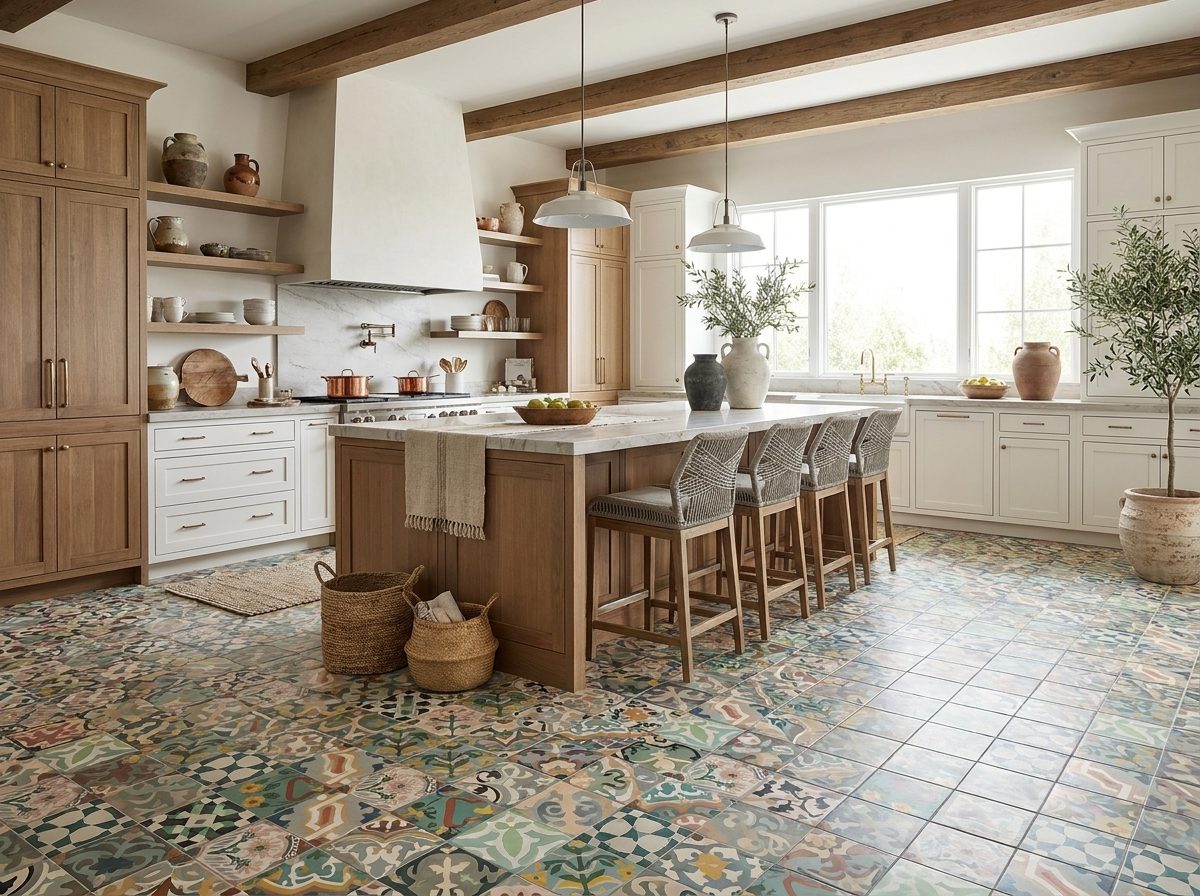
Patterned floor as a tile rug
On floors, Moroccan-style pattern works best when it’s given boundaries. In a smaller kitchen, that might mean tiling the whole room. In a larger open-plan space, I often prefer using the patterned field to define the kitchen zone while adjacent dining or living areas transition to wood or another finish.
That approach gives the eye a frame. It also keeps the pattern from feeling endless.
A floor pattern should support the room’s architecture. If the cabinets are richly colored, choose a pattern with discipline and a narrower palette. If the cabinetry is pale or natural oak, the floor can take on more personality.
On floors, scale matters more than people think. The pattern has to read from standing height, not just from a sample board held in your hands.
Island wrap and furniture moments
The island is one of the best places to add Moroccan character without committing the whole room to it. Wrapping the back or side panels in patterned cement tile creates a furniture-like centerpiece. It’s especially effective in kitchens that open to a breakfast area or family room, because the island becomes something worth looking at from a distance.
I like color with confidence. Deep blue, earthy green, off-black, terracotta, muted ochre. Colors that can hold their own against wood stools, metal pendants, and natural stone.
The island also tolerates a more decorative move because it isn’t competing directly with grease splatter and upper cabinet interruptions. The tile can breathe.
For a closer look at varied Moroccan-style kitchen applications, this short video gives helpful visual context:
Accent wall or niche
Sometimes restraint is the stronger move. A recessed coffee station, a vent hood surround, a pantry wall seen from the entry, or a small open niche can all carry Moroccan tile beautifully.
This works well in modern kitchens that need warmth without losing their simplicity. A small field of hand-touched material breaks up flat cabinetry and hard stone surfaces. It gives the room memory.
Here are a few pairings I return to often:
- Walnut cabinetry with deep green glaze: warm, refined, atmospheric
- White oak with soft white or sand Zellige-inspired tile: quiet, textural, bright
- Painted charcoal cabinets with cream and black cement pattern: graphic and architectural
- Plaster-tone cabinets with dusty blue and clay hues: relaxed and old-world without looking themed
Keep one voice in the room
A Moroccan-style kitchen doesn’t need carved doors, ornate hardware, patterned stone, and decorative tile all at once. That’s costume, not design.
Choose where the craft lives. Let the cabinets be simple if the tile is intricate. Let the backsplash stay quiet if the floor is doing the heavy lifting. Let the grout support the tile rather than drawing more lines than the room can handle.
That’s how a kitchen keeps its soul and its discipline at the same time.
Planning Your Project Budget Lead Time and Customization
Handmade tile rewards people who plan early. It punishes people who choose late.
That’s especially true with authentic Moroccan and Moroccan-style materials. Manufacturers often have minimum order requirements of 50 square feet and delivery timeframes of 8 weeks or more, which can affect renovation schedules and make these products a poor fit for rapid-turnaround projects (lead times and minimums for handmade Moroccan tile).
Start with the timeline, not the sample
Most kitchen delays don’t begin with installation. They begin when tile is selected after cabinetry is already underway, countertops are templated, and everyone assumes material will appear on command.
Handmade tile doesn’t work that way.
Order timing affects everything: wall prep, trim decisions, appliance clearances, countertop edge transitions, and grout planning. If you’re still shaping the broader financial picture, a practical resource on how to budget for a kitchen renovation can help place tile decisions in context with cabinets, labor, and stone.
What changes cost and complexity
Tile pricing isn’t just about square footage. In real projects, several design choices move the needle.
- Pattern complexity: A multi-color geometric repeat usually requires more planning than a field of plain tile.
- Format and shape: Squares are straightforward. Specialty shapes can change layout time and cutting labor.
- Color development: Custom palettes take more coordination than standard stock combinations.
- Application area: A backsplash with outlets, shelves, and window returns is more labor-intensive than an uninterrupted wall.
- Waste and overage: Handmade products need room for cuts, selection, and jobsite judgment.
The cheapest route on paper often becomes the expensive route in the field if the material wasn’t selected with the kitchen’s conditions in mind.
Why customization is worth considering
A custom tile kitchen doesn’t have to mean excess. Often it means editing. You might take a traditional pattern and mute the palette. Or simplify a motif so it works with contemporary slab cabinetry. Or shift a border tile into a cleaner field layout.
That’s where a heritage manufacturer can be useful, not because custom is always better, but because many kitchens need a specific answer that stock lines don’t provide. Original Mission Tile, for example, makes handmade cement tiles and offers a Design Studio for custom pattern and color development, which is relevant when a project calls for a Moroccan-style kitchen surface that needs to coordinate with a particular cabinet finish, stone slab, or architectural detail.
Customization works best when the room already has constraints. Good tile design responds to them. It doesn’t ignore them.
Installation Best Practices for a Flawless Finish
Beautiful tile can be ruined by casual installation. That’s true of all handmade materials, but especially of patterned cement and irregular glazed tile. The installer has to understand that variation is part of the product, not a defect to be fought.
The goal is control without over-correction.

Substrate first
No tile solves a bad wall or floor. Surfaces must be flat, stable, clean, and appropriate for the application. If the substrate has humps, deflection, or moisture issues, handmade tile will reveal them quickly.
Before material is ordered, confirm measurements carefully. This guide on how to measure for tile is the kind of practical checklist worth reviewing before takeoff. It helps avoid the common problems of under-ordering, awkward layout changes, and rushed patchwork decisions.
For homeowners who want a straightforward overview of the broader backsplash process, this walkthrough on how to install a kitchen backsplash is also useful as a planning reference.
Dry layout is not optional
With cement patterns, dry layout determines whether the design reads cleanly across the whole field. The installer should open boxes, blend pieces, check pattern continuity, and establish the starting point before adhesive work begins.
With Zellige-inspired tile, dry layout matters for a different reason. It lets the installer distribute variation in tone, sheen, and dimension so the finished wall looks natural rather than clustered.
A few field rules matter here:
- Blend from multiple boxes so variation is balanced.
- Find the visual center of the wall or focal area before setting.
- Test grout width rather than assuming a standard joint will suit the tile.
- Review cuts at edges and outlets before committing to the layout.
Grout and spacing decide the final look
People fixate on tile color and forget that grout can either support the craft or flatten it. In cement work, the grout usually needs to recede so the pattern reads properly. In Zellige-inspired work, grout choice can either emphasize the handmade geometry or make the field feel muddy.
Joint size should follow the tile, not a rigid ideal. Handmade products often need a slightly more forgiving eye than machine-perfect tile. What matters is consistency of appearance.
The installer’s job isn’t to make handmade tile look factory-made. It’s to make it look intentional.
Seal what needs sealing
Porous surfaces need proper sealing at the right stage. That means following the material’s requirements, protecting the tile during grout work when needed, and making sure the owner understands what has been applied and how future maintenance should be handled.
A rushed install usually leaves evidence in three places: uneven pattern flow, poor edge cuts, and sealing problems. All three are avoidable when the installer treats handmade tile as a finish material rather than commodity stock.
Living with Your Tiles Daily Care and Long Term Durability
“High maintenance” gets thrown around too loosely. In practice, the question isn’t whether Moroccan-style tile needs care. Every kitchen finish needs care. The pertinent question is whether the care is predictable and reasonable.
For cement tile, it is. Many sources say Moroccan tiles need more maintenance, but often don’t explain what that means. A workable routine for cement tiles is cleaning with pH-neutral cleaners and resealing every 2-3 years, which is a manageable trade-off for a durable, non-fired surface that can be refinished if needed, something glazed tiles can’t do (maintenance guidance for Moroccan-style cement tile).
Daily care that actually works
Most of the day-to-day routine is simple.
- Use pH-neutral cleaners: Harsh chemicals are unnecessary and can work against the finish.
- Wipe spills promptly: Oil, wine, tomato sauce, and coffee are part of kitchen life. Don’t let them sit.
- Avoid abrasive scrubbers: They can dull the surface or wear at the sealer.
- Keep grease from building up: Backsplashes near ranges benefit from regular light cleaning rather than occasional aggressive cleaning.
That’s not a fussy maintenance plan. It’s normal kitchen discipline.
Cement and glazed tile age differently
Owners should be honest about what they value. Cement develops character. It can also be refinished if needed, which is a meaningful advantage for people who want a floor or backsplash that can be renewed rather than replaced.
Glazed tile is different. It’s easy to wipe down and excellent in splash zones, but once the visible finish is damaged, you’re not refinishing that glazed face the way you can work with a cement surface.
Neither is universally better. They age in different ways.
What long-term durability really depends on
Durability starts long before the first cleaning. It depends on whether the tile was used in the right place, installed correctly, grouted properly, and protected according to its material.
A well-chosen Moroccan-style kitchen can hold up beautifully because these materials were born from practical architecture, not just decoration. But they do best when owners respect the material instead of demanding that every surface behave like mass-produced porcelain.
Good maintenance is less about effort and more about knowing what the material is asking from you.
If that expectation is clear from the start, living with these tiles is satisfying, not burdensome.
Bringing Your Vision to Life with Custom Tile
The difference between a kitchen that feels “Moroccan-inspired” and one that feels personal usually comes down to editing. Color edits. Scale edits. Shape edits. Sometimes one small adjustment turns a familiar pattern into something that belongs to the house.
That’s where custom design earns its place.
A heritage manufacturer can help you move beyond standard square repeats into formats that better fit the room. Hexagons, arabesques, star and cross shapes, fish scale profiles, brick formats, and patchwork compositions all change the rhythm of the surface. A simple two-color pattern in an unexpected shape can feel more distinctive than a complicated stock motif in the wrong format.
If you’re designing for a specific kitchen, start with these questions:
- Where should the eye land first
- Should the tile read as pattern, texture, or both
- Do you want contrast with the cabinetry, or harmony
- Does the room need a custom palette more than a custom motif
Those choices matter more than chasing novelty.
Digital tools help at this stage because they let you test combinations before production. A good design studio environment lets you adjust pattern and color with enough control to coordinate with millwork, counters, and hardware. That’s especially useful when the kitchen needs a one-of-a-kind backsplash, a floor with a quieter repeat, or an island treatment that ties the room together without copying anything off the shelf.
The best custom kitchens don’t look custom because they’re flashy. They look custom because every choice feels resolved.
Frequently Asked Questions About Moroccan Kitchen Tiles
Are Moroccan-style tiles suitable for underfloor heating
They can be, but the assembly matters more than the style label. The substrate, setting materials, movement accommodation, and the tile’s intended use all need to be reviewed as a system. Confirm the specification with your installer and tile supplier before ordering.
How do I clean grease from a backsplash without damaging the tile
Start with a pH-neutral cleaner and a soft cloth or non-abrasive sponge. Clean regularly rather than letting grease build into a stubborn film. If the backsplash is a porous cement surface, treat it with more care than a glazed wall tile and make sure the sealer is current.
Is a moroccan tiles kitchen a bad idea for a rental property
Not necessarily. It depends on the rental tier, tenant turnover, and how much maintenance you’re prepared to manage. Glazed wall tile is usually the easier fit where turnover is frequent. Cement can still work, but only if the owner accepts the care requirements and values the design enough to support them.
Do Moroccan tiles only work in traditional kitchens
No. Some of the strongest pairings are with modern cabinetry. Flat-panel oak, painted slab fronts, simple plaster walls, and restrained hardware can all benefit from the texture or pattern of Moroccan-style tile. The key is contrast in the right proportion.
Should I use patterned tile on both the floor and backsplash
Usually not. One patterned focal area is often enough. If both surfaces are active, the kitchen can lose clarity fast. A patterned floor paired with a quieter wall, or a bold backsplash paired with a calmer floor, is usually the stronger composition.
What’s the biggest mistake people make
They choose with their eyes only and ignore use. Kitchens are working rooms. The right material in the wrong location will disappoint you, no matter how beautiful the sample looked.
If you’re refining a moroccan tiles kitchen and want to translate inspiration into an actual specification, explore Original Mission Tile for handmade cement tile options, format ideas, and design resources that can help you shape a kitchen with more craft, more clarity, and a more personal finish.