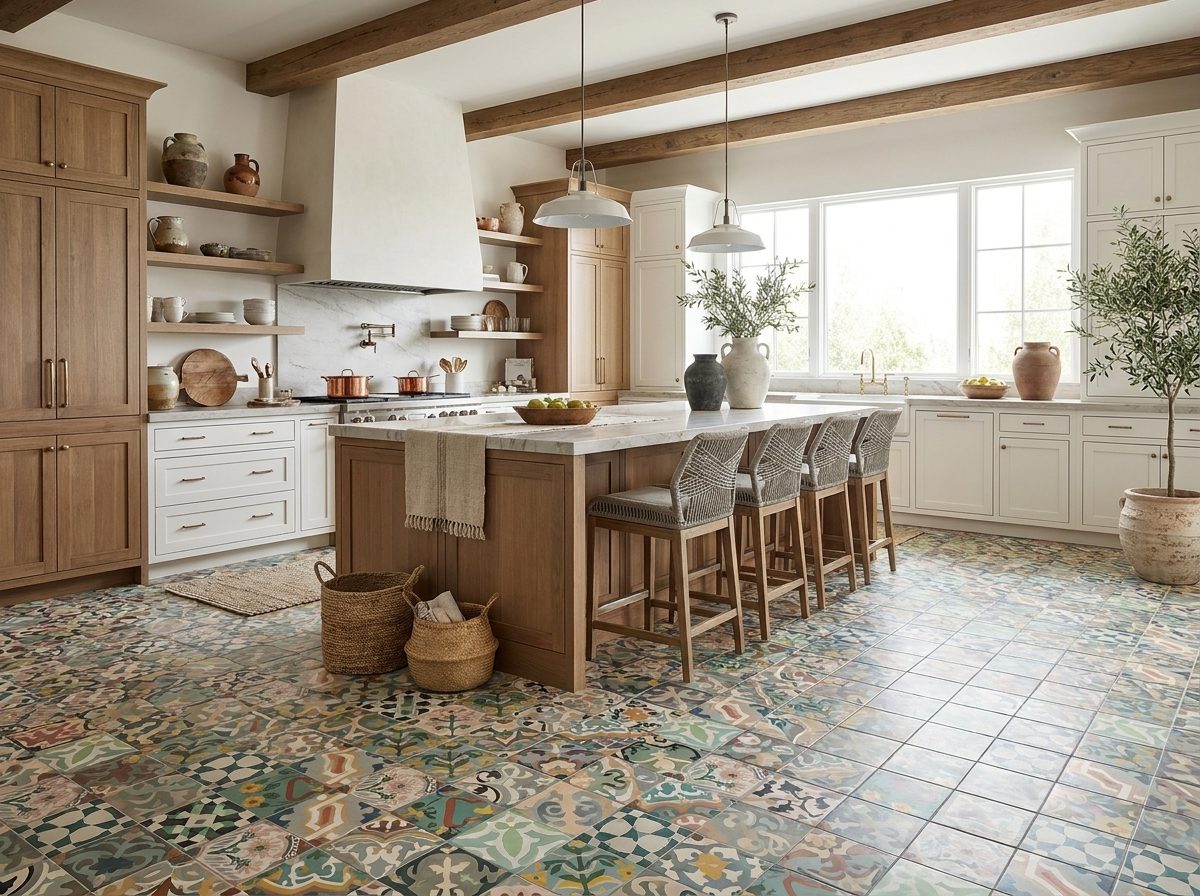
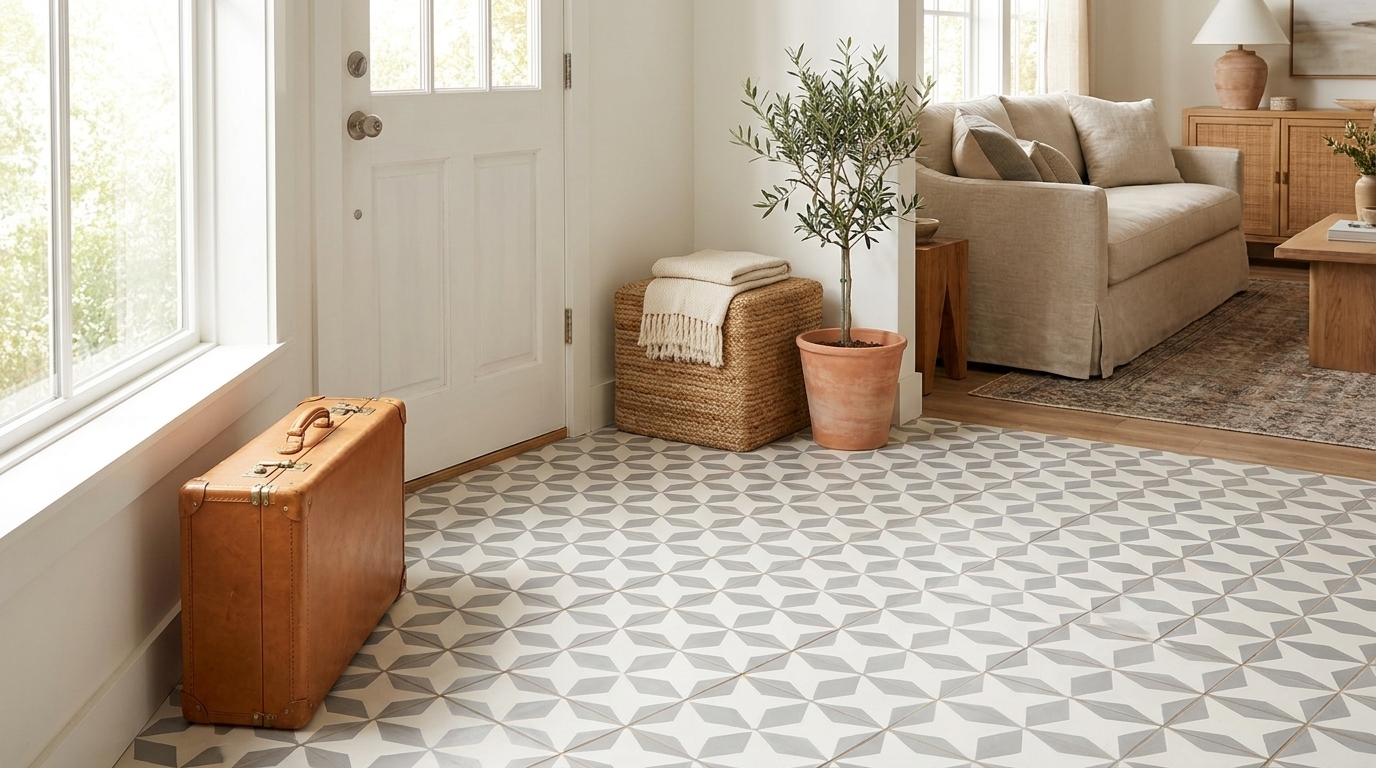
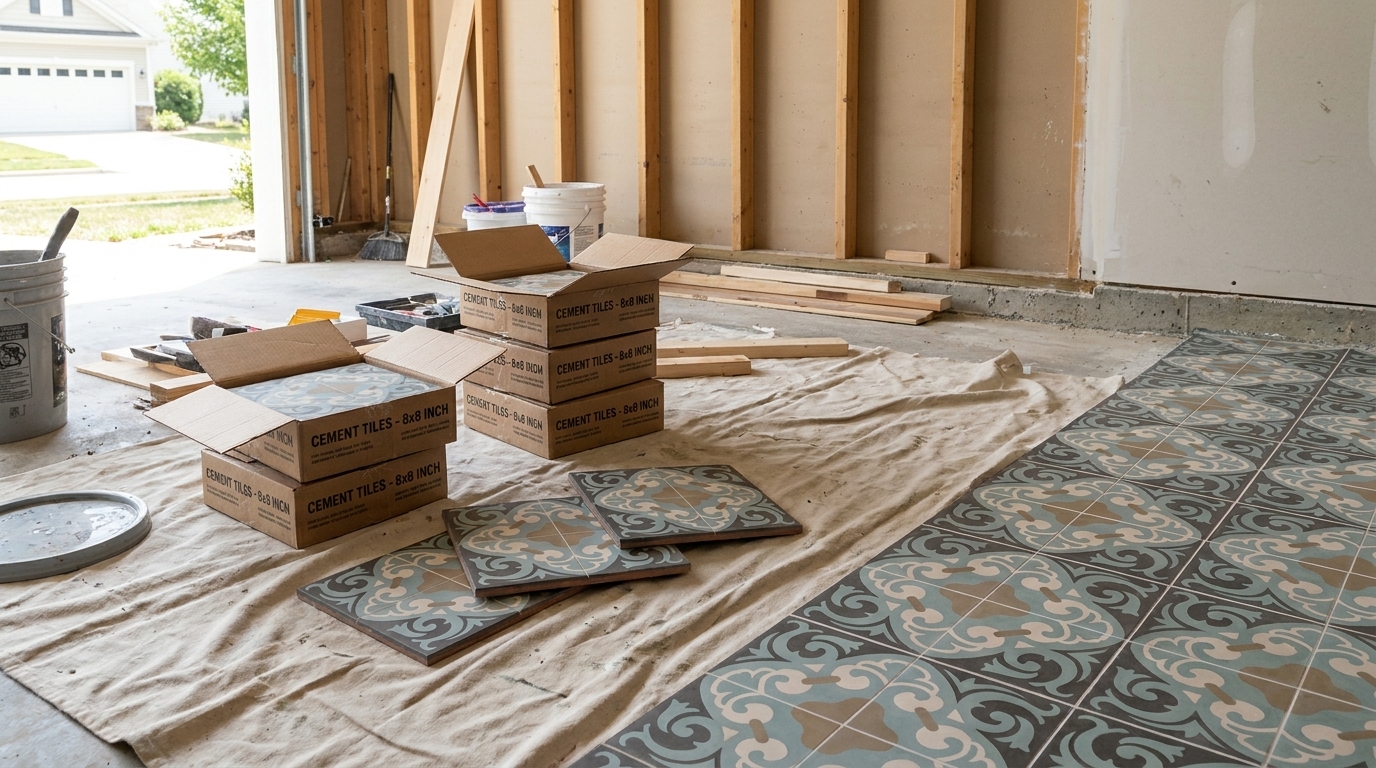
You're probably here because you love the look of patterned cement tile, but you're hesitating at the countertop question. Floors, yes. Backsplashes, of course. But a working kitchen surface that sees oil, lemons, coffee, wet glasses, hot pans, and daily cleanup? That's where the advice usually gets muddy.
Most of that confusion comes from one mistake. People lump cement tile countertops together with poured concrete countertops. They are not the same material system, and they don't behave the same way in fabrication, installation, or maintenance. One is a field of individual hydraulically pressed tiles with joints and edge conditions to resolve. The other is a monolithic slab with its own mix, reinforcement, curing, and crack-control challenges.
A cement tile countertop can be beautiful, practical, and long-lasting. But only when it's specified accurately. This is a surface for people who want craft, pattern, and a finish with life to it. It is not the right choice for someone who wants a zero-thought, wipe-and-forget slab.
An Introduction to Cement Tile Countertops
A client stands in a finished kitchen, runs a hand across the counter, and realizes this surface asks for a different standard than quartz or granite. The beauty is immediate. So are the questions. Where do the joints fall? How is the edge resolved? What happens around the sink cutout, at the backsplash return, and along the front apron where hands, water, and cleaners hit the surface every day?
Those questions matter because a cement tile countertop is a tiled assembly, not a monolithic slab. It is built from pre-fabricated cement tiles installed over a rigid substrate, then grouted, sealed, and finished at every change of plane and exposed edge. The pattern is only part of the story. The installation method determines whether the counter feels refined and durable, or busy and high-maintenance.
That distinction separates cement tile from poured concrete, and it is the point many articles miss. Poured concrete countertops are fabricated and cured as slabs. Cement tile countertops are composed piece by piece. They have grout joints, layout lines, edge profiles, and transitions that must be designed on purpose. A good result depends less on slab-making techniques and more on disciplined tile-setting, accurate substrate prep, and honest expectations about a handcrafted, absorbent surface.
Where the real trade-off lives
Cement tile countertops reward owners who value pattern, depth, and visible craft. They also ask for more from the installer and the household than a factory-finished slab does.
The trade-offs are straightforward:
- Visible joints that need careful layout, clean execution, and a grout choice that supports the pattern instead of fighting it
- A porous surface that needs proper sealing and periodic maintenance
- Handmade variation in tone and texture that gives the counter character, but does not read as machine-perfect
A well-made cement tile countertop can perform beautifully in the right kitchen. It should be judged as a tiled work surface with many resolved parts, not as an imitation of poured concrete or a substitute for engineered stone.
That shift in thinking improves every decision. It changes how the counter is specified, how the sink and edge are detailed, and whether the material suits the client at all.
The Art and Soul of Cement Tile
A client runs a hand across a sample board and usually notices the same thing first. Cement tile does not feel like a fired, factory-coated surface. It feels cool, matte, dense, and slightly velvety, with color that seems to sit below the face instead of on top of it.
That character comes from the way the tile is made. Traditional cement tile is pressed and cured rather than fired, so the pattern and surface read differently from ceramic or porcelain. For countertop work, that matters. You are specifying a tile with body, depth, and porosity, then asking it to perform on a horizontal surface with joints, edges, and daily use.

What cement tile is, and what it isn't
Cement tile has no glaze layer. Its face is the material itself. Pigment is worked into the upper wear layer, then the tile is compressed and cured into a dense unit with a substantial body. That is why the color has depth and why a well-made tile can age gracefully instead of showing a printed surface wearing off.
For designers who want a sharper read on material categories, this guide to different types of tile materials and applications helps place cement tile in the right family. It should never be specified as if it were porcelain in a cement-like colorway. The performance profile is different from the start.
Why the surface has so much presence
Good cement tile has visual weight. Light does not bounce off it the way it does off a polished slab or a glazed wall tile. It settles into the surface, which gives patterns a softer edge and makes solids look richer than their actual color card suggests.
That softness is part of the appeal.
It also explains why cement tile countertops read as crafted surfaces rather than monolithic slabs. Each piece carries slight variation from pressing, pigment, and curing. On a floor, those shifts create movement across the field. On a countertop, they become part of the composition, along with grout joints, cut tiles, and edge details. That is the soul of the material. It is assembled beauty, not poured mass.
Why craftsmanship matters more on a countertop
A backsplash can get away with a little romance. A countertop cannot.
Horizontal use exposes every decision. Pattern alignment at the sink. Joint placement at the front edge. How the field tile dies into a trim or wood nosing. Whether the color variation looks intentional across a small surface instead of busy. These are tiled-surface questions, not slab-fabrication questions, and they are exactly what separates a successful cement tile countertop from a disappointing one.
I tell clients to judge cement tile counters the way an old-world setter would. Look at the layout before you look at the pattern. If the layout is disciplined, the material sings. If the layout is casual, even beautiful tile looks unsettled.
The honest appeal
Cement tile earns its place through atmosphere. It brings pattern, old-house credibility, and a hand-finished surface that quartz and other uniform materials cannot imitate convincingly. In the right project, it can also carry outdoors, especially in covered entertaining spaces designed to elevate your outdoor kitchen, provided the assembly and maintenance plan suit the climate.
The trade-off is straightforward. Cement tile gives more character because it asks for more discipline. That exchange is worthwhile for clients who want a countertop with visible craft and are willing to treat it like a tiled surface, not a maintenance-free slab.
Cement Tile vs Other Countertop Materials
Most countertop decisions come down to personality and tolerance. Not just budget or style. Tolerance for maintenance, tolerance for patina, tolerance for visible joints, and tolerance for a surface that won't look factory-new forever.
That's where cement tile separates itself from quartz, granite, and marble. It doesn't beat all of them at everything. It wins when the project calls for pattern, craft, and a surface with visual rhythm.

A practical comparison
| Material | Best quality | Main compromise | Best fit |
|---|---|---|---|
| Quartz | Uniformity and low maintenance | Less artisanal character | Busy kitchens that want predictability |
| Granite | Natural durability and strong visual mass | Less pattern control | Traditional and high-use kitchens |
| Marble | Elegant natural movement | Sensitive to acids and wear | Owners who accept patina |
| Cement tile | Custom pattern and handmade matte finish | Requires sealing, grout care, and thoughtful detailing | Design-led kitchens with committed owners |
Where cement tile wins
Cement tile gives you something slabs rarely do. You can create geometry, borders, repeats, color blocking, and old-world or modern compositions at the scale of the room. The countertop can echo the floor, connect to a backsplash, or become the feature that anchors plain millwork.
That makes it especially compelling in projects where the kitchen is part of a larger design story. Outdoor entertaining spaces can also benefit from this kind of material language. If you're comparing surfaces broadly before you elevate your outdoor kitchen, it helps to think in terms of use patterns, weather exposure, and how much visible character you want from the finish.
For designers sorting through material categories more generally, this guide to all types of tile is useful because it frames tile choices by behavior, not just appearance.
Where other materials beat it
Let's be honest. Quartz is easier. Granite is more forgiving. A monolithic slab also avoids the visual and maintenance reality of grout joints.
Cement tile countertops ask more from the owner and the installer:
- More maintenance because the surface needs sealing and resealing
- More technical discipline because substrate movement and poor edge detailing show up fast
- More acceptance of wear because the finish develops character rather than resisting every mark indefinitely
Selection advice: If the client already dislikes the idea of marble etching or wood patina, cement tile is usually the wrong countertop material.
The right way to think about value
This isn't a “best countertop material” contest. It's a question of fit.
Choose cement tile when the design needs a living finish. Choose it when pattern matters more than slab continuity. Choose it when the owner will respect the maintenance routine. Don't choose it because someone said it looks like concrete, or because it seems like an easy shortcut to a custom surface. It isn't a shortcut. It's a deliberate craft choice.
Structural and Installation Essentials
A cement tile countertop fails in predictable places. The front edge chips because the tile was left unsupported. The sink rail cracks because the cutout weakened the deck. Grout opens up because the base flexes. Those are tiled-surface problems, not poured-concrete problems, and they need tiled-surface solutions.
That distinction matters. A poured concrete slab behaves as one mass, with its own curing, reinforcement, and crack-control concerns. A cement tile countertop is an assembly. Tile, substrate, membrane, mortar, grout, edge treatment, and sink detailing all have to work together. If one layer is wrong, the weakness shows on the finished surface.

Build the counter like a tile assembly
Start with a flat, rigid deck. Any dip, crown, or twist telegraphs straight through the tile lines, and patterned cement tile makes those errors easy to see. Countertops also face concentrated point loads at front edges, around faucets, and beside sink cutouts, so ordinary cabinet-top assumptions are not enough.
Use a tile-appropriate substrate and confirm that every layer is compatible with the mortar, membrane, and edge detail you plan to use. Wet areas need waterproofing discipline, not guesswork. A crack-isolation or waterproofing membrane is often a smart addition, especially at sink runs, splash transitions, and other stress points. Installers who want a step-by-step field reference can review this cement tile installation guide.
Layout controls both appearance and durability
Dry-lay the countertop before mixing mortar. On a tiled counter, layout determines more than pattern placement. It decides where cuts land, how joints line up at the backsplash, whether the sink opening leaves strong tile pieces, and how intentional the front edge looks.
Set the main visual axis first, usually at the longest run or the island face. Then work outward with these checks in mind:
- Protect the front edge. Avoid tiny cut pieces where hands, pans, and stool backs will hit the surface.
- Respect the sink opening. Keep narrow fragments away from sink corners and faucet penetrations.
- Coordinate joints. If the backsplash is tiled, align the joint pattern so the counter and wall read as one composition.
- Resolve the edge early. Decide upfront whether the profile will use mitered tile, trim pieces, a built-up edge, or a metal profile.
I do not advise “figuring it out in the field” on a patterned countertop. By then, the expensive mistakes are already built in.
Mortar coverage and grout width matter more on counters
Use a high-quality thin-set suited to the substrate and service conditions. Full support under each tile is the goal. Voids near the front edge or around a sink cutout create weak spots that can sound hollow at first and fail later under everyday use.
Joint width deserves discipline. Tight, consistent joints usually give cement tile countertops their cleanest look and keep the grout from dominating the surface. That said, tighter joints also leave less room to disguise poor sizing, uneven setting, or a sloppy deck. Good work starts below the tile.
Edge details separate custom work from a patched-together top
The quality level of tiled countertops is most quickly revealed by their edges. A good edge feels deliberate and finished. A bad one looks thin, awkward, or vulnerable.
Common options include:
- Metal edge profiles for a crisp contemporary line
- Fabricated or bullnosed tile edges for a more traditional appearance
- Built-up edges where the design needs more visual thickness
Each choice changes both the look and the labor. Built-up edges can give a stronger furniture-like profile, but they add joints and detailing. Metal profiles protect exposed corners well, but they need to suit the design language of the room. There is no universal best choice. There is only the detail that fits the project and is executed cleanly.
Sink cutouts, seams, and transitions need planning
Sink openings are the highest-risk area on most cement tile countertops. The rail behind the sink is narrow, frequently wet, and easy to overstress if the substrate or membrane work is weak. Undermount installations can look refined, but they demand careful edge finishing and waterproofing. Drop-in sinks simplify some of that work, though they change the visual character of the counter.
Seams also deserve honest discussion. With cement tile, you are not dealing with the broad uninterrupted field of a slab. You are dealing with a grid of units and joints. That can be beautiful, but the seam strategy has to be intentional at inside corners, at long runs, and where the countertop meets a backsplash, wall, or appliance. If those transitions are treated casually, the whole top reads as pieced together instead of designed.
Habits that produce a better countertop
- Check the deck for flatness before setting tile
- Plan the full layout, including sink cuts and edge returns
- Get full mortar coverage, especially at edges and openings
- Keep joints even so the pattern reads cleanly
- Protect the surface during cure and finishing
- Coordinate waterproofing, grout, and edge details as one system
A cement tile countertop can perform well for years, but only when it is built with the discipline of fine tile work. This material rewards careful hands. It also punishes shortcuts fast.
Sealing Performance and Long-Term Care
A cement tile countertop starts its real life the day the installers leave. The pattern is set, the grout is cured, and now the surface has to stand up to olive oil, lemon juice, red wine, wet glasses, and the puddle that always forms around the faucet. This is the clearest difference between tiled cement and a poured concrete slab. With tile, you are protecting both the face of each piece and a field of grout joints. Care has to address the whole assembly, not just the visible surface.
Sealing is part of the specification, not an optional add-on. Cement tile is porous and unglazed, so it will absorb moisture and staining agents unless it is treated correctly. In countertop work, I want the tile sealed before grouting so grout haze and pigment do not lodge in the face, then sealed again after installation so the tile and joints are working as one protected surface.
A penetrating sealer helps by slowing absorption inside the tile body. It does not create a hard film on top, and it does not make cement tile behave like glazed ceramic or porcelain. The practical benefit is working time. You can wipe up coffee before it shadows the surface. You can catch oil before it settles into the grout. You still need prompt cleanup, especially with turmeric, tomato, vinegar, citrus, and wine.
That is the trade-off. Cement tile offers depth, softness, and pattern that slab materials cannot reproduce in the same way. In exchange, it asks for better habits.
Good long-term results usually come from a simple routine:
- Reseal on a regular schedule based on use, with sink runs and prep zones checked first
- Wipe spills quickly, especially oils, acids, and highly pigmented foods
- Use pH-neutral cleaners made for sealed cement and natural mineral surfaces
- Avoid abrasive pads and harsh degreasers, which wear down the sealer and dull the finish
- Use trivets and cutting boards so heat, knives, and grit do not scar the surface
- Watch the grout joints, because they often show wear before the tile face does
Resealing intervals vary. A lightly used bar top may hold its protection for quite a while, while a family kitchen with daily cooking may need attention sooner. The easiest field test is a few drops of water in an inconspicuous spot. If the water darkens the tile instead of beading briefly on the surface, it is time to reseal.
Daily cleaning should stay gentle and consistent. Spray-and-wipe products that are fine on quartz can be too aggressive here if they contain acids or strong solvents. For product guidance and safe maintenance methods, use this guide to cleaning cement tiles.
One more point deserves honest mention. Countertop performance is not only about the sealer. Layout and use patterns matter too. A breakfast bar that receives light serving duty is a different proposition from the main prep counter beside a range and sink. Early planning helps set those expectations. Reviewing architectural blueprints for kitchen planning can help clients decide where cement tile belongs, and where another surface may make better sense.
Owners who do well with cement tile understand the material for what it is. It is durable, repairable, and visually rich. It is also absorbent, jointed, and more hands-on than a factory-finished slab. Respect those facts, and the countertop ages with character instead of frustration.
Designing Your Custom Cement Tile Countertop
The technical side of a cement tile countertop matters. The reason people choose it is creative freedom.
A slab gives you one continuous field. Cement tile gives you a language. You can build rhythm with repeats, frame an island with a border, soften a galley kitchen with tonal geometry, or turn a compact coffee bar into the most memorable surface in the room. That range is what keeps designers coming back to tile when a project needs more personality than stone can provide.

Start with the room, not the tile rack
The strongest countertop designs usually respond to architecture first. Cabinet color, wall tone, floor pattern, window light, and edge profile all affect which tile works. A dense, high-contrast motif can make a small kitchen sing, or make it feel busy. A quieter repeating pattern can hold a room together without taking over.
In these situations, broader planning documents are beneficial. Before finalizing a decorative surface, it's worth reviewing architectural blueprints for kitchen planning so the tile design supports circulation, appliance placement, and sight lines rather than competing with them.
A few design directions that work well
- Historic kitchens often suit traditional motifs, matte neutrals, and quieter grout that lets the pattern read as age-old rather than loud.
- Mediterranean and Spanish revival interiors welcome bolder geometry and stronger color contrast, especially when paired with plaster, brass, and wood.
- Modern kitchens usually do better with restrained palettes, cleaner repeats, and sharper edge profiles.
The best cement tile countertops don't feel randomly decorative. They feel anchored.
A good way to evaluate options is to narrow the design to three interacting choices: pattern scale, palette, and grout visibility. Change one, and the whole countertop reads differently.
Seeing the pattern before you commit
Video can help you think in terms of composition rather than single samples.
Designers often make the smartest decisions when they compare a full-field mockup against a loose stack of favorite samples. A tile that looks beautiful alone can become overpowering across a long run of counter. The reverse also happens. A modest pattern can become elegant once repeated.
Choose the countertop pattern the way you'd choose fabric for upholstery. A sample tells you the colors. Repetition tells you whether you can live with it.
Custom work is where cement tile becomes uniquely personal. A kitchen can borrow a motif from historic flooring, echo a courtyard pattern, or introduce a color story that ties together cabinetry and adjacent rooms. That level of authorship is hard to match in any slab material.
Bringing Your Vision to Life A Project Checklist
A cement tile countertop works when design ambition and technical discipline meet in the same project. If one side is missing, the result usually disappoints. Before you move forward, use this checklist to pressure-test the plan.
The shortlist before you specify
- Confirm the lifestyle fit. This surface suits owners who accept sealing, prompt cleanup, and a finish that develops character.
- Choose tile, grout, and edge detail together. Don't make those decisions separately. They create one visual system.
- Vet the installer for countertop tile work. Floor tile experience alone isn't enough. Ask how they handle sink openings, edge profiles, and layout control.
- Define the substrate and membrane approach early. A rigid, flat deck and a moisture strategy matter more here than in many decorative wall applications.
The details that decide success
- Resolve the sink condition before layout begins. Undermount and drop-in options drive very different edge and waterproofing details.
- Plan the sealing sequence in writing. Everyone should know when the initial sealing happens, when grouting happens, and what the final protection step is.
- Set expectations for maintenance. The owner should know what cleaner to use, how quickly to wipe spills, and when to reassess the sealer.
- Mock up the pattern if the design is custom or high contrast. A small preview often saves a large regret.
A cement tile countertop is never the default choice. That's part of its value. It belongs in kitchens where materials are selected for character, not just convenience. When the structure is right, the detailing is disciplined, and the owner understands the care routine, it becomes one of the most distinctive working surfaces you can build.
Original Mission Tile brings that kind of project within reach. If you're specifying a cement tile countertop and want handcrafted material, custom design support, and practical guidance on installation and care, explore Original Mission Tile.