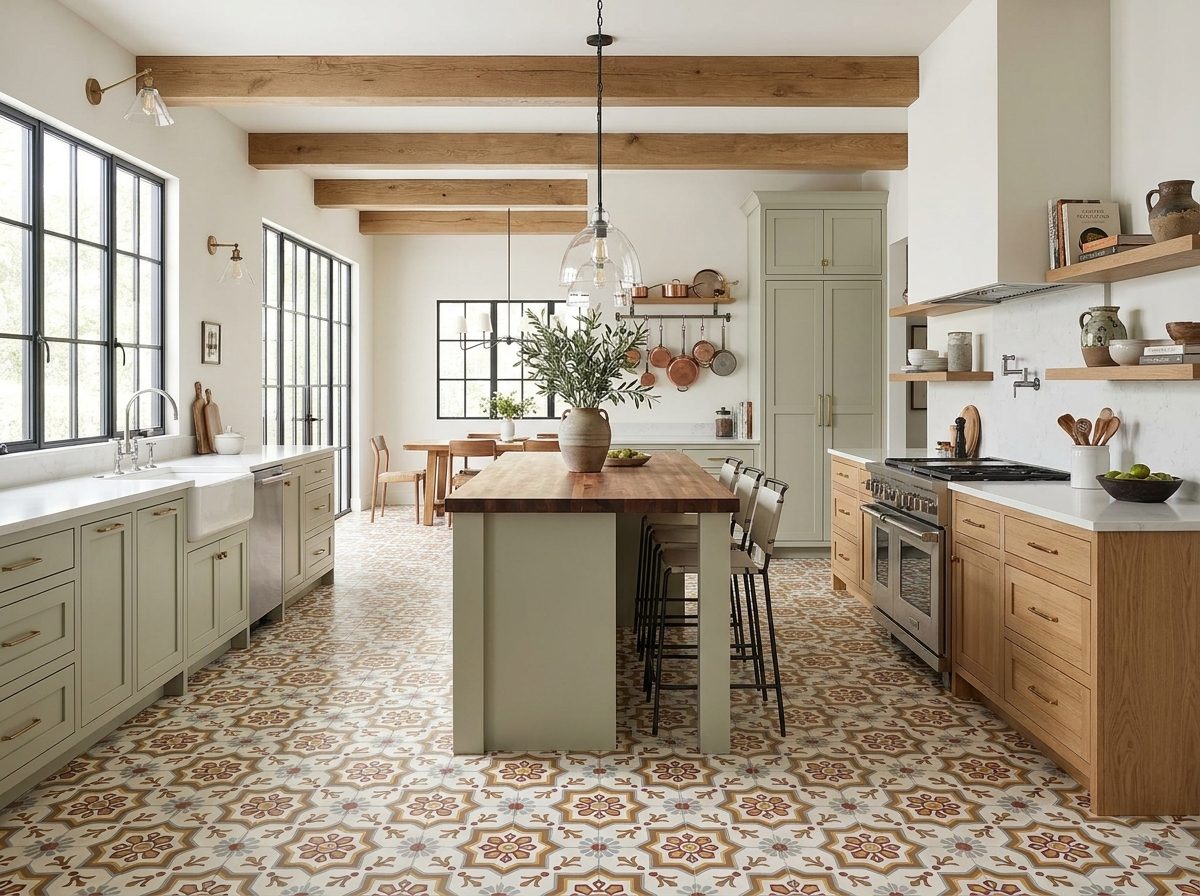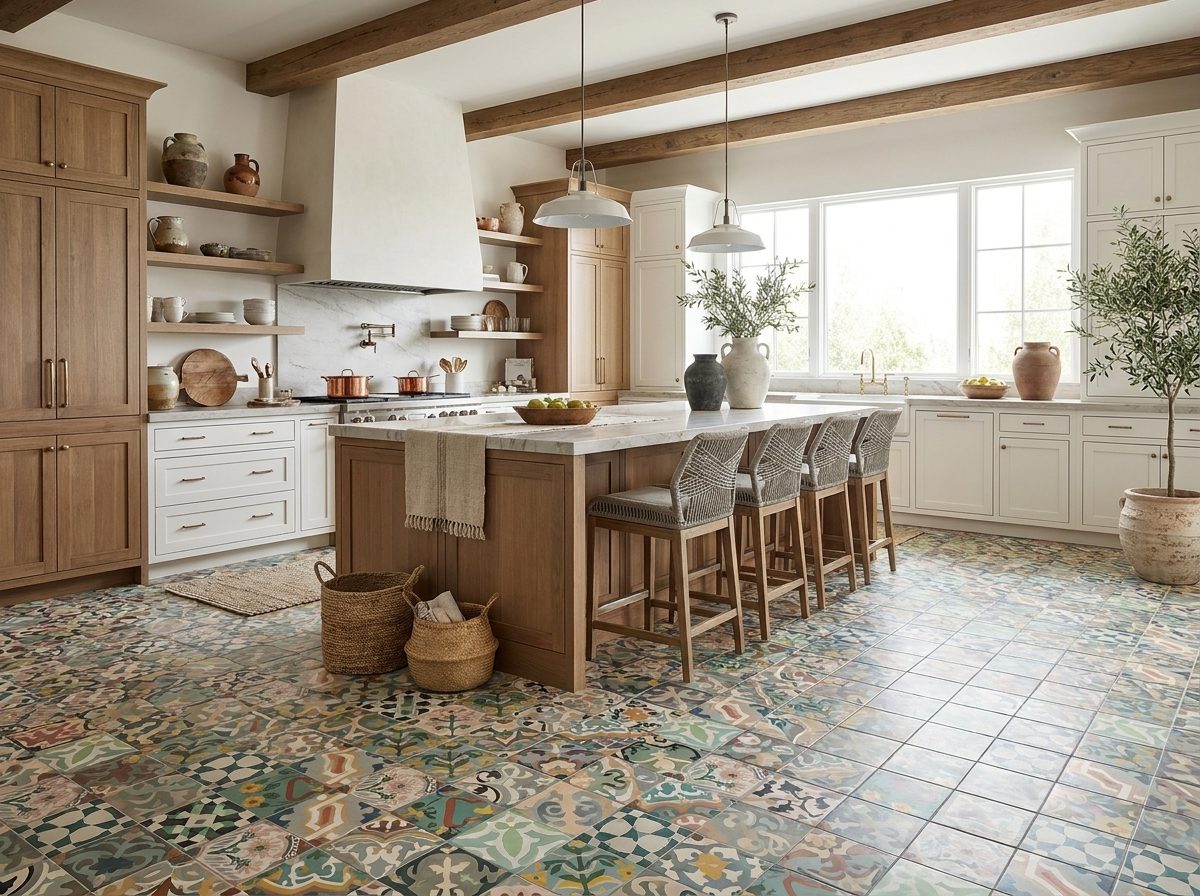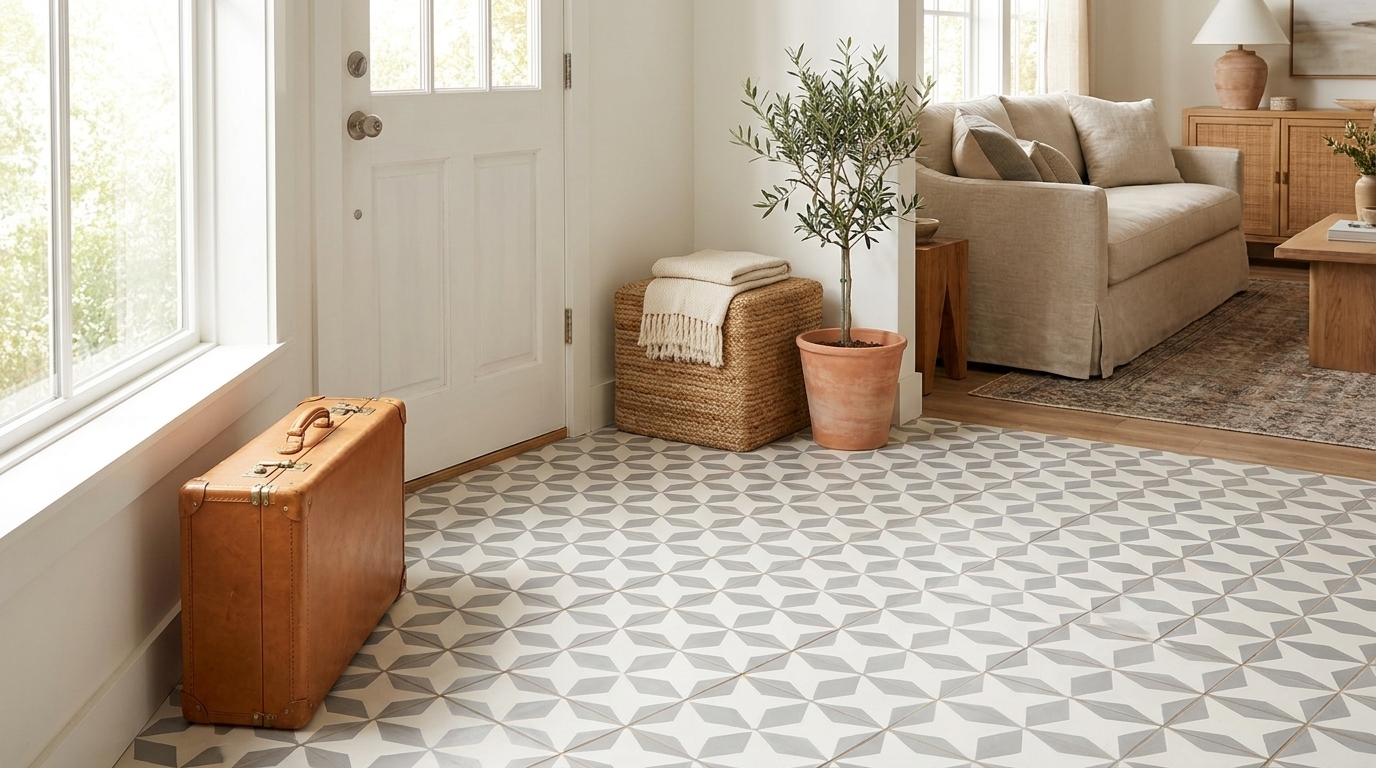
You're probably here because the design is already in your head. Maybe it's a kitchen floor with a worn-in, old-world pattern. Maybe it's a powder room that needs one surface with real personality. Then you search cement tile store near me, and suddenly every showroom seems to sell “cement look,” “encaustic style,” or “pattern tile” without making the differences clear.
That's the challenge. Finding a nearby store is easy. Finding a store that can help you identify authentic handmade cement tile is harder, and it matters. The wrong product can give you the look for a season. The right product can anchor a space for decades.
Starting Your Search for the Perfect Cement Tile
The appeal of cement tile isn't just visual. It sits at the intersection of craft, material honesty, and longevity. The global cement tile market was valued at $420 million in 2022 and is projected to hit $720 million by 2030, with growth supported by a 35% surge in residential applications from 2019 to 2023 and 62% of interior designers specifying encaustic patterns for their natural composition and matte, inlaid color, according to Casa Castillo's market summary.

That popularity has created a showroom problem. Many local stores now carry printed porcelain and ceramic products that borrow the look of handmade tile, but they don't behave the same way, age the same way, or tell the same material story. If you care about authenticity, your search can't stop at proximity.
Practical rule: Search for the store, then vet the product, then vet the staff. In that order.
A good local showroom helps you answer three things quickly:
What is the tile actually made of
Ask whether the pattern is inlaid into cement or printed on a glazed surface.How was it made
Authentic cement tile is formed with a hydraulic press and isn't fired or glazed.Who can support the install
Handmade tile needs informed handling, not just a quick retail transaction.
The smartest buyers don't just look for a nearby address. They look for evidence that the store understands artisan tile at the product level.
How to Locate Promising Local Tile Showrooms Online
A map result alone won't tell you much. Some stores are excellent with handmade materials. Others mainly stock fast-moving porcelain and add “cement tile” to category pages because the term gets searched. Your online screening should separate those two groups before you spend an afternoon driving around town.
Use better search language
Start broad, then narrow. Search terms like encaustic tile supplier, handmade cement tile showroom, artisan tile showroom, and hydraulic press cement tile usually pull up more useful results than a simple location search. If you work in a competitive metro, local search quality matters too. A practical overview of how businesses show up in map and proximity-based results is this local SEO near me guide for Miami, which helps explain why some stores dominate search even when their product knowledge is thin.
Once you have a shortlist, look at the website as if you were auditing a spec sheet.
Read for manufacturing clues
Authentic cement tile has a distinct lineage. It traces to mid-19th century France, where a hydraulic press technique was patented to layer colored cement without firing, and the method later spread globally, with over 1,000 unique patterns documented in Havana factories by 1900, as outlined in this history of authentic cement tile craftsmanship.
That history should show up in the way a real specialty store describes the product. Look for language such as:
- Hydraulic-pressed rather than kiln-fired
- Inlaid pigment rather than printed surface
- Marble dust, sand, and cement rather than generic “tile body”
- Handmade variation presented as a normal feature, not a defect
If a site only talks about color, pattern, and square footage, be cautious. That usually means the merchandising is stronger than the product education.
Audit the visuals and project photos
Stock photography is common in tile retail, so don't judge by polished room scenes alone. Focus on details that reveal the actual material:
- close-ups of tile edges
- photos of loose samples, not only installed rooms
- variation between pieces in tone or surface
- project galleries that show grout joints and scale realistically
For design teams building presentations, it also helps to study how showrooms display artisan materials. A page like tile showroom display ideas for patterned and handmade tile can sharpen your eye for how serious suppliers present product information, layout possibilities, and sample boards.
If the website teaches you how the tile is made, the store usually knows what it's selling. If it only sells the mood, expect gaps once you ask technical questions.
Vetting Tile Quality and Authenticity In-Store
Once you're in the showroom, stop looking at the display wall as decoration. Treat it like a material inspection. Buyers often confuse real handmade cement tile with porcelain lookalikes. According to CLAD Tile's discussion of cement tile buyer confusion, 70% of “cement tile” queries can lead to mispurchases. The same source notes that authentic handmade tiles can last over 50 years with proper sealing, while printed alternatives often show fading or chipping within 10 to 15 years.

Start with your hand, not your eyes
The first test is tactile. A true cement tile usually has a silky, matte feel. It won't feel like a slick glaze. The surface may show slight tonal movement or tiny natural inconsistencies. That's not poor quality. It's often evidence of hand production.
A printed imitation tends to feel more uniform and visually flatter. The pattern can look sharp from a distance but superficial up close.
Here's what I tell clients to check in a showroom sample rack:
Surface feel
Run your fingertips across the face. Handmade cement should feel dense and soft-matte, not glassy.Pattern depth
Study the face at an angle. Inlaid color reads as part of the tile, not as a skin sitting on top.Finish consistency
Minor variation is normal. A fake distressed print often repeats in a way handmade tile does not.
Inspect the edge and body
Turn the sample over. Then look at the edge. The edge usually reveals the honest story.
A genuine cement tile shows a material build-up that makes sense for a handmade pressed product. You're looking for body, density, and a pattern layer that belongs to the tile rather than a surface treatment trying to imitate one. If the display staff won't let you handle loose samples, ask why.
For readers comparing options, Original Mission Tile is one example of a manufacturer that documents traditional handmade cement construction, which gives you a useful benchmark for what authentic product descriptions and sample characteristics should look like.
Don't reject a sample because every piece isn't identical. Reject it if the variation looks artificial or if the store can't explain what you're seeing.
Weight, thickness, and visual honesty
Handmade cement tile has presence. It usually feels more substantial in the hand than printed ceramic or porcelain alternatives meant to mimic it. That added heft isn't just about shipping. It affects substrate requirements, installation planning, and how the floor performs over time.
Use this quick in-store checklist:
- Lift one full tile and note whether it feels dense and solid.
- Check thickness across the edges for consistency.
- Look for crisp pattern lines without blurry printed edges.
- Tap the tile lightly and listen for a solid response.
- Compare multiple pieces to see whether variation looks natural rather than machine-repeated.
A good showroom rep should be comfortable with all of those checks. If they redirect the conversation back to color trends every time you ask a material question, that's a warning sign.
Critical Questions to Ask Your Tile Specialist
A productive showroom visit isn't about asking, “How much is it per square foot?” That's part of it, but it's rarely the question that saves a project. The better conversation is technical, because handmade cement tile only performs well when the store, installer, and client are aligned on prep, sealing, and ordering.
Ask about substrate requirements first
Handmade cement tile needs a stable surface. According to installation guidance summarized by Vitagres, rigorous substrate prep is needed to achieve 95%+ long-term adhesion, subfloor deflection must not exceed L/360, excess flex contributes to 89% of callback failures, flatness should be no more than 1/8 inch over 10 feet, and concrete moisture should test below 4 to 5% to reduce delamination risk.
That means your first questions should sound like this:
- What substrate conditions do you require for handmade cement tile?
- What flatness standard does your installer need?
- What moisture testing do you expect before setting tile?
- Which thinset and sealer systems do you recommend for this exact product?
Field note: A beautiful tile can still fail if the slab is wet or the floor flexes. Most “tile problems” blamed on the tile start underneath it.
Ask about ordering realities
The second part of the conversation is practical. Not every project uses stock material, and not every store handles custom or made-to-order product well. Clarify lead times, shade variation, returnability, and whether the store can provide final approval samples before production.
If you're a designer or architect, also ask whether the showroom supports mockups, finish boards, and project coordination with the installer.
Questions for your tile store visit
| Category | Essential Question | Why It Matters |
|---|---|---|
| Product authenticity | Is this handmade cement tile or a porcelain or ceramic lookalike? | You need to know whether the pattern is inlaid or printed before comparing durability and care. |
| Construction | How is this tile made? | A knowledgeable seller should be able to explain hydraulic pressing, non-fired production, and the tile body. |
| Installation | What substrate conditions are required? | Cement tile needs a flat, stable, dry surface for reliable performance. |
| Moisture control | Do you require slab or subfloor moisture testing before install? | Moisture can lead to bond failure and staining problems. |
| Setting materials | Which thinset and sealer do you recommend? | Product-specific guidance reduces installation guesswork. |
| Variation | What kind of shade and surface variation should I expect? | Handmade tile should have character, but you want to know what is normal before delivery. |
| Samples | Can I take home a few pieces to view in my lighting? | Pattern scale and color shift can look different in a home than under showroom lights. |
| Logistics | Is this in stock, special order, or custom made? | Delivery timing affects construction scheduling. |
| Returns | What is your return policy for stock versus custom orders? | Bespoke product usually has tighter return limits than stocked inventory. |
From Samples and Custom Designs to Your Final Order
The last part of the process happens away from the showroom wall. Once you've narrowed the field, bring samples into the actual room. Cement tile changes with light, and pattern scale can feel very different once it's next to your cabinetry, paint, stone, or millwork.

Test the sample like a designer
Don't glance at it once and decide. Move it around. Put it in morning light, afternoon light, and artificial light at night. Set it beside grout options. If the pattern is bold, step back and view several pieces together, because a single sample can understate how active the field will feel when repeated.
A custom route is worth considering if you have a clear palette or are matching an architectural style. Tools such as this custom 8×8 cement tile collection and design resource can help you evaluate whether a bespoke pattern or colorway makes sense before you finalize a local purchase.
Confirm every line on the order
Before you sign, verify:
Tile name and pattern orientation
Small naming errors can create big layout mistakes.Colorway and finish notes
Make sure the order matches the approved sample, not just a showroom tag.Application area
Floor, wall, wet area, backsplash, or exterior use should be clear to everyone involved.Lead time and delivery condition
Ask how the shipment will be packed, received, and inspected.
A quick visual overview of handmade tile design and selection can help at this stage:
If you're using more than one box, ask the installer to blend tiles during layout rather than pulling one carton at a time. That's one of the simplest ways to make handmade variation look intentional and balanced.
Bringing Your Vision to Life with Authentic Tile
A local search gets you to the door. Knowledge gets you to the right product.
When you know how to read a tile edge, feel the finish, question the manufacturing story, and talk through installation requirements, you stop shopping by appearance alone. That's the difference between buying a decorative surface and choosing a material with lineage.
Authentic cement tile carries the marks of how it was made. Slight variation, matte depth, and inlaid color are part of the appeal, not flaws to eliminate. If the store near you can explain those qualities clearly and support the technical side of the project, you're in the right place. If not, keep looking. The right tile should satisfy both the eye and the build.
Frequently Asked Questions About Cement Tile
Can cement tile be used on walls as well as floors
Yes, many projects use cement tile on both. The main issue isn't style. It's whether the substrate, setting materials, and installer are appropriate for the application. For vertical work, ask your tile specialist whether the tile's weight changes the installation approach, especially for full-height features or wet-area walls.
How should I clean cement tile after installation
Use pH-appropriate, non-harsh cleaners recommended for sealed cement or natural stone-type surfaces. Avoid guessing with acidic or overly aggressive products. If you're coordinating install timing and cure time with a flooring or remodeling schedule, practical drying guidance like this tile drying advice for Richmond homeowners is useful as a general planning reference before routine cleaning begins.
Is variation in color or finish a defect
Usually, no. Handmade cement tile should have some visible variation. What matters is whether that variation looks natural, consistent with the sample you approved, and acceptable across the full order. Ask to see several pieces together before committing. One loose sample rarely tells the whole story.
If you're sourcing handmade cement tile and want a manufacturer with a long heritage in traditional production, browse Original Mission Tile for in-stock patterns, custom options, and technical guidance before your next showroom visit.