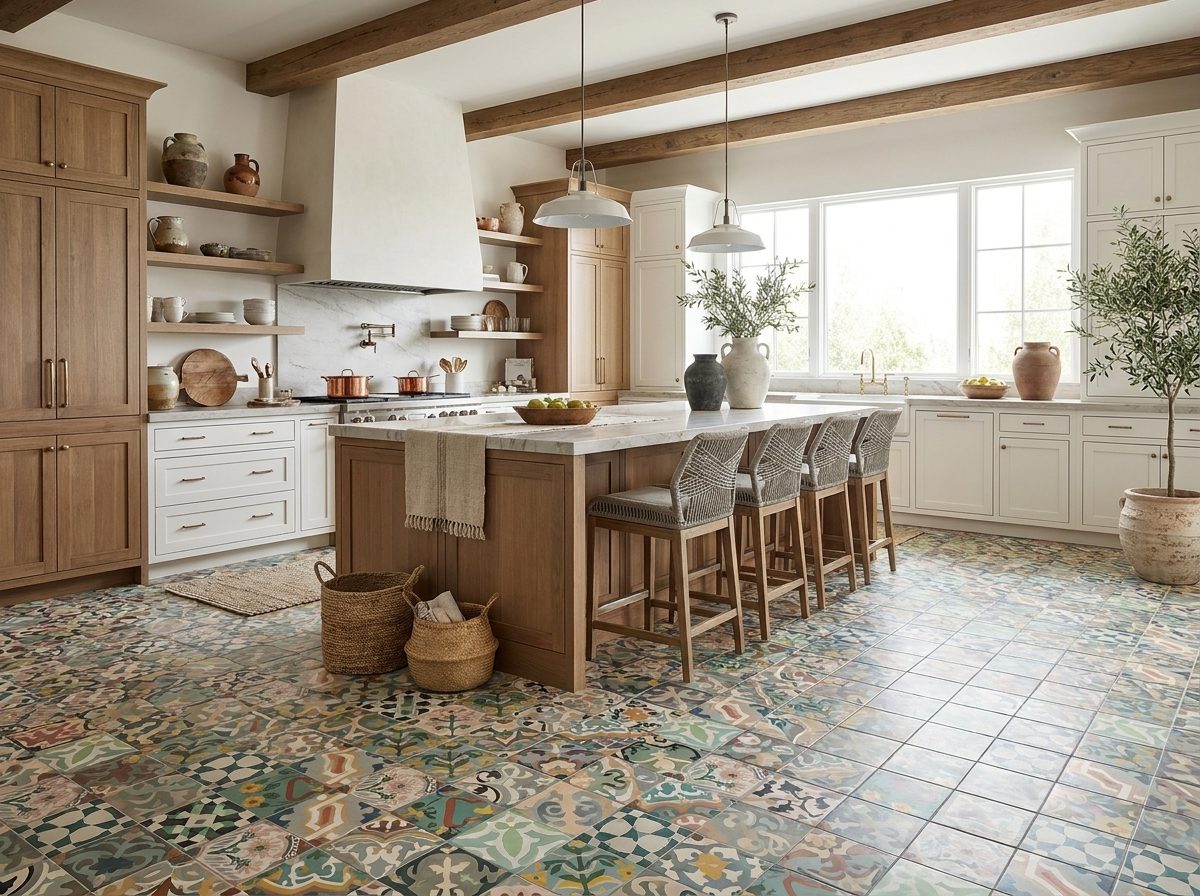
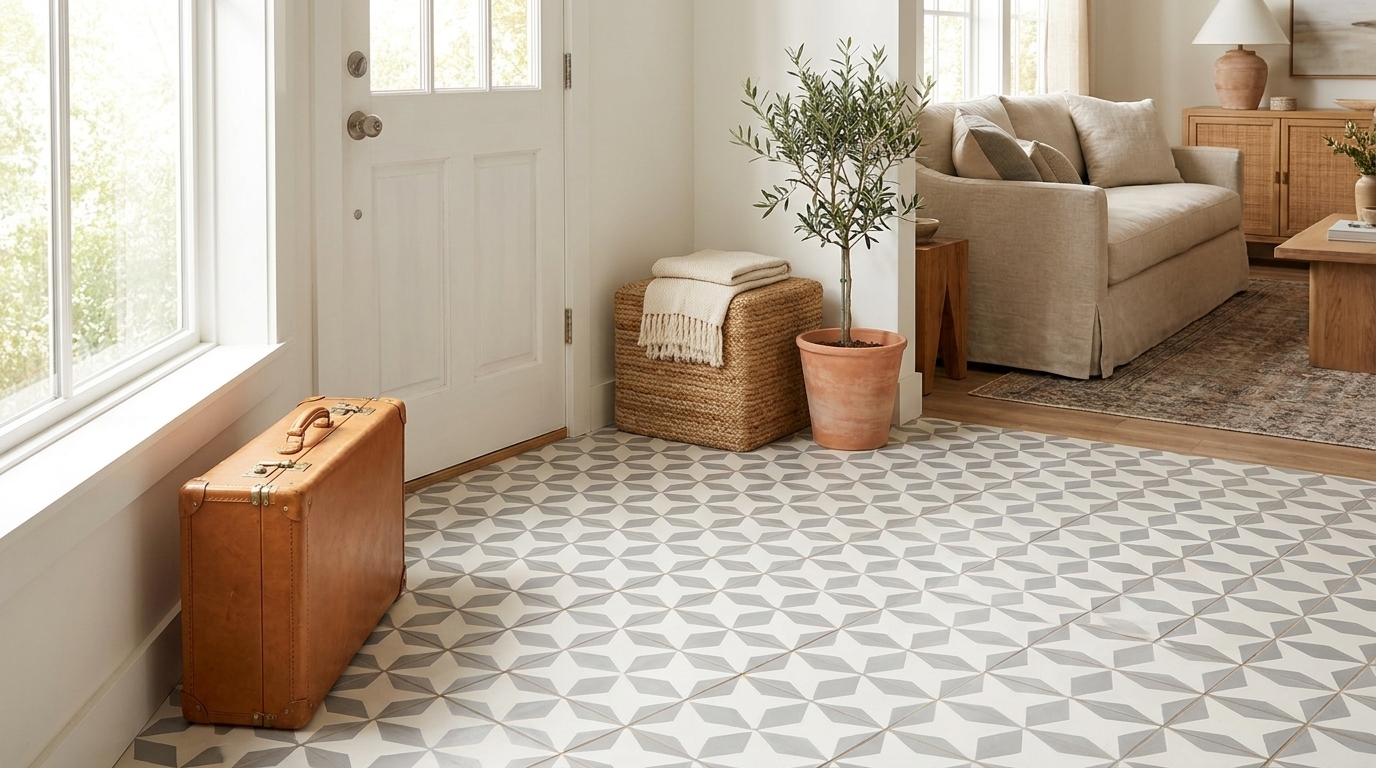
You are staring at two flooring samples on your kitchen counter. One is a hand-poured cement tile with a pattern that looks like it belongs in a 1920s hacienda. The other is a plank of luxury vinyl that photographs almost like real wood or stone. Both claim to be durable. Both claim to add value to your home. The cement tile vs LVP decision comes down to three things: what you pay now, what you pay later, and what a buyer sees when they walk through your door. Let’s separate the marketing from the math.
What Cement Tile and LVP Actually Are
Cement tile is not fired in a kiln. It is a handmade tile, pressed under hydraulic pressure and cured with water over several weeks. The color sits in a thin top layer of pigmented cement, backed by a stronger cement-and-sand body. Original Mission Tile has made this way since 1900 at our factory in San Luis Potosí, Mexico, and the process has barely changed. The result is a dense, mineral floor that gets more character as it ages, not less.
Luxury vinyl plank, or LVP, is a manufactured product built in layers. A printed design layer sits under a clear wear layer, all bonded to a rigid or flexible core. Because it is printed, LVP can mimic almost any material, including cement tile patterns. However, it is still plastic at its core, and that matters for how it performs over 10, 20, or 30 years.
Both are legitimate flooring choices. The question is which one fits your budget, your timeline, and how long you plan to stay in the house.
Upfront Cost: Cement Tile vs. LVP Per Square Foot
LVP wins on sticker price, and it is not close. Material for luxury vinyl plank typically runs $2 to $10 per square foot, with mid-range options landing around $4 to $6. That price includes the printed design, so you get a lot of visual variety for the money.
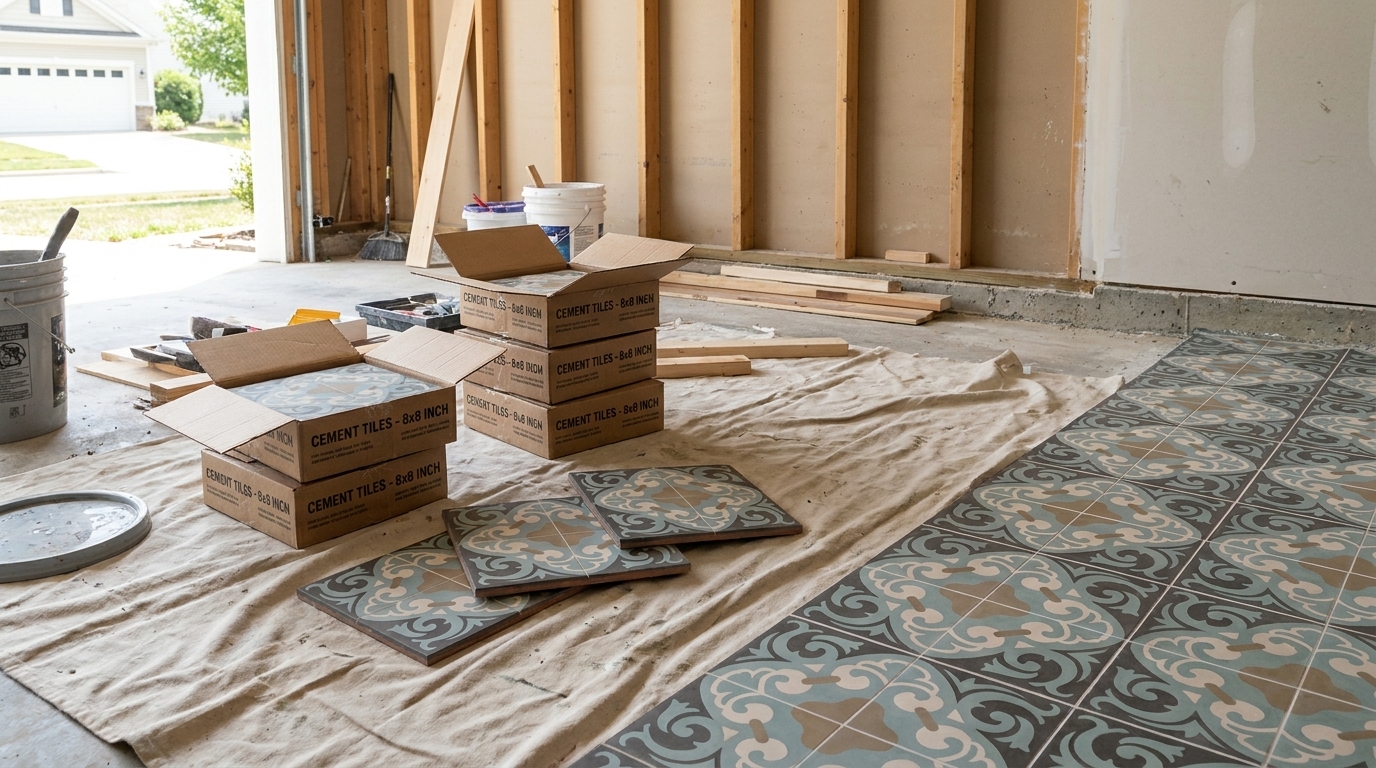
Cement tile costs more per square foot because every tile is made and pressed by hand. Our 8×8 in-stock patterns run in the $48 to $77 range per box, and one box covers 5.17 square feet. That works out to roughly $9 to $15 per square foot in material, depending on the pattern you choose. Browse the full range of in-stock cement tiles to compare pricing across patterns and colors.
That gap looks large until you factor in coverage math. A box of 8×8 tile holds 12 tiles at 5.17 square feet. We always recommend ordering 15% extra for cuts, breakage, and future repairs, so a little more material cushions the project without much added cost.
If you want a pattern outside our in-stock catalog, custom made cement tiles are made to order in about 4 to 6 weeks. LVP has no custom-color equivalent at that level of craftsmanship, because it is printed, not pigmented by hand.
Installed Cost: Labor, Subfloor Prep, and Hidden Expenses
Material price is only half the story. Installed cost is what actually shows up on your contractor’s invoice.
LVP is designed for fast, straightforward installation. Many products click together over an existing subfloor with minimal prep, which is why total installed cost often lands between $4 and $16 per square foot including labor. Homeowners who install it themselves can push that number even lower.
Cement tile installs like natural stone. It needs a flat, stable substrate, thinset mortar, and a skilled setter who understands how to handle a tile that is more porous during installation than after it cures. Because of that, labor costs more per square foot than LVP labor. However, the tile itself never needs replacing, so you are paying once for a floor instead of paying for several floors over the life of the home. Our installation guidelines walk through sealing, spacing, and setting so your contractor gets it right the first time.
One hidden cost with LVP: subfloor moisture and flatness still matter, even though marketing suggests otherwise. A subfloor that is out of tolerance will telegraph through the planks over time, causing visible seams and gaps. That fix is not free.
Durability: How Long Each Floor Really Lasts

This is where the two products separate the most.
Independent flooring resources put LVP’s realistic lifespan at 10 to 20 years, and that estimate assumes moderate traffic and no major impacts. Sharp furniture legs, dropped knives, and direct sun exposure all shorten that window. When the wear layer fails, you cannot refinish a vinyl plank. You replace it.
Cement tile is a mineral surface, not a coating on plastic. It does not have a “wear layer” that runs out, because the color is embedded in the cement itself, not printed on top. Properly sealed and maintained cement tile floors from the early 1900s are still in service today, in homes and public buildings across Latin America and the American Southwest. That is not a marketing claim. It is simply how dense, cured cement behaves over a century of foot traffic.
For a side-by-side sense of what that looks like in real rooms, our installation gallery shows patterns in kitchens, entryways, and bathrooms that have been walked on for years without losing their pattern definition.
That said, cement tile is not indestructible. It can chip if you drop something heavy and sharp, and it will scratch if you drag unprotected furniture across it. The difference is that a chipped cement tile can be swapped out from your overage stock, while a failed LVP plank usually means the whole floor is nearing the end of its useful life at roughly the same time.
Comfort, Maintenance, and Everyday Living
LVP feels warmer underfoot and is quieter to walk on, which matters in bedrooms and living rooms. It is also naturally forgiving of minor spills because the surface is fully sealed plastic. For busy households with young kids, that low-maintenance simplicity is a real advantage.
Cement tile feels cool and solid, closer to natural stone than to vinyl. It needs to be sealed after installation and resealed periodically, which is a maintenance step LVP skips entirely. In exchange, you get a floor that can be damp-mopped, that hides small imperfections in its handmade texture, and that does not scuff the way plastic can under rolling chairs. Our maintenance and cleaning guide covers the sealing schedule in detail, and it is far less demanding than most homeowners expect.
Neither floor is the right choice for standing water. LVP handles splashes well but can fail at the seams if water sits for long periods. Cement tile, once properly sealed, resists moisture in normal residential bathrooms and kitchens, though it is not a submerged-pool product.
Resale Value: What Buyers and Appraisers Actually See

This is the category most homeowners underestimate. Multiple flooring industry studies put LVP’s return on investment around 70% to 80%, which is solid for a budget-friendly upgrade. Buyers recognize it as a clean, modern floor, and it photographs well for listings.
Tile, however, consistently ranks higher. Industry ROI estimates for tile and natural stone-style flooring run from roughly 70% up to 85%, and the reasoning is straightforward: buyers perceive tile, especially handmade or patterned tile, as a permanent upgrade rather than a temporary fix. A buyer touring a kitchen with a hand-laid cement tile floor sees craftsmanship. A buyer touring a home with vinyl plank sees a nice, practical floor that they may need to budget for again in 15 years.
That perception gap widens further with patterned cement tile. A bold entryway or a checkerboard kitchen floor becomes a talking point in listing photos, something LVP’s printed patterns rarely achieve because buyers can usually tell it is not the real material once they look closely.
If resale value is a top priority, an entryway, a kitchen floor, or a primary bathroom are the highest-impact rooms to invest in cement tile, because they are the spaces buyers remember.
Which One Wins for Your Project?
There is no universal winner here, only a better fit for your situation.
Choose LVP if you are working with a tight budget, plan to sell within the next five to seven years, or need a floor installed quickly without hiring a specialized tile setter. It is also the more forgiving choice over uneven subfloors that are not worth correcting right now.
Choose cement tile if you plan to stay in the home long-term, want a floor that improves your resale story instead of just meeting a minimum standard, or if the room in question is a showcase space like an entryway, kitchen, or primary bath. Because cement tile is the more expensive, more permanent choice, it also rewards careful planning. Order samples before committing. They cost $20 for the first and $10 for each additional, with free shipping, from any in-stock product page.
Many designers land on a hybrid approach: LVP in bedrooms and secondary spaces where softness and speed matter, cement tile in the rooms that define the home. That split controls the budget while still delivering the design impact where it counts most.
Whichever way you lean, get real numbers before you decide. Request a quote and compare it directly against LVP bids for the same square footage.
Frequently Asked Questions
Is cement tile more expensive than LVP?
Yes, on a per-square-foot basis, cement tile costs more in both material and installation. However, because it does not need replacing every 10 to 20 years, the lifetime cost gap is smaller than the upfront price suggests, especially in homes where you plan to stay for a decade or more.
Can LVP be installed directly over cement tile, or vice versa?
LVP can sometimes go over a flat, stable existing floor if the subfloor meets flatness requirements. Cement tile needs a proper mortar bed and cannot simply be laid over vinyl. If you are converting a room from one to the other, plan for subfloor prep either way and talk to your installer before ordering material.
Does cement tile need to be sealed before use, unlike LVP?
Correct. Cement tile requires sealing after installation and periodic resealing over its life, while LVP arrives fully sealed from the factory. It is one extra maintenance step, but it is what allows cement tile to last for generations instead of years.
Which floor is better for resale value in a kitchen?
Cement tile generally performs better for resale in kitchens because buyers read it as a permanent, higher-end material. LVP is a safe, budget-conscious choice that buyers accept but rarely get excited about in listing photos.
See the tile in person before you commit
Photos only tell you half the story. Colors, texture and the handmade character of cement tile are best judged in your own light. Order a sample of any in-stock pattern for $20 (additional samples $10, free shipping) — or tell us about your project and we’ll help you narrow it down.
Browse in-stock cement tiles →
Talk to us about your project →