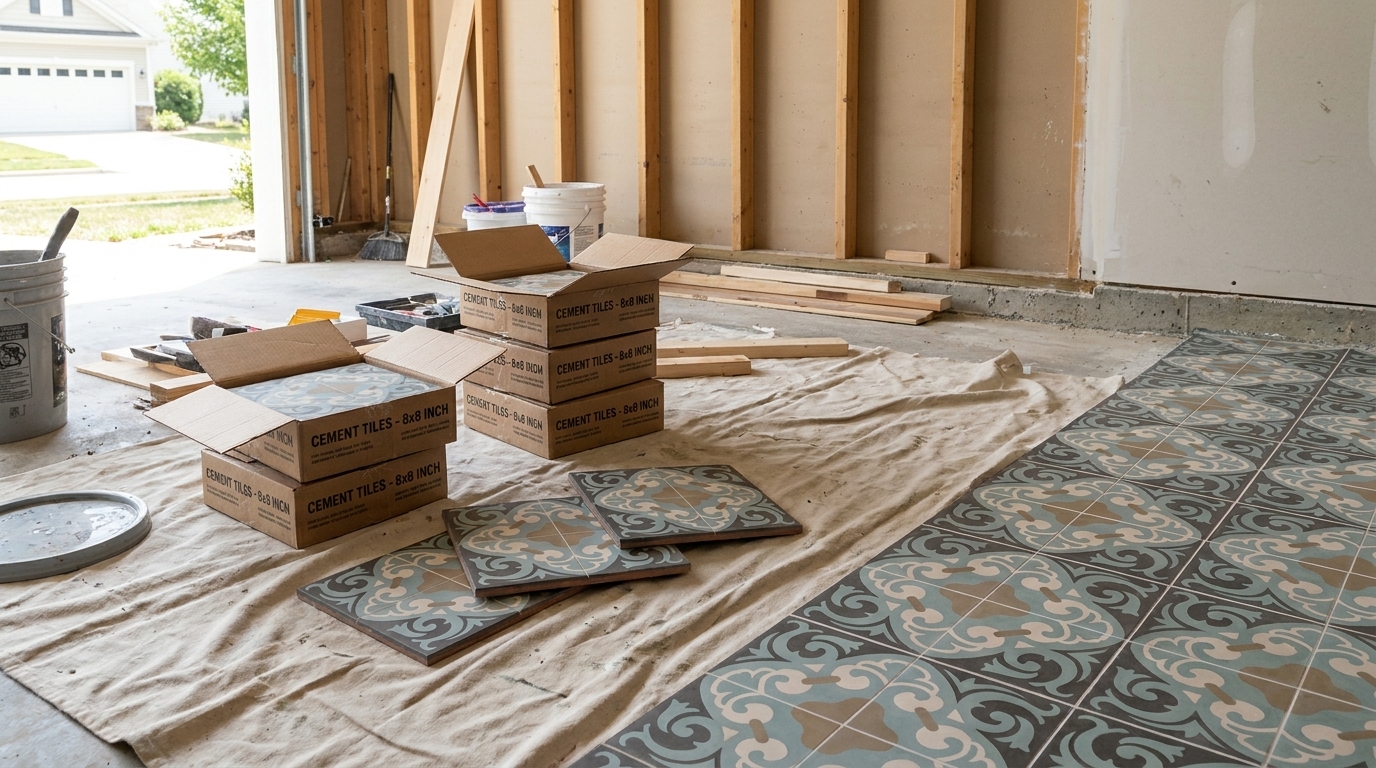
Tile shipment inspection is the five minutes that decide whether a shipping problem costs you nothing or costs you weeks. Cement tile travels by freight on wooden pallets, often for hundreds of miles, and it rides alongside other heavy freight. A corner gets crushed. A pallet shifts. A box gets wet. None of that is common, but it happens, and how you handle the first hour after the truck pulls away determines whether you get a fast, free replacement or a denied claim. This guide walks through what to check before you sign, how to open your boxes correctly, how freight claims actually work, and how to put your leftover tile, your overage, to good use instead of letting it sit in a garage for a decade.
Why Tile Shipment Inspection Can’t Wait
Freight carriers treat your signature on the delivery receipt as proof the shipment arrived in good condition. If you sign without noting a problem, the carrier can deny a damage claim later, even if the tile was clearly cracked when it left the truck. That is why tile shipment inspection has to happen at delivery, not after the driver leaves.
Cement tiles are hand-pressed and cured, not fired like ceramic or porcelain. Because of that, they are more brittle during handling than kiln-fired tile until they are sealed and set. A rough forklift drop or a tipped pallet can chip edges or crack a tile face without damaging the box itself. That is exactly why a quick visual check at the curb is not enough. You need to open something before the driver drives off.
Before You Sign: The Delivery Inspection Checklist

Start with the pallet, not the boxes. Walk around it and look for crushed corners, a leaning stack, or shrink wrap that has been cut and retaped. Any of these is a sign the load shifted in transit.
- Count the boxes on the pallet against the number listed on the bill of lading (the shipping document the driver carries).
- Check for wet cardboard, water stains, or a sagging bottom box.
- Open at least one box from each pallet while the driver is still there, if the carrier allows it.
- Photograph the pallet, the shrink wrap, and each box before you move anything.
If you see damage, do not just sign and hope for the best. Write a specific description on the delivery receipt, for example “two boxes crushed on left corner, tile visible through box,” instead of a vague “damaged” note. Specific language protects you if the claim gets reviewed later. If the damage looks severe, you also have the right to refuse that pallet entirely.
The Room-by-Room Unboxing Protocol
Once the truck leaves, open every box, not just the top layer of the pallet. Padding and packaging can hide a cracked tile two or three boxes down that looked fine from the outside. Do this before any tile touches thinset.
Work through the order in stages. First, confirm the pattern and color on the box label match what you ordered. Then count tiles per box against what should be inside, since an 8×8 box should hold 12 tiles covering 5.17 square feet. Finally, fan out a few tiles from different boxes side by side to check for dye lot consistency across the shipment.
Unbox everything as soon as possible after delivery. Freight carriers generally require concealed damage, the kind you only discover once a box is open, to be reported within just a few business days of delivery. Waiting two weeks to open your tile because the project hasn’t started yet can close that window before you even know there is a problem.
Visible Damage vs. Concealed Damage: Why the Difference Matters
Visible damage is anything you can see from the outside: a crushed box, a torn pallet, a tile corner poking through cardboard. You handle this at delivery, by noting it on the receipt and photographing it before the driver leaves.
Concealed damage is different. The box looks fine, but a tile inside is cracked or chipped from handling earlier in the shipping chain. Because nothing looked wrong at delivery, carriers hold concealed damage claims to a tighter timeline and a higher standard of proof. That is why opening every box promptly matters so much, instead of stacking unopened boxes in a corner until the installer arrives.
For either type of damage, take clear photos of the box label, the lot number, and the damaged tile itself. A photo with a tape measure or coin next to the crack helps establish scale and is easy for a claims reviewer to assess quickly.
How to File a Freight Claim, Step by Step
Filing a claim is straightforward if you have documentation ready. Here is the order that works best.
- Keep the damaged tile and the original packaging. Do not discard anything until the claim is resolved, because carriers may request to inspect it.
- Photograph the damage from multiple angles, including the shipping label and lot number on the box.
- Pull the exception language you wrote on the delivery receipt, or note the date you discovered concealed damage.
- Reach out to our team through the contact page with your order number, photos, and receipt notes. We handle the carrier coordination from there.
- Expect a quick turnaround on replacements for in-stock patterns, since those ship within days. If your order was a custom pattern, the replacement follows the standard four-to-six week production cycle, because it is made to order.
The single biggest reason claims get denied isn’t fraud or bad luck. It’s missing documentation. A photo taken thirty seconds after the box is opened is worth more than a detailed email written a week later from memory.
Put Your Overage to Work

We recommend ordering 15% more tile than your measured square footage to cover cuts, pattern matching, and the occasional breakage during installation. That overage is not wasted material. Treat it as an asset, not a leftover.
First, set aside at least one full box before your installer starts cutting into the pile for edge pieces. Label it clearly and store it flat in a dry spot, away from direct sun and temperature swings, the same storage conditions covered in our maintenance and cleaning guide. That box becomes your insurance policy against future chips, cracks, or a dropped pot in the kitchen.
Here’s why this matters more for cement tile than for most flooring. Each batch is hand-poured with pigment, so subtle color variation can creep in between production runs, even within the same named pattern. A box from your original shipment will always match better than a box ordered two years later. Keeping overage from day one is the cheapest insurance against a mismatched repair down the road.
Overage also has a second life beyond repairs. Extra tile from a run of something like La Espanola Sage 01 can frame a mudroom bench, line a small planter, or edge a backsplash niche. Browse our installation gallery for ideas on where a handful of leftover tiles can do real design work instead of sitting in a box.
When to Call Us Before You Call Your Installer
Some shipment issues aren’t about broken tile at all. They’re about the wrong tile, a short count, or a dye lot that doesn’t match your sample. If any of that shows up during your unboxing, call us before the installer opens a bag of thinset.
An installer can’t fix a shipping error with trowel work. Once tile is set and grouted, correcting a pattern mix-up means tearing out finished floor, not just swapping a box. Catching it during inspection, instead of mid-install, saves real time and money.
If you’re unsure whether a shade looks off, order a fresh sample for comparison. Samples run $20 for the first and $10 for each additional, with free shipping, and they’re the fastest way to confirm whether what’s on your floor matches what you ordered. It’s a small cost against the alternative of reinstalling a room.
Finally, remember that every in-stock pattern in our in-stock collection ships from our Laredo, Texas warehouse, and every tile is still made the way our factory in San Luis Potosí has made it since 1900. If something about your shipment doesn’t look right, trust that instinct and reach out. We would rather answer a quick question now than process a claim after the floor is already set.
Frequently Asked Questions
How long do I have to file a freight claim for damaged tile?
Visible damage should be noted on the delivery receipt the day it arrives. Concealed damage, discovered after you open the boxes, typically needs to be reported within a few business days under standard freight carrier rules. The sooner you contact us, the stronger your claim.
What if I didn’t notice damage until after I signed for the delivery?
You can still file a concealed damage claim. Open every box as soon as possible after delivery, photograph what you find, and contact our team right away. Acting quickly matters more than anything else at this stage.
How many extra tiles should I order, and what should I do with the leftovers?
We recommend 15% over your measured square footage to cover cuts and breakage. Instead of using every spare tile during installation, set a box aside unopened for future repairs, since it will always match your floor better than a tile ordered years later.
Can I return unused boxes from my overage?
Reach out through our contact page to discuss your specific order. Because handmade cement tile is produced in batches, we handle returns and exchanges case by case rather than with a blanket policy.
See the tile in person before you commit
Photos only tell you half the story. Colors, texture and the handmade character of cement tile are best judged in your own light. Order a sample of any in-stock pattern for $20 (additional samples $10, free shipping) — or tell us about your project and we’ll help you narrow it down.
Browse in-stock cement tiles →
Talk to us about your project →