The most successful commercial spaces in America right now have something in common — and it isn’t their furniture, their lighting, or their branding. It’s what’s beneath their guests’ feet.
In 2026, the floors and walls of restaurants, boutique hotels, spas, and retail spaces across the United States are being specified with the same intentionality once reserved for residential interiors. Business owners and the designers they hire have realized something that the hospitality industry has known for decades: the surface tells the story. Before a guest reads a menu, checks in at a front desk, or touches a product on a shelf, the floor has already communicated whether this place is worth their time.
This guide covers the commercial floor and wall tile trends defining the U.S. market in 2026 — the patterns, palettes, and material decisions that separate spaces guests remember from spaces they forget. And at the center of nearly every compelling specification on this list: handmade cement tiles.
Why Commercial Tile Is Changing in 2026

The forces reshaping commercial tile in America this year are rooted in something beyond aesthetics — they’re rooted in business performance.
Experience over transaction. In every commercial category — dining, hospitality, retail, wellness — businesses that create genuine experiences are outperforming those that simply provide services. The physical environment is the experience. And the floor is the first element of that environment guests process, even if they never consciously register it.
Post-generic differentiation. A decade of tech-minimalist commercial design — white walls, exposed concrete, Edison bulbs — has produced visual saturation. The brands separating themselves in 2026 are doing so through material specificity: surfaces with craft, pattern, and cultural depth that communicate a point of view. Generic is invisible. Specific is memorable.
Durability as design value. Commercial clients who invested in handmade cement tiles in the 2010s are now seeing the long-term return: floors that have developed patina and character rather than showing wear, that require straightforward maintenance, and that still look distinctive a decade after installation. Word travels in design circles, and those outcomes are driving new commercial specifications.
Trend 1: Pattern-Led Restaurant Floors

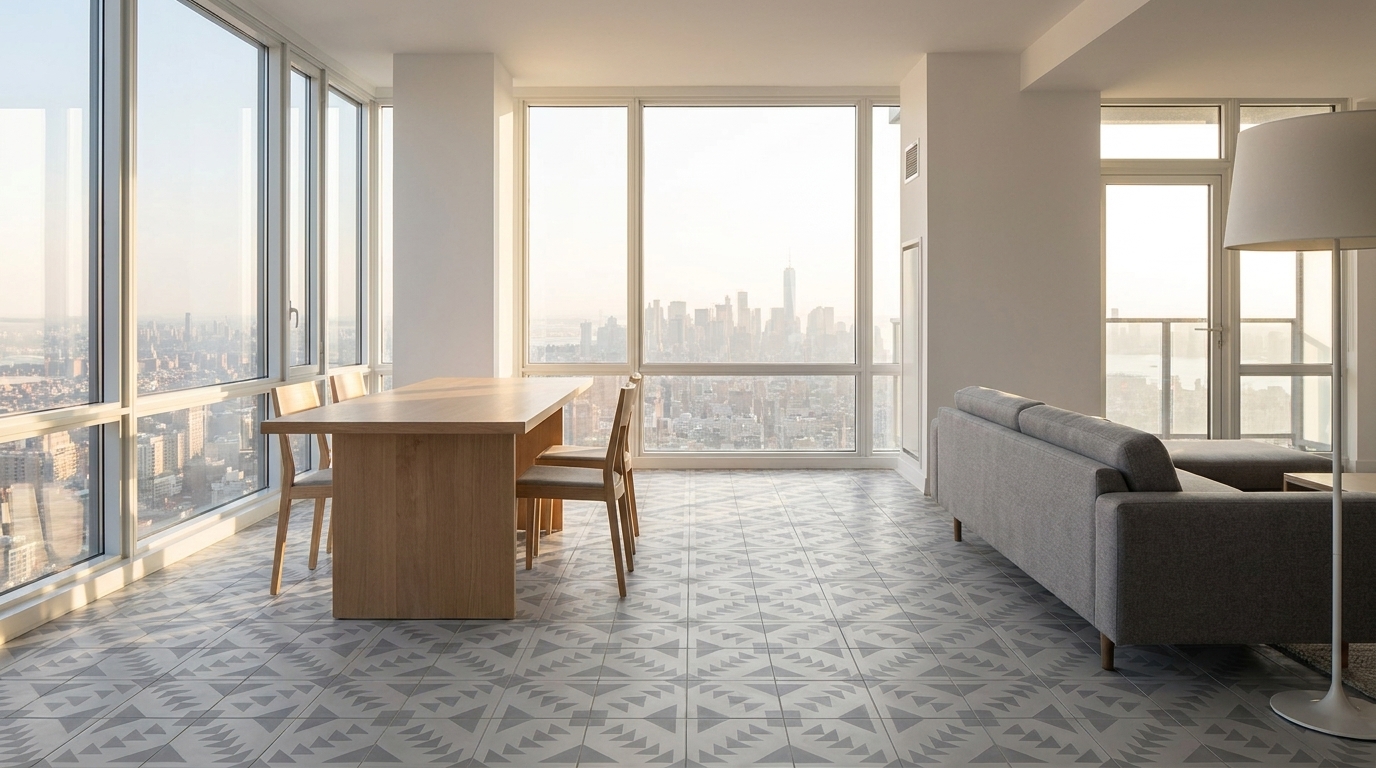
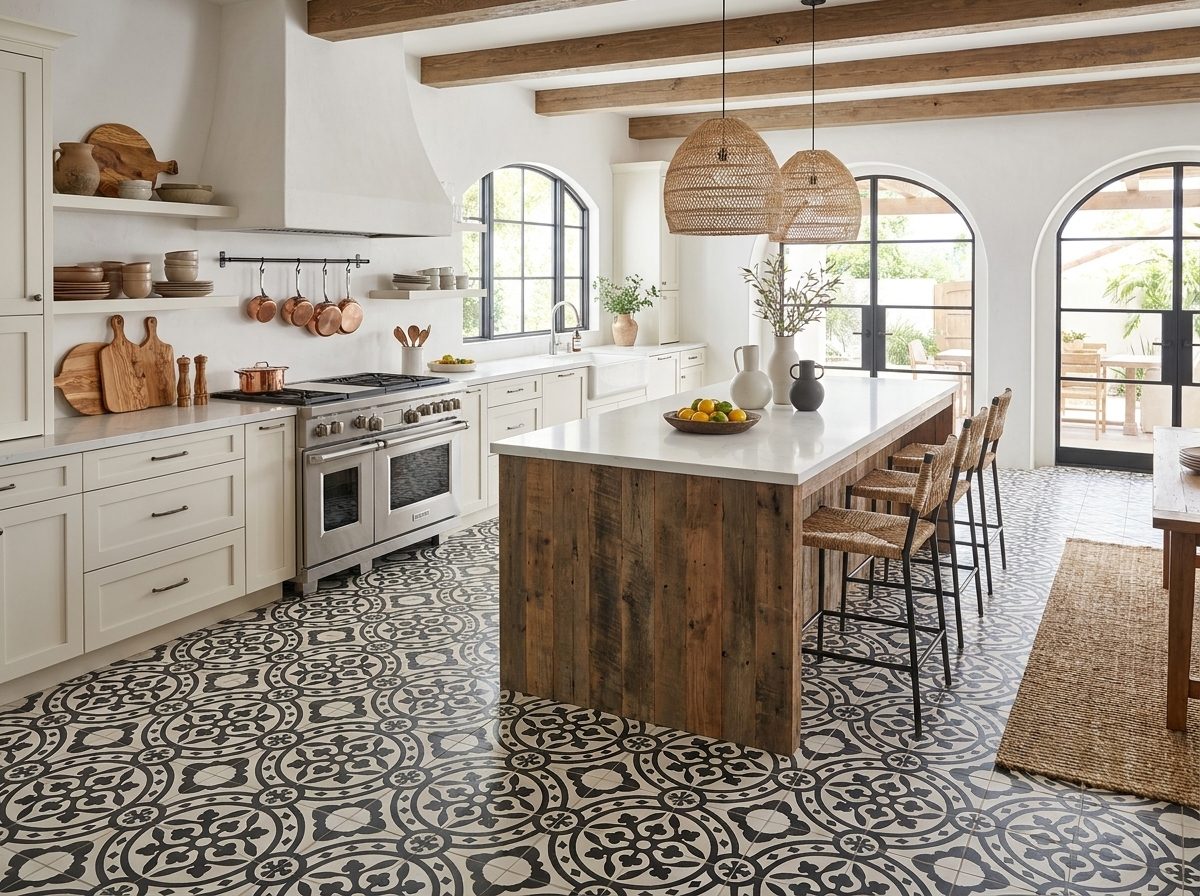
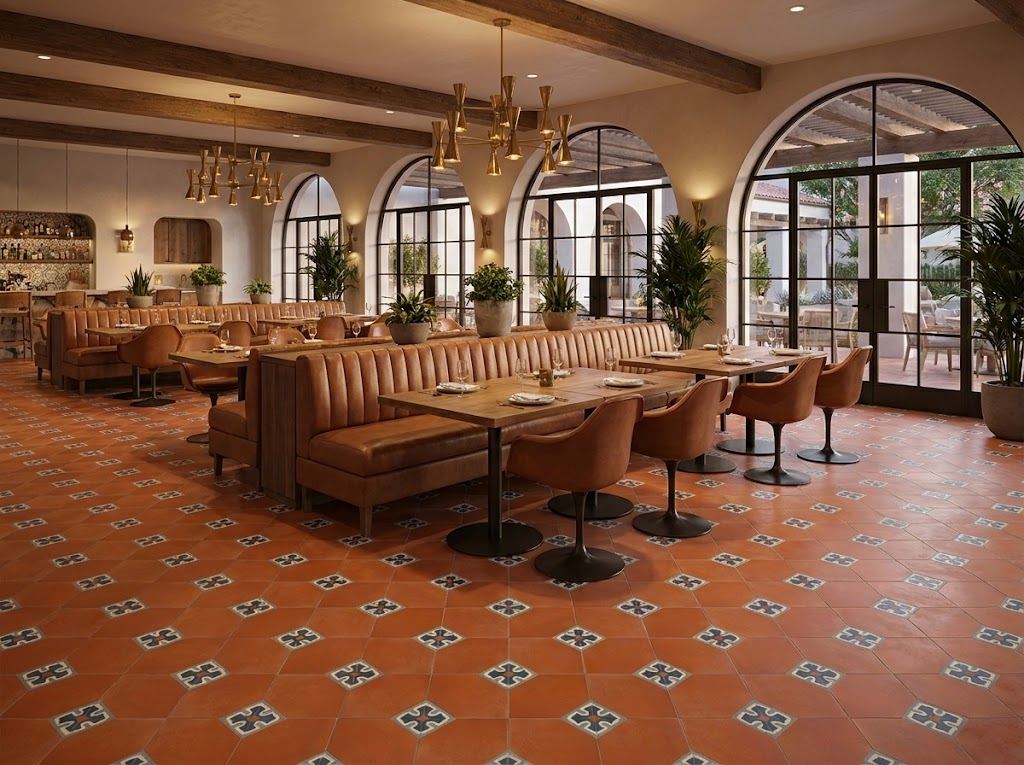
The most design-forward restaurants opening in the U.S. in 2026 are treating the floor as the room’s primary design statement. Bold Moroccan geometric patterns in deep navy and cream, classic encaustic star-and-cross combinations, and large-scale terracotta and white compositions are being specified in dining rooms where the architecture is deliberately restrained — allowing the floor to define the room’s character completely.
This approach works for a specific business reason as much as an aesthetic one: a distinctive patterned floor is the element of a restaurant interior that photographs most consistently well across different lighting conditions, from different angles, and with different subjects in frame. In an era when Instagram and Google imagery drive significant foot traffic decisions, a cement tile floor is content infrastructure as much as it is a design choice.
Designer tip: For open-plan dining rooms, center the geometric pattern optically within the room and work outward. A pattern that’s off-center in a restaurant floor reads as a mistake to a trained eye — and increasingly to an untrained one.
Explore commercial-ready geometric and Moroccan patterns in the In-Stock Collection.
Trend 2: Hotel Bathrooms as Brand Proof Points

In hotel design, the bathroom has emerged as the single most influential driver of guest satisfaction scores and online review sentiment. Guests spend significant time in hotel bathrooms; they experience them at close range; and they make strong quality judgments based on what they find there.
The most forward-thinking hotel brands — both independent properties and design-led boutique collections — are responding by specifying bathroom surfaces that communicate craft and investment in a way that standard large-format porcelain cannot. Patterned cement tile floors, feature walls behind freestanding tubs, and fully tiled shower enclosures in warm encaustic patterns are the specifications driving the best-reviewed boutique hotel openings across the U.S. this year.
The material logic is sound: cement tile’s matte surface provides natural slip resistance. Its mineral pigment depth communicates quality at the close viewing distances typical of bathroom use. And its handmade variation signals that this bathroom was designed — not standardized.
For hotel brands developing a signature tile specification across multiple properties, the Custom Made Collection allows designers to develop a pattern tied to the brand’s visual identity — a specification that no competitor property will share.
Trend 3: Retail Floors That Do the Brand’s Work

Physical retail in 2026 is defined by a single challenge: giving people a reason to show up in person when they could buy online in thirty seconds. The answer, consistently, is environment — a space worth experiencing, worth spending time in, worth bringing a friend to see.
The floor is where that environmental proposition begins. A cement tile floor in a boutique fashion store, specialty food shop, or premium beauty retail space communicates brand values before a customer has looked at a single product. It says: we pay attention to what things are made of. We care about surfaces. We chose this because we wanted something specific, not something adequate.
The commercial tile trends in U.S. retail for 2026 are leaning toward:
- Warm terracotta and earth-toned patterns in food, wellness, and lifestyle retail — where the earthy palette reinforces the brand’s artisan or natural product positioning
- Bold geometric combinations in fashion and home goods boutiques — where the floor pattern functions as a visual anchor for minimal, product-forward merchandising
- Moroccan-influenced patterns in spa, beauty, and wellness retail — where the cultural resonance of the pattern creates the sensory atmosphere clients pay a premium for
Use the Design Studio to visualize how different patterns and palettes will read within the specific footprint of a retail space before presenting options to clients.
Trend 4: Commercial Wall Tile Moves Beyond the Backsplash

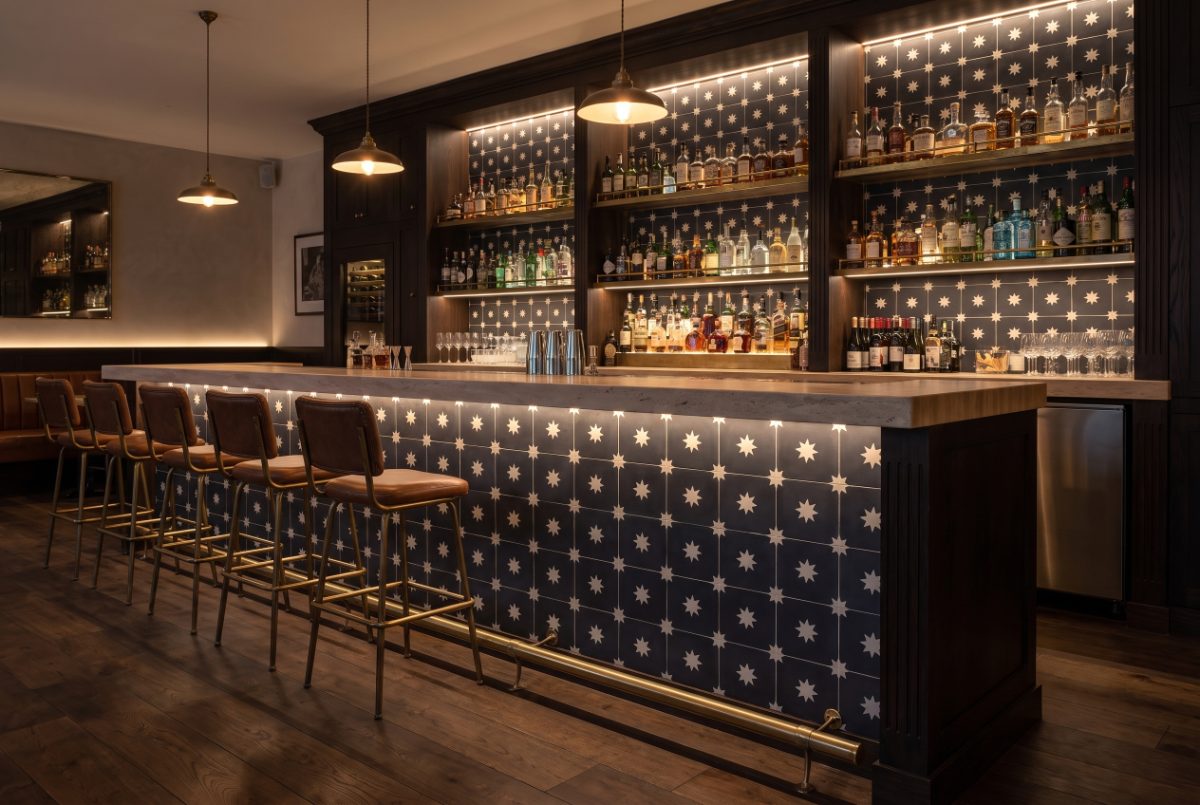
Wall tile in commercial interiors has historically been confined to functional applications — kitchen surrounds, bathroom walls, service areas. In 2026, that constraint has dissolved. Patterned cement tiles are appearing on commercial walls as feature surfaces in dining rooms, hotel lobby accent walls, spa reception areas, and boutique retail fitting rooms — wherever a brand wants to make a material statement at eye level rather than underfoot.
The case for commercial wall tile applications is both aesthetic and strategic. A patterned cement tile feature wall creates a photographic focal point within a commercial space — a surface that guests and customers will photograph and share, generating organic social content that functions as brand marketing. Positioned behind a bar, at the end of a hotel corridor, or as the back wall of a restaurant host stand, a cement tile wall specification can produce years of brand imagery at no ongoing cost.
For commercial wall applications, specify a high-bond, non-slip adhesive rated for vertical use, and confirm substrate load capacity with the structural team before finalizing the specification. The Projects Gallery includes completed commercial wall installations across restaurant, hotel, and retail typologies.
Trend 5: The Custom Tile as Competitive Advantage

The most sophisticated commercial design move of 2026 isn’t following any of the trends above — it’s transcending them. The brands investing in custom cement tile designs developed specifically for their spaces are creating a differentiation that no competitor can replicate without starting the same process from scratch.
A restaurant with a floor pattern derived from the neighborhood’s historic architecture. A hotel with a bathroom tile colorway that echoes the regional landscape. A retail brand with a geometric design embedded in the floor of every store location — proprietary, protected, immediately recognizable. These are commercial design decisions that become brand assets.
The Custom Made Collection is built for exactly these conversations. Custom work requires early engagement — typically 12–16 weeks before the required on-site date — but the competitive and brand value of the result justifies the planning discipline it requires.
Specification Essentials for Commercial Cement Tile Projects
Whether you’re specifying for a fifty-seat restaurant or a multi-property hotel rollout, these principles apply:
- Commercial sealing specification: Penetrating sealer before grouting plus a commercial-grade topcoat after installation — rated for the specific traffic type (food-service, hospitality, retail dry traffic)
- Epoxy grout for food-service floors: More resistant to staining and easier to clean under daily restaurant service conditions than standard cement grout
- Substrate flatness: 3mm tolerance over 3m — lippage is more visible on patterned tiles than solids, and non-compliant substrates produce installation problems that are expensive to correct
- Movement joints: At all columns, doorways, perimeter transitions, and at intervals specified by the adhesive manufacturer — commercial buildings experience more structural movement than residential
- Overage: 12–15% for cuts, waste, and future repairs — dye lot matching for future patching is important in commercial settings where a single replaced tile in a bold pattern is immediately visible
- Contractor qualification: Specify a contractor with documented experience installing handmade cement tiles in commercial environments — the installation process differs meaningfully from standard porcelain or ceramic
FAQ: Commercial Cement Tile Trends 2026
Are cement tiles durable enough for high-traffic commercial floors? Yes — cement tiles have been used in commercial environments for over 150 years, including in restaurants, hotel lobbies, and retail spaces with heavy daily foot traffic. The mineral pigment runs through the full wear layer, meaning traffic develops patina rather than wear-through. With correct commercial-grade sealing and a proper maintenance program, cement tile commercial floors perform beautifully for decades.
How do I justify the cost of handmade cement tiles to a commercial client? The most effective framing is total cost of ownership. Cement tiles last significantly longer than printed-surface alternatives, develop character over time rather than dating quickly, and carry brand storytelling value that manufactured tiles don’t. A restaurant that photographs well and generates consistent social content is a business asset — and the floor is part of that asset.
What commercial spaces are best suited to cement tile? Restaurants, boutique hotels, spas, wellness centers, specialty retail, and any commercial space where the design experience is part of the brand value proposition. Cement tiles are less suited to fully exposed outdoor commercial applications subject to freeze-thaw cycling, or to heavy industrial environments requiring impermeable surfaces.
How early should I engage Original Mission Tile for a commercial project? For in-stock patterns, as early as possible to confirm quantity availability. For custom patterns, a minimum of 12–16 weeks before the required on-site date is recommended. The design team is equipped to support commercial projects from early concept through specification finalization.
Conclusion: The Commercial Spaces Worth Visiting Are the Ones Worth Designing
Every commercial space that matters in 2026 — the restaurant that’s booked three weeks out, the hotel that earns consistent five-star reviews, the boutique with the lines out the door on Saturday morning — has one quality in common: it feels like it was designed, not assembled.
That quality begins with material decisions. With surfaces chosen for what they communicate, not just what they cost per square foot. With floors and walls that tell a story about what a brand believes and how it wants its guests to feel.
Handmade cement tiles are one of the most powerful tools available for creating that quality in a commercial space. The pattern range is extraordinary. The durability record is proven. The brand differentiation is real and lasting. And the spaces they create — warm, distinctive, impossible to replicate without starting from the same place — are the ones that get talked about, photographed, returned to, and remembered.
Ready to specify for your next commercial project?
Explore proven commercial patterns in the In-Stock Collection, begin a custom tile conversation through the Custom Made Collection, and browse completed restaurant, hotel, and retail installations in the Projects Gallery.