Choosing the right tile for a space is one of the most consequential design decisions you can make. It affects how a room feels, how it performs, and how it ages over the years. Yet many designers, contractors, and renovators still treat tile as a finishing detail — chosen last, decided quickly, and often regretted slowly.
In 2026, that approach is changing. The most successful interiors being built and renovated across the United States are tile-first spaces. The floor, the wall, the kitchen backsplash — each surface is chosen with intention, and everything else follows from it. This guide covers every major tile application room by room, so you can specify with confidence, advise clients with authority, and build spaces that earn their place for decades.
Why Handmade Cement Tiles Belong at the Center of Every 2026 Specification

Before diving room by room, it’s worth understanding what separates handmade cement tiles from the mass-produced alternatives that fill most specification catalogs.
Cement tiles are hydraulically pressed — not kiln-fired. Each tile starts as mineral pigment poured by hand into a metal mold. A cement and marble powder layer follows, and then the press applies thousands of pounds of pressure. The result is a tile where color runs through the full wear layer, not printed on a surface coating that chips and fades.
In practical terms, this means several things. First, cement tiles develop patina rather than wear damage. Second, their matte, micro-textured surface provides natural slip resistance without anti-slip treatments. Third, the pattern range is essentially unlimited — geometric, Moroccan, botanical, custom — because the mold, not a printer, creates the design. Finally, no kiln firing means a significantly lower energy footprint than porcelain or ceramic alternatives.
With that foundation in place, let’s go room by room.
Kitchen Tiles: The Floor and Backsplash as Design Anchors
Kitchen Floor Tiles
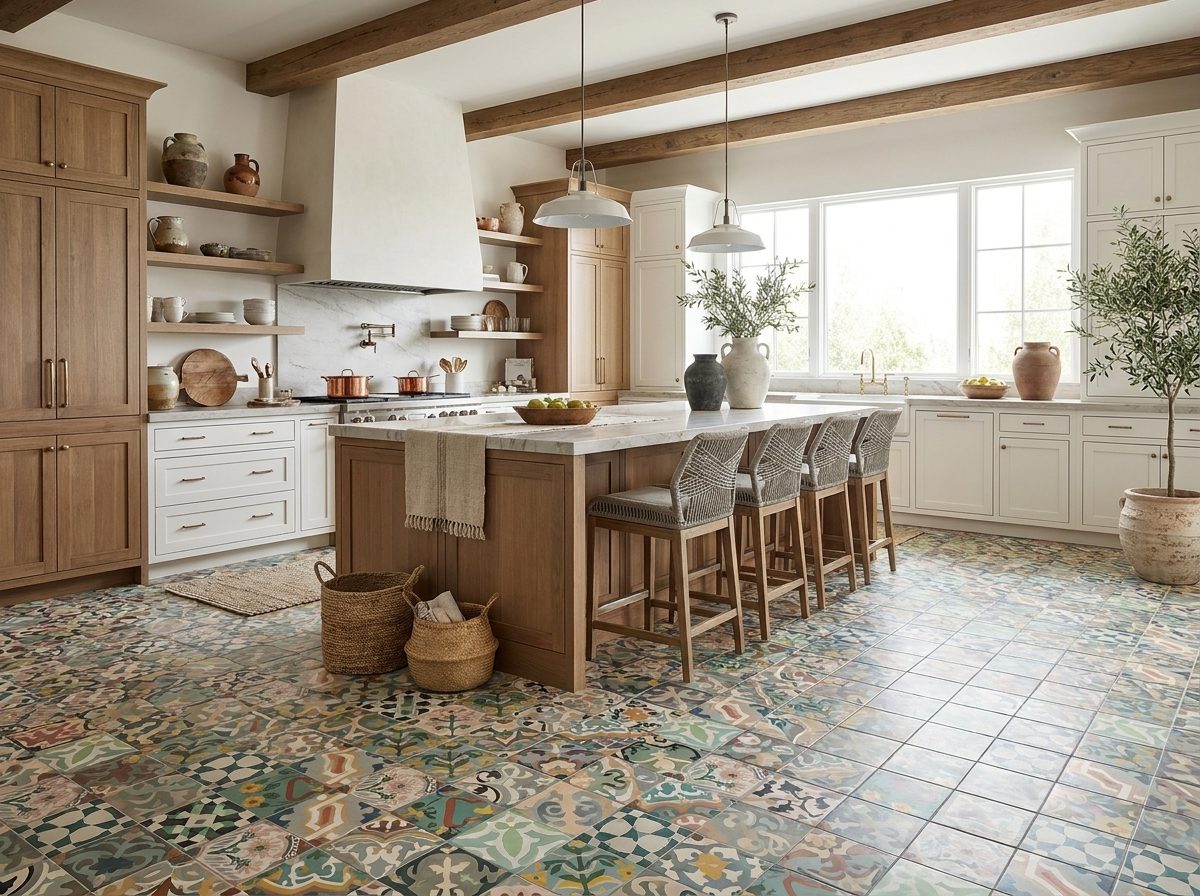
The kitchen floor sets the tone for the entire space. Moreover, it must perform under daily spills, foot traffic, and the general demands of a working kitchen. In 2026, the dominant kitchen floor tile trend is bold geometric and Moroccan patterns in deep, saturated colorways — cobalt and cream, terracotta and white, charcoal and warm sand.
Cement tiles handle this environment exceptionally well. Their mineral pigment absorbs the visual evidence of everyday cooking life. A warm terracotta floor, for instance, forgives what a white tile would highlight. Furthermore, the dense pressed body resists the acidic spills — citrus, vinegar, wine — that attack porous fired clay surfaces.
For contractors: always dry-lay the pattern before setting. Optical centering in the room, not geometric centering on the substrate, determines whether a patterned kitchen floor reads as intentional or accidental.
Kitchen Backsplash Tiles
The backsplash has evolved from a functional splash guard into the kitchen’s focal artwork. As a result, designers are specifying patterned cement tile backsplashes that function more like curated wall installations than standard tile work. A Moroccan geometric in deep navy behind a white shaker kitchen. A warm encaustic pattern in terracotta and cream behind marble countertops.
Under-cabinet lighting grazes across the backsplash surface, amplifying the natural variation and texture of handmade cement tiles in a way that printed porcelain never achieves. Additionally, the matte surface of cement tiles prevents the visual glare that high-gloss backsplash tiles produce under task lighting.
Browse backsplash and kitchen floor patterns in the In-Stock Collection.
Bathroom Tiles: From Functional to Sanctuary
Bathroom Floor Tiles

The bathroom has completed its transformation from utility room to sanctuary. Consequently, floor tile specifications have moved decisively toward pattern, warmth, and material depth. In 2026, patterned cement tile bathroom floors — Moroccan star-and-cross, interlocking diamond, classic encaustic geometric — are the specification driving the most client satisfaction and the most social media engagement in residential renovation.
In terms of performance, cement tiles’ natural matte surface provides excellent slip resistance. This is a meaningful advantage over polished porcelain, which requires additional anti-slip treatments in wet applications. Furthermore, a properly sealed cement tile bathroom floor handles everyday moisture with straightforward maintenance — neutral-pH cleaner and periodic resealing.
For small bathrooms and powder rooms specifically, a bold patterned cement tile floor creates the jewel-box effect that makes compact spaces feel deliberately precious rather than simply small.
Bathroom Wall Tiles
Wall tile in American bathrooms has historically been conservative. However, 2026 is changing that. Feature walls behind freestanding tubs, back walls of walk-in showers, and fully tiled powder room walls are all receiving patterned cement tile treatment in this year’s most forward-thinking residential projects.
A fully tiled powder room wall in a warm encaustic pattern — terracotta and cream, or deep indigo and white — transforms a functional space into a room guests remember. Similarly, a cement tile feature wall behind a freestanding bath creates a spa atmosphere that no painted surface can approach. For shower wall applications, proper waterproofing behind the substrate is essential. Additionally, specify a wet-area penetrating sealer formulated for continuous moisture exposure.
Patio and Terrace Tiles: The Outdoor Room Grows Up

Why the Patio Now Gets the Same Attention as the Living Room
The covered terrace and patio has become a primary living space in contemporary residential design. As a result, designers and renovators are bringing the same material intentionality to outdoor floors that they’ve always applied indoors. In particular, the indoor-outdoor continuity trend — running complementary patterns from interior kitchen or living room floors onto adjacent terraces — is reshaping how outdoor tile is specified.
Pattern Strategies for Outdoor Tiles
For covered terraces, Moroccan and Mediterranean geometric patterns are the dominant 2026 specification. These pattern families have lived outdoors for centuries — in Andalusian courtyards, Moroccan riads, Portuguese quintas — so their association with outdoor living is deep and culturally resonant. Moreover, they hold their visual impact across larger outdoor expanses in a way that simpler geometric patterns sometimes don’t.
For outdoor applications, cement tiles perform well on covered surfaces protected from direct weather exposure. However, for fully exposed areas subject to freeze-thaw cycling, consult with the Original Mission Tile team on appropriate sealing and substrate preparation before specifying. Additionally, specify an outdoor-rated penetrating sealer, and build a reapplication schedule into the maintenance handover documentation.
Browse completed indoor-outdoor projects in the Projects Gallery.
Entryway Tiles: The Home’s First Sentence
Why the Entry Floor Is the Highest-Impact Specification
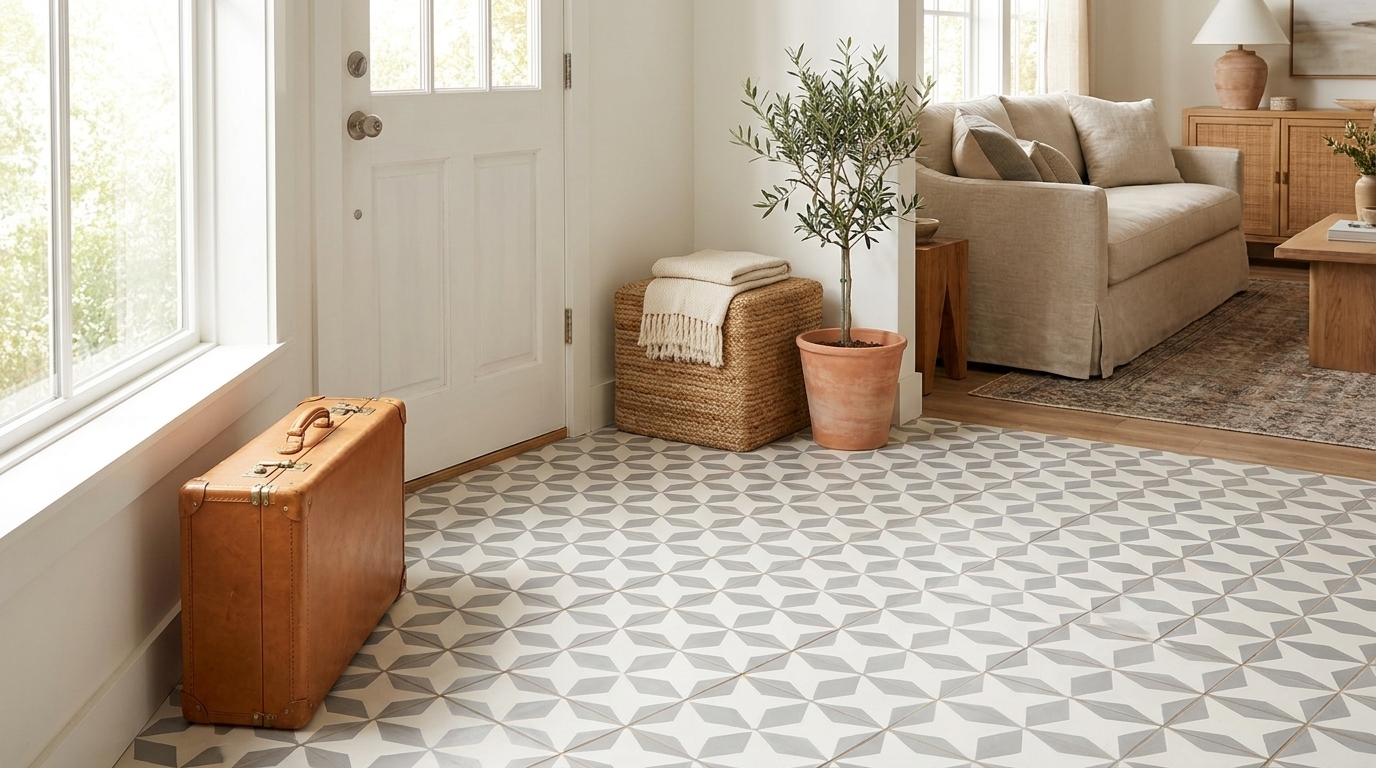
The entryway communicates the design intention of an entire home before a guest has taken a second step inside. Consequently, designers are treating entry floors as the home’s thesis statement — the surface that establishes the material language of every room that follows.
For renovators, the entryway is also the most efficient introduction to cement tile specification. First, it requires less square footage than a kitchen or bathroom floor. Second, the close-range experience of the entry means that the material quality of handmade tile is immediately legible. Third, the before-and-after of a patterned entry floor renovation is one of the most shareable and referral-generating project photographs a contractor can produce.
The Patterns That Lead in 2026
The patterns generating the most entryway specification activity this year include classic Moroccan star-and-cross combinations, bold two-color geometric diamonds, and encaustic floral designs. Additionally, mixed-pattern borders around a simpler field tile center are increasingly popular — they create a composed, rug-like quality that grounds the entryway without overwhelming it.
Use the Design Studio to visualize pattern and color combinations at the actual proportions of a specific entryway before presenting options to clients.
Living Room and Feature Wall Tiles
Floor Tiles in Open-Plan Living Spaces
In open-plan homes, the floor tile specification affects every zone simultaneously. As a result, pattern scale and color selection require particular care. Large-scale geometric patterns — bold enough to read from across the room — work well in expansive open plans. In contrast, more intricate Moroccan patterns read best in rooms experienced at closer range.
Furthermore, cement tile floors in open-plan living spaces offer a spatial design tool that furniture cannot: they can define zones without physical dividers. A patterned tile dining area that transitions to a complementary field tile in the sitting area creates distinction without walls. Similarly, a Moroccan pattern at an entryway transition point marks arrival into the main living space.
Breeze Block Feature Walls
Beyond floor tile, one of the most compelling wall applications of 2026 is the cement breeze block feature wall. Positioned behind a fireplace, across the living room’s accent wall, or at the end of an open hallway, breeze blocks introduce architectural depth and geometric shadow play that no flat surface can achieve.
The 8×8 Breeze Block Collection draws from the same Moorish and Mediterranean pattern vocabulary as Original Mission Tile’s encaustic tile range. Consequently, a project can specify complementary breeze block and floor tile designs from a single material family — creating visual coherence across both horizontal and vertical surfaces.
Commercial Spaces: Restaurants, Hotels & Retail
Floors That Work as Brand Architecture
In commercial interiors, the floor tile specification serves a dual purpose. On one hand, it must perform under heavy daily use for years. On the other, it must communicate brand character before a guest has processed anything else about the space.
Cement tiles meet both requirements. Their mineral pigment body develops patina under commercial traffic rather than wearing through. Furthermore, the pattern and palette options available — from bold Moroccan geometric to warm terracotta field tile — give commercial designers the range to create floors that are genuinely brand-specific rather than generically high-end.
For restaurant and hospitality applications, specify a commercial-grade penetrating sealer plus an appropriate topcoat. Additionally, epoxy grout is recommended for food-service floor applications — it resists staining better than standard cement grout under daily service conditions.
For projects requiring a signature pattern tied to a brand’s visual identity, the Custom Made Collection supports bespoke tile development in collaboration with the Original Mission Tile design team.
Specification Essentials That Apply Everywhere
Regardless of the room or application, these principles apply to every cement tile specification.
Sample first, always. Cement tile colors read differently under different lighting conditions. Therefore, always view samples in the actual space before final specification — not in a showroom, not on a screen.
Seal correctly. Apply a penetrating sealer before grouting and a topcoat appropriate for the use type after installation. Moreover, include a resealing schedule in the project handover — cement tiles maintained correctly last for decades; those that aren’t maintained will show it faster than expected.
Order 10–15% overage. Dye lot consistency matters significantly when a pattern tile needs future repair. Additionally, cuts and waste always consume more material than estimated calculations suggest.
Choose grout color intentionally. A grout that blends with the tile’s dominant tone creates an immersive, continuous surface. In contrast, a contrasting grout emphasizes the grid and creates a more graphic, editorial effect. Both outcomes are valid — but the choice should be deliberate, not default.
For anything beyond the standard range, the Custom Made Collection allows designers to develop specific patterns and colorways for any application and any room.
FAQ: Tiles for Every Room in 2026
Which room is the best starting point for a client new to cement tile? The entryway or powder room offers the lowest cost, highest impact, and lowest maintenance risk. Both are small in area, experienced at close range, and ideal for a bold pattern statement. Furthermore, they generate significant referral value — guests always notice and always ask.
Can the same cement tile be used on both floors and walls? Yes. The same pattern and colorway can be specified for both floor and wall applications. However, for wall applications above a certain height, confirm substrate load capacity and specify a high-bond vertical adhesive. Additionally, wet-area wall applications require appropriate waterproofing behind the substrate.
How do I keep sections of a patterned floor consistent across a large open-plan space? Establish chalk line grids from the optical center of the room before installation begins. Dry-lay at least two pattern repeats in each direction before setting any tile in adhesive. Furthermore, check alignment diagonally as well as orthogonally — Moroccan and geometric patterns reveal misalignment most clearly on the diagonal.
What is the best tile specification for a covered outdoor terrace in a warm climate? A Moroccan or Mediterranean geometric pattern in a warm, earthy palette — terracotta, sand, warm ochre — performs well on covered terraces in warm U.S. climates. Specify an outdoor-rated penetrating sealer and include a reapplication schedule in the maintenance documentation. Additionally, ensure the substrate provides adequate drainage to prevent standing water beneath the tile.
Conclusion: Every Room Deserves a Surface Worth Noticing
The most enduring interiors of 2026 share one quality: every surface was chosen, not settled for. The kitchen floor was the starting point, not the footnote. The bathroom wall was a design decision, not a default. The terrace floor extended the language of the home rather than ignoring it.
Handmade cement tiles from Original Mission Tile — pressed by hand, pigmented with minerals, and proven across generations of residential and commercial use — give designers, contractors, and renovators the material range to bring that quality of intention to every room in a project. Furthermore, with in-stock patterns, custom colorway development, and an interactive Design Studio, the path from inspiration to specification is shorter than ever.
Every room has a surface that matters. In 2026, it’s time to make each one count.
Ready to specify for every room in your next project?
Explore proven patterns in the In-Stock Collection, develop something unique through the Custom Made Collection, visualize your project in the Design Studio, and browse completed installations across every room type in the Projects Gallery.
Contact the Original Mission Tile design team for samples and expert project guidance →