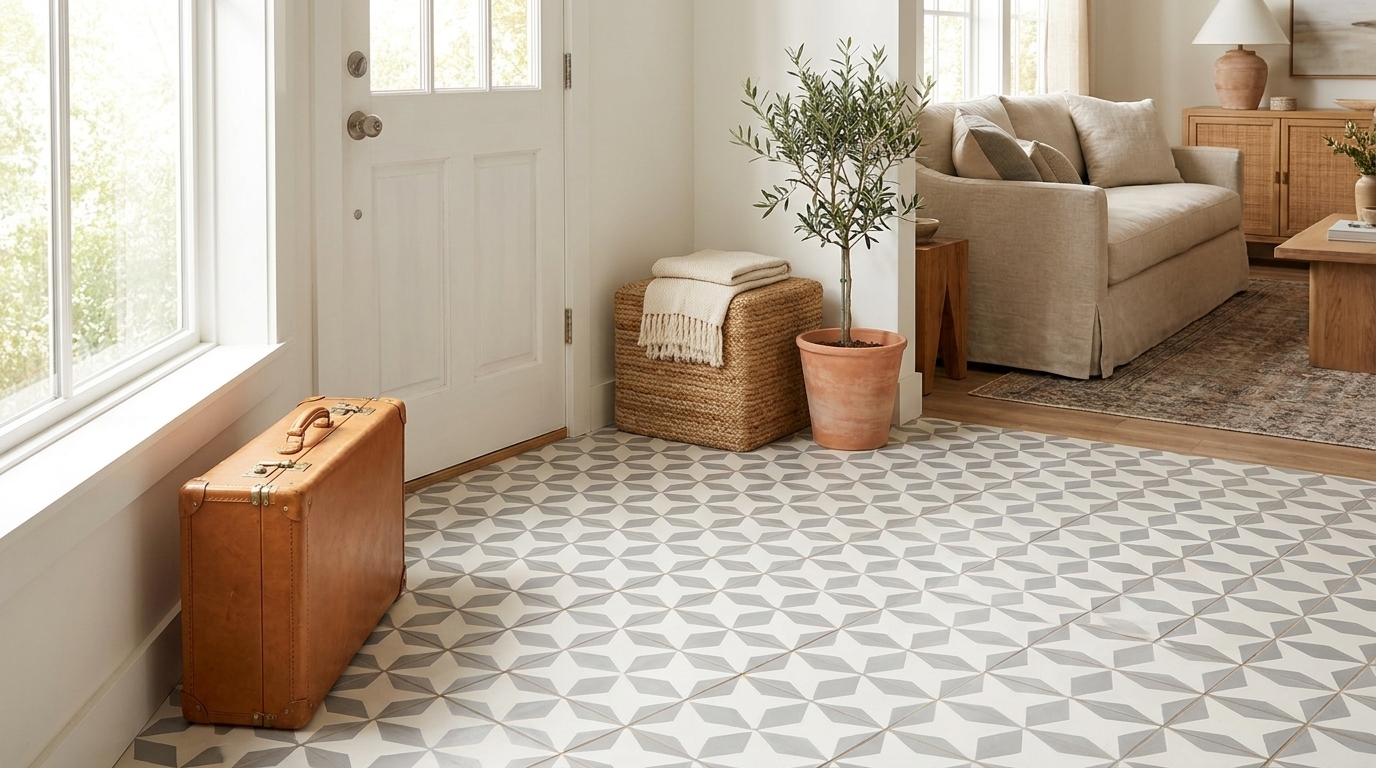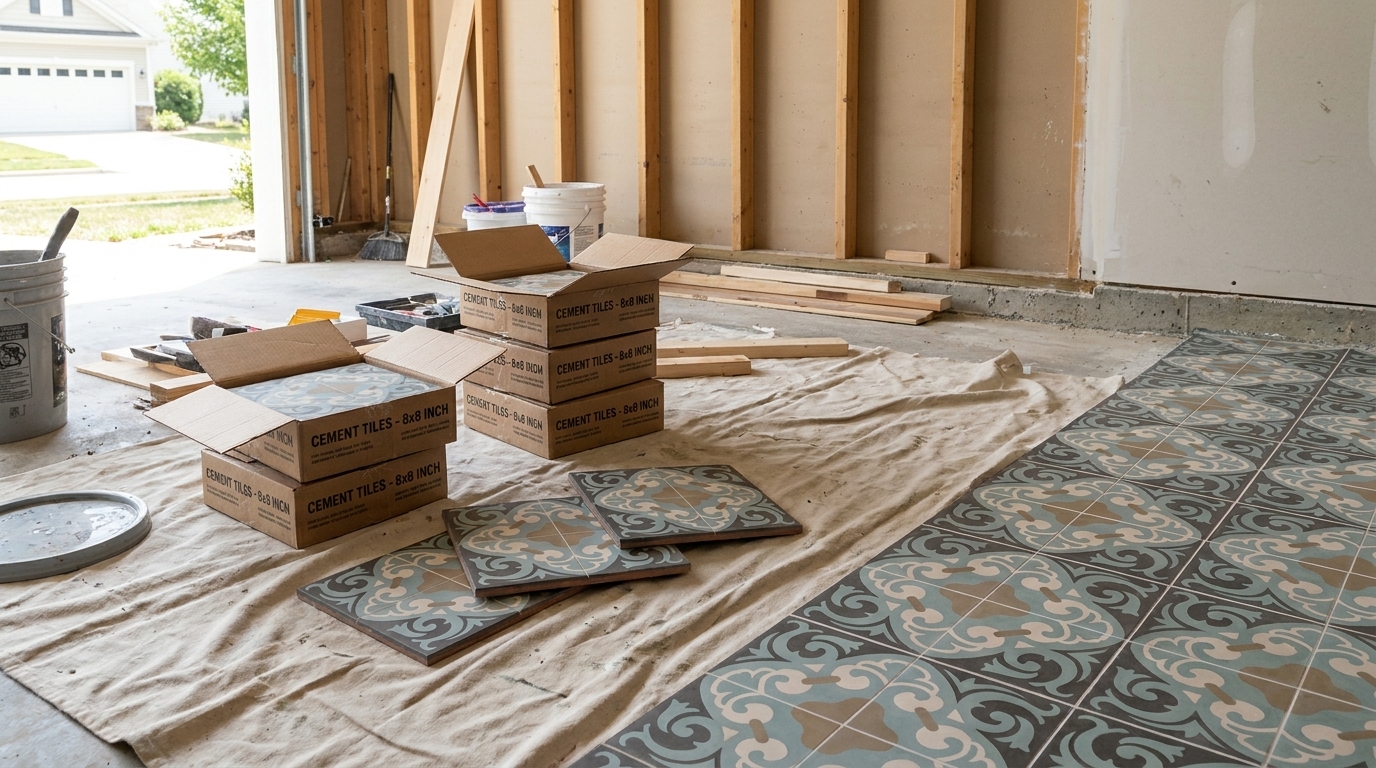
You've chosen the tile. It's the right color, the right finish, the right statement. Maybe it's handmade cement tile with soft variation and crisp pattern. Maybe it's a large-format porcelain slab that turns a plain room into architecture. The installation goes in clean, the grout lines look sharp, and everyone relaxes.
Then a few months later, one corner sounds hollow. A tile edge lifts. Another cracks for no obvious reason.
In a lot of failed installations, the tile gets blamed first. Often, the problem sits underneath it. The bond was too rigid for the job, the substrate wasn't treated properly, or the installer used a bag labeled “flexible” without checking whether that flexibility matched the stresses in the space. That matters more than most buyers realize.
The industry has moved in that direction for a reason. The global tile adhesive market was valued at USD 4.8 billion in 2024 and is projected to reach USD 10.1 billion by 2034, reflecting demand for higher-performance products that help prevent installation failures, according to tile adhesive market analysis from Global Market Insights.
The Unseen Hero of a Flawless Tile Installation
A tile installation only looks simple when it's done well.
Tile itself is hard, dense, and unforgiving. Cement tile adds another layer of responsibility because it's both a finish material and a crafted surface. Once it's installed, there's no hiding a cracked corner or a loose field tile. If the bond below can't handle movement, the tile becomes the part that shows the damage.
Why the bond line matters
Floors move. Walls move. Concrete cures and shifts. Wood framing responds to humidity. Heated floors expand and contract in service. Even a solid slab can transmit stress into the tile layer.
A standard adhesive behaves like a rigid handshake between tile and substrate. That can work in calm conditions. It fails in assemblies that breathe, warm up, cool down, flex slightly, or carry concentrated traffic. A flexible tile adhesive is the part of the system that absorbs those small movements before they become visible failure.
Practical rule: Expensive tile over the wrong adhesive is still a risky installation.
Where premium tile projects go wrong
The most common mistake isn't always dramatic. It's often a specification shortcut:
- A premium tile gets paired with a commodity adhesive because the surface “looks flat enough.”
- A wet area gets tiled before the substrate is properly sealed because the schedule is tight.
- A large or dense tile gets set with a generic flexible product that doesn't have enough deformability for the application.
That's why the adhesive deserves as much attention as the tile itself. For cement tile in particular, success comes from matching the bond to the movement, the substrate, and the service conditions. The bag matters. The standard matters. The preparation matters even more.
What Is Flexible Tile Adhesive
A flexible tile adhesive is an engineered bond coat designed to hold tile securely while accommodating the small movement that occurs in real buildings. Instead of passing that stress straight into the tile, it absorbs part of it within the adhesive layer, which helps prevent cracked grout, debonding, and tile failure.
For cement tile, that distinction matters. These tiles are heavy, dense, and often installed in rooms where moisture, temperature change, and foot traffic all work against the bond. A premium finish can still fail if the adhesive below it is the wrong type.

What makes it flexible
In most cases, flexibility comes from polymer modification in a cement-based adhesive. Those polymers change how the adhesive cures and performs. They improve bond strength, help the adhesive tolerate stress, and reduce the tendency of the cured bed to behave like a rigid, brittle layer.
On site, the result is practical rather than theoretical. The adhesive has enough deformability to deal with slight substrate movement, thermal cycling, and the internal stresses created by large or dense tiles. That is the difference between an installation that stays quiet and one that starts showing hairline grout cracks or drummy spots.
Why movement has to be expected
Movement is normal building behavior, not always a sign of a defect. Concrete continues to dry and shrink. Timber-based floors respond to humidity. Underfloor heating repeatedly expands and contracts the assembly. Even well-built bathrooms see seasonal change, moisture exposure, and service loads.
The adhesive has to be selected with that in mind. Cement tile does not forgive avoidable stress well, especially in wet areas where bond integrity and moisture management work together. That is also why substrate preparation and proper waterproofing for Melbourne bathrooms matter just as much as the adhesive bag itself.
Why this matters for cement tile
Handmade cement tile brings its own set of demands. It is thicker and heavier than many ceramic wall tiles, and its value usually makes replacement costly and disruptive. The adhesive must suit the substrate, the tile format, and the service conditions.
In practice, “flexible” on the bag is only the starting point. The real question is whether the adhesive has the right level of deformability for the job, and whether the substrate is flat, stable, cured, and dry enough to receive it. Those two points are what separate a long-lasting cement tile installation from one that looks good for six months and then starts to move.
Decoding Adhesive Standards S1 and S2
S1 and S2 are not marketing labels. They are deformability classes, and that distinction matters on site.
Under ISO 13007, S1 adhesives deform from 2.5 mm to 5 mm, while S2 adhesives deform more than 5 mm. In practical terms, S1 suits demanding work with controlled movement. S2 is reserved for assemblies that are expected to move more, carry more stress, or place the bond under tougher service conditions.
What deformability means on a real job
Deformability measures the adhesive's capacity to bend under stress without failing.
That stress can come from thermal cycling, minor substrate movement, loading, or differential expansion between the tile and the background. With handmade cement tile, that matters because the finish layer is valuable, relatively heavy, and far less forgiving of a poor specification than a basic ceramic wall tile.
Higher deformability does not mean “better” in every case. It means the adhesive is designed to absorb more movement before that stress transfers into the tile layer.
S1 vs S2 Flexible Adhesive At a Glance
| Characteristic | S1 (Flexible) | S2 (Highly Flexible) |
|---|---|---|
| Deformability | 2.5 mm to 5 mm | More than 5 mm |
| Best fit | Standard demanding work, including heated substrates | Severe movement or high-stress applications |
| Typical use cases | Large-format porcelain, interior floors, some movement-prone substrates | Exterior cladding, tile-over-tile, very heavy natural stone |
| Risk profile | Strong choice where movement is present but controlled | Better choice where stress absorption is critical |
| Buying mistake to avoid | Assuming every “flex” product automatically meets the job | Paying for S2 without needing it, or worse, not using it where it belongs |
A practical decision framework
The right question is simple. What is the tile assembly asking the adhesive to tolerate?
For many cement tile installations, S1 is the starting point, not the upgrade. It is commonly appropriate for stable interior floors and walls, including bathrooms, provided the substrate is flat, cured, and dry enough to receive the adhesive. If the background is less predictable, or the installation includes stronger thermal or structural movement, S2 may be the safer specification.
Many installation failures are often misattributed. Installers blame the adhesive class, but the underlying issue is an uncured screed, a timber floor with too much deflection, trapped moisture, or poor waterproofing details. Before setting cement tile, it is worth checking both the substrate build-up and the tile moisture barrier requirements for wet area installations.
Bathrooms are a common example. Adhesive class matters, but it sits inside a larger system that also depends on falls, movement joints, curing time, and proper waterproofing for Melbourne bathrooms. A premium tile can only perform as well as the base it is bonded to.
When to Insist on a Flexible Tile Adhesive
Some projects leave room for debate. These don't.
If you're setting handmade cement tile, tiling over a substrate with known movement, or working with large dense units, flexible tile adhesive isn't an upgrade line on a quote. It's the specification that protects the whole installation.

Cement tile should never be treated like a bargain ceramic
Handmade cement tile deserves a high-quality flexible adhesive, typically at least S1, because the goal isn't merely sticking tile to a surface. The goal is protecting a finish material that's difficult and costly to replace once the room is complete.
The same logic applies to large-format and low-absorption tile bodies. Recent analysis reported a 35% increase in failures on large-format tile installations where the adhesive was not sufficiently polymer-modified, leading to pop failures even when an S-rated product was used, as noted in this industry video discussion on flexible adhesive and large-format tile failure.
Jobs where the answer is yes from the start
Insist on flexible tile adhesive in these conditions:
- Handmade cement tile floors where appearance and longevity both matter.
- Large-format porcelain or stone that puts more stress on the bond line.
- Underfloor heating systems where repeated thermal cycling is built into the assembly.
- Wood or mixed substrates that don't behave like stable concrete.
- Exterior applications exposed to sun, rain, and temperature swings.
- High-traffic commercial areas where repeated loading tests every weak point.
For spaces that take concentrated vehicle or rolling load, the tile selection itself also matters. A detailed garage floor tile guide can help frame how substrate conditions and service loads affect performance before the adhesive is even chosen.
Moisture changes the specification
Many failures blamed on “bad adhesive” begin with moisture management. Bathrooms, laundry rooms, entries, and slab-on-grade floors need the tile installer to think beyond the bag. A bond coat cannot compensate for a substrate that's taking on or transmitting moisture unchecked. For that reason, it's worth reviewing a dedicated guide to a tile moisture barrier when the installation sits over vulnerable or moisture-prone construction.
How to Choose the Right Flexible Adhesive
Once you know the project needs flexible adhesive, the next step is reading the data sheet like an installer instead of shopping by label color. Two bags can both say “flex” and still behave very differently on the floor.
Start with the system, not the slogan
Choose adhesive by matching it to four realities:
- The tile. Size, weight, absorption, and thickness all matter.
- The substrate. Concrete, cement board, gypsum-based surfaces, existing tile, and wood-backed assemblies all place different demands on the bond.
- The environment. Interior dry, interior wet, exterior exposed, or heated floor.
- The workflow. Crew size, room temperature, and job pacing affect what open time and pot life are workable in the field.
If the floor build-up is still being planned, the underlayment choice should be resolved before the adhesive is specified. A practical reference on underlayment for tile floors helps clarify how the layer beneath the adhesive influences movement, flatness, and long-term support.
Read these terms carefully
A professional data sheet usually gives away whether a product fits the job.
- Pot life tells you how long the mixed material remains usable in the bucket. If the crew mixes too much or works too slowly, the adhesive may be technically in the pail but no longer trustworthy on the wall or floor.
- Open time tells you how long the spread adhesive remains ready to receive tile. This matters in warm rooms, breezy spaces, and large layouts.
- Bed thickness matters when the tile has slight variation or the substrate isn't perfectly flat. Some adhesives are designed for thin-bed work, others for medium-bed conditions.
- Curing time affects when you can grout, walk on the floor, or expose the installation to moisture.
A premium adhesive used outside its stated open time is no longer a premium installation.
What experienced buyers compare
When comparing products, look for compatibility with waterproofing membranes, suitability for your tile type, and whether the adhesive is intended for vertical, horizontal, interior, or exterior work. Don't assume one product should handle every room in a project. On mixed jobs, professionals often use different adhesives for different conditions because that's what the assembly requires.
Installation Essentials and Troubleshooting Failures
Most adhesive failures aren't mysteries. They are process failures.
The adhesive gets blamed because it's hidden and easy to suspect. But the bigger problems usually come from what happened before, during, or right after the tile was set. In wet areas especially, up to 60% of adhesive failures are tied to unsealed substrates or failure to allow the full 24 to 72 hour cure before exposure to stress or moisture, according to Walplast's FAQ on tile adhesive failures and curing.

The steps installers skip when they're rushed
A flexible tile adhesive only performs if the installer gives it the conditions it was designed for.
- Substrate prep comes first. The surface needs to be clean, sound, and appropriate for tile. Dust, curing compounds, paint residue, and moisture problems all interfere with bond.
- Mixing must be exact. Too much water weakens the mix. Too little prevents proper workability and coverage.
- Trowel technique matters. Consistent notch selection, directional troweling, and full support under the tile reduce voids.
- Back-buttering helps on demanding installations. It improves contact, especially under dense or large tiles.
- Cure time is not a suggestion. Walking on the floor too early or introducing moisture before cure can compromise the bond before the room is even handed over.
For more detailed field guidance specific to decorative cement products, many installers benefit from a focused resource on installing cement tile.
What common failures usually mean
A few failure patterns show up again and again:
| Symptom | Likely cause |
|---|---|
| Hollow-sounding tile | Poor coverage, skinning over, or voids under the tile |
| Tile lifts or pops | Inadequate deformability for the movement in the assembly |
| Bond weakens in wet area | Substrate was not properly sealed or cured before exposure |
| Cracked tile with sound substrate | Stress transferred through a rigid or insufficient bond layer |
| Powdery or weak adhesive bed | Incorrect water ratio or disturbed cure |
Respecting cure time is part of the installation, not downtime between steps.
Frequently Asked Questions
How should a designer specify flexible tile adhesive?
Specify by performance, not by a generic note that says “use flexible adhesive.” Include the required class, substrate type, tile type, location, and any special conditions such as heated floors or wet areas. That gives the contractor less room to substitute a product that sounds right but isn't right.
Is S2 always better than S1?
Not automatically. S2 is better for high-stress applications where the extra deformability is needed. On the wrong project, over-specifying doesn't improve workmanship, substrate prep, or cure discipline. The right answer is the adhesive class that matches the actual movement and service conditions.
Can the same flexible adhesive be used on walls and floors?
Sometimes, but not by default. Wall work may need slip resistance and controlled sag. Floor work may need different bed behavior or support under heavier tiles. Always check the product's intended use and the technical data sheet.
Why do contractors push back on cheaper adhesive substitutions?
Because adhesive is one of the least expensive parts of a tile job and one of the most consequential. Saving money on the bag while risking a premium tile surface is a poor trade. Contractors who have replaced failed tile know that labor, demolition, downtime, and client frustration cost far more than specifying correctly at the start.
Does flexible adhesive solve every movement problem?
No. It helps the system tolerate normal and expected movement. It doesn't fix structural deflection, bad underlayment, uncontrolled moisture, or ignored movement joints. Adhesive is one piece of a complete assembly.
What's the biggest mistake homeowners make?
Treating all “flexible” products as equal. The second biggest is rushing the installation. Good tile work rewards patience. Bad tile work often looks acceptable until the room goes into service.
If you're selecting handmade cement tile and want guidance that goes beyond pattern and color, Original Mission Tile offers both the product knowledge and installation resources needed to help a beautiful surface stay beautiful. When the tile is crafted to last, the setting materials and installation method need to be chosen with the same care.