You're probably standing in the space right now, tape measure in hand, looking at a bare floor or wall and trying to picture the finished surface instead of the mess in front of you. Maybe it's a bath remodel, a restaurant refresh, a kitchen floor that has seen too many years, or a feature wall that needs more presence than paint can give it.
A good stone tile installation guide is essential, not because tile is mysterious, but because stone and other handmade surfaces punish rushed work. The finished job only looks effortless when the installer has controlled the substrate, the bonding system, the layout, the coverage, and the finish. Miss one of those, and the problems show up later as lippage, hollow spots, cracked corners, stained surfaces, or grout that never quite looks clean.
Tile setting is skilled work for a reason. The U.S. Bureau of Labor Statistics projects about 8,400 openings per year on average from 2024 to 2034 for flooring installers and tile and stone setters, a reminder that this trade still depends on precision and practiced hands in the field, not shortcuts on paper (BLS occupational outlook for tile and stone setters).
A lasting installation starts by thinking in systems. The base matters. The underlayment matters. Mortar selection matters. Sealing and cleanup timing matter. If your project includes larger structural work before finishes begin, it helps to understand what proper site preparation looks like well below the tile line too. This comprehensive guide to civil groundwork is useful for seeing how much long-term performance depends on what gets built underneath the visible surface.
Setting the Foundation for a Flawless Tile Project
Stone tile isn't forgiving, and that's part of its beauty. It has weight, variation, character, and a way of exposing every decision the installer made before the first tile touched mortar. Handmade cement tile behaves the same way. It rewards patience and punishes casual handling.
Think Like a Craftsperson, Not Just an Installer
The strongest installations begin with a simple shift in mindset. You're not just attaching units to a surface. You're building a layered assembly that has to stay stable under traffic, moisture, temperature changes, cleaning, and time.
That means asking a few questions before opening a single bag of mortar:
- What is the substrate made of: Concrete, plywood, backer board, existing tile, and patchwork repairs all behave differently.
- How will the space be used: A powder room wall and a commercial entry floor don't demand the same level of impact resistance, drainage planning, or maintenance strategy.
- What kind of tile is going in: Dense porcelain, porous stone, and handmade cement products each need different handling.
- Where can failure begin: Corners, transitions, wet zones, movement points, and weak substrate areas deserve attention first.
Practical rule: The tile is the finish layer. The installation system does the real work.
Honor the Material
Stone has natural variation in thickness, veining, porosity, and edge quality. Handmade tile can have tonal movement, slight dimensional differences, and a surface that marks easily before it's protected. None of that is a defect. It's the material telling you to slow down and install with intention.
What works is sorting the tile before installation, blending from multiple boxes or pallets, and dry-laying enough material to understand visual balance. What doesn't work is grabbing pieces blindly and hoping the pattern or color variation sorts itself out on the floor.
A few habits separate clean installations from disappointing ones:
- Stage materials in the room so you can inspect them under actual lighting.
- Check all specialty pieces early such as trims, corners, and border units.
- Match the installation method to the tile, especially if the surface is porous or the piece is prone to warping or edge stress.
Build for the Finished Use, Not the Photograph
A project can look good on installation day and still fail in service. Wet rooms need drainage planning. Entries need dirt and moisture control. Commercial spaces need realistic maintenance routines. A matte porous tile may be perfect in the right setting and a headache in the wrong one.
Good work comes from choosing methods that suit the room, not just the sample board. That's the difference between a tile job that photographs well and one that still performs years later.
Mastering Site Prep and Substrate Perfection
A stone floor can look promising for the first few rows, then start fighting back. Corners lift. Veins stop lining up. One tile sits proud of the next no matter how carefully you tap it in. That trouble usually starts below the tile, in a substrate that was never flat or stable enough for the material going over it.
Stone is less forgiving than many ceramic products, and handmade surfaces raise the stakes. Slight variation in thickness is normal with artisanal material. If the base is also out of plane, small differences stack up fast and turn into visible lippage, weak support, and a floor that never settles into a clean rhythm.
What the Substrate Has to Do
Before any mortar is mixed, the substrate needs four things: sound structure, dryness appropriate for the assembly, a clean bond surface, and flatness that matches the tile size. Flatness gets ignored more than it should because it takes time to check and even more time to correct. It is still the part that decides whether installation feels controlled or constantly compromised.
Industry guidance calls for the substrate to be flat within 1/4 inch over a 10-foot span for standard tiles, and 1/8 inch over 10 feet for large-format tiles with any edge longer than 15 inches (tile and stone installation best practices). Those tolerances matter in real work. Mortar can bond tile. It is not there to fix a wavy floor one piece at a time.

How to Check It in the Field
Use a long straightedge and mark the floor as you go. A six-foot or ten-foot straightedge shows the truth quickly, especially on large-format stone where a short level hides more than it reveals.
Check the room in multiple directions, not just one pass down the middle. Diagonals often expose the worst crowns and dips. Pay close attention to doorways, patched utility cuts, board joints, and slab cracks that were skimmed but never flattened.
Three conditions usually need correction:
- High ridges that force adjacent tile edges upward
- Low areas that leave unsupported corners or demand too much mortar buildup
- Abrupt changes at seams, patches, and transitions that telegraph through the finish surface
On demanding work, installers often hold themselves to tighter field tolerances than the bare minimum. That is good practice, especially with rectified stone, long units, or handmade cement tile that already asks for careful sorting and thoughtful joint control. I also plan extra material for cuts, culling, and layout adjustments instead of ordering to the exact square foot. It keeps the installation honest and prevents bad decisions late in the job.
Check the floor first. Fixing the plane is cheaper than fighting every tile.
Concrete and Wood Need Different Prep
Concrete needs bond prep and surface correction. Remove paint, curing compounds, old adhesive, drywall mud, and construction dust. If water beads on the slab or residue comes off on your hand, it is not ready. Cracks also need judgment. Some are dormant and manageable within the tile assembly. Others point to movement that no setting material will solve on its own.
Wood-framed floors require a different mindset because deflection and seasonal movement are always in play. The goal is to build a tile-ready surface above the framing, not to trust plywood alone and hope for the best. If you are sorting through layer build-up and panel choices, this guide to underlayment for tile floors lays out the practical options.
Handmade cement and other artisanal tile surfaces deserve extra discipline here. They do not benefit from being forced flat with excess mortar. They benefit from a flat substrate, a controlled mortar bed, and an installer who understands that the assembly below the tile shapes the finished surface just as much as the tile itself.
What Works and What Fails
| Condition | What works | What fails |
|---|---|---|
| Minor low areas | Approved patching or leveling approach | Filling everything with extra thin-set while setting |
| Dirty substrate | Vacuuming, scraping, wiping, proper prep | Setting over dust, paint, or residue |
| Board joints | Properly treated seams | Untreated seams telegraphing through |
| Perimeter contact | Leaving room at adjoining surfaces | Tight, pinched tile edges |
The best prep work rarely looks dramatic. It looks methodical. Straightedge, pencil marks, patching compound, scraper, vacuum, and the discipline to stop and correct the surface before the first tile goes down. That is how good stone installations stay quiet and solid for years.
Selecting Mortar Membranes and Waterproofing
A beautiful tile surface can fail from layers nobody sees. Mortar, membranes, and waterproofing determine whether the installation merely looks good or endures service conditions.
Stone and handmade cement products aren't materials to pair with bargain-bin setting products. They deserve a system approach. That means selecting materials based on the room, the substrate, the tile body, and the moisture exposure.
Choose the System by Location
Dry interior wall. Kitchen backsplash. Shower. Exterior terrace. Commercial restroom. They don't get the same treatment.
Here's the practical comparison most installers use:
| Area | Main concern | System priority |
|---|---|---|
| Dry interior wall | Bond and alignment | Stable substrate and compatible mortar |
| Kitchen floor | Movement and cleanup | Strong bond, crack management if needed |
| Shower or wet room | Water management | Waterproofing layer and careful detailing |
| Exterior or exposed area | Drainage and moisture cycling | Full system compatibility and drainage planning |
In wet areas, waterproofing isn't optional just because the tile itself looks dense. Water travels through joints, transitions, penetrations, and weak detailing. If you're evaluating shower assemblies, this overview of how to waterproof shower walls is a useful companion to the tile-setting side of the work.
Mortar Choice Matters More With Porous and Light Materials
For natural stone, the wrong mortar can lead to poor bond, uneven support, and visual issues. For pigmented handmade cement tile, material selection also affects the face of the tile. A low-quality or dark-setting product can create unnecessary risk under a porous surface.
What tends to work best is a high-quality, white, non-shrinking thin-set mortar paired with a substrate and membrane system suitable for the application. White mortar is the safer choice when you don't want the setting bed influencing the final appearance of a lighter or more porous tile.
A few field realities are worth remembering:
- Crack-isolation membranes help when the substrate has known movement risk, but they don't repair structural problems.
- Waterproofing membranes belong in assemblies exposed to regular moisture, especially showers and other wet zones.
- Mastic has limited usefulness and isn't the universal answer some DIY instructions make it sound like.
- Thin-set is not a flattening compound. If the floor is wrong, fix the floor first.
A waterproof shower isn't created by grout and tile. It's created by what sits under them.
Cement Tile Needs Respect, Not Force
Handmade cement tile is especially unforgiving of sloppy handling. It can stain during installation, pick up residue during grout work, and show edge stress if it's jammed tight at transitions. Dense porcelain often lets people get away with rougher habits. Cement tile doesn't.
That's why installers who do well with artisanal material treat the full assembly carefully. Clean water. Clean buckets. Controlled mortar mix. Protective pre-treatment when needed. No rushing cleanup. No guessing on cure times.
The tile may be decorative, but the install method should stay disciplined.
Planning Your Layout for Visual Impact
You notice layout mistakes before you notice the stone itself. A narrow sliver at the doorway, a border that dies crooked at the tub, or a patterned field that misses the room's true center can make expensive tile look careless. Good installation starts with a layout that respects both the architecture and the material.
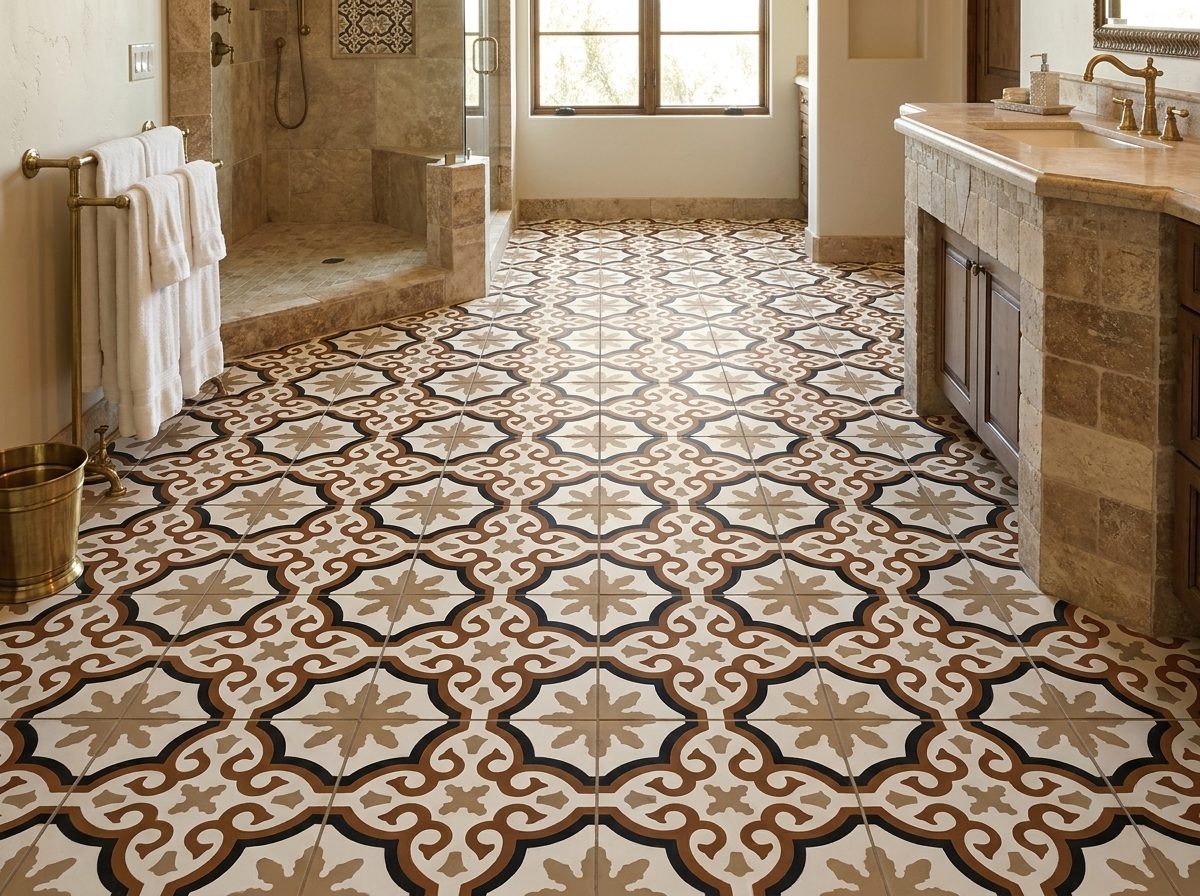
Layout decisions happen before any tile is set, and they deserve the same discipline as substrate prep. That is even more true with natural stone and handmade cement tile, where variation in tone, edge, and pattern can either create character or visual noise depending on how the field is organized.
Start With Control Lines That Serve the Room
The first wall you see is rarely the best reference. Rooms drift out of square. Framing bows. Cabinet runs can be slightly off, and older homes almost never give you a perfectly honest starting edge.
Set control lines from the room's visual anchors instead. In practice, that may be the center of the main entry, the longest sightline through a hall, the focal wall behind a vanity, or the line that makes cuts die evenly at an island. Then dry-lay enough tile to see the pattern at full scale. Tape-measure math is only the first pass. The room gets the final vote.

Dry Layout Reveals Problems While They Are Still Cheap to Fix
A dry layout answers the questions that drawings and rough measurements miss.
- Where cuts will fall
- Whether the pattern feels balanced from normal viewing angles
- How grout joint width changes the scale and rhythm of the installation
For ordering, a cutting allowance of about 10 percent is a sound rule of thumb for many standard layouts. Complicated rooms, diagonal patterns, heavy obstruction work, and handmade tile with more sorting loss usually call for more. Running short near the end of a job is expensive. With artisanal material, it can also create a shade-match problem if a second batch varies from the first.
Grout color and joint width significantly alter the final appearance of the tilework. On stone, they can either sharpen each unit or let the surface read more monolithically. On patterned cement tile, they influence how busy or calm the overall field feels.
Pattern Choice Changes the Layout Strategy
Straight lay patterns reward symmetry and well-balanced perimeter cuts. Running bond layouts need attention to actual tile size and facial variation, especially with handmade material that is not machine-perfect. Decorative patterns such as herringbone, basketweave, star-and-cross, and patchwork need a mockup early, because small alignment errors become obvious across a large floor or wall.
Artisanal tile asks more from the installer. A handmade pattern is not just a repeating module. You have to watch motif direction, shading, and where the eye lands when the room is entered. If a border is part of the design, center it to the architecture you want people to read, not to the least reliable wall in the room.
For natural stone, study veining before you commit. Veins can be blended for a quiet surface or arranged more deliberately for movement. Either approach works if it is intentional.
Check these points before setting begins:
- Doorways: Avoid cuts that announce themselves right at the threshold.
- Cabinet faces and islands: Keep joint lines looking deliberate, not accidentally offset.
- Feature areas: Center the pattern on the visual axis of the room, not on framing that may be off.
- Transitions: End the tile where adjoining finishes can meet cleanly and make sense underfoot.
- Borders and insets: Confirm that field dimensions support the design without forcing tiny filler pieces.
Plan Movement Space Into the Layout
Perimeter space matters visually and mechanically. Tile jammed tight to walls, tubs, thresholds, or wood flooring leaves no room for normal movement in the assembly. The result can show up later as edge stress, cracked grout, or pressure against adjacent finishes.
With handmade cement tile, I leave myself room to keep those edges calm and clean. The material has presence, but it does not respond well to being forced into a space that was measured too aggressively. Good layout work prevents that mistake before the first tile ever touches mortar.
A strong layout looks quiet when it is finished. That is the point. The room feels resolved, the cuts feel intentional, and the material gets to do what it was chosen to do.
Cutting Setting and Achieving Full Mortar Coverage
This is the part people think tile installation is all about. In reality, it's the phase where the prep and layout either pay off or expose every shortcut.
Stone needs support across its body, not just contact in a few random ridges. Handmade materials need gentle handling and clean setting practices. If you rush the bedding process, the floor may still look acceptable at first, but weak support tends to show up later as cracks, loose corners, and hollow sounds.
Start with the core techniques:

Build the Mortar Bed Correctly
Mix the mortar to the manufacturer's instructions and keep the batch size realistic. Mortar that sits too long becomes harder to work, and installers get tempted to force tile into material that's already losing its useful open time.
On the substrate, key the mortar in first. That means using the flat side of the trowel to press mortar into the surface before combing. Then comb in one direction with the appropriate notched trowel. Uniform ridges collapse better and release trapped air more effectively than swirled mortar.
Back-Buttering Is Not Optional for Stone
For natural stone, industry guidance based on MIA and ANSI standards recommends at least 95% mortar coverage for stone 5/8 inch thick or thinner, and 80% for stone 3/4 inch thick or thicker, with no voids larger than 2 square inches and none within 2 inches of tile corners (natural stone tile installation guidelines). That's why back-buttering matters. It helps fill surface irregularities on the back of the stone and improves contact when the tile is pressed into the fresh bed.
If an installer presses stone into mortar that has already skinned over, bond quality drops fast. The ridges may look like they touched. They didn't fully transfer.
A short visual can help lock in the hand motion and pacing involved in proper setting:
A Reliable Setting Sequence
A field-tested sequence keeps the work controlled:
- Spread only what you can cover while the mortar is still fresh. Don't chase square footage.
- Back-butter the tile. A thin coat fills the back and promotes transfer.
- Set and move the tile slightly across the ridges. That motion collapses the ridges instead of leaving isolated lines.
- Lift and check periodically. Coverage has to be verified, not assumed.
- Use spacers or a leveling system where appropriate. They help control the plane and the joints, but they don't replace a flat substrate.
- Clean joints as you go. Hardened mortar in grout spaces creates finishing problems later.
Pull a tile early in the run. The back tells the truth faster than confidence does.
What Good Coverage Looks Like
| Result | What it tells you |
|---|---|
| Mortar transferred broadly across the back | Bond contact is developing properly |
| Corners fully supported | Lower risk of edge cracks and corner failure |
| Few or no significant voids | Better load support and less hollow sound |
| Clean, open joints | Easier grouting and neater finish |
What doesn't work is dot-setting, random dabs, or trying to “make up” for substrate irregularities by piling mortar under individual corners. Stone wants continuous support. Anything less is a gamble.
Grouting Sealing and Essential Finishing Touches
A lot of installations are damaged in the last stretch. The tile is set well, then the grout is rushed, the cleanup is sloppy, or the sealer goes on at the wrong time and traps problems into the surface.
This phase is where appearance and durability meet. It's also where porous materials demand more discipline than dense manufactured tile.
Grout Changes the Look More Than Most People Expect
Joint width, grout type, and grout color all affect how the surface reads. A close color can quiet the pattern and let the field behave like one plane. A contrasting grout sharpens geometry and makes every unit more visible.
The practical question is not just what looks good on a sample board. It's what can be installed cleanly on the material you chose. Porous stone and handmade cement surfaces can pick up pigment and residue if the installer treats grout like a routine final step.

Timing Matters More Than People Realize
Independent guidance for natural stone and cement tile stresses that grout cleanup, curing, and sealer timing materially affect the finished surface and long-term maintenance profile, especially in wet or exterior settings (natural stone tile installation considerations). That's exactly right.
A few examples from real jobs:
- Grout haze left too long can become much harder to remove from textured or porous faces.
- Sealer applied too early can interfere with proper curing or lock residue into the tile.
- Poor cleanup water control can spread pigment or slurry over the surface instead of removing it.
- Wet areas suffer when installers focus on appearance and ignore cure discipline.
Cement and Porous Surfaces Need Protection Before Grout
With handmade cement tile and many porous stones, a grout release or pre-seal approach can make the difference between crisp joints and a stained field. This isn't overkill. It's surface protection.
Use clean tools and fresh water. Change rinse water often. Keep the grout float under control so joints are filled without smearing more material than necessary over the face. The goal is to finish the joints, not to sandblast the tile with aggressive cleanup.
A sound finishing routine looks like this:
- Confirm the setting bed has cured sufficiently before grouting.
- Test any protective treatment first on spare material.
- Work in manageable sections so cleanup stays timely.
- Let the installation cure properly before sealing.
- Apply the appropriate penetrating sealer evenly and wipe residue as directed.
A premium tile can still end up with a cheap-looking finish if the grout wash is careless.
Sealer Is Part of the Performance Package
Sealer doesn't make a bad installation good. What it does is help porous tile resist water, oils, and routine dirt pickup. That matters on floors, in kitchens, in baths, and anywhere maintenance habits are less gentle than the showroom setting.
The best results come from matching the sealer to the material and respecting the cure window. Fast hands and guesswork have ruined more surfaces than difficult tile ever has.
Troubleshooting Common Issues and Long-Term Care
Even on a careful job, small issues can show up. What matters is recognizing them early and responding with the right fix instead of forcing a cosmetic patch that makes things worse.
Stone and handmade tile also need sensible maintenance. Not complicated. Sensible. Most long-term damage comes from harsh cleaners, delayed spill cleanup, neglected sealers, or impact at vulnerable edges.
Common Problems and the Practical Response
A few field issues show up again and again:
| Problem | Usual cause | Best response |
|---|---|---|
| Lippage | Substrate irregularity, poor bedding, or inconsistent tile thickness | Assess whether the issue is isolated or systemic. Replace isolated offenders if needed. Severe widespread lippage usually traces back to prep. |
| Hollow-sounding tile | Incomplete mortar support | Monitor first. If the piece is loose or vulnerable, replacement is safer than hoping it stays put. |
| Grout haze | Delayed or incomplete cleanup | Use the safest cleaner recommended for the material and test first on spare tile. |
| Chipped edge or cracked tile | Impact, unsupported corner, or movement stress | Remove and replace the unit carefully. Protect neighboring tiles during demolition. |
If you need to remove a damaged tile, cut out the grout joints cleanly first. Break the tile inward, not outward into adjacent pieces. Then clean the cavity thoroughly before resetting the replacement.
Clean Gently and Consistently
Stone and cement tile don't respond well to aggressive chemicals. Acidic cleaners, abrasive powders, and stiff scrubbing can dull the surface, attack cementitious components, or strip protection unevenly.
The safer routine is simple:
- Use a pH-neutral cleaner intended for stone or similarly sensitive surfaces.
- Blot spills early instead of letting oils, wine, soap residue, or food acids sit.
- Keep grit off the floor because abrasive dirt does more wear than many owners realize.
- Avoid “all-purpose” products unless they are clearly suitable for the material.
For day-to-day care practices and material-safe cleaning habits, this guide to cleaning stone tiles is a practical reference.
Watch the Surface, Not the Calendar Alone
Resealing doesn't follow a single universal schedule because use conditions vary so much. A guest bath wall, a busy restaurant floor, and a kitchen around a range don't age the same way. What matters is inspection.
Look for changes such as faster darkening when wet, increased staining tendency, or uneven absorption during cleanup. Those signs usually tell you more than a fixed date on a maintenance sheet.
Good tile maintenance is mostly restraint. Use the mildest effective cleaner, protect the surface from grit, and don't wait too long to address a small issue.
A well-installed surface shouldn't feel fragile. It should feel settled, supported, and easy to live with. That's the payoff for doing the unseen parts correctly.
If you're choosing handmade cement tile for a residential, hospitality, or commercial project, Original Mission Tile is worth a close look. Their collection includes heritage patterns, custom designs, and installation resources that help designers, builders, and homeowners match the right material to the right application.