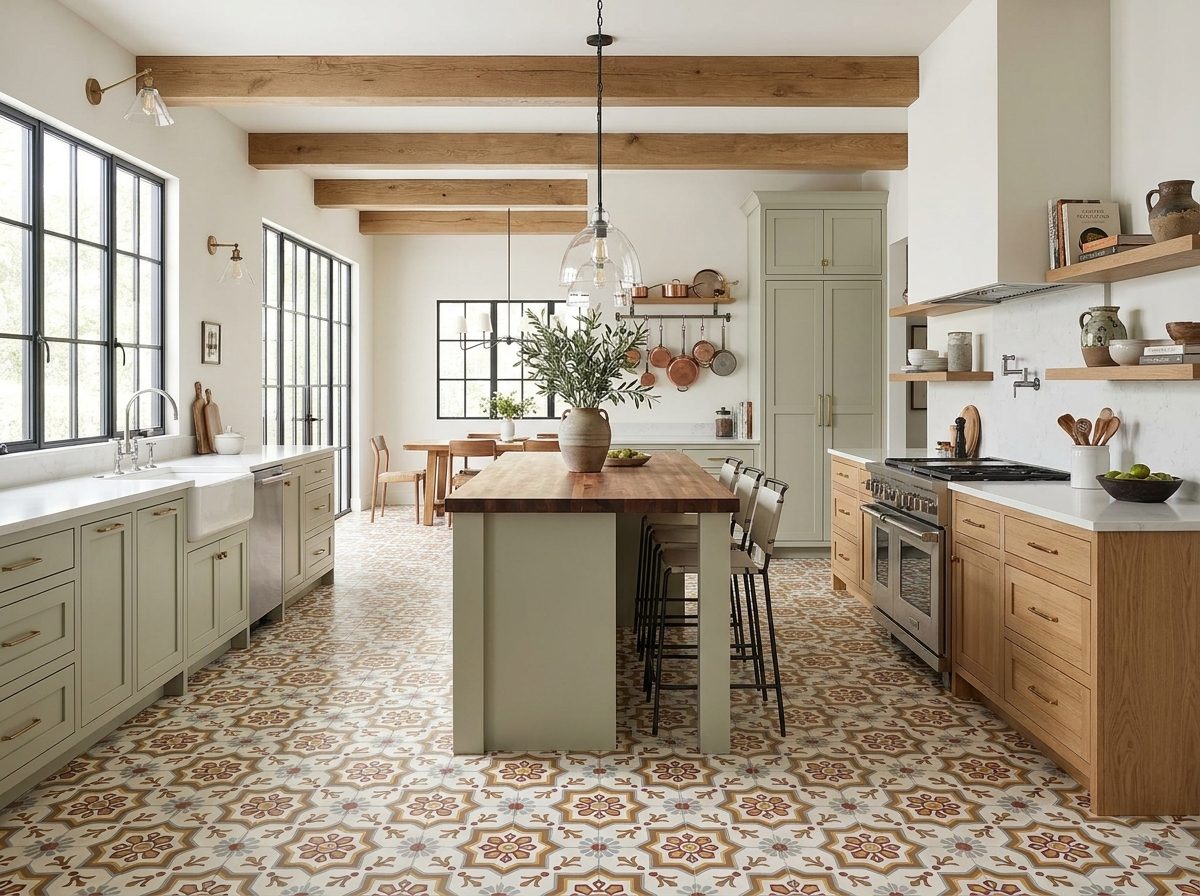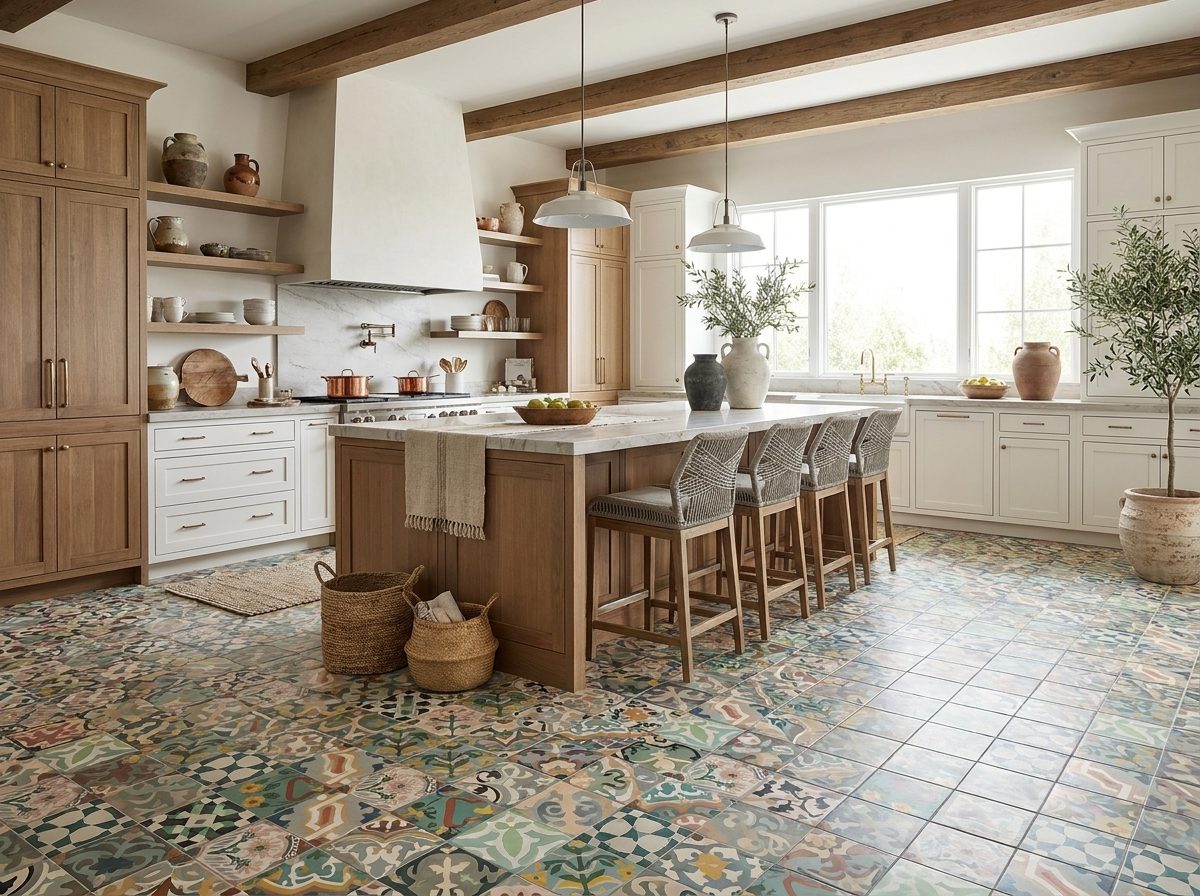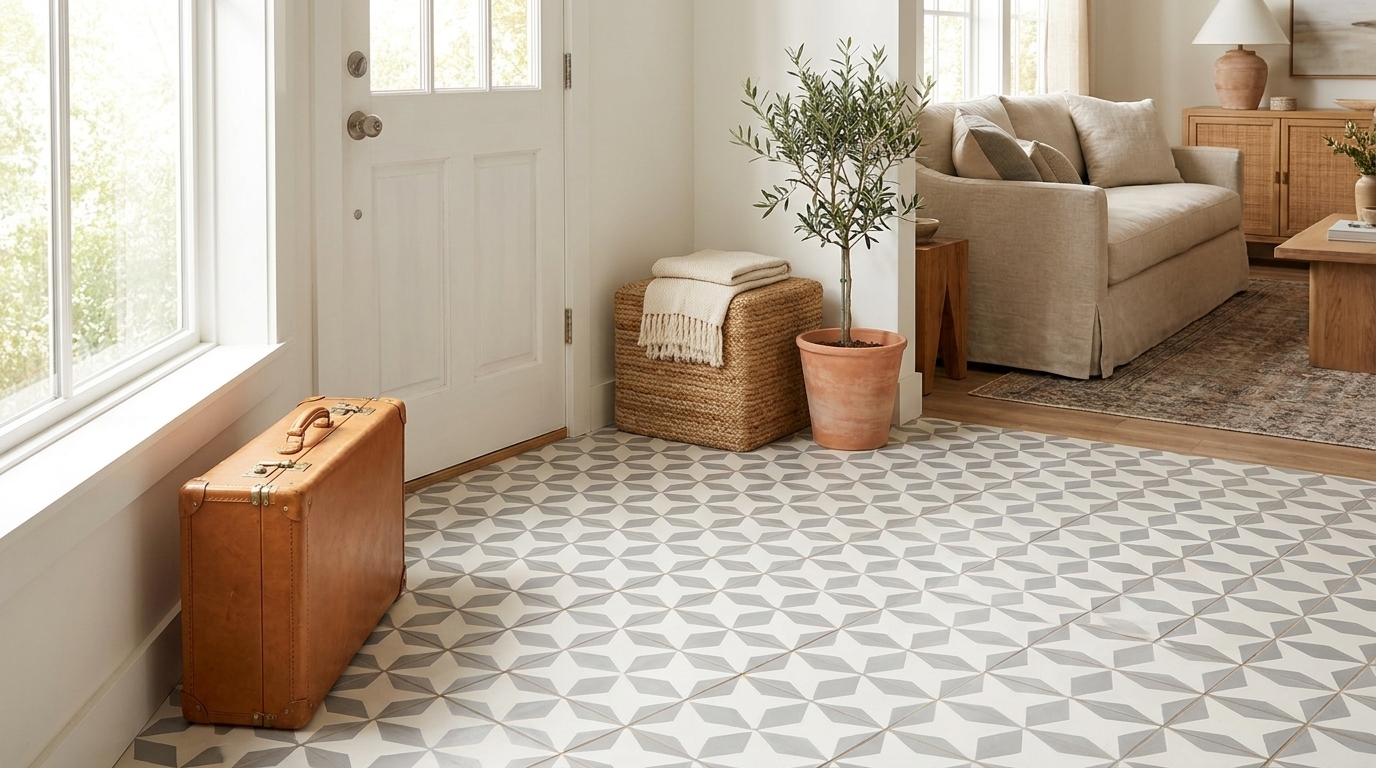
You're probably looking at a floor or wall surface right now and feeling the usual tension. You want pattern, but not something that reads like a printed trend. You want durability, but not a material so slick and sterile that it drains the room of character. And if you've already started shopping, you've likely noticed that many products labeled “encaustic” aren't the same thing at all.
That confusion matters.
True encaustic cement tile is a handmade, hydraulic-pressed material with color built into the body of the tile's wear surface. An encaustic-look ceramic or porcelain tile may carry a similar pattern, but it achieves that look in a completely different way. One is cured cement with a soft matte finish and a long visual life that develops patina. The other is a fired product with a surface-applied image or glaze.
For architects, designers, and homeowners who care about how materials age, that difference isn't academic. It affects texture, maintenance, specification, installation, and the overall feel of a project.
Beyond Surface Beauty
A patterned surface can do one of two things. It can sit on a room like decoration, or it can become part of the architecture.
That's why encaustic cement tile continues to hold attention across generations of design. It doesn't just show pattern. It carries depth, density, and a handmade visual weight that mass-produced tile rarely achieves. The finish is matte rather than glassy. The color feels grounded rather than printed. And over time, the surface doesn't stay frozen. It softens and matures the way stone does.
A living material, not a graphic effect
When people first encounter real encaustic cement tile, they often respond to the finish before they understand the construction. The surface has a silky, almost chalk-mineral quality. Light doesn't bounce off it the way it does from a glossy glaze. It settles into it.
That's also why this material asks for a different mindset. You don't choose it because you want a floor that never changes. You choose it because you want a floor that wears authentically and gains richness through use.
True encaustic cement tile rewards the client who values substance over perfection and texture over shine.
Many specification mistakes begin with this common scenario. Someone falls in love with the look of heritage patterning, then selects a ceramic imitation expecting the same tactile experience. The room may still look attractive, but it won't feel the same underfoot, and it won't age the same way.
Why the distinction matters in real projects
For kitchens, entry halls, powder rooms, boutique hospitality spaces, and feature floors, material truth shows up fast. If you're selecting a handcrafted surface, you also need to think about sealing, cleaning, and how the finish will respond to daily use. That's why practical care guidance matters as much as pattern selection. For day-to-day upkeep, cleaning cement tiles properly starts with understanding that this is a porous, heritage material, not a wipe-and-forget glazed tile.
The beauty is real. The trade-offs are real too. That's exactly why encaustic cement tile remains worth serious consideration.
The History and Revival of Cement Tile
Encaustic cement tile belongs to a lineage of architectural materials that never needed novelty to matter. It earned its reputation by serving buildings well, then outlasting the fashion cycles around it.
Its origins reach back to the 1850s in Spain and France, and the period from 1850 to 1950 is widely regarded as its golden era. By the 1920s, encaustic cement tiles appeared in Russian palaces, mansions on the French Riviera, and works associated with Antoni Gaudí. Around 1950, industrial materials began pushing it aside, and the material later returned to favor in the early 2000s as designers and homeowners renewed their interest in artisanal and sustainable products, as detailed in this history of cement tile.

From invention to architectural prestige
The rise of cement tile wasn't accidental. It arrived at a moment when builders and artisans wanted ornament with permanence. The material offered pattern without relying on kiln-fired glaze, and that gave designers a different palette. Floors could carry complex geometry, borders, and color fields while still feeling monolithic and grounded.
By the early decades of the 20th century, encaustic cement tile had moved well beyond a niche craft. It was used in grand residences, public buildings, and commercial interiors because it could deliver a strong decorative identity while still functioning as serious flooring.
A material doesn't appear in palaces and civic buildings by mistake. It gets there because clients trust both its appearance and its staying power.
Why it fell out of favor
The decline had less to do with beauty than with industrial convenience. Mid-century building culture shifted toward products that were faster to make, easier to standardize, and simpler to install at scale. Ceramic and other industrial materials fit that moment well.
Handmade cement tile, by contrast, asked for labor, touch, and patience. It also carried the irregularities that come with artisan production. In a market chasing uniformity, those qualities became liabilities rather than strengths.
Some materials disappear because they fail. Others disappear because the industry becomes impatient with craftsmanship.
That distinction matters. Encaustic cement tile didn't vanish because it lacked design value. It receded because industrial production favored speed, repetition, and lower-touch manufacturing.
What drove the revival
Its return in the early 2000s makes sense if you've watched what clients ask for today. Many don't want spaces that look copied from a catalog. They want rooms with memory, weight, and evidence of the hand.
That's where encaustic cement tile found its footing again. Designers started revisiting historic interiors. Homeowners became more interested in natural finishes and traditional processes. Hospitality projects looked for materials that could tell a story the moment a guest walked in.
Three forces tend to bring people back to this material:
- Authenticity over imitation. Clients increasingly recognize the difference between a printed pattern and an inlaid one.
- Craft over anonymity. Handmade surfaces bring variation that many contemporary interiors need.
- Aging with dignity. Some materials look worse as they wear. Cement tile often looks more settled and more convincing.
Why the revival has lasted
Some revivals are short-lived because they depend on nostalgia alone. This one has held because encaustic cement tile works in both historic and contemporary settings. A traditional border in a restored bungalow feels natural. So does a restrained geometric field in a minimalist bath or hospitality lobby.
The old patterns still matter, but the material's relevance now goes beyond historical reproduction. It speaks to a broader shift in design thinking. Many specifiers want fewer false finishes and more honest ones. They want surfaces that reveal what they're made of.
That's exactly what cement tile does. It doesn't pretend to be stone, ceramic, or vinyl. It is cement, pigment, pressure, and cure. The history gives it pedigree. The revival proves it still answers a present-day need.
How Authentic Cement Tiles Are Made
The quickest way to understand encaustic cement tile is to stop thinking about glaze and start thinking about compression.
A true cement tile isn't fired in a kiln. It's built in layers, pressed under force, then cured. That process is the reason the material feels different in the hand and underfoot.

The tile is built like a stratified assembly
The most important layer is the face. The top wear layer is typically 3 to 4 mm thick and is made from white Portland cement, marble dust, and mineral pigments. That layer is then hydraulically fused to the tile body at 1,700 psi, creating inlaid color that won't peel away as a coating can. The tile is never fired, but instead cured, which is what gives it its matte finish and porosity, as described in this technical cement tile guide.
Below that face sits a supporting body of cement-based material designed to give the tile structure and bonding strength. The result is a layered unit rather than a single decorative surface sitting on top of a fired clay base.
If you want a simple mental model, think of it as a tile sandwich:
| Layer | Role in the tile |
|---|---|
| Top wear layer | Holds the pattern and visible color |
| Middle body layer | Supports compression and structural continuity |
| Bottom layer | Provides mass and helps the tile bond to the setting bed |
How the pattern gets into the tile
The pattern begins in a metal mold. Artisans place the divider on the tile surface area, then hand-pour pigmented cement mixtures into each compartment. That step is where craftsmanship shows itself most clearly. Clean linework depends on steady handling, proper mixture consistency, and experience.
Once the colors are in place, the mold is removed. Dry materials and backing layers are added. Then the full assembly goes into a hydraulic press.
That pressing step matters more than most buyers realize. It doesn't just shape the tile. It consolidates the layers into a unified body, which is why authentic cement tile has visual depth instead of a graphic skin.
Practical rule: If the pattern lives only on the surface, you're looking at a lookalike. If the color is part of the wear layer itself, you're looking at the real material.
Cured, not fired
True encaustic cement tile differs from ceramic and porcelain in this regard. Fired tile relies on kiln heat. Cement tile relies on hydration and cure.
That difference shows up in three ways you can feel immediately:
- Finish. Cement tile has a soft matte face rather than a vitreous glaze.
- Porosity. The tile can absorb moisture, which affects installation and sealing.
- Visual depth. The surface reads as mineral and inlaid, not coated.
For a closer look at the process in motion, this factory-style demonstration helps illustrate the sequence from mold to press to cure.
Why this construction changes performance
Because the pattern is embedded in the wear layer, the tile doesn't depend on a printed face to keep its identity. Over time, the surface can mellow without losing the design itself. That's a major distinction from many patterned imitations.
It also explains why encaustic cement tile demands respect during installation. A porous, cured cement tile won't behave like dense porcelain fresh out of a carton. Installers need to treat it as the handcrafted cement product it is, or the job can go sideways quickly.
Cement Tile Compared to Other Materials
The most common specification mistake isn't choosing the wrong pattern. It's choosing the wrong material for the pattern you want.
A client says they love encaustic tile. A designer pulls a porcelain lookalike. An installer treats handmade cement like standard ceramic. Everyone is talking about motif, while the underlying issue is construction. If you want to make the right call, compare materials by how they're made, how they feel, and how they age.

Encaustic cement tile versus encaustic-look ceramic and porcelain
Here's the core distinction. Printed ceramic and porcelain tiles carry their pattern at the surface, which means chips and wear can interrupt the visual layer. True encaustic cement tile has an inlaid pigment layer several millimeters thick, so the pattern remains present as the tile wears and develops patina over time, as explained in this overview of what encaustic tile is.
That difference affects more than longevity of appearance.
| Material | What you notice first | What matters later |
|---|---|---|
| Encaustic cement tile | Matte, soft, handcrafted presence | Requires sealing, develops patina, pattern remains integral |
| Ceramic tile | Glazed surface, broad style range | Easier maintenance, glaze can chip |
| Porcelain tile | Dense, hard, uniform | Strong moisture resistance, often less tactile depth in patterned products |
Ceramic and porcelain absolutely have their place. If you need a lower-maintenance surface in a demanding moisture environment, they may be the smarter answer. If the project calls for visual depth, artisanal variation, and a floor that will age like a mineral surface rather than stay factory-frozen, cement tile offers something different.
Cement tile versus true clay encaustic tile
There's another confusion in the market. Historically, “encaustic tile” can also refer to clay encaustic tile, which is a separate tradition. That material is fired clay with inlaid design, often used in ecclesiastical and historic restoration contexts.
The two materials share the idea of pattern embedded into the tile rather than painted onto it. But they don't share the same finish, composition, or visual temperature.
Clay encaustic tile tends to feel more formal and more historically specific. Cement tile usually gives designers a broader range of colors, a flatter matte finish, and more flexibility across Mediterranean, Spanish Colonial, Art Deco, contemporary, and eclectic interiors.
Cement tile versus terrazzo and stone
Terrazzo and natural stone often enter the conversation because they also carry mineral depth and age well. But they solve a different design problem.
- Terrazzo gives a more continuous, aggregate-driven look with less emphasis on framed pattern.
- Natural stone offers unique veining and geological movement, but not the same graphic geometry.
- Cement tile sits in the middle. It has the honesty of a mineral material with the compositional control of a designed pattern.
If the room needs geometry with soul, cement tile usually does the job better than stone and with more intimacy than terrazzo.
What works where
Specifiers often ask for a simple rule of thumb. Here it is.
Choose ceramic or porcelain when moisture resistance and low maintenance outrank tactile depth. That's why some homeowners researching below-grade or moisture-prone spaces start with practical references like this Denver homeowner's guide to basement floors, then work backward into aesthetic choices.
Choose encaustic cement tile when the floor or wall needs presence, handcrafted variation, and a pattern that belongs to the material itself.
Choose stone or terrazzo when the design asks for natural movement or aggregate texture rather than framed ornament.
The right material isn't the one that looks closest in a photo. It's the one whose construction matches the life the room will have.
Designing with Encaustic Cement Tile
A well-designed cement tile floor often decides the room before the furniture arrives. Step into an entry with a properly scaled border and field, or a powder room with a disciplined geometric repeat, and the architecture feels settled. That is the strength of true hydraulic-pressed cement tile. The pattern is not a printed skin or a glaze effect borrowed from ceramic. It is part of the wear layer itself, which is why the surface reads soft, mineral, and substantial in a way fired encaustic-look tile usually does not.
The design question is placement first, pattern second. Use encaustic cement tile where the room needs identity and structure. Entries, powder rooms, bars, kitchen feature zones, stair landings, and hospitality spaces all benefit from that kind of visual anchor.

Where the material earns its place
Designers often choose cement tile for its history, but the better reason is how it behaves visually in a finished room. The matte face diffuses light instead of bouncing it back. Color has depth because it comes from pigmented cement, not a glossy fired coating. Small tonal shifts from tile to tile are part of the composition, especially in larger fields.
That difference matters when clients compare authentic cement tile to fired ceramic sold as "encaustic." Ceramic encaustic-look products can be practical and consistent. They do not give the same surface depth, edge softness, or handmade variation. If the project needs graphic pattern with a more crafted, mineral character, true cement tile usually carries the design more convincingly.
Some applications consistently work well:
- Tile rugs for foyers, kitchens, and dining areas where a framed field defines space without adding walls
- Feature floors in powder rooms, vestibules, and small commercial interiors where pattern can do most of the decorative work
- Brand-led commercial layouts that use borders, repeats, or custom motifs to reinforce identity
- Vertical installations such as fireplace surrounds, stair risers, and select wall panels where the matte finish avoids glare
Pattern needs discipline
The most common mistake is scale, not color. A dense motif in a cramped room can feel nervous. An oversized repeat in a small bath can lose its geometry once fixtures and cuts interrupt it. Good layouts account for sightlines, door swings, cabinetry, and where the eye lands.
Balance helps. Use solid companions to give a patterned field room to breathe. Let a border resolve the perimeter instead of forcing a full motif into awkward cuts. In larger rooms, a repeat with clear geometry usually holds up better than several competing patterns.
For clients who need help judging boldness, general pattern principles still matter. This patterned room design guide for homeowners is a useful outside reference for discussing scale, repetition, and contrast before the tile schedule is finalized.
Old formats still work, but they are not the whole story
The classic 8×8 tile remains popular because it is legible, efficient to lay out, and firmly rooted in historic cement tile work. It also suits the way many traditional patterns are drawn. Yet good cement tile design is broader than the standard square.
| Format | Best use |
|---|---|
| Square patterns | Historic floors, kitchens, entries, broad repeating fields |
| Hexagons | Softer geometry, transitional and contemporary spaces |
| Arabesque and fish scale | Feature walls, baths, boutique hospitality accents |
| Star and cross layouts | Mediterranean and Spanish Colonial compositions |
| Plain companion tiles | Borders, framing, visual relief, mixed-material fields |
Format changes more than appearance. It affects cutting, layout waste, pacing, and how easily a pattern survives real room conditions. A square field with a border is often easier to resolve cleanly than a highly articulated shape wrapped around several penetrations or out-of-square walls.
Custom work is strongest when it solves a design problem
Custom cement tile should do more than announce itself. It can pull a new addition into conversation with a historic house, turn a restaurant floor into part of the brand language, or give a hotel public space a pattern guests remember because it belongs to that property and nowhere else.
The practical phase begins early. Review the layout, border conditions, and transitions before approving color and motif. Mock up the field if the room is large or the pattern is intricate. Ensure the design intent matches the logistical requirements of handling and installation. A detailed cement tile installation guide for specifiers and installers helps teams account for those jobsite requirements while design decisions are still easy to adjust.
The best cement tile rooms feel composed. They have rhythm, relief, and enough restraint to let the material show what it is. Authentic encaustic cement tile rewards that approach because its beauty comes from construction as much as pattern.
Installation and Long-Term Care Essentials
This material rewards careful installers and punishes casual ones.
If a crew approaches encaustic cement tile the way they approach standard glazed ceramic, problems can start before the first course is set. The tile's porosity, surface character, and sealing requirements change the workflow. None of this is mysterious, but some of it is essential.
Start with moisture awareness
Because it's a cement-based product, encaustic cement tile absorbs water. The tile has a water absorption rate of 9.5 to 10.5%, which is why installers should pre-soak the tile or thoroughly sponge the backs before setting with a high-quality white thinset mortar to avoid bonding issues and efflorescence, according to this installation-focused technical reference.
That single point prevents a surprising number of failures. A dry tile can pull moisture too aggressively from the setting material. When that happens, bond quality and surface appearance can both suffer.
What competent installation looks like
The details vary by project, but the underlying discipline stays the same.
Dry-lay before committing
Handmade tile has natural variation. Open boxes, blend pieces, and review the visual mix before setting.Use white setting materials when appropriate
White thinset helps avoid unwanted shadowing or color interference beneath lighter tiles.Handle the surface gently
Don't grind dirt into the face during installation. Cement tile can stain during a messy job long before the room is ever occupied.Seal in the proper sequence
The tile needs sealing attention before grouting and again after grouting according to the system being used. This isn't optional maintenance theater. It's surface protection.
Never assume the grout stage is routine. On cement tile, that's the moment careless work can permanently change the face of the installation.
Cleaning mistakes that shorten the tile's life
Harsh acidic cleaners are a poor match for cement tile. So are aggressive stripping habits borrowed from other flooring categories. A pH-neutral cleaner is the safer baseline for routine care.
A few rules keep the surface looking honest rather than worn out:
- Clean spills promptly. Porous materials are forgiving in some ways, but not when pigments, oils, or acids sit too long.
- Use neutral cleaners. Strong acid washes can damage the surface.
- Reseal as needed. The exact schedule depends on use, exposure, and cleaning habits, so evaluate the floor rather than relying on guesswork.
- Protect during construction and punch work. Many cement tile complaints begin after installation, when other trades track debris or spill compounds across unprotected floors.
Know the trade-offs
Cement tile isn't the right choice for every condition. It asks more of the installer and owner than porcelain does. It needs sealing. It needs appropriate cleaners. It benefits from a client who understands patina and doesn't confuse it with failure.
What it gives back is a surface with depth and long visual life.
For installers and specifiers, the simplest rule is this: follow a cement tile protocol from the beginning. Don't retrofit one after problems show up. Most disappointments with this material come from treating it like something it isn't.
How to Specify and Source Your Tile
A specification often succeeds or fails before the purchase order is issued. I see the same problems repeatedly: a team approves a pattern from a screen instead of a real sample, treats handmade cement tile like fired ceramic in the schedule, leaves border and edge conditions unresolved, or brings in an installer who has only worked with porcelain. Those are procurement problems on paper, but they show up later as visual compromises, delays, and avoidable field corrections.
This is also where the distinction between true encaustic cement tile and encaustic-look ceramic matters. They may share a pattern language, but they do not ask for the same specification language. Hydraulic-pressed cement tile has a pigmented wear layer, natural variation, and different installation and maintenance requirements because it is not kiln-fired. If the spec treats both materials as interchangeable, the project team will make the wrong assumptions about lead time, sealing, cuts, and final appearance.
The specification checklist that saves trouble
A strong specification answers the practical questions before anyone commits to quantity, budget, or layout.
Review full samples in person
A photograph can help narrow a pattern family. It cannot show the depth of pigment, the softness of the surface, or the range of tonal movement that gives authentic cement tile its character.State the exact application
Floor, wall, powder room, kitchen, covered exterior, commercial entry. Each condition changes how the tile should be detailed, sealed, and maintained.Draw the layout completely
Resolve borders, corners, transitions, stair conditions, and terminations before ordering. Handmade tile is far more convincing when the pattern lands intentionally at the edges.Carry sensible overage
Cuts, attic stock, and future repairs should be planned from the start. A replacement ordered years later may not match the original run exactly, and that is part of working with an artisan material.Match production method to the construction schedule
In-stock and custom tile belong to different project calendars. Custom work buys originality and architectural fit. It also requires earlier decisions.
What designers and builders should ask suppliers
The best supplier conversations go past color and price. Ask whether the product is true hydraulic-pressed cement tile or a fired lookalike. Ask how thick the wear layer is, whether companion solids and trims are available, how custom color matching is handled, and what installation guidance is provided for your substrate and setting.
Ask who reviews the layout before production. Ask how the order is packed and sorted. On larger jobs, ask whether phased deliveries can be coordinated without losing design continuity across areas.
A practical starting point is a supplier page that clearly separates stock patterns from custom options, such as these cement tile flooring collections. That kind of organization helps specifiers compare pattern families, understand the scope of the line, and decide quickly whether the material suits the architecture.
Matching source to project type
Fast-track remodels usually benefit from ready-to-ship inventory. Signature entries, hospitality floors, and custom residential work often justify bespoke production because the pattern becomes part of the architecture rather than a surface finish applied at the end.
Support matters as much as selection. Architects and designers need clear submittals, pattern drawings, realistic lead times, and direct answers about installation and maintenance. Builders need quantities, packaging logic, and coordination they can trust. Homeowners need to know what they are buying, especially if they are comparing a true cement tile to a ceramic product with a similar visual reference.
Original Mission Tile is one factual example of that model. The company offers handmade cement tile in both in-stock and custom formats, along with a design studio and project support for residential and commercial work.
Choose the source with the same care used to choose the pattern. The right partner helps align design intent, material behavior, and jobsite reality before the first tile is ever set.
If you are choosing between a true encaustic cement tile and a lookalike, start with the material itself. Original Mission Tile provides handmade cement tile, custom design options, and practical guidance for specification, installation, and maintenance so you can judge whether this heritage material fits the project.