You’re probably standing in one of two places right now. Either you’ve seen a patterned floor that stopped you cold and you want that same depth, warmth, and personality in your own project, or you’re trying to sort through a mess of conflicting advice about what “encaustic” tile means.
That confusion is common. Some people use the word for medieval clay tiles found in old churches. Others use it for the handmade cement tiles that define much of today’s patterned tile market. Both uses have a real historical basis. They are not the same material, and that distinction matters if you’re choosing a floor for a kitchen, bath, restaurant, entry, or hospitality space.
Designers care because the finish, thickness, maintenance, and visual character are different. Homeowners care because a floor that looks similar in a photo can behave very differently once it’s installed and lived on. Installers care because these tiles demand better planning than off-the-shelf ceramic.
The good news is that the underlying idea is consistent. An encaustic tile carries its pattern within the body of the tile rather than as a printed surface effect. That’s the lineage worth understanding.
The Enduring Allure of Patterned Floors
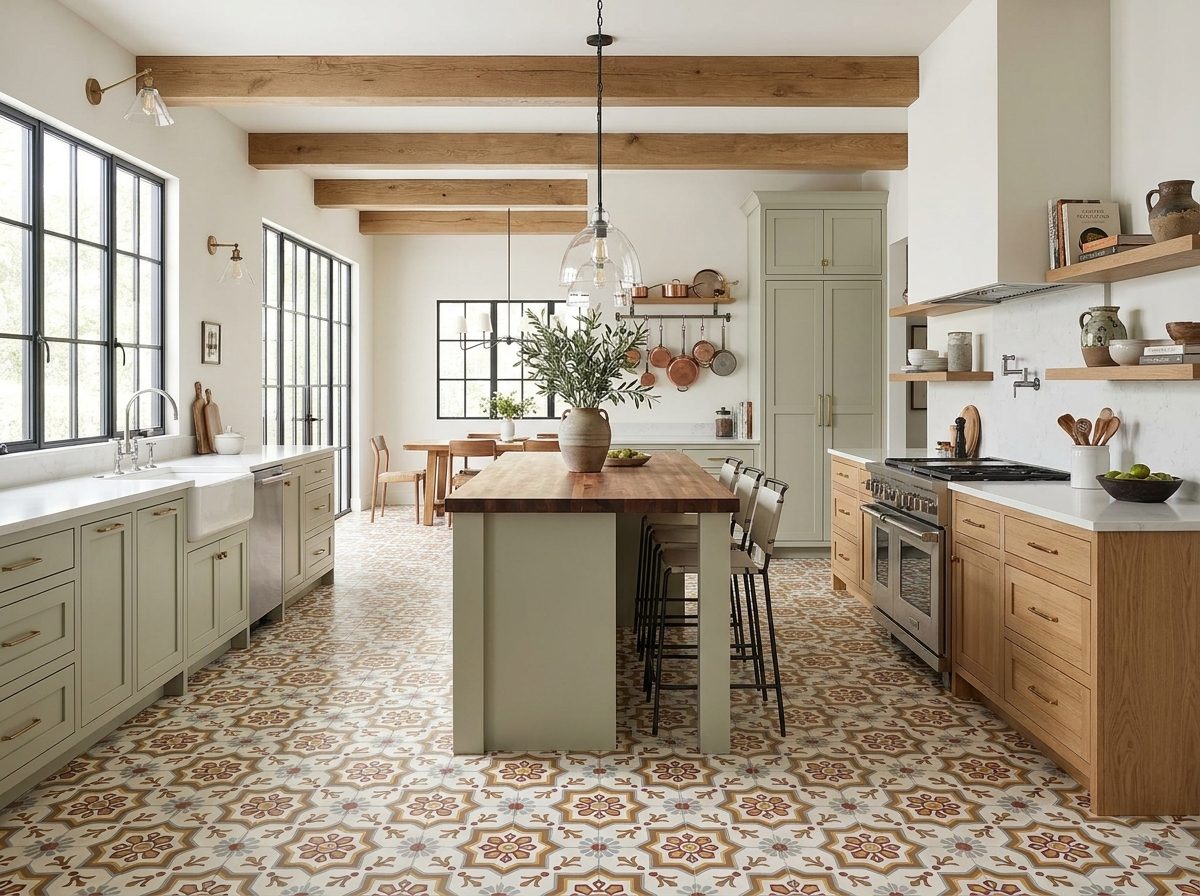
Patterned floors do something plain surfaces rarely can. They anchor a room before furniture ever arrives. A good encaustic floor tile layout can make a narrow hall feel intentional, give a kitchen its center of gravity, or turn a commercial entry into a signature moment.
That appeal isn’t only visual. It’s emotional. People respond to these floors because they feel made, not merely manufactured. The pattern has weight. The surface has softness instead of glare. The room feels settled.
Why the name causes confusion
The term encaustic gets used for two different tile traditions. One is the original fired clay version, with colored clays inlaid into the tile before firing. The other is the later cement version, made by hand with pigment, cement, sand, and pressure rather than glaze and kiln heat.
Both belong to the same family in spirit. Each relies on inlaid color rather than a surface print. That’s why the name has endured, even though the material changed.
A printed look can imitate pattern. An inlaid tile ages with the pattern intact.
What matters when you choose
If you’re specifying encaustic floor tiles today, the practical questions are straightforward:
- Material first: Are you looking at fired clay encaustic or handmade cement encaustic?
- Finish matters: Do you want a matte, tactile surface with patina, or a denser low-maintenance alternative?
- Installation reality: Is the floor height planned for a thicker handmade tile?
- Maintenance tolerance: Are you comfortable sealing and periodic resealing?
The rest of the decision flows from those points. Get the material right first, and the design conversation becomes much easier.
Understanding Encaustic Tiles Then and Now
A client walks into the showroom asking for encaustic tile and usually has one picture in mind, but two very different materials may fit that request. That confusion starts with the name. In the trade, encaustic can refer to the original fired clay tradition or to the handmade cement tiles that carry the same inlaid idea into modern interiors.
The original encaustic tile was made from clay. Its pattern was built into the body with contrasting colored clays, then fired. The decoration was part of the tile itself, which is why worn historic floors still read clearly centuries later.
According to the history of encaustic tile on Wikipedia, encaustic tiles rose to prominence in medieval Western Europe, especially in England, where they were widely used in churches and other important buildings. That history matters for one reason above all. The word encaustic first described a method of making pattern integral to the tile, not a fashionable surface effect.

The medieval meaning of encaustic
In its historic sense, encaustic belongs to clay tilemaking. Craftsmen pressed or inlaid colored clays into a prepared body, then fired the piece hard in a kiln. The result was durable, matte, and architectural. It suited monasteries, churches, and civic interiors where floors were expected to last and wear naturally.
Several traits define that early form:
- Inlaid clay decoration: The pattern sits within the tile body.
- Unglazed visual depth: Color comes from the material, not a printed or painted film.
- Architectural permanence: These tiles were made for buildings meant to endure.
- Visible wear without pattern loss: Foot traffic softens the surface before it erases the design.
The revival that carried the name forward
The craft returned during the Gothic Revival, when architects and manufacturers studied medieval floors and brought the method back into production. Industrial improvements made patterned tile more available, but the guiding principle stayed the same. The design belonged inside the tile.
That continuity is the key point designers and homeowners often miss. The lineage is about construction, not chemistry.
What modern encaustic usually means
Today, in most residential and hospitality projects, encaustic tile usually means handmade cement tile. It is still an inlaid tile, but the material changed. Instead of colored clays and kiln firing, makers use pigmented cement, fine aggregates, and hydraulic pressure.
That shift matters in practice. Clay encaustic tile belongs more often to restoration work, traditional ecclesiastical settings, and historically exact specifications. Cement encaustic tile fits current kitchens, baths, mudrooms, porches, restaurants, and boutiques because it offers the same sense of depth and handwork in a format that suits contemporary design.
Same family, different behavior
Clay encaustic and cement encaustic share a visual tradition, but they do not perform exactly alike.
Fired clay handles moisture, cleaning methods, and surface wear one way. Handmade cement has a softer, more absorbent face and asks for different installation and maintenance decisions. That is where projects succeed or fail. A beautiful pattern does not excuse choosing the wrong material for the site.
The cleanest way to use the term is this: traditional encaustic tile is inlaid and fired clay; modern encaustic tile usually refers to artisanal cement made with an inlaid pigmented surface. Once that distinction is clear, the rest of the specification becomes much easier.
The Art of Crafting Cement Tiles by Hand
A handmade cement tile starts long before the press comes down. It begins at the pigment table, where color is mixed by eye and experience. Mineral pigments, white cement, marble powder, and fine aggregates are blended into a liquid slurry that will form the visible face of the tile.
For encaustic floor tiles, craft still matters. Slight changes in pigment load, moisture, and mixing affect the final tone. That’s one reason handmade encaustic floor tiles have more life than printed lookalikes. Their color sits in the material itself, and small variation is part of the appeal.
How the pattern is formed
The pattern is created with a metal mold often called a divider or trepa. Each compartment receives a different color slurry by hand. For a multi-color design, the maker fills one section at a time, carefully, because blurred edges at this stage stay blurred forever.
Once the face is poured, the mold is lifted away. The tile then receives a dry backing blend and a structural base layer. Those layers support the decorative surface and give the finished tile its density.
The process usually follows this sequence:
- Pigments are prepared for the chosen colorway.
- The face mix is hand-poured into the metal pattern mold.
- The mold is removed once the design is set in place.
- Backing layers are added for compression and strength.
- The tile is hydraulically pressed rather than fired in a kiln.
- The tile cures slowly until it’s ready for handling and installation.
Why the finish looks different
Because there’s no glaze and no firing, the finished surface has a matte, silky look rather than a glassy one. Light doesn’t bounce off it the way it does from a polished porcelain. It settles into the room. That’s why cement encaustic tiles work so well in spaces where designers want pattern without glare.
This method also explains the “perfectly imperfect” quality people notice right away. Handmade tiles don’t read as sterile. They read as crafted.
A cement encaustic tile should look crisp, but it shouldn’t look synthetic.
What that means in practice
The strength of the tile comes from the layered body and the press, not from a fired glaze shell. The pattern depth matters because normal foot traffic won’t erase it at the first sign of wear. The trade-off is that a cement tile is more absorbent and asks more from the installer and owner than a low-maintenance porcelain.
That trade is worth making when the project needs texture, historical character, and a floor that gains presence as it ages.
Design Styles and Architectural Applications
The design range is much broader than many buyers expect. People often arrive looking for one classic black-and-white cement tile and leave realizing these floors can be quiet, graphic, traditional, or contemporary depending on scale, layout, and grout treatment.

The historical record helps explain that variety. During the 19th-century Gothic Revival, The Antique Floor Company’s history of encaustic tile notes that production expanded dramatically, with manufacturers such as Minton issuing catalogs featuring hundreds of patterns by 1835 and later dust-pressing methods allowing up to 8 colors per tile. Once encaustic moved beyond church commissions, it became an architectural language for public buildings and homes as well.
Pattern families that work today
Some styles carry their history openly. Others feel almost modernist.
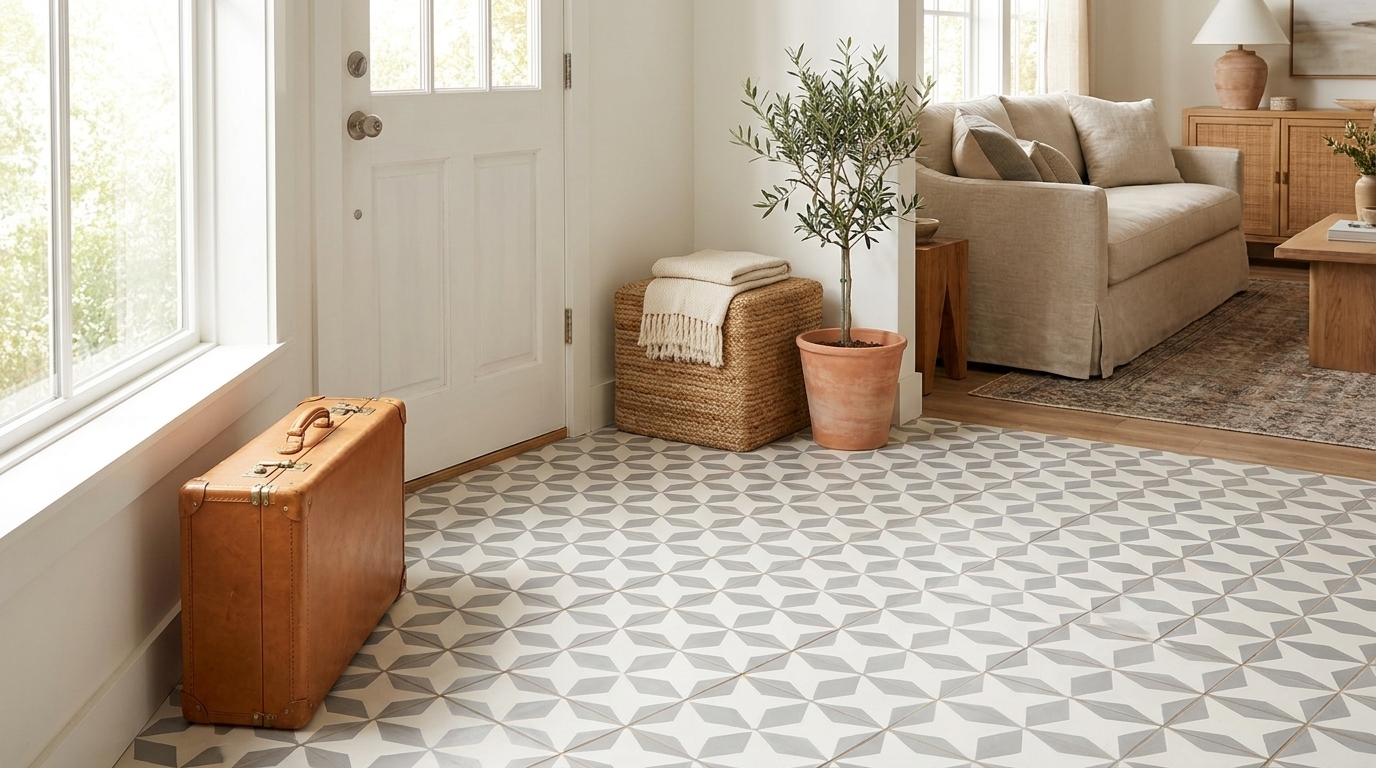
- Geometric repeats: Grids, stars, checks, and interlocking motifs suit kitchens, foyers, cafes, and long corridors.
- Floral and scrolling designs: These soften baths, powder rooms, and boutique hospitality spaces.
- Solid fields with borders: A strong choice when the room needs structure without visual noise.
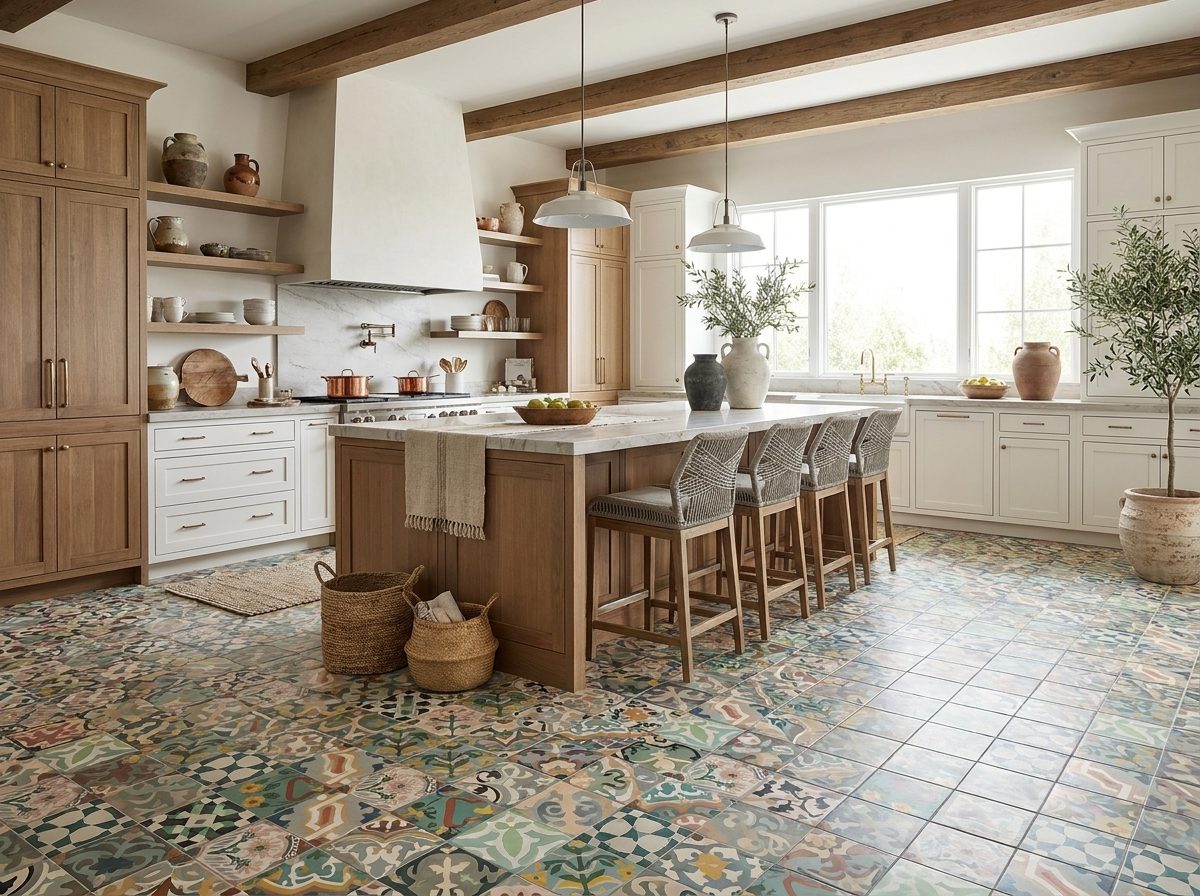
- Patchwork layouts: Better for casual spaces, especially when the architecture is simple and the floor needs to do more of the talking.
A useful rule is to match the pattern scale to the room’s visual clutter. Busy cabinetry, open shelving, and dramatic stone already occupy attention. In those spaces, a simpler tile often performs better than an intricate one.
Format changes the mood
An 8×8 square feels rooted and architectural. Hexagons read lighter. Star and cross layouts create movement. Fish scale and arabesque shapes shift the tile from strict flooring language into something more decorative and spatial.
The application matters as much as the pattern. Encaustic floor tiles can define:
| Application | What works well |
|---|---|
| Entry floors | Strong geometry, darker grout, border treatment |
| Kitchens | Rug layouts under islands, repeating fields, restrained palette |
| Bathrooms | Smaller pattern scale, soft contrast, slip-aware detailing |
| Hospitality spaces | Bold motifs at thresholds, bars, corridors, host stands |
| Feature walls | Repeating motifs with enough color contrast to read from distance |
Later in the design process, seeing movement and surface in action helps more than a flat sample board. This short clip gives a useful sense of patterned tile presence in interior settings.
Residential and commercial use aren’t the same conversation
In homes, the floor often acts as a visual anchor. In restaurants, hotels, and retail, it also has to direct traffic, hold up under repeated cleaning, and still look intentional from across a room.
That’s why the best commercial uses tend to be disciplined. Pattern is concentrated where it can frame an arrival, define a zone, or support branding without overwhelming the space.
Comparing Encaustic Cement to Other Tiles
A client walks into the showroom with three samples in hand. One is a printed porcelain that mimics an old cement pattern. One is terrazzo. One is true encaustic cement. They may look related at first glance, but they behave very differently once they are installed, cleaned, and lived with for years.
The first distinction is the name itself. Historically, encaustic tile referred to fired clay tile with pattern inlaid from different colored clays. Modern “encaustic cement” tile carries that name because the pattern is also inlaid, not printed on the surface, even though the material is cement rather than kiln-fired clay. That lineage matters. It explains why cement encaustic should be compared not only by appearance, but by composition, wear behavior, and maintenance demands.
Where cement encaustic stands apart
Cement encaustic earns its place when the floor is meant to have depth, variation, and a handmade surface that improves with age. The color layer is part of the tile body, so light wear does not strip away a factory print. The finish is naturally matte, with a softness under light that many glazed products imitate but rarely match.
It also asks more of the project team. Cement tile is porous. It needs sealing, prompt cleanup of staining spills, and careful specification in spaces where harsh cleaners are routine. Anyone choosing it should do so with open eyes.
Side-by-side decision factors
Here is the comparison I give designers and homeowners after years of specifying these materials.
| Material | Strengths | Trade-offs |
|---|---|---|
| Encaustic cement | Inlaid pattern, matte surface, handmade character, reparable visual patina | Porous, requires sealing, more sensitive during installation and early use |
| Porcelain | Dense, low absorption, easy day-to-day care, wide availability | Often flatter in surface character, printed patterns can feel less convincing up close |
| Ceramic | Good range of colors and shapes, useful for walls and light-duty floors | Usually less dense and less hard-wearing than porcelain in demanding floor use |
| Terrazzo | Durable, architectural, strong in large open areas | Different aesthetic altogether, less suited to intricate historic-style pattern work |
A few practical choices usually settle the conversation.
Choose cement encaustic if the design benefits from visible craft, slight variation, and a floor that develops patina rather than resisting it. Choose porcelain if the goal is lower absorption, simpler maintenance, and tighter visual consistency from box to box. Choose terrazzo if the project wants a broad, continuous aggregate field instead of a patterned tile surface. In some houses, the right answer is not tile at all, but a continuous finish such as residential polished concrete.
What clients tend to misjudge
The common mistake is assuming all patterned tile performs the same if the face looks similar. It does not.
Printed porcelain gives pattern with very little upkeep. Cement encaustic gives pattern with substance and depth, but it needs a sound substrate, the right sealer, and realistic expectations about use. If the floor will see heavy traffic, rolling loads, or frequent wet cleaning, planning the assembly below the tile matters as much as the tile choice itself. Good floor underlayment for tile can decide whether a beautiful floor stays flat and sound.
The long view
The true comparison shows up five years after installation.
Porcelain usually looks much the way it did on day one. Cement encaustic tends to soften visually, especially in busy areas, and that is either part of its appeal or a reason to choose something else. Neither response is wrong. The right specification depends on whether the project calls for permanence of appearance or the kind of wear that gives a floor history.
Expert Guidance for Installation and Substrates
Most failures with encaustic floor tiles don’t begin with the tile. They begin below it. Handmade cement tile is less forgiving of an uneven substrate, sloppy mortar coverage, and bad floor-height planning than many installers expect.
The thickness is one reason. A frequent concern is achieving a flush installation with these handmade products. According to installation guidance on thick encaustic tiles, cement encaustic tiles are commonly 18-22mm thick, which often requires deeper rebates in new slabs or other advance planning to keep transitions level. The same source notes that tile council standards indicate lippage tolerances under 1.5mm, a target that becomes harder to hit when the tile itself has handmade variation.
Start with the finished floor height
Before setting a single tile, work backward from the desired final elevation. If the project includes adjacent wood, stone, polished concrete, or thinner porcelain, the assembly needs to be calculated early. Waiting until the tile arrives usually means awkward reducers or proud edges at thresholds.
For that reason, underlayment planning isn’t a side issue. It is the installation strategy. A good reference on this part of the build-up is floor underlayment for tile, especially when you’re balancing substrate condition, tile thickness, and neighboring finishes.
The field rules that prevent trouble
Installers who do this work well tend to follow a few disciplined habits.
- Flatten first: Don’t use the tile to correct an uneven slab or wood subfloor. Correct the plane before layout begins.
- Dry-lay and sort: Handmade tiles should be blended from multiple boxes and checked for face variation before setting.
- Control mortar coverage: Full support matters, especially on larger formats and in commercial traffic paths.
- Watch the edges: Lippage shows first where light rakes across the floor. Entryways and long corridors expose every shortcut.
- Leave room for movement: Perimeter and field movement provisions still apply. Decorative tile doesn’t cancel building movement.
What works better on real jobs
On new construction, recessing the slab or planning the tile build-up early is the cleanest path. On renovation work, removing old layers to regain height often produces a better result than trying to stack fixes on top of a compromised base.
For installers, the challenge isn’t only adhesion. It’s visual flatness. A floor can be technically bonded and still look poor if neighboring edges telegraph every handmade irregularity.
The best encaustic installation looks quiet. You notice the pattern first, not the corrections.
Substrates worth trusting
Concrete is generally the most straightforward substrate when it is properly cured, clean, and flat. Wood-framed floors can perform well too, but only when deflection, underlayment choice, and surface preparation are handled with care. A flexible structure under a rigid handmade tile assembly is where small cracks and edge stress begin.
Experienced tile setters know the difference between “good enough for ceramic” and “good enough for thick cement tile.” They are not the same standard.
Sealing Maintenance and Long-Term Care
If you love the look of encaustic cement, you need to love one more thing. Sealing is not optional. This material is porous by nature, and good results depend on treating it that way from the start.
That porosity is also why these floors feel alive under changing light. They don’t have the sealed-off visual quality of a glazed surface. The price of that character is attentive care.
Why sealing matters
Cement encaustic tiles are non-vitreous. According to The Decorologist’s discussion of encaustic tile porosity and care, they can have absorption rates of 5-8%, and that porosity makes sealing especially important in humid settings and freeze-thaw zones. The same source notes that resealing may be needed every 2-3 years to help prevent staining and moisture-related issues.
That’s the trade-off in plain language. A vitrified ceramic asks less of the owner. A cement tile gives back a different visual experience, but it expects maintenance in return.
The care routine that actually works
The best maintenance is steady and uncomplicated.
- Seal at the right time: Use a penetrating sealer after installation cleaning and before grouting when the tile system calls for that sequence.
- Clean gently: pH-neutral cleaners are the safe default for routine care.
- Wipe spills early: Oils, wine, acids, and highly pigmented foods are easier to manage before they sit.
- Avoid harsh products: Acidic cleaners and abrasive pads can dull or damage the surface.
For owners who need a practical maintenance reference, cleaning cement tiles is worth reviewing before the floor goes into daily use.
Climate changes the conversation
A cement tile that performs beautifully in a dry interior doesn’t automatically belong in every exterior or semi-exposed setting. In cold climates, freeze-thaw exposure is the obvious concern. In humid climates, moisture cycling and staining move to the front of the list.
That doesn’t mean the material is fussy. It means placement matters. Specify it where its strengths can show, and detail the vulnerable conditions clearly.
Some floors ask to be left alone. Encaustic cement asks to be looked after, and it rewards that attention.
When professional cleaning helps
Routine cleaning is usually simple, but older floors with embedded soil, residue buildup, or neglected sealer often benefit from outside help. In those cases, a local specialist in professional tile cleaning services can be useful, especially when the goal is to restore the surface without using aggressive cleaners that create new damage.
A well-maintained encaustic floor won’t look frozen in time. It will look settled, used, and better connected to the life of the building.
Your Guide to Cost Customization and Ordering
A client falls in love with an encaustic pattern online, then the project's practicalities begin. The room dimensions, pattern repeat, border treatment, lead time, and floor build-up all start affecting the order. That is where good decisions save money and poor ones show up later as delays, awkward cuts, or a floor that never quite feels resolved.
With encaustic tile, the name can blur two related but different traditions. Historic encaustic clay tile and modern handmade cement tile share the language of inlaid pattern, but they are ordered and produced differently. For current residential and hospitality work, most patterned "encaustic" floors being specified are cement tile, made by hand and priced according to design, color, and production method.
What changes the price
Cost usually rises for clear, practical reasons. A two-color checker or simple geometric repeat is faster to make than a pattern with many small color reservoirs in the mold. Custom colors add approval time. Non-standard shapes can increase cutting, waste, and installation labor, especially at perimeters and transitions.
The main pricing factors are straightforward:
- Pattern complexity: Fine details and multi-part motifs require more hand work at the press.
- Color count: Each added color division increases setup and production steps.
- Tile size and shape: Standard squares are usually the simplest to order and install. Hexagons, triangles, and custom formats need tighter layout planning.
- Stock versus custom production: In-stock tile supports shorter schedules. Custom work adds manufacturing time and sample approval.
- Order quantity: Small orders can carry a higher cost per square foot. Large orders need disciplined overage calculations and batch coordination.
Price per square foot only tells part of the story. Waste allowance, freight, sealing, labor, and schedule pressure often make a larger difference than buyers expect.
How to order intelligently
Start with the room. Measure the full field, then mark doorways, cabinets, islands, drains, stair landings, and any place where cut tile will be visible. On patterned floors, those conditions matter as much as the tile itself.
Samples earn their keep. A pattern that looks balanced on a screen can read too busy in a powder room or too faint in a large kitchen. Color also shifts with natural light, lamp temperature, and the materials around it.
Different buyers need different checks before approval:
| Buyer | Best next step |
|---|---|
| Homeowner | Order samples, verify room measurements, and confirm the level of upkeep the floor will need |
| Designer | Test the pattern against adjacent finishes, finalize grout color, and review border or transition details |
| Architect | Confirm thickness, floor height, substrate conditions, movement joints, and transition requirements |
| Builder or installer | Review lead time, waste allowance, layout centering, and sequencing with cabinets, trim, and other trades |
In-stock or custom
In-stock material works well when the schedule is fixed and the design can adapt to available patterns. Custom production makes sense when the project depends on a specific scale, a restrained palette, a period reference, or a brand identity that off-the-shelf designs will not match.
A good first step is to compare available and made-to-order cement tile flooring options against your schedule and layout needs. Some manufacturers, including Original Mission Tile, which has operated since 1900, offer both in-stock and custom handmade cement tile produced with traditional hydraulic-press methods. For specifiers, that can simplify sampling and procurement if one project needs a standard pattern and another needs a custom run.
Buy for the room, not the trend
Pattern should suit the architecture. A tight, intricate motif can bring life to a small vestibule, but it may feel restless across a large open-plan kitchen unless the surrounding finishes stay quiet. A broad, simple repeat often reads better in larger rooms because the eye can understand it from a distance.
Restraint usually produces the stronger floor.
Choose cement tile because you want surface variation, depth of color, and a pattern with the look of handwork. If the project calls for the lowest-maintenance option available, porcelain may be the better fit. Good specification starts with that trade-off, not with a trend image or a sample viewed in isolation.