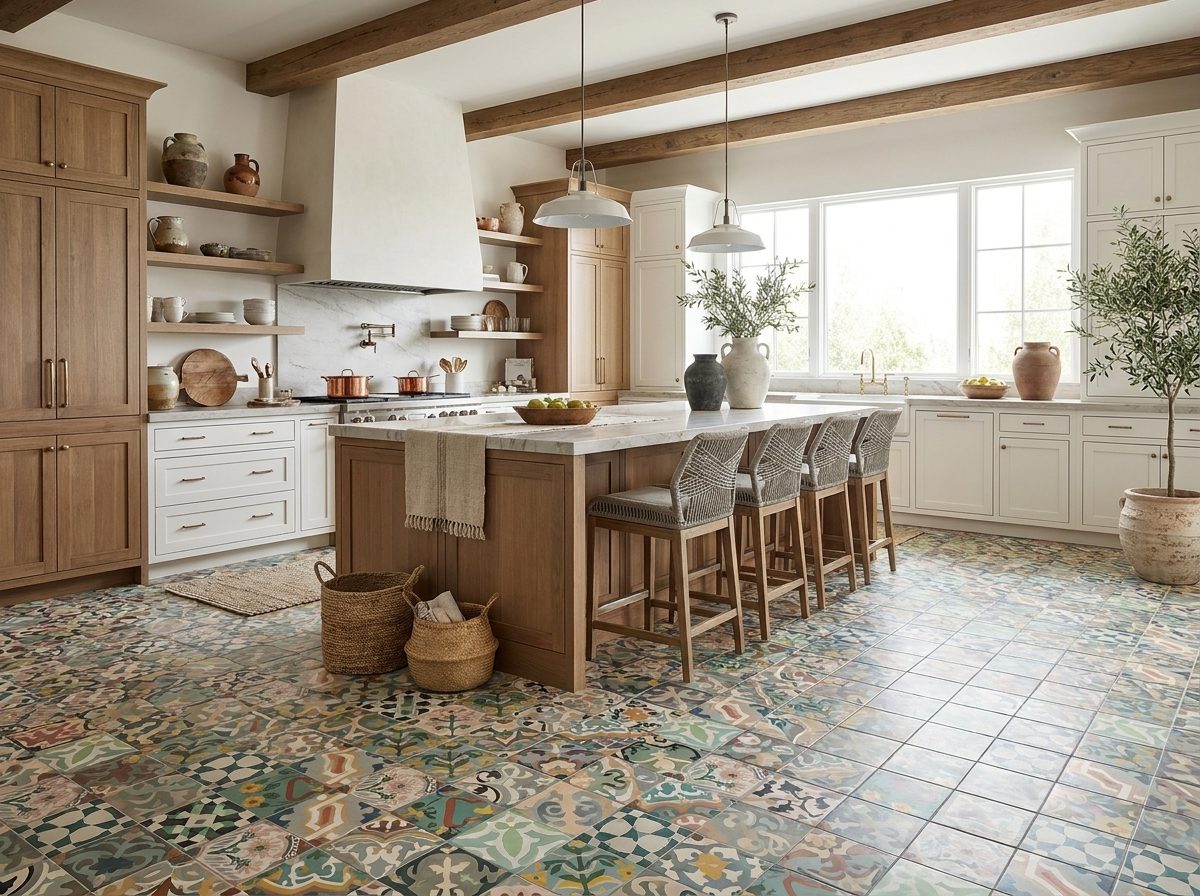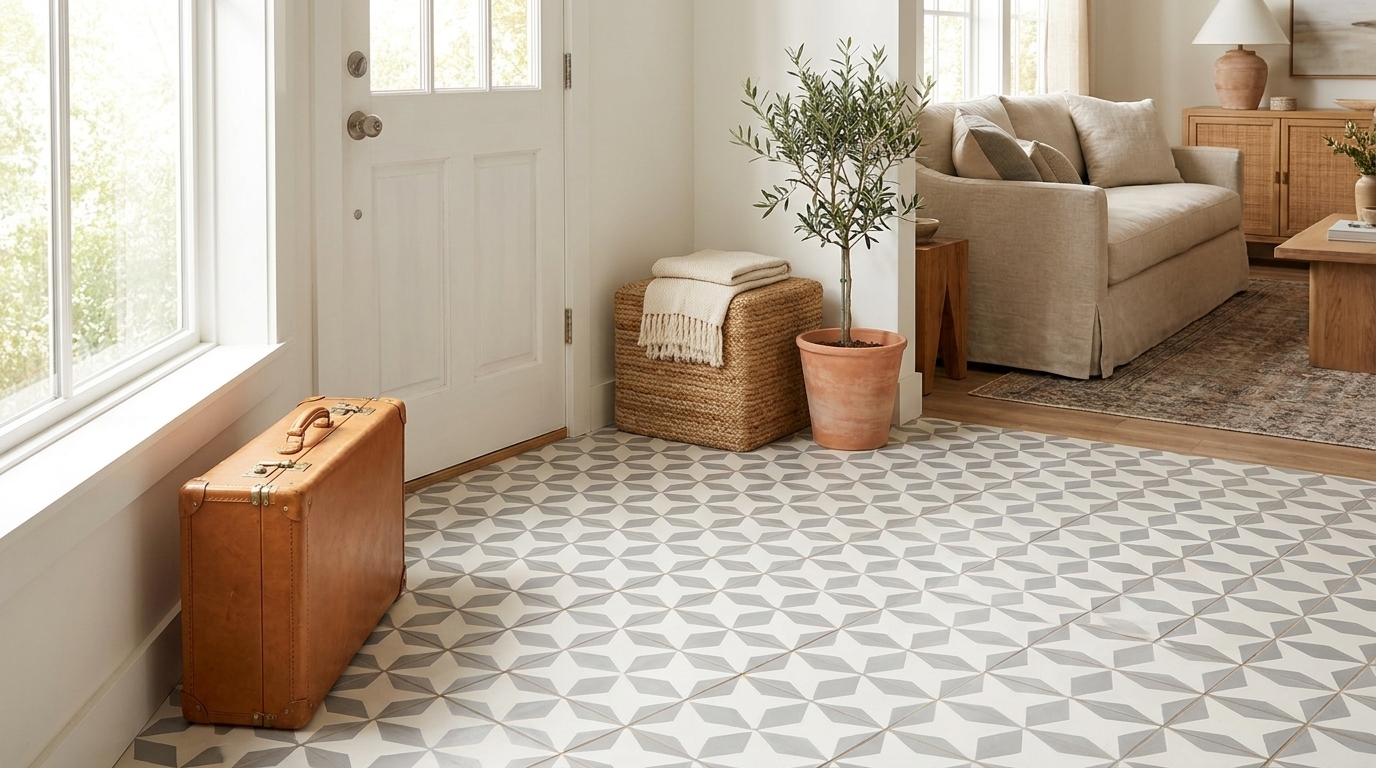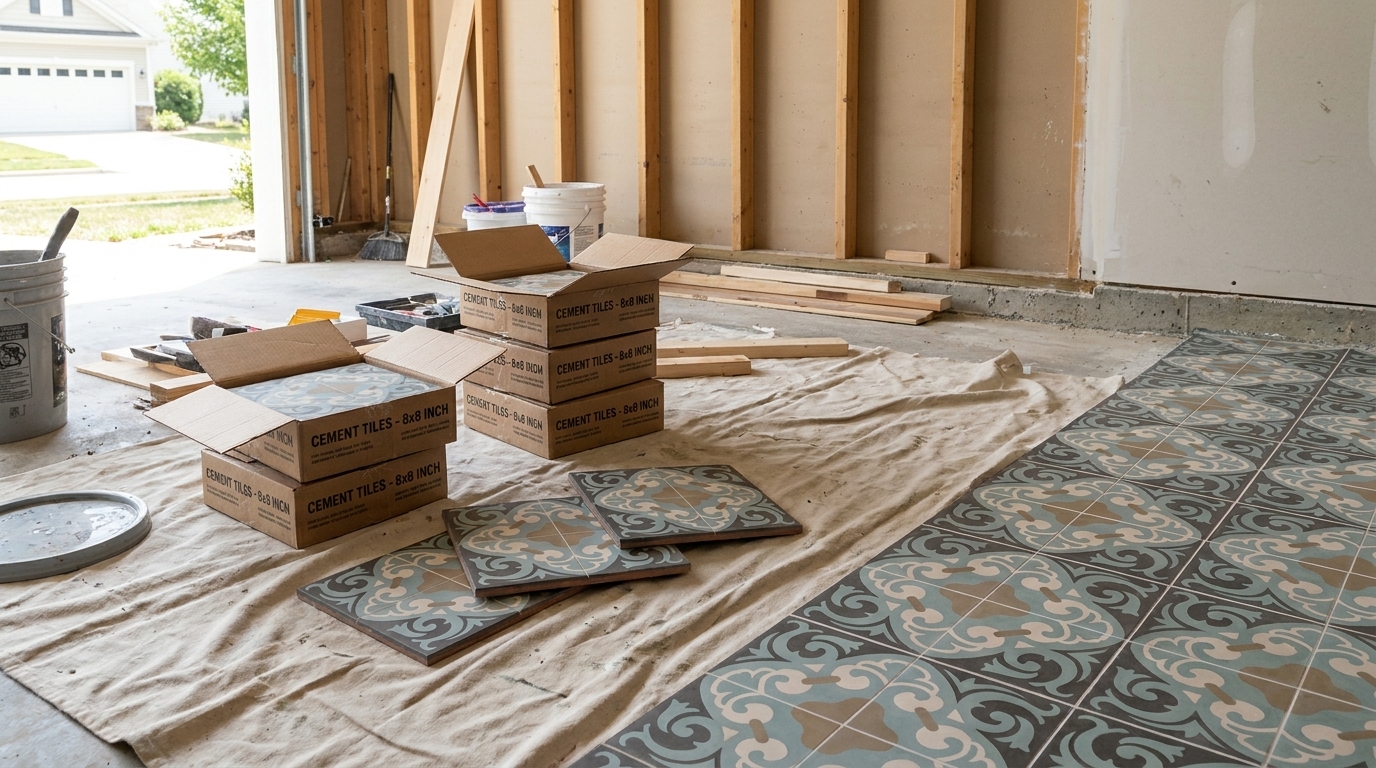
You’re usually standing in one of two places when encaustic tiles come into the conversation.
You’re either looking at a room that feels too clean, too flat, too forgettable, and you need a surface with memory in it. Or you’re staring at samples that all claim to be “encaustic,” while your instinct tells you they can’t possibly all age the same way.
That instinct is right.
A true encaustic cement tile doesn’t rely on a printed face to create its beauty. Its pattern is part of the tile itself. That difference changes everything. It affects how the tile feels in the hand, how it should be installed, how it wears under shoes and chair legs, and whether the floor still looks convincing years from now.
Designers tend to notice the visual depth first. Builders notice the installation demands. Owners notice the long-term value later, once the room has lived through daily use. The smart specification takes all three into account from the beginning.
An Introduction to Timeless Design
Some materials decorate a room. Encaustic tiles shape its character.
A foyer finished in authentic cement tile feels deliberate before anyone has spoken a word. A kitchen backsplash gains weight and rhythm from pattern. A bath that might have read cold in plain white suddenly feels grounded, collected, and personal. The right tile doesn’t just fill a surface. It sets the tone for how the whole room is perceived.
That’s why discerning clients keep coming back to this material. Not because it’s fashionable, but because it gives architecture a sense of permanence. It can sit comfortably in a Spanish Colonial renovation, a pared-back contemporary kitchen, a hospitality project, or a town house that needs one memorable moment underfoot.
The trouble starts when every printed ceramic with a decorative face gets folded into the same category. On a screen, the difference can seem minor. On a jobsite, and especially after real use, it isn’t minor at all.
A good patterned tile draws the eye. A good encaustic tile also earns the right to stay there.
The projects that age well usually begin with a simple decision. Choose a material whose beauty isn’t skin-deep. That means understanding where the encaustic tradition comes from, how authentic cement tiles are made, and how to separate handmade work from products that only imitate the look.
The Enduring Art of Encaustic Tiles
What makes a tile encaustic isn’t the motif, the color palette, or the country of origin. It’s the inlaid method.
What the word means
With true encaustic character, the pattern is formed within the body of the tile rather than applied as a surface decoration. That’s the critical distinction. If the design is only sitting on top, you’re looking at a look-alike, not the authentic tradition.
The language around the term has always been a little messy. The word “encaustic” comes from the Greek term for “to burn in,” but the name was later misapplied by Victorians to inlaid clay tiles because they resembled enamel work. That usage stuck, even though the label wasn’t technically precise. The historical background and the later Victorian revival are outlined in the history of encaustic tile.
That bit of history matters because it explains why so many products borrow the name today. The market often uses “encaustic” as a style word. Craftsmen use it to describe a way of making the pattern integral to the tile.
From medieval floors to revival workshops
The lineage is older than commonly perceived. Encaustic tiles first flourished in the medieval period, with a major era of popularity running from the 13th century to the 16th century English Reformation under Henry VIII, especially in churches, monasteries, and public buildings across Western Europe. Those early inlaid clay tiles were kiln-fired at high temperatures, which helps explain why many survived significant periods of wear while keeping their patterns and color.
The revival took shape through practical innovation, not nostalgia alone. Herbert Minton began experiments in 1828, secured a patent in 1830, and issued a catalog of medieval-inspired designs in 1835. Later developments refined production, including Richard Prosser’s 1842 dust-pressing patent and William Boulton’s 1868 machine patent that could produce dust-pressed encaustic tiles using fretted brass plates for up to multiple colors of clay.
By 1900, production had expanded to many makers across western and southern Europe. The trade later declined in the UK, while activity continued in France, Belgium, and Spain until the 1930s.
Why the method still matters
A pattern that belongs to the tile wears differently from a pattern that sits on top of it.
That’s the lesson worth carrying forward into modern cement tile. Even though cement encaustic tiles aren’t made the same way as the medieval clay versions, they inherit the most important principle. The design isn’t a cosmetic afterthought. It’s part of the structure of the piece.
That’s why authentic encaustic tiles don’t age with the same brittle character as printed products. They soften. They patinate. They keep their authority.
Three signs you’re dealing with an authentic tradition
- Inlaid design: The motif is built into the tile rather than printed or glazed onto the face.
- Material character: The surface reads matte and mineral, not slick or factory-coated.
- Graceful wear: Time tends to reveal character, not expose a disguise.
How True Encaustic Cement Tiles Are Made
A designer opens a sample box and sees two patterned tiles that look similar at first glance. Cut them, handle them, or live with them for a few years, and the difference becomes obvious. A true encaustic cement tile is built in layers under pressure, with the pattern formed in the body of the tile itself. An imitation relies on a surface treatment that only looks convincing while the face stays intact.

The structure inside the tile
A proper cement tile is a compact assembly of distinct layers, and each one contributes something different to performance.
The face layer carries the pattern. It is made from white cement, marble dust, and mineral pigment, poured by hand into a metal divider mold. That decorative layer is relatively thin, but it is thick enough to wear well over time because the color is part of the material, not a print sitting on top.
Behind it sits a finer cement layer that supports compression and helps lock the face to the body. The bottom layer provides mass, stability, and the open structure that gives cement tile its characteristic porosity and bond. The finished piece feels weighty for a reason. It is a solid finish material with real depth, not a thin decorative shell.
You can see that build in authentic handmade cement tile construction, and it explains why good encaustic tile has a grounded, mineral presence in the hand.
The workshop process
The making is slow, manual work.
Pigmented cement is mixed to the right consistency, then poured into a brass or metal mold that separates each color in the pattern. The craft lies in control. If the mix is too wet, edges blur. If it is too dry, the face can look chalky or weak. An experienced workshop keeps the pattern crisp without making the surface feel hard or artificial.
Once the design layer is poured, the supporting layers are added, and the tile goes into a hydraulic press. Pressure compacts the materials into a single body. The tile is then removed from the mold and left to cure carefully over time.
There is no firing stage and no glaze to create the finish. The matte surface, soft variation, and dense feel come from cement, pigment, pressure, and curing.
Workshop truth: A printed face starts to fail from the top down. An inlaid cement tile carries its pattern below the immediate surface, so ordinary wear does not erase the design at the first sign of use.
A short look at the process makes the distinction easier to see in practice.
What matters to a specifier
This construction has direct consequences on site.
Cement encaustic tile is heavier and more substantial than many designers expect from a patterned finish. That affects handling, substrate preparation, and installation sequencing. It also explains why the material reads with more depth once it is laid. Light falls on a cement tile differently than it does on a glazed ceramic imitation. The surface is quieter, flatter, and more architectural.
The anatomy is simple:
| Layer | Material role | Why it matters on site |
|---|---|---|
| Wear layer | Pigmented cement and marble dust | Holds the visible pattern and withstands daily abrasion |
| Middle layer | Fine sand and cement | Supports compression and bonds the face to the body |
| Base layer | Cement-rich backing | Adds mass, stability, and predictable setting behavior |
Specifiers who understand that anatomy make better decisions. They allow for sealing, handle the material with more care before installation, and judge samples by depth of pattern and surface character rather than by print sharpness alone. That is usually the point where authentic encaustic tile separates itself from a cheaper look-alike.
Choosing Authentic Tiles Over Imitations
Most buying mistakes happen before the first tile is ever installed.
A client sees a bold pattern online. A showroom label says “encaustic look” or “Moroccan encaustic.” The price seems attractive. The sample reads well from a few feet away. Then the project reaches real life, with wet shoes, kitchen splashes, moving furniture, and ordinary abrasion.
That’s where authentic handmade cement tile separates itself.
What usually gets confused
The market bundles together three very different products:
- Authentic handmade cement encaustic tile
- Ceramic or porcelain look-alike tile
- Printed cement tile
Only the first one carries the inlaid, body-based patterning that defines the tradition.
A frequent point of confusion is the difference between authentic handmade cement tiles and cheaper printed cement or ceramic “encaustic-look” tiles. Printed variants are often highly porous and unsuitable for wet areas, with surface pigments that can chip and fade quickly. Authentic hydraulic-pressed cement tiles have inlaid color running through the body, which gives them stronger long-term durability and color stability in high-traffic residential and commercial settings, as explained in this guide to encaustic tiles use types and care.

Authentic Cement vs. Look-Alikes A Comparison
| Attribute | Authentic Cement Tile | Ceramic/Porcelain Look-Alike | Printed Cement Tile |
|---|---|---|---|
| Pattern construction | Inlaid into the tile body | Usually surface image or glaze effect | Surface printed |
| Surface character | Matte, mineral, hand-worked | Hard, factory-finished, often uniform | Can mimic matte, but reads flatter in person |
| Aging | Develops patina | Stays visually consistent | Surface wear is more obvious |
| Repairability | Can often be professionally restored | Limited once face is damaged | Printed face damage is difficult to disguise |
| Wet-area confidence | Suitable when properly specified and sealed | Depends on product type and finish | Often a poor choice where moisture is persistent |
| Design intent over time | Holds depth and character | Holds the look of the print | Risks fading, chipping, or disappointment |
What to look for before you buy
A serious buyer should ask better questions than “Is it encaustic style?”
Ask how the pattern is made. Ask whether the tile is hydraulic-pressed or printed. Ask what the face looks like in raking light. Ask what the installer must do before grouting. Those questions reveal the product quickly.
Here are the signs that usually matter most:
- Cut edge inspection: If you can inspect a sample edge, authentic cement tile shows a meaningful wear layer rather than a decorative film.
- Surface feel: Handmade cement has a soft matte texture. It doesn’t feel glazed.
- Variation: Small tonal and surface shifts are normal in handmade work. Uniform perfection usually points to industrial imitation.
- Installation notes: Cement tile comes with clear handling, sealing, and setting requirements because it behaves like cement, not ceramic.
If a seller only talks about the pattern and avoids the construction, treat that as a warning.
For designers comparing sources, it helps to review manufacturers that specialize in the material rather than in trend-driven replicas. One example is this collection of handmade cement tile, where the category itself makes the production method clear.
The practical trade-off
Imitations aren’t useless. Porcelain look-alikes can suit projects where uniformity, thinner profiles, or low-maintenance expectations take priority over material depth. But they should be chosen for those reasons, not mistaken for the same thing.
Authentic encaustic cement tile asks more from the installer and more from the buyer upfront. In return, it gives the project something printed products never fully achieve. Substance.
Designing with Encaustic Tile Patterns and Shapes
The best encaustic tile projects don’t begin with a pattern board. They begin with a room function.
An entry floor has to welcome abuse gracefully. A backsplash has to hold visual attention at eye level. A powder room can take more risk than a large open-plan kitchen. Once that purpose is clear, the pattern choice becomes easier, and usually stronger.
Floors that anchor a room
A patterned encaustic floor can do the work of a rug without behaving like one.
In an entry, geometric motifs establish order the moment the door opens. In older homes, that kind of floor can bridge original architecture and newer furnishings. In hospitality settings, a repeated field pattern gives the room an identity guests remember, even if they never know why it feels so complete.

Walls that need more than color
Wall applications call for a different hand.
A kitchen backsplash benefits from tighter pattern control. Too much visual agitation in a small cooking zone can overpower cabinetry and hardware. A simpler repeat, or a pattern with one dominant tone, usually carries better across the length of a counter.
Bathrooms can go further. A vanity wall, shower surround, or wainscot in encaustic tile adds warmth that plain stone or white ceramic often lacks. The matte finish also softens light in a way glossy surfaces don’t.
Shapes that change the tone
The classic square remains popular because it frames pattern so well, but it isn’t the only language available.
Different shapes create different kinds of movement:
- Hexagon: More contemporary, often cleaner and more graphic.
- Arabesque: Softer and more ornamental.
- Fish scale: Particularly effective on vertical surfaces where rhythm matters.
- Star and cross: Architectural and historic in feeling.
- Plain fields with borders: Useful when the room needs restraint at the center and detail at the edge.
A seasoned designer doesn’t reach for the most intricate option first. Often the strongest composition comes from balancing a bold field with quieter adjacent materials, or using a single custom motif as an accent rather than covering every surface.
A memorable encaustic installation needs pattern discipline as much as pattern courage.
A practical design rule
Match the complexity of the tile to the visual noise already in the room.
If cabinetry is expressive, let the floor be simpler. If the architecture is plain, the tile can carry more narrative. If the room is small, scale matters more than ornament. Large motifs in tight spaces can either create drama or crowd the room, depending on how much breathing room the surrounding finishes provide.
That judgment is where craft and design finally meet.
Key Selection and Installation Criteria
A designer signs off on a beautiful encaustic floor. Six months later, the client calls. The pattern still looks rich, but the surface is blotchy, a few corners sound hollow, and the grout has stained the face of the tile. In nearly every case, the failure started before the floor was ever walked on. It started with a bad product choice, a weak substrate, or an installer who treated cement tile like printed ceramic.

The specifications that matter
Real encaustic cement tile asks for a different kind of judgment than imitation products. A surface-printed tile is often selected by appearance alone. Authentic cement tile must be selected by appearance, body, wear layer, and setting conditions together.
The first question is simple. Is the pattern in the tile, or only on it?
A true encaustic tile has an inlaid color layer with enough depth to age gracefully under foot traffic. That gives the floor a different service life than a cheap printed lookalike, where wear can expose the plain body beneath the image or leave the face looking tired long before the room itself is ready for renovation. Slip resistance and wet-area suitability also matter, especially in baths, entries, mudrooms, and kitchens, but numbers only help when the installer understands what they mean on site.
Here is how I judge the material in practice:
| Criterion | What it means in practice |
|---|---|
| Slip resistance | Good footing matters more in entries, baths, and working kitchens than in a formal powder room |
| Wet-area suitability | A tile may suit bathrooms, but only with proper waterproofing, slope, sealing, and grout selection |
| Surface hardness | Cement tile wears well under normal use, but grit, dragged metal, and harsh cleaners will mark it faster than porcelain |
| Inlaid wear layer | A true wear layer gives the pattern depth and lets the surface mature without exposing a printed face |
For kitchen planning, the broader performance picture matters as much as the sample board. Moisture, grease, chair movement, dropped utensils, and cleaning habits all shape how the floor will age. This guide to tile flooring types, installation, and maintenance for kitchens is useful because it looks at kitchen floors under real use, not just showroom lighting.
Installation rules for authentic cement tile
Good installation starts with accepting that cement tile is porous, weighty, and less forgiving than factory-glazed ceramic. That affects adhesive choice, coverage, cutting, handling, sealing, and grouting.
Full thinset coverage is required. White setting materials are often the safer choice, especially under light-colored tiles, because darker mortars can influence the appearance. Many handmade tiles also need careful moisture control before installation. Some lines are pre-treated at the factory, some are not, and some require dampening rather than soaking. The manufacturer’s instructions for the exact tile being installed should govern the work.
Pre-grout sealing is also required.
That single step prevents a large share of avoidable staining complaints. If the face is left unsealed before grouting, pigment can lodge in the surface and stay there. If coverage is spotty, the tile may crack under point loads or sound hollow later. If the crew reaches for the same habits they use on porcelain, the floor may look acceptable on day one and disappoint by the end of the first year.
The site checklist I’d insist on
- Substrate readiness: Flat, rigid, cured, and suitable for the tile’s weight and thickness.
- White setting materials: A practical safeguard under many cement tiles, especially pale colors.
- Full support: No voids, no skimpy troweling, no shortcuts at edges or corners.
- Pre-grout sealing: Required to reduce staining and uneven absorption.
- Pattern control: Dry-lay, check orientation, and approve the repeat before the first permanent course is set.
- Qualified wet-area detailing: Waterproofing, movement joints, and perimeter conditions need the same attention as the tile face.
Underlayment decides whether the finish lasts
A patterned surface gets the attention. The assembly below it determines whether that surface stays intact.
Cement tile is not the place to ignore deflection, patch over cracks without a plan, or assume an old floor is "probably fine." Movement in the substrate will telegraph through the finish, and handmade tile gives those mistakes nowhere to hide. Anyone specifying this material should review the floor build-up early, including crack isolation, flatness tolerances, and the right underlayment for tile floors.
Authentic encaustic tile rewards good judgment twice. First at selection, then at installation. That is one reason it outlasts many imitations that look convincing in a carton and fail once real use begins.
Long-Term Care Customization and Cost
Authentic encaustic tiles reward steady care, not heroic maintenance.
Daily cleaning should stay simple. Dust and grit need to be removed before they can abrade the surface, and routine washing should use a pH-neutral cleaner rather than acidic products. Harsh chemicals don’t make cement tile cleaner. They make the surface and sealer more vulnerable.
Caring for the floor you installed
Resealing is part of ownership, especially in rooms with water, grease, or frequent traffic.
A properly maintained floor can also be revived when age begins to show unevenly. One advantage of an authentic inlaid tile is that wear doesn’t expose a fake image layer. Restoration is a realistic conversation with material, not camouflage over a printed face. For practical maintenance steps, this guide to cleaning cement tiles is a useful reference.
When the tile is going into a bathroom, the value of qualified trades becomes even clearer. Waterproofing details, slope, penetrations, and movement joints all affect the finish. Homeowners comparing scope and trade coordination may find it helpful to review how professional bathroom renovation services approach the larger renovation process rather than treating tile as an isolated finish item.
Custom work and budgeting
Customization is one of the strongest reasons to choose handmade cement tile in the first place.
A designer can alter color, scale, border treatment, or field pattern to fit the architecture rather than forcing the room to accept a generic off-the-shelf solution. That matters in branded hospitality spaces, period-sensitive renovations, and homes where one floor is meant to become the signature element.
Cost depends on practical factors more than marketing language. Pattern complexity matters. Color variety matters. In-stock selections move differently than custom runs. Lead time also shifts with production demands and the specificity of the order.
The right way to think about price is not as a simple square-foot comparison against printed alternatives. It’s a material and craft decision. If the project needs lasting depth, repairable character, and a pattern that belongs to the tile itself, authentic cement encaustic belongs in the budget discussion from the start.
The Lasting Value of Authentic Tile
Authentic encaustic tiles ask you to care about how something is made, not just how it looks on day one.
That’s why they endure. Their pattern isn’t a temporary face. Their value isn’t tied to a passing trend. They bring craft, weight, and visual memory into a room in a way mass-produced imitations rarely manage. When specified well and installed properly, they not only survive use, they gain presence from it.
For designers, that means more control over material expression. For homeowners, it means living with a surface that keeps its conviction. For builders and installers, it means respecting a product that rewards correct practice.
If you want a floor or wall that still feels honest years from now, choose the version with substance in it.
Original Mission Tile offers handmade cement tile collections, in-stock options, and custom design support for residential and commercial work. If you’re selecting materials for a current project, it’s worth exploring Original Mission Tile to review patterns, formats, and specification guidance before you finalize samples.