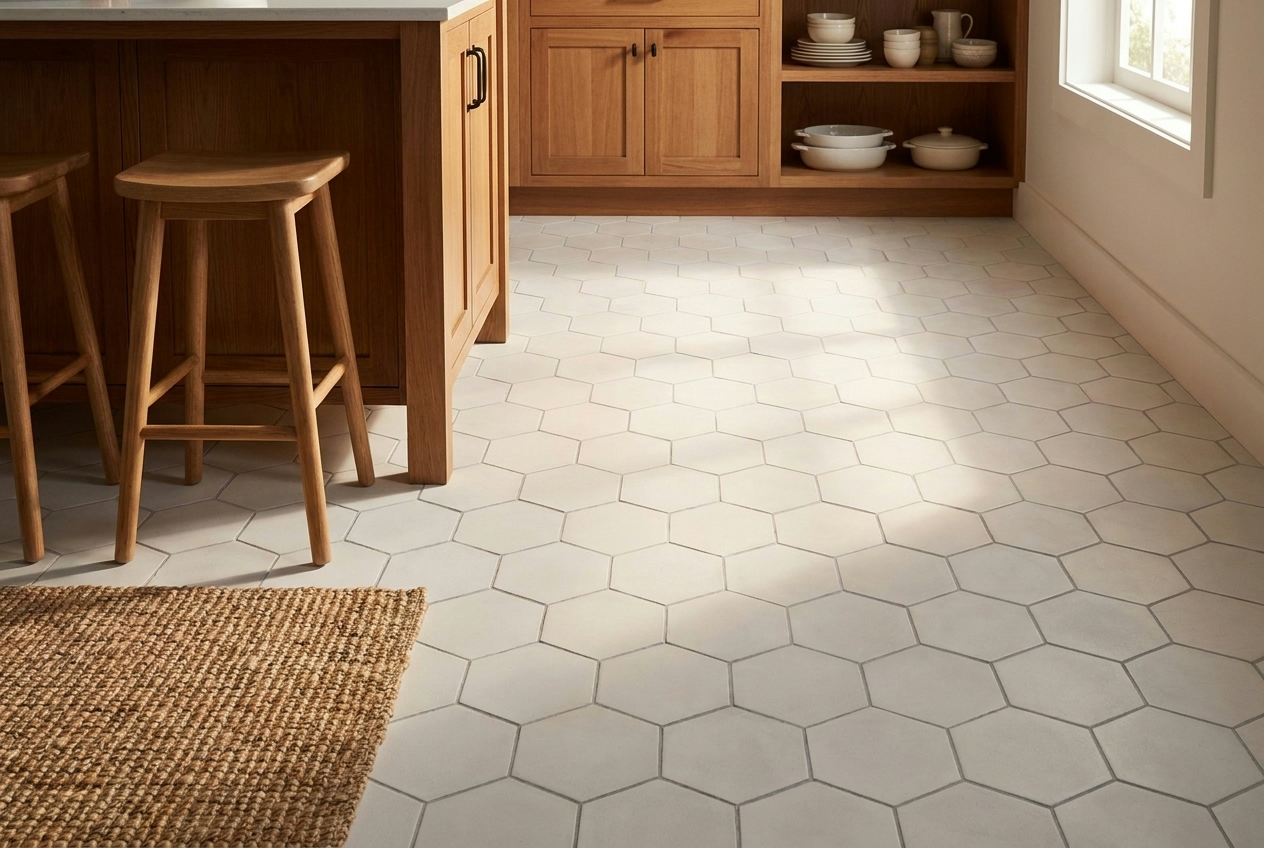
You're standing over a stack of beautiful floor tile, and the first full piece is about to become the first cut piece. That's the moment the job changes. Up to then, it's design. After that, it's craft.
A good layout can still look average if the cuts are ragged, chipped, or slightly off where the eye naturally lands, at doorways, vents, tub fronts, and the perimeter. A great tile job usually isn't defined by the field tile. It's defined by the pieces that had to be persuaded into place without looking forced.
That's why the floor tile cutter matters so much. It isn't just a tool purchase or rental line item. It's the difference between a floor that looks settled and intentional, and one that always feels a little tense around the edges.
The Difference Between a Good and a Great Tile Job
The first cut tells you a lot. If the tile breaks clean, the line stays true, and the edge fits where it's supposed to, the rest of the installation gets calmer. If the first cut chips the glaze, wanders off the mark, or snaps short, every next step gets more expensive and more frustrating.
That's especially true when the tile itself is premium. Handmade surfaces, patterned pieces, and visible-edge installations don't forgive rough handling. A floor tile cutter, used the right way, protects the design you paid for.
Tile cutting isn't a modern workaround. It comes from a very old building tradition. Ceramic floor tile use dates back to the fourth millennium B.C., and the first tile cutter was created to solve the practical problem masons faced when cutting mosaics of encaustic tiles, according to the historical record summarized in this ceramic tile cutter reference. That matters because it explains what the tool was always meant to do. Save labor, improve fit, and make hard materials behave on real jobsites.
Great tile work looks effortless only after someone has done the hard part well.
On a floor, the hard part usually isn't spreading mortar. It's making clean decisions before the blade or scoring wheel ever touches the tile. Subfloor prep plays into that more than many people realize, because a perfectly cut tile can still fail on a bad base. If you're planning the job from the ground up, it's worth reviewing floor underlayment for tile before you start cutting anything at all.
An Overview of Floor Tile Cutter Types
Shoppers often look for a floor tile cutter as if one machine should do everything. That's the wrong approach. Think of tile cutters like kitchen knives. A chef's knife, bread knife, and paring knife all cut, but nobody sensible slices crusty bread with a paring knife and then blames the bread.
Tile cutting works the same way. The best tool depends on the material and the shape of the cut.
Manual cutters
A manual tile cutter uses a score-and-snap mechanism, which makes it best for fast, straight cuts on ceramic and porcelain, while a wet saw uses a water-cooled diamond blade and is preferred for complex shapes or ultra-hard stone, as explained in Rubi's comparison of tile cutter vs wet saw.
A manual cutter is quick to set up, quiet, and easy to carry into a finished home. For repetitive straight cuts on standard floor tile, it's hard to beat. That's why many installers keep one nearby even when a saw is on site.
If you're handling a smaller project and want to understand what a compact tool looks like in practice, a manual tile cutter for DIY is a useful reference point because it shows the kind of straightforward score-and-snap setup many homeowners start with.
Manual cutters struggle when the tile is unusually dense, when the cut is narrow, or when the edge must be flawless on a visible premium surface. They also don't help much with notches, circles, or odd architectural conditions.
Wet saws
A wet saw is the workhorse. It doesn't score and break. It grinds through the material with a diamond blade while water cools the blade and helps control debris.
That makes it the better choice when the tile is hard, thick, brittle, expensive, or all four. It's also the tool that gives you more confidence on mitered edges, long rip cuts, and anything where a chipped finish will be obvious from standing height.
Wet saws are slower to set up and messier to run. They need space, power, cleanup, and some discipline. But they give you a much wider margin for success on demanding material.
Angle grinders and rotary tools
An angle grinder is not a replacement for a proper saw, but it solves problems the other tools can't. If you need a curved cut around a toilet flange, a notch at a door jamb, or a center cut that doesn't start from the tile edge, the grinder becomes the problem-solver.
It's also the least forgiving tool in the group. A grinder can chip, wander, burn an edge, and throw dust in a hurry if your hands or blade choice aren't right. It's best used as a specialty cutter, not the default choice for every cut on the project.
Tile Cutter Comparison
| Cutter Type | Best For | Cut Type | Portability | Mess & Noise |
|---|---|---|---|---|
| Manual cutter | Ceramic and porcelain on straight layouts | Straight cuts | High | Low mess, low noise |
| Wet saw | Dense tile, stone, premium finishes, cleaner edges | Straight cuts, miters, many detail cuts | Moderate | Higher mess, motor noise |
| Angle grinder | Notches, curves, center cuts, awkward field adjustments | Irregular and specialty cuts | High | High dust and noise |
If a tool feels fast but leaves edges you need to hide, it wasn't the right tool. It just made the mistake sooner.
How to Choose the Right Cutter for Your Tile
The right floor tile cutter is chosen by tile material first, cut shape second, and project scale third. People often reverse that and shop by price or convenience. That's how premium tile gets ruined by a cheap scoring wheel, or a simple ceramic job gets overcomplicated by the wrong saw.

Start with the material, not the tool
Ceramic is usually the most forgiving. A manual cutter often handles it well if the tile is consistent and the job is mostly straight cuts.
Porcelain is different. It's denser and less willing to snap cleanly if the score isn't right. Some pieces cut beautifully on a strong manual cutter. Others behave better on a wet saw, especially if the tile is large, thick, or has a finish that shows every tiny chip.
Natural stone demands more respect. Stone varies by type, but in general it doesn't reward forcing a break line. If the material is expensive and the edges matter, use a saw.
Handmade cement tile needs an even gentler approach. It isn't porcelain, and that's exactly why people mishandle it. Installers see a tile that isn't fired like ceramic and assume it will be easy. In practice, the finish can bruise, the face can chip, and the visible edge can look tired before the tile is even set if the wrong cutter is used.
Match cutter capacity to tile size
Large-format work exposes weak tools fast. Professional tile cutters are commonly specified by maximum cut length. Rental-grade systems support tiles up to 600 mm and 730–1000 mm, while some manual cutters reach 48 inches (about 1,219 mm) and handle tile thicknesses of 0.2–0.6 inches (about 5–15 mm), which is why checking cutter capacity before the job starts matters so much, as outlined in these tile cutter specifications and features.
A simple rule helps here:
- If the tile barely fits the cutter on paper, it usually doesn't fit comfortably on site.
- If the layout includes long diagonals, check the actual cutting path, not just the nominal tile size.
- If the tile has a delicate face, don't push the cutter to its limit.
A practical decision framework
Use this checklist when you're deciding:
- Mostly straight cuts on standard ceramic: A manual cutter is usually the fastest path.
- Dense porcelain or visible edges: Lean toward a wet saw, especially when the finish can't hide flaws.
- Notches, circles, and awkward penetrations: Add an angle grinder to the workflow.
- Handmade cement tile: Choose a wet saw and treat the tile like a finish material, not a utility surface.
- Large-format tile: Confirm the cutter's length and thickness capacity before buying or renting.
For rooms where design choices drive tool choices, broader planning helps too. If you're still narrowing down material, scale, and finish for a bathroom project, these expert tips for bathroom tile can help you make better decisions before you get to the cutting stage.
The cutter should suit the tile. The tile should not be forced to suit the cutter.
Mastering Safe and Precise Cutting Techniques
Technique matters as much as tool choice. Two installers can use the same floor tile cutter and get completely different results because one is cutting with control and the other is fighting the tool.

Start with safety that isn't optional
Tile edges are sharp. Diamond blades don't care how experienced you are. Dust and flying chips punish sloppy habits.
Keep it simple:
- Protect your eyes: Wear safety glasses every time.
- Protect your hands carefully: Gloves help with handling sharp tile, but keep them snug around spinning tools.
- Protect your hearing: Wet saws and grinders are loud enough to justify hearing protection.
- Stabilize the work: Most bad cuts start before the blade moves, when the tile rocks or shifts.
A calm setup usually produces a clean cut. A rushed setup usually produces a ruined tile.
How to use a manual cutter well
Manual cutters reward firmness, not force. Mark the line clearly. Set the tile square against the fence. Score once, with even pressure, and commit to that pass. Don't retrace the line over and over. That often roughens the score instead of improving it.
When you snap, apply pressure cleanly over the score line. If the tile doesn't feel right under the breaker foot, stop and reset. Narrow strips and small slivers often break unpredictably on manual cutters, even when the main tile would snap cleanly.
A manual cutter is best when the cut is straight, the tile is cooperative, and speed matters. Once any of those conditions changes, don't keep insisting. Switch tools.
How to feed tile through a wet saw
Let the blade work. Most chipping on a wet saw comes from feeding the tile too aggressively or twisting it mid-cut.
Use a steady feed rate and keep the tile flat to the table and fence. If the blade starts to sound strained, slow down. If the tile begins to drift, don't muscle it back into line. Stop, back out carefully if the setup allows it, and reset.
For readers who want to see the motion and hand position more clearly, this walkthrough is a useful visual reference:
Cutting tile in place during renovation
Many general guides stop being helpful at this point. Bench cuts are one thing. Cutting a tile that's already installed on a floor is a different job.
For in-place cuts, angle grinders and rotary tools are often used. Success depends on controlling vibration and dust. Installers use masking tape and water spray to reduce chipping, and a stable backing helps prevent cracking the tile in its fixed substrate, as noted in this guide to cutting tiles.
Here's what works in the field:
- Tape the cut line when the surface finish is prone to flaking or chipping.
- Score the path lightly first instead of diving full depth immediately.
- Make shallow passes and let the tool establish the line.
- Support the surrounding area so vibration doesn't telegraph into adjacent tile.
- Finish the edge by dressing it if the cut will remain visible.
If you're specifically dealing with renovation cuts and want a more focused look at that problem, this guide on how to cut floor tile is worth reviewing before you touch an installed surface.
The Art of Cutting Handmade Cement Tiles
Handmade cement tile punishes rough technique faster than many installers expect. That's because the surface isn't a glazed shell over a fired body. It's part of the tile itself. When you chip the face, you're not just damaging an outer coating. You're bruising the finished material.

Why standard cutting habits fail
A strong snap that works on basic ceramic can leave a cement tile edge looking tired and fuzzy. An aggressive grinder pass can scar the face. Even a wet saw can leave tiny chips if the blade is wrong or the feed is rushed.
The key to cutting dense porcelain and delicate cement tiles is often the combination of blade and technique. Purpose-built thin diamond blades, shallow passes, and back-cutting the last half-inch are professional methods used to prevent micro-chipping on premium materials, according to this guide to cutting tiles and selecting tools.
What actually works
For handmade cement tile, a wet saw is usually the safest choice. Use a fine blade suited to finish work, keep the feed slow and steady, and avoid forcing the tile at the exit point of the cut. That last bit matters because many visible chips happen right as the blade leaves the tile, not when it enters.
Use habits like these:
- Tape delicate faces: It won't cure bad technique, but it can help protect the surface.
- Make shallow passes when needed: One aggressive cut is often worse than a controlled approach.
- Back-cut the finish end: That reduces the risk of breakout at the last part of the cut.
- Dress the edge lightly: If the cut stays visible, refine it instead of pretending nobody will notice.
Premium tile should be cut like finish carpentry, not demolition.
If you're working with patterned encaustic-style surfaces or evaluating material before installation, it helps to understand how handmade cement tile differs from standard fired tile in both makeup and handling.
Cutter Maintenance and Blade Selection
A floor tile cutter only cuts as well as its wear parts and alignment allow. Many “bad tile” complaints are really dull wheel problems, dirty rail problems, or blade problems.
Keep the tool honest
Manual cutters need clean rails, a scoring wheel that still bites cleanly, and a fence that stays square. If the carriage drags or the wheel skips, your score line won't be consistent. Then the snap becomes a gamble.
Wet saws need regular cleanup. Slurry buildup affects smooth travel and can interfere with accurate feeding. Check that the tray moves cleanly, the water flow reaches the blade properly, and the blade still cuts rather than burns through the tile.
A short maintenance routine saves a lot of waste:
- Wipe rails and guides after use
- Check for square before important cuts
- Clean the water reservoir
- Replace worn scoring wheels and tired blades promptly
Choose the blade for the finish you want
Blade choice isn't an accessory decision. It's part of the cut itself.
For delicate visible edges, a finer blade is usually the safer choice. For rougher utility cuts, a more aggressive blade may move faster. The mistake is using one blade for every tile type and expecting identical results.
Think in terms of finish quality, not just speed. The blade that gets through the tile fastest isn't always the blade that leaves the edge you can live with.
A maintained cutter feels predictable. Predictable tools produce repeatable cuts.
Rent Buy or Hire a Pro A Decision Guide
The right path depends on how often you'll use the tool, how demanding the tile is, and how much error the project can tolerate.
Rent if the job is limited
Rent a cutter or saw when the project is one room, the timeline is short, and you don't want another bulky tool in the garage. Renting makes sense when you need a better machine than you'd justify buying outright.
Buy if tile work will keep coming
Buy when you remodel regularly, handle your own property work, or want a dependable floor tile cutter available for future repairs and additions. Ownership also gives you time to practice, which matters more than many people admit.
Hire a pro if the tile is expensive or the cuts are unforgiving
Hire an installer when the material is premium, the layout includes many exposed cuts, or the room has difficult transitions and penetrations. Handmade cement tile, polished stone, and highly visible patterned floors all raise the cost of mistakes.
A simple rule works well:
- Simple ceramic, straight cuts, patient DIYer: rent or buy
- Dense porcelain, large format, mixed cut types: rent a strong saw or hire out
- Premium handmade tile, visible edges, pattern alignment: hire a pro unless you already know your tools well
The smartest decision isn't always doing it yourself. It's finishing with a floor that still looks right years later.
If you're planning a floor with character, not just coverage, Original Mission Tile is worth a close look. Their handmade cement tile collections, custom design options, and material guidance can help you choose a surface that deserves careful cutting and rewards good installation with lasting visual depth.