A lot of flooring decisions get made while everyone is still looking at clean samples on a table. The trouble starts after opening week, after the rainy season, after carts, chair legs, grit at the entry, and daily cleaning have had time to tell the truth. That's when a beautiful floor either settles into its role or starts asking for repairs, stain removal, grout work, and apologies.
The reader usually arrives at this decision from one of three places. A restaurant needs a floor that won't become hazardous when service gets messy. A family mudroom needs to absorb years of abuse without looking tired. A hotel, retail space, or lobby needs to carry design intent and still look composed at the edges, transitions, and traffic lanes. In all three cases, the wrong question is “what's the strongest tile?” The better question is “what floor system will still work, safely and visually, after years of use?”
That broader lens matters in a market this large. The ceramic tiles market was estimated at USD 226.41 billion in 2025 and is projected to reach USD 380.61 billion by 2033, a 6.6% CAGR, according to Grand View Research's ceramic tiles market analysis. High traffic floor tile sits inside that larger story, but the best specifications still come down to project-level judgment. Wear resistance matters. So do slip resistance, grout strategy, maintenance routines, replacement planning, and whether the finish will still suit the space once it has aged.
Choosing a Floor That Endures
A busy floor rarely fails all at once. It starts with small signs. The entry tile looks fine, but the grout at the threshold darkens faster than expected. A polished surface cleans easily, yet staff notice it feels less confident underfoot after spills. A dramatic pale floor still photographs beautifully, but every tracked-in mark announces itself by noon.
That's why a high traffic floor tile spec should begin with the whole life of the floor, not the showroom pitch. In a café, I'd worry about traction near the counter and at the front door before I'd worry about whether the sample board looked refined under gallery lighting. In a family entry, I'd care less about a flawless uninterrupted surface and more about whether the pattern can absorb dirt visually until the evening cleaning run. In hospitality, I'd ask how the floor will look in the worn path from reception to elevator, not just in a corner that never sees luggage.
The floor is a system
Tile doesn't perform alone. The tile body, finish, grout, setting materials, subfloor condition, maintenance products, and cleaning frequency all influence the result.
A floor that endures usually gets these decisions right:
- Traffic type: Foot traffic, rolling loads, pets, wet shoes, and service equipment wear a floor differently.
- Safety conditions: Dry use and wet use aren't the same specification problem.
- Visual aging: Some surfaces patinate gracefully. Others look tired the moment they lose uniformity.
- Serviceability: If one area chips or stains, can it be repaired without disrupting the whole space?
A durable floor that looks dirty all the time or feels unsafe when wet is still a poor specification.
Designers and clients often start by comparing materials. That's useful, but only after the performance language is clear. Once you can read a tile data sheet without guesswork, the right choices narrow quickly.
Decoding Durability Your Key Performance Metrics
Spec sheets can either clarify the decision or bury it. For high traffic floor tile, a handful of metrics matter more than the marketing copy.

Start with PEI and water absorption
PEI tells you how well a glazed tile surface resists abrasive wear. Think of tracked-in grit as the main enemy. It acts like fine sandpaper under shoes. For heavy-traffic floors, PEI 4 is commonly recommended for kitchens and hallways with regular residential use, while PEI 5 is the stronger choice for entryways and commercial spaces with daily heavy use, as outlined in Toupin Construction's guide to tile for heavy traffic areas.
Water absorption tells you how porous a tile body is. That matters for staining, moisture exposure, and freeze-thaw performance where relevant. A dense tile body gives you a wider safety margin in demanding spaces. If a tile behaves like a sponge, it needs a different maintenance plan from day one.
Then read the surface, not just the body
DCOF or COF relates to slip resistance. Many specifications falter on this point. A tile can score well on wear and still be the wrong choice if the surface gets slick in its intended use conditions. For restaurant entries, wash areas, bars, mudrooms, and pool-adjacent spaces, traction deserves equal billing with durability.
MOHS hardness is useful as a scratch-resistance shorthand. It won't tell you everything about long-term floor behavior, but it helps you judge how a surface may handle grit, dragged debris, or abrasive cleaning.
Chemical resistance also belongs in the conversation for commercial spaces. Cleaning agents, food acids, and repeated sanitizing cycles can change the look of some materials faster than foot traffic alone.
What to look for on a data sheet
Instead of asking whether a tile is “commercial grade,” ask for concrete data. A practical review looks like this:
- PEI rating: Match it to the traffic pattern, not just the project category.
- Surface finish: Matte and textured finishes often hide wear better than glossy ones.
- Water behavior: Dense bodies are simpler to manage in wet-prone areas.
- Slip profile: Check the tile for the actual use condition, especially where spills are normal.
- Maintenance notes: If the supplier can't explain routine care clearly, the specification is incomplete.
Practical rule: If the tile rep can only talk about color and size, keep asking questions.
A good spec sheet doesn't choose the floor for you. It strips away the wrong options before you spend money installing them.
Material Showdown Comparing High-Traffic Tile Options
Once the metrics are clear, material choice becomes less emotional and more strategic. Different tile types succeed in different kinds of high-use spaces. The best answer depends on whether your project values low porosity, visual character, repairability, slip confidence, or a floor that wears with patina rather than uniformity.
Industry guidance commonly points to porcelain for busy floors because it pairs water absorption below 0.5% with high wear resistance, often with PEI 4 or 5 for demanding residential and commercial areas, as summarized in this overview of ceramic floor tiles for high-traffic settings.
High-Traffic Tile Material Comparison
| Material | Key Strengths | Considerations | Best For |
|---|---|---|---|
| Porcelain | Dense body, low porosity, broad style range, easy day-to-day care | Some smooth finishes can be unforgiving when wet; commodity looks can feel flat in premium projects | Entryways, kitchens, corridors, many commercial interiors |
| Cement tile | Inlaid color, matte character, rich pattern language, graceful visual aging | Requires sealing and a disciplined maintenance plan; not a set-it-and-forget-it material | Hospitality, statement entries, kitchens, boutique retail, design-led homes |
| Terrazzo tile | Strong visual depth, hides day-to-day dust well, suits contemporary and classic schemes | Surface and maintenance approach need to fit the use condition; detailing matters at transitions | Lobbies, retail, restaurants, high-design residential floors |
| Quarry tile | Practical traction, robust utilitarian look, proven in service spaces | Aesthetic is more industrial or rustic; sealers and cleaning methods still matter | Back-of-house, mudrooms, commercial kitchens, service corridors |
| Terracotta | Warm character, soft visual texture, excellent in the right architecture | More porous, more maintenance-sensitive, less forgiving in spill-heavy use | Covered outdoor areas, low-gloss residential projects, Mediterranean and rustic interiors |
What works and what doesn't
Porcelain works when the brief demands a straightforward, low-porosity floor with broad availability. It doesn't always work when the chosen finish is too slick or too visually sterile for the project.
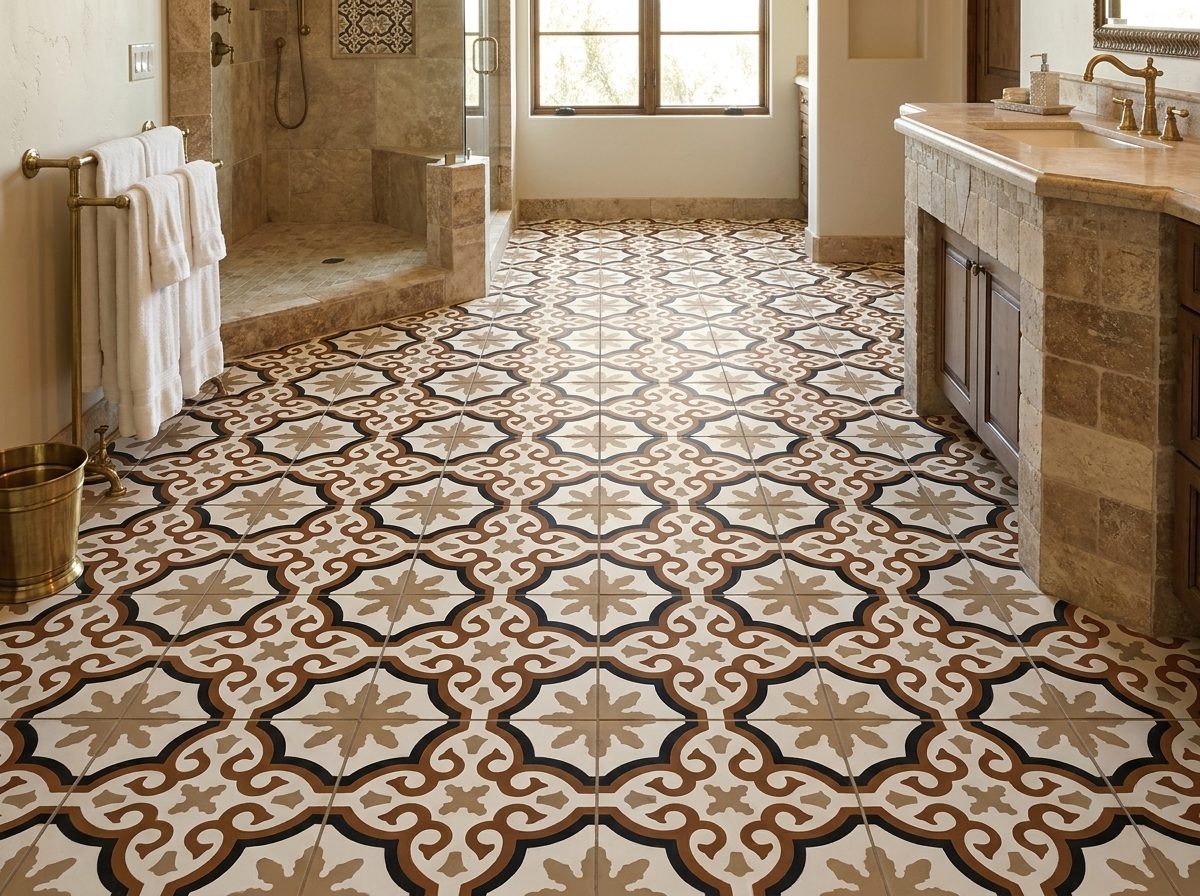
Cement tile works when design and wear need to coexist. Pattern does real labor here. It can disguise dirt, soften visible abrasion, and make traffic paths feel intentional rather than damaged. It doesn't work if the client expects zero sealing, careless cleaning, or harsh chemical use without consequence.
Terrazzo tile works in projects that need visual movement and a specific palette. It's often more forgiving than plain monolithic color because aggregate variation helps break up the evidence of daily life.
Quarry tile works when practicality leads. It often feels right in kitchens, utility areas, and hard-working transitional zones. It doesn't suit every front-of-house design story.
Terracotta works where atmosphere matters more than immaculate uniformity. It struggles when the environment is consistently wet, heavily soiled, or maintained by teams who need a more forgiving system.
For more project-specific considerations in commercial settings, this guide to flooring for high-traffic commercial areas is a useful reference point.
The Case for Cement and Terrazzo
There are projects where porcelain is the sensible answer, and there are projects where sensible isn't enough. If the floor has to carry the design, shape the atmosphere, and still remain practical, cement and terrazzo deserve much more attention than they usually get.

Why they age differently
Cement tile doesn't depend on a printed image or a superficial decorative effect. Its appeal is tied to body, color, and finish working together. In real use, that matters because the floor can develop character without immediately looking cheap or exhausted. A silky matte surface often sits more comfortably in high-use interiors than a glossy finish that broadcasts every scuff.
Terrazzo tile offers a related advantage. Aggregate creates movement, and movement is practical. A floor with visual depth usually hides the day's minor marks better than a plain, flat field of color. That's not a small benefit in hospitality, retail, or active family spaces where the floor is on display all day.
Safety is part of luxury
The industry often overfocuses on wear and underexplains slip resistance. Guidance from Tile Decor points out a key tradeoff: the strongest-wearing tile isn't always the safest, and large-format floors that reduce grout lines can become more slippery in wet spaces. That's especially relevant in restaurants, entryways, and wash areas, as discussed in their piece on tile options for high-traffic areas.
That point matters when clients ask for a unified, refined floor. Fewer grout joints may simplify cleaning and look calm in plan view, but surface confidence underfoot still has to win. Matte cement and well-considered terrazzo can thus outperform a sleeker-looking alternative in lived conditions.
In wet-prone spaces, a floor should feel stable at walking speed, not just look elegant in a sample photo.
Where they fit in a specification
For design-led projects, cement and terrazzo tile options can make sense when you need a floor with visual authorship, maintainable character, and a broader language than commodity porcelain offers. They're particularly strong in cafés, boutique hospitality, powder rooms, kitchen floors, galleries, and residential entries where pattern and surface matter as much as raw durability.
If a client is comparing these materials with harder-edged monolithic systems, it also helps to review broader facility concerns such as cleaning method, sheen management, and slip behavior. This overview on understanding polished concrete floors is useful because it frames the same question from another angle: how does a hard floor behave over time under maintenance, moisture, and repeated use?
Strategic Design for Wear and Tear
Good material selection solves only part of the problem. Floor design itself can either absorb wear gracefully or spotlight every bit of it.

Pattern can do maintenance work
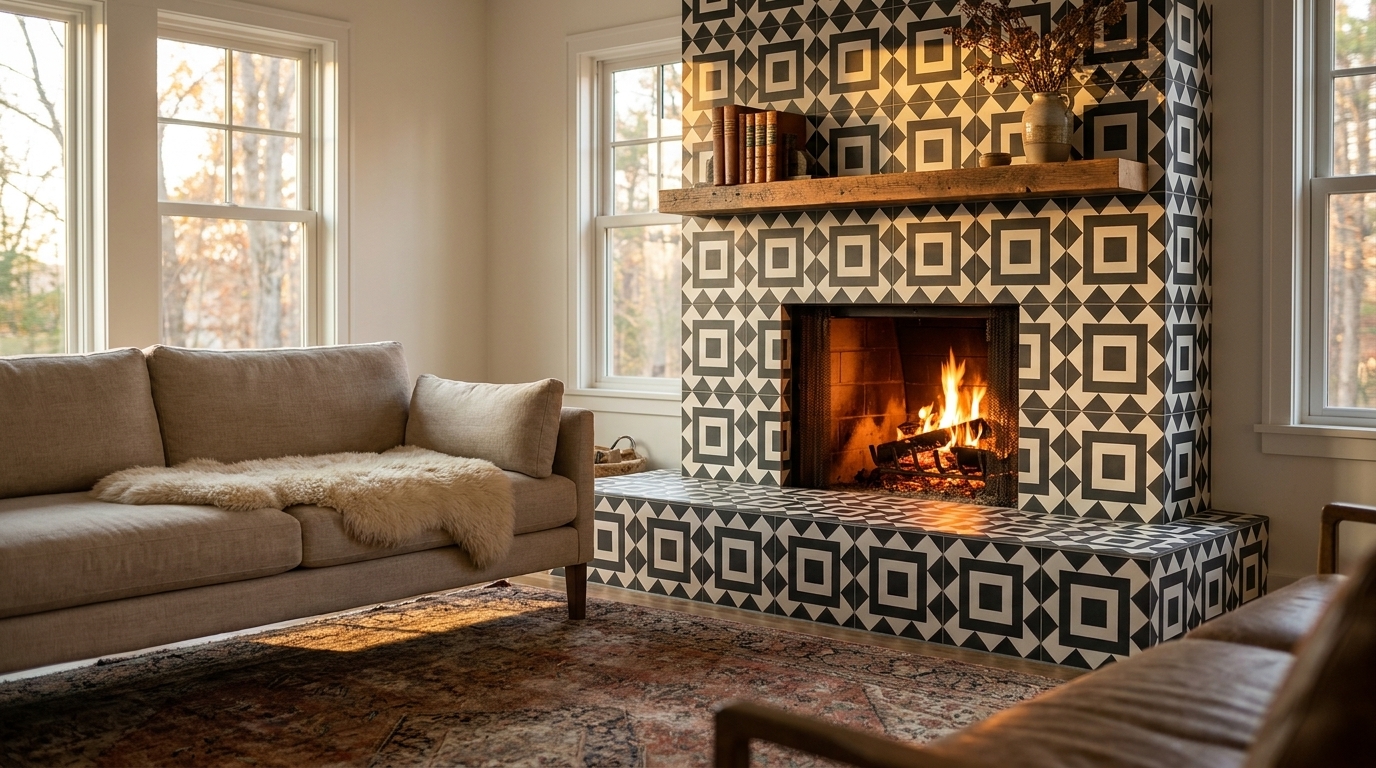
In busy interiors, pattern isn't decorative excess. It's operationally smart. Variegation, tonal movement, and geometric rhythm help a floor carry dust, crumbs, and everyday abrasion without looking neglected by midday.
This is one reason historic encaustic-inspired and cement tile floors still feel so intelligent in modern use. A patterned entry can age better visually than a solid pale slab, even if both materials remain structurally sound.
Consider these design moves:
- Use tonal variation: Mixed neutrals and soft contrast hide tracked-in dirt better than flat, solid fields.
- Place pattern where use is concentrated: Entries, service lines, island perimeters, and transition zones benefit most.
- Frame wear zones intentionally: Borders and field changes can make circulation paths look designed rather than accidental.
Size changes performance
Large-format tiles are attractive because they reduce grout lines and create visual calm. That can be an advantage in dry areas with straightforward circulation. But they aren't always the right answer.
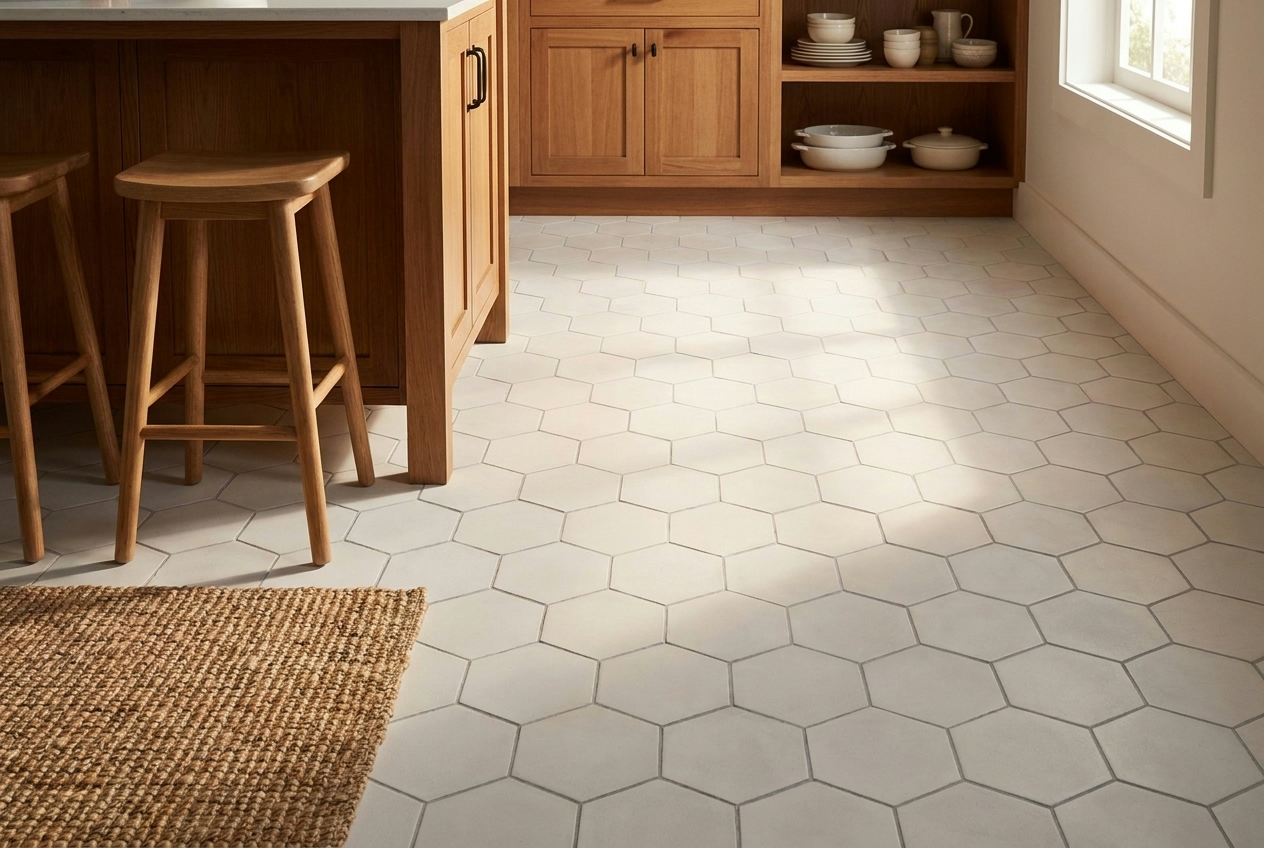
Smaller formats do several useful things. They introduce more joints for traction, make drainage and subtle slopes easier, and often tolerate minor subfloor irregularities with less visual drama. They also make future spot replacement more manageable.
A floor with more joints can be easier to live with than a floor that insists on perfection.
Color is a maintenance decision
Clients often choose color as if it were separate from upkeep. It isn't. Very light solid colors can show every mark. Very dark smooth floors can show dust and footprints. Mid-tone, broken-color, and aggregated surfaces are usually more forgiving.
A practical palette for high traffic floor tile often includes:
- Mid-range neutrals: They mask both dust and minor staining better than extremes.
- Darker grout in active zones: It keeps the floor looking composed longer.
- Textured or matte finishes: They diffuse light and hide scuffs more effectively than polished surfaces.
The most successful floors align appearance with expected mess. If the design language fights the conditions of use, maintenance staff will lose that battle first, and the floor will look worse than it should.
Installation and Maintenance for Lasting Floors
A durable tile can fail because of bad preparation long before the material itself gives up. In practice, the hidden costs of high traffic floors often come from the back-end decisions: poor subfloor prep, rushed setting, weak grout choices, or maintenance routines that don't match the material.
Guidance on high-traffic flooring often misses this point, but it's central. A floor sold as durable can become expensive if grout soils quickly or if installation over an uneven subfloor leads to cracking. That's why grout selection and substrate preparation matter just as much as tile selection for long-term value, as noted by East Coast Floor Coverings in their article on tile flooring for high-traffic areas.

What must happen before tile goes down
Subfloor flatness and stability aren't glamorous, but they determine whether the finished floor sounds solid, stays crack-free, and wears evenly. If the floor has dips, flex, moisture issues, or movement at transitions, the tile assembly inherits those problems.
Before installation, insist on:
- A verified substrate condition that matches the tile format and setting method.
- Movement planning at perimeters and transitions so the field isn't forced to absorb building stress.
- Grout selection by use case rather than habit. Wet service, food zones, and active entries may need a different grout strategy from a quiet residential hall.
Maintenance should be designed in
For porous or maintenance-sensitive materials, sealing isn't an optional afterthought. It's part of the specification. The same goes for grout color, cleaning chemistry, mats at entries, and expectations around spill response.
This video offers a helpful visual reference for installation and care basics:
A realistic maintenance plan should include:
- Entry protection: Mats and runners at doors reduce grit before it reaches the tile.
- Routine cleaning: Use products appropriate to the material and finish. Aggressive cleaners can dull or damage some surfaces.
- Immediate spill cleanup: Especially important on porous surfaces and at grout joints.
- Periodic resealing where required: Sealer performance changes over time and with cleaning frequency.
- Spare tile storage: Keep attic stock for future repairs, especially where batch variation matters.
The cheapest floor on bid day often becomes the most expensive floor to keep looking presentable.
A floor that's easy to patch, reseal, or clean without visual mismatch usually wins over time, even if it asks for more thought up front.
Specifying Your Perfect High-Traffic Floor
The strongest high traffic floor tile specification usually follows a simple sequence. Start with performance metrics. Then choose the material that matches how the space will be used. Shape the floor visually so it can hide normal wear. Finish by specifying installation and maintenance with the same seriousness as the tile itself.
That process changes the conversation. Instead of asking for the hardest product on the shelf, you start asking better project questions. Will the surface stay safe after spills? Will the grout age well? Does the pattern reduce visible wear? Can a damaged tile be replaced without redoing half the room? Will the maintenance team understand what the floor needs?
For architects, designers, and homeowners working through those decisions, this resource on high-traffic commercial flooring is a practical next step. It's useful when the brief calls for a floor that does more than survive. It needs to carry a point of view, support maintenance realities, and still look intentional years after installation.
The right floor isn't always the densest, glossiest, or most uniform. It's the one that keeps doing its job, visually and functionally, after the project photos are old news.
If you're narrowing options for an entry, restaurant, kitchen, retail space, or hospitality project, Original Mission Tile is a solid place to continue the specification process. Review in-stock options for faster timelines, explore custom pattern development through the Design Studio, or contact the team to discuss material fit, layout, and maintenance expectations for your specific floor.