Something is shifting in how Americans design their homes — and the floors and walls are where you can see it most clearly.
After years of safe choices — greige walls, neutral LVT, large-format porcelain in endless shades of “barely there” — residential design across the United States is moving toward something more intentional, more personal, and more materially honest. Pattern is returning. Warmth is returning. And the surfaces that define a room — the floor beneath your feet, the wall that frames your kitchen, the bathroom tile that greets you every morning — are being chosen with a level of design confidence that feels genuinely new.
For interior designers and renovators navigating this shift, 2026 is a particularly interesting moment: the trends are clear enough to specify with conviction, but still fresh enough to feel ahead of the curve. This guide covers the floor and wall tile movements defining American residential design right now — and how handmade cement tiles are showing up at the center of nearly every one of them.
The Forces Behind the 2026 Tile Shift

Three forces are converging to reshape residential tile choices across the US this year.
The craft correction. A decade of mass-market minimalism has produced a widespread appetite for materials that feel made rather than manufactured. Homeowners who spent the 2010s in houses full of smooth, uniform surfaces are now actively seeking texture, variation, and the sense that someone’s hands were involved in making what surrounds them.
The renovation boom’s second act. The pandemic renovation wave that swept US residential design in 2020–2022 is maturing. Many of those hastily chosen finishes are already being reconsidered — and this time, renovators are making slower, more deliberate material decisions. They’re ordering samples. They’re hiring designers. They’re choosing surfaces they intend to live with for twenty years.
Regional design confidence. American residential design has historically deferred to European taste in tile. That’s changing. The success of Southwestern, Mediterranean, and Latin American-influenced interiors in the US market — driven partly by demographic shifts and partly by a growing appreciation for cultural craft traditions — has given American homeowners permission to embrace patterned, colorful, handmade tile with a confidence that would have felt adventurous five years ago.
Trend 1: Patterned Floors as the Room’s Defining Element

The biggest shift in American residential tile in 2026 is attitudinal: the floor has stopped being a background and started being the point.
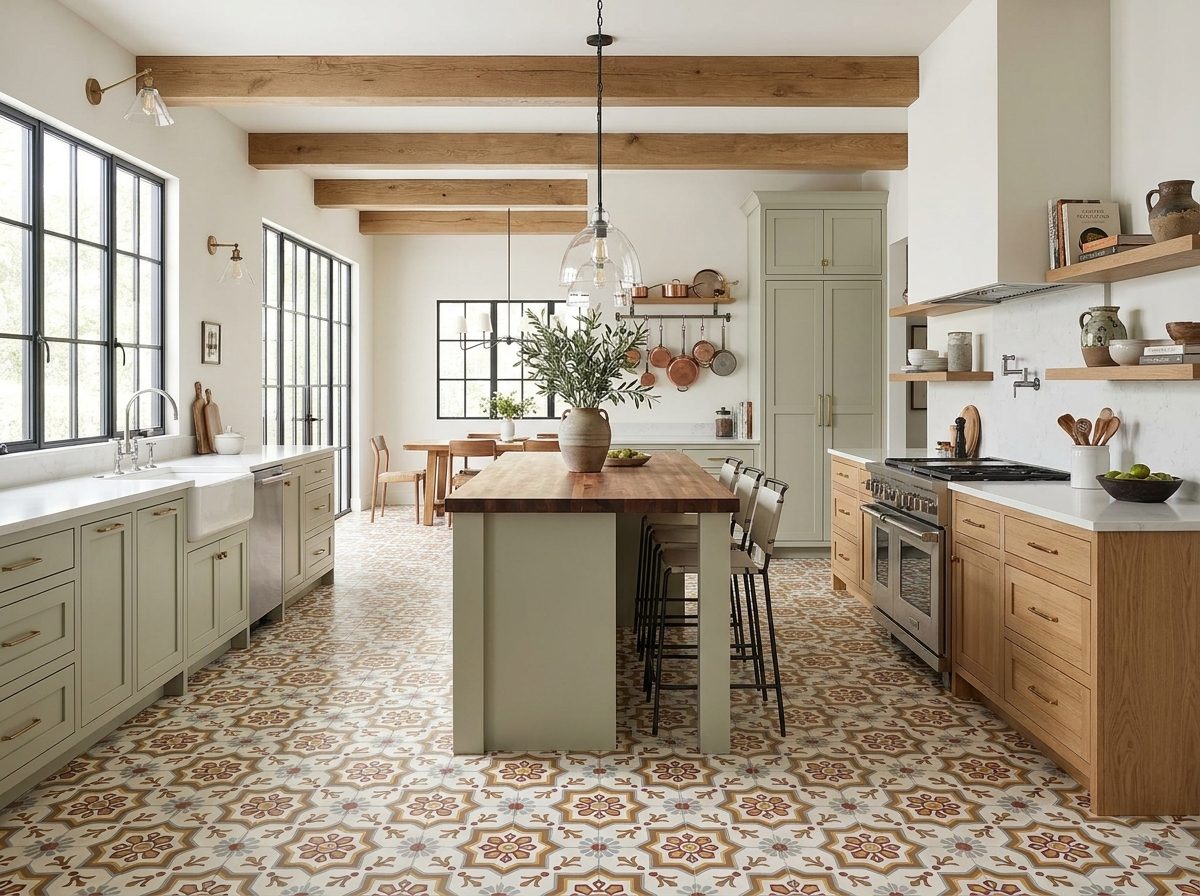
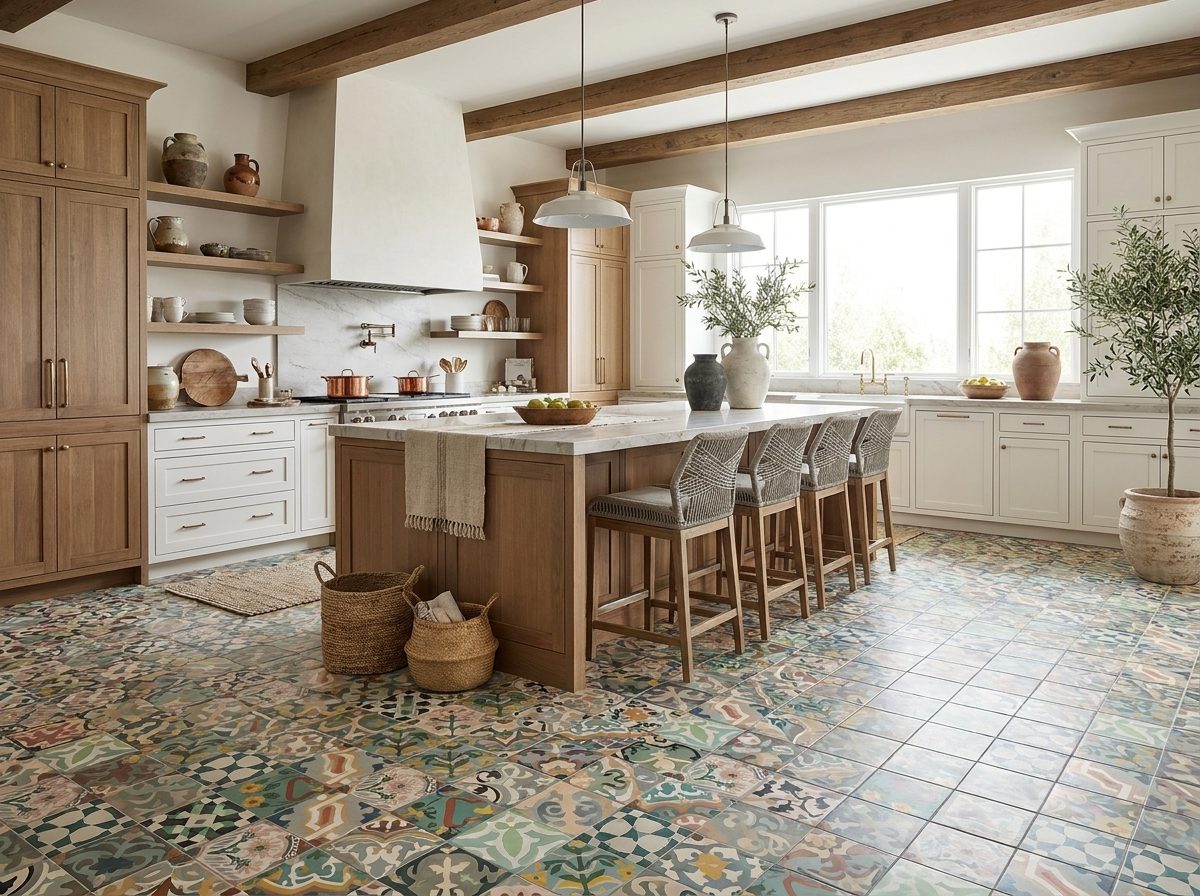
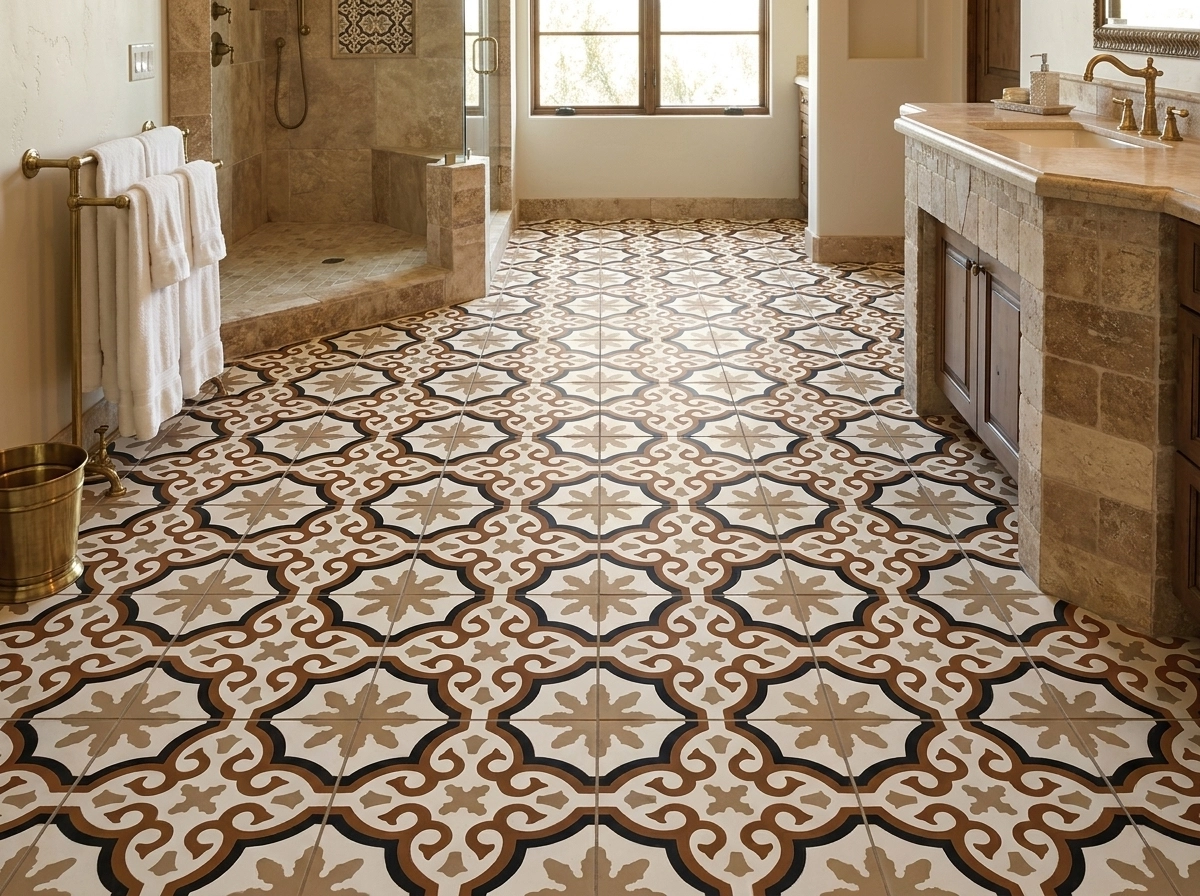
In kitchens, bold geometric cement tile floors — eight-pointed stars, interlocking diamonds, classic encaustic patterns in black, white, and warm terracotta — are being specified against the simplest possible cabinetry and countertop combinations, allowing the floor to carry the entire design concept. In bathrooms, patterned tile floors are being used in rooms where every other surface is deliberately quiet — white plaster, simple chrome, clean lines — so the floor becomes the room’s sole decorative act.
This approach works particularly well with handmade cement tiles because the mineral pigment depth and natural tile-to-tile variation mean the pattern never feels flat or overly graphic. It breathes. It shifts with the light. It looks different in the morning than it does in the evening — and that quality is exactly what American renovators are responding to after years of surfaces that looked the same at any hour.
The In-Stock Collection offers the geometric and Moroccan-inspired patterns that are driving this trend — proven designs that work across kitchen, bathroom, and entryway applications.
Trend 2: The Warm Palette Takeover
The color story of American residential design in 2026 is warm, earthy, and grounded: terracotta, burnt sienna, warm ochre, clay, dusty rose, sage green. This is the palette that dominated editorial coverage at every major US shelter publication this year — and it translates directly and powerfully into tile specification.
Cement tiles in terracotta and warm neutral palettes are showing up in renovated kitchens, bathroom floors, and entryways across the country — and the reason goes beyond trend alignment. The mineral quality of cement tile pigments produces warm tones with a depth and richness that printed or glazed tiles can’t replicate. A terracotta cement tile floor has a warmth that you feel as much as see — a quality that resonates deeply with American homeowners who want their spaces to feel genuinely welcoming rather than aesthetically correct.
For designers: The warm palette also gives clients easier yes-decisions. A terracotta encaustic floor against warm white walls and natural wood is a combination with enormous emotional pull and very low risk of feeling dated — which makes the client conversation significantly more straightforward than it would be with a bolder, high-contrast palette.
Trend 3: Entryways as the Home’s First Statement

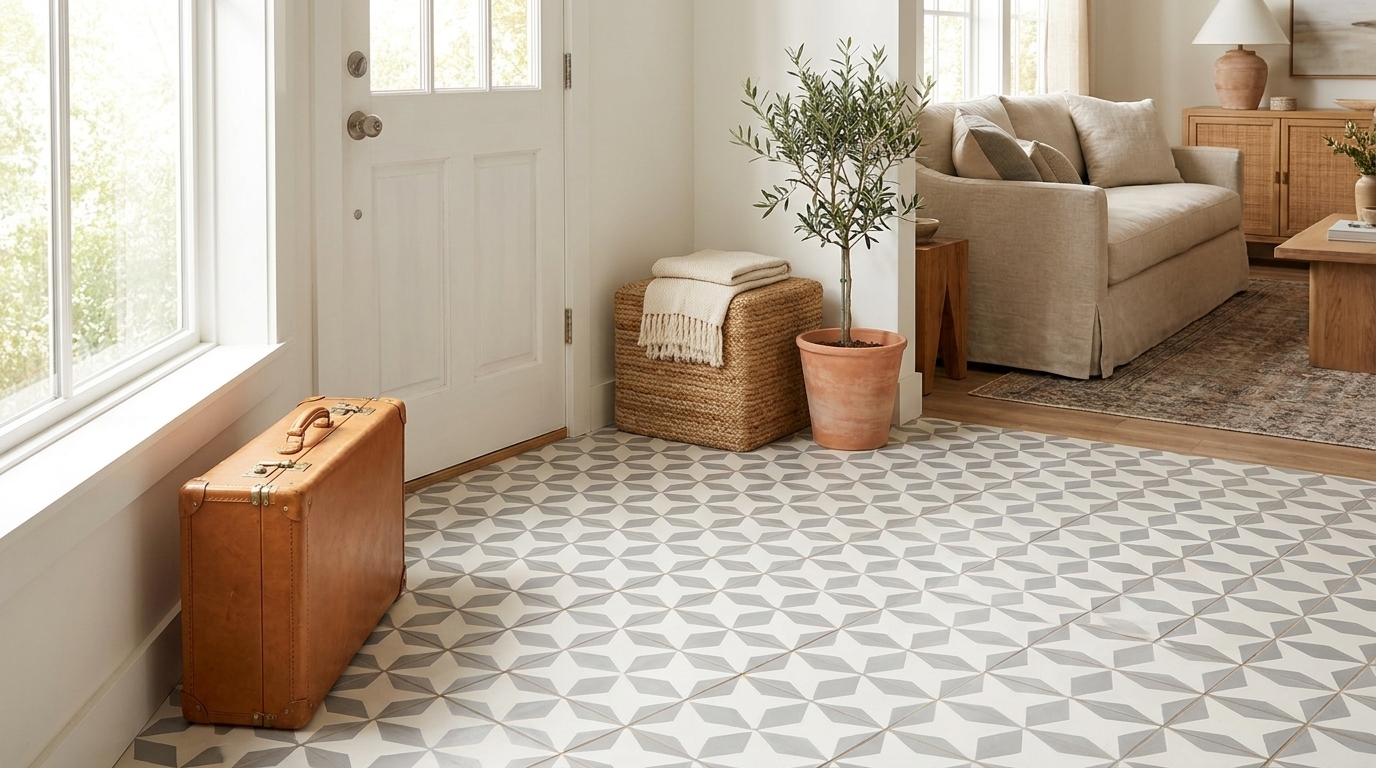
Of all the rooms where patterned tile is making its presence felt in 2026, the entryway may be the highest-impact application. A patterned cement tile entry floor — in a craftsman bungalow, a contemporary new build, or a renovated colonial — transforms the arrival experience of a home completely. It communicates intention before a guest has taken a second step inside.
American designers are increasingly treating the entryway as the home’s thesis statement: the surface where the design language of the whole house is established, compressed into the first few square feet. For this application, cement tiles are unrivaled. Their pattern range is wide enough to suit any architectural context, their scale is flexible, and their handmade quality immediately signals the level of care that went into every other decision in the house.
Classic Moroccan star patterns, bold two-color geometric combinations, and encaustic border designs are the most specified entryway patterns for 2026. Use the Design Studio to visualize pattern and color combinations in your project’s specific proportions before presenting options to clients.
Trend 4: Bathroom Walls Get Their Moment

Wall tile in American bathrooms has historically been conservative — subway tile, large-format neutral, the occasional mosaic feature strip. In 2026, that conservatism is giving way. Bathroom walls — particularly the wall behind a freestanding tub, the back wall of a walk-in shower, and the full surface of a powder room — are being treated as design canvases rather than functional hygiene surfaces.
Patterned cement tiles on bathroom walls create a quality that simply can’t be achieved with glazed ceramic or large-format porcelain: an immersive, enveloping warmth that makes the bathroom feel intentionally designed rather than adequately finished. In powder rooms especially — where the enclosed scale means every surface is experienced at close range — a fully tiled cement tile wall creates the jewel-box effect that has become one of the most shared bathroom design images across US design platforms in 2026.
For shower wall applications, proper waterproofing behind the substrate is essential, and a penetrating sealer formulated for wet environments should be specified. The pattern depth and matte surface of cement tiles provide natural slip resistance and a spa-like atmosphere that clients consistently respond to with the same reaction: why didn’t I do this sooner.
Trend 5: Staircase Risers — The Detail That Travels
One of the fastest-growing cement tile applications in American residential renovation is one that requires no large floor area and almost no budget premium: the patterned staircase riser.
A flight of stairs with plain treads and cement tile risers — each one a different Moroccan pattern, or a single pattern repeated across all risers, or alternating patterned and plain — transforms one of the most structurally inevitable elements of a home into a moment of genuine delight. It’s a detail that photographs beautifully, that guests inevitably comment on, and that takes up less than ten square feet of tile in a typical residential staircase.
For designers, it’s also one of the easiest client conversations: low cost, high impact, no maintenance downside, easily reversible if a future owner wants to change it. The Projects Gallery includes staircase applications across a range of architectural styles — from contemporary new builds to historic renovations — that demonstrate just how transformative this detail can be.
What This Means for Your Next Project
The 2026 residential tile landscape is generous to designers who are ready to move beyond the safe neutral. The clients are ready. The trends are aligned. The material — handmade cement tile — is proven across centuries and performing beautifully in some of the best-designed American homes being published and photographed right now.
A few practical principles for bringing these trends into your next renovation:
- Let the tile lead: Specify the cement tile first, then build the palette around it — not the other way around. The richness of cement tile pigment means it will anchor any palette you develop from it
- Sample in the space: Cement tiles read differently under different lighting conditions; always view samples in the actual room before final specification
- Specify overage: Order 10–15% more than the calculated area for cuts, waste, and future repairs — maintaining dye lot consistency is important for any patching years down the line
- Seal correctly: A penetrating sealer before grouting and after installation is non-negotiable; include the sealing specification in your contractor brief
For projects that call for something beyond the catalog, the Custom Made Collection allows designers to develop a pattern or colorway specific to the project — an increasingly requested capability as American renovators seek surfaces that belong uniquely to their home.
FAQ: Residential Tile Trends 2026
Are patterned cement tiles too bold for an American home? The homes generating the most design attention in the US right now — the ones being published, shared, and awarded — are almost uniformly bolder than the American residential average. Pattern reads as confident, not risky, when the tile is handmade and the rest of the room is appropriately restrained. The question isn’t whether your clients can handle a patterned floor — it’s whether they’re ready to have the most talked-about room in their neighborhood.
Which rooms are easiest to introduce cement tile into for a first-time client? Entryways and powder rooms are the lowest-risk, highest-impact introduction points. Both are small in area (lower cost and commitment), both are experienced at close range where the material quality of handmade tile is most legible, and both are spaces where clients are typically most open to a design statement. Staircase risers are a close third.
How do the warm tile palettes of 2026 translate to existing American home styles? Remarkably well across almost every American residential vernacular. Terracotta and warm encaustic patterns work naturally in Spanish Colonial, craftsman, farmhouse, and Mediterranean-influenced homes. In contemporary new builds and mid-century properties, the same warm palette reads as a considered, intentional counterpoint to the architecture’s clean lines. The one context that requires more care is a very cool-toned, Scandinavian-influenced interior — where a terracotta floor can feel out of vocabulary.
Conclusion: The Year American Homes Got Their Character Back
The best American residential interiors of 2026 share a quality that’s difficult to name precisely but immediately recognizable when you walk into a room that has it: they feel like they were made for someone specific, in a specific place, with specific attention to what endures.
Patterned cement tile floors and walls are one of the most powerful contributors to that quality. They bring craft into spaces that mass production can’t touch. They bring warmth into rooms that neutral palettes have kept at arm’s length. And they bring a sense of permanence — of a surface chosen to last for decades rather than until the next renovation cycle — that American homeowners are increasingly ready to invest in.
The trend is clear. The material is ready. The only remaining question is which room you’re starting with.
Ready to bring these trends into your next project?
Explore the In-Stock Collection for proven patterns available now, or develop something unique through the Custom Made Collection. Browse real American residential installations in the Projects Gallery.
Contact the Original Mission Tile design team for samples and expert project guidance →