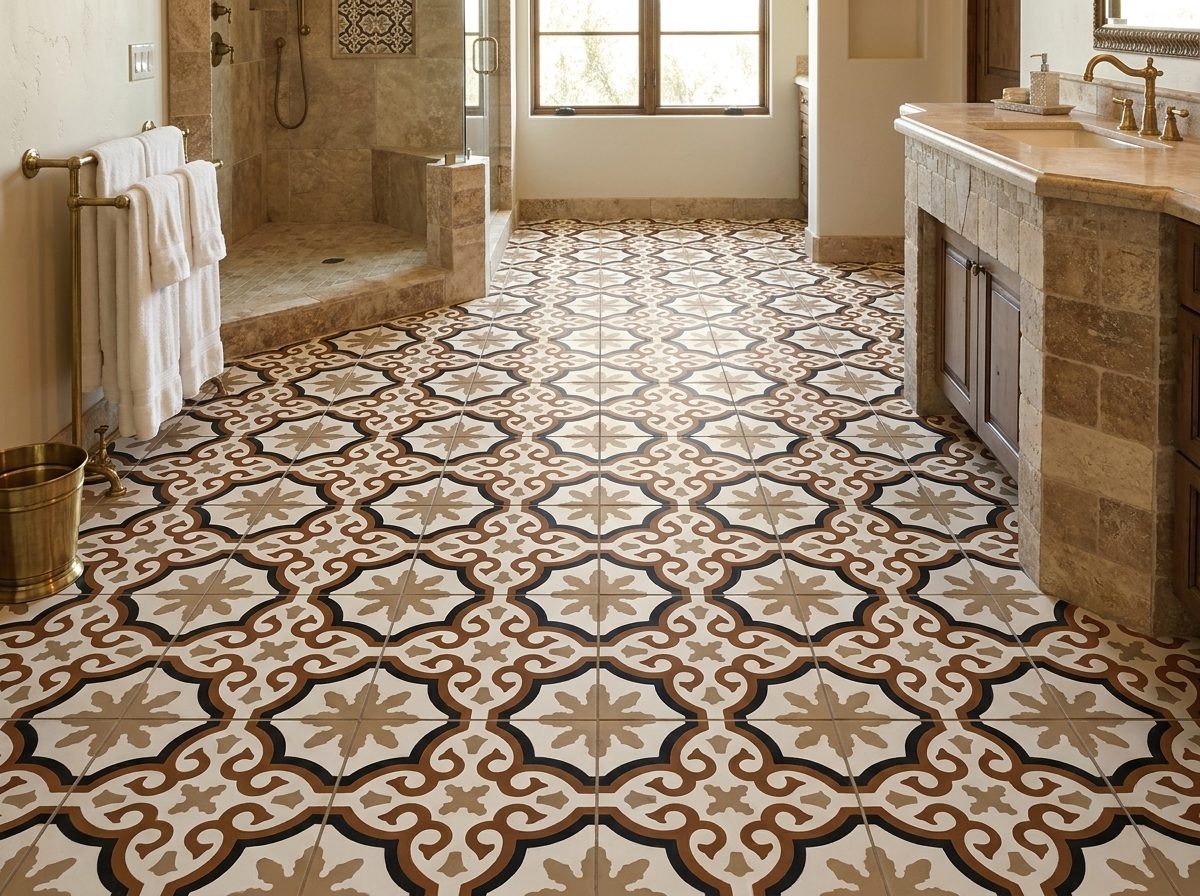
You’re probably in one of two places right now. Either you’ve uncovered an old hallway floor under vinyl or carpet and want to know whether it’s worth saving, or you’re designing a new space and want that unmistakable Victorian character without making an expensive material mistake.
That’s where victorian encaustic tiles get interesting. They sit at the intersection of architecture, craft, and performance. They can look formal in a cathedral vestibule, welcoming in a townhouse entry, and unexpectedly sharp in a modern kitchen. But the phrase itself causes confusion. Many people use it to describe both historic ceramic inlaid tiles and modern handmade cement tiles, even though they’re made in completely different ways and behave differently on site.
If you’re choosing for a restoration, that difference matters. If you’re specifying for new construction, it matters even more.
The Enduring Allure of Victorian Patterned Floors
Walk into a restored church, a railway building, or a well-kept Victorian terrace and the floor often does the talking first. The eye drops immediately to the geometry. Buff, black, red, green, blue. Borders that frame a hall. Repeating stars that pull you toward a doorway. Wear marks that tell you where generations walked.
That appeal didn’t begin in the Victorian period. It was revived there. Techniques associated with medieval monastic floors had been lost after the dissolution of monasteries, then rediscovered and industrialised in the 19th century. What had once belonged largely to abbeys and great ecclesiastical buildings moved into public buildings, churches, and eventually domestic interiors. Designers still return to those layouts because they do something few finishes can do. They give a room order, rhythm, and memory at the same time.
Why these floors still feel current
Victorian patterned floors work because they’re architectural, not decorative in a flimsy sense. They define thresholds. They create procession. They make a narrow hallway feel intentional instead of leftover space.
They also adapt well. A traditional checker-and-border scheme can suit a period porch. A dense geometric field can hold its own beside minimalist joinery. If you’re studying layouts before a renovation, a good starting point is a library of historic tile patterns that shows how these motifs were composed.
Old patterned floors rarely look dated when the pattern matches the architecture around them.
The confusion that catches people out
The look is consistent. The materials aren’t.
Some projects need a ceramic inlaid tile that behaves more like a dense fired body. Others are better served by a handmade cement tile with a softer, matte finish and a different maintenance profile. People often choose based on appearance alone, then discover too late that wet areas, freezing conditions, or restoration requirements call for a more disciplined decision.
That’s the point of this guide. Respect the history, but choose the material with open eyes.
A Story Baked in Clay The History of Encaustic Tiles
Step into a Victorian church porch or a townhouse hall with its original floor intact and you can read the whole ambition of the 19th century underfoot. These tiles carried medieval precedent into an industrial age. They were made to look rooted in history, but they were also products of highly organised ceramic manufacture.
Medieval inlaid tiles had long been used in monasteries, abbeys, and great churches because they could carry pattern through wear. By the early 19th century, architects involved in the Gothic Revival wanted that same gravity and permanence again. Manufacturers responded by studying surviving floors, reviving old methods, and adapting them for larger building programmes.

How the revival took hold
Herbert Minton sits at the centre of that revival. He began experimenting with encaustic production in the late 1820s and helped turn what had been a specialist, half-recovered craft into a repeatable ceramic product. As Johnsons’ history of Victorian encaustic tiles records, the trade expanded dramatically across Britain and Europe during the 19th century as churches, civic buildings, and domestic projects adopted the material.
Architects were not passive clients. They drove the market. George Gilbert Scott and other Gothic Revival architects specified encaustic floors because they suited the moral and visual seriousness they wanted in restored churches and new public buildings. Royal projects helped too. Once royal and high-profile commissions used these floors, the material moved from ecclesiastical association into mainstream architectural fashion.
Why industry changed everything
The revival succeeded because the Victorians solved production, not just style.
Pressing methods improved. Clay preparation became more controlled. Firing became more consistent. Those changes mattered because a true ceramic encaustic tile has to survive both manufacture and long-term wear without the pattern failing. Staffordshire became a natural centre for this work because the region already had the clays, fuel, kiln knowledge, and labour needed for serious ceramic production.
That industrial base is one of the clearest differences between Victorian encaustic tile and the cement tiles people often compare it with today. Victorian encaustic tiles came out of the pottery industry. They were pressed from clay, inlaid with contrasting coloured clays, then fired hard in the kiln. Cement tiles belong to a different lineage altogether. They are a later material, made without firing, and they behave differently on site and in service.
From abbey floor to household material
By the late 19th century, encaustic tile was no longer confined to cathedrals and grand institutions. It had become a familiar specification for halls, porches, corridors, schools, pubs, and municipal interiors. That shift matters in restoration work because it explains why original examples turn up in ordinary houses as often as in landmark buildings.
It also explains why these floors still command respect from designers and conservation teams. They were decorative, but they were never fragile decoration. They were built as working surfaces.
For anyone choosing between authentic Victorian-style ceramic encaustic and modern cement tile, history is not a museum footnote. It tells you what the material was designed to do. One came from a fired-clay tradition built for public wear. The other came later, with a different manufacturing logic and a different maintenance profile. That distinction starts in the 19th century and still affects specification now.
What Makes a Tile Truly Encaustic
A homeowner lifts an old threshold tile and sees the pattern continuing below the worn face. That is the test. A true encaustic tile carries its design within the tile itself, not as a printed image or a thin decorative coating.
That matters because the word "encaustic" is used loosely now. Porcelain can copy the colours. Cement tile can copy the geometry. Neither should be mistaken for Victorian ceramic encaustic unless the pattern is formed from contrasting clays within the tile body.
Inlaid pattern versus surface decoration
In a genuine ceramic encaustic tile, coloured clay is pressed into a moulded recess in the face, then the tile is fired so the body and pattern become one hard ceramic unit. Wear does not strip away the design in the way it can with a surface-applied finish. On an old floor, that is often why the pattern still reads clearly even after decades of use.
This is also where confusion with cement tile starts. Cement tiles are made with a pigmented wear layer, and that layer can be substantial, attractive, and long-lasting in the right setting. But it is still a different construction method and a different material. If you need a clear technical breakdown, this guide to cement tile vs ceramic tile is a useful starting point.
The construction detail that affects specification
For restoration architects, interior designers, and homeowners trying to buy the right product, three distinctions matter:
- Traditional ceramic encaustic is clay-based, pattern-inlaid, and kiln-fired.
- Modern cement tile is cement-based, pigmented at the face, and hydraulically pressed, then cured rather than fired.
- Printed or glazed imitations can capture the look of a Victorian floor, but the decoration sits at the surface rather than being formed through inlaid material.
Those differences show up in service, not just in a showroom sample.
A fired clay encaustic tile usually has sharper arrises, a denser ceramic body, and a performance profile that suits wet areas and hard wear, especially in modern vitrified reproductions. Cement tile offers a softer, more powdery visual character that many designers want in residential schemes, but it is generally more porous and more dependent on correct sealing, cleaning chemistry, and ongoing maintenance.
The question to ask before you specify
If the brief says "encaustic," ask what the project specifically needs. Historic material accuracy. A Victorian-style pattern. Better slip resistance. Lower porosity. Easier patch repair. Those are different requirements, and they do not all point to the same tile.
That single clarification saves a lot of trouble on site. In conservation work, it protects material honesty. In new-build work, it helps match the tile to the way the floor will really be used.
Ceramic Encaustic vs Cement Tile A Practical Comparison
Most specification mistakes happen here. Someone falls in love with a Victorian pattern, assumes all “encaustic” products behave the same way, and chooses based on a sample board alone. On site, the differences become obvious fast.
A frost-prone exterior entry wants one kind of performance. A restaurant floor wants another set of priorities. A historic hallway repair may call for visual sympathy more than technical mimicry. Ceramic encaustic and cement tile can both be right. They’re just right for different reasons.

The side-by-side comparison that actually matters
| Attribute | Victorian Ceramic Encaustic | Modern Cement Tile (e.g., Original Mission Tile) |
|---|---|---|
| Base material | Clay body with inlaid coloured clay pattern | Cement-based body with pigmented inlaid face layer |
| Manufacturing | Pressed and kiln-fired | Hydraulic pressed and cured, not fired |
| Surface character | Crisp, dense, often more precise in feel | Matte, silky, handmade appearance |
| Water behaviour | Modern ceramic reproductions can be fully vitrified | More porous and needs sealing |
| Best fit | Wet areas, exteriors, heavy-wear locations, heritage-style ceramic specs | Interior floors and walls where softness, patina, and custom colour are desired |
| Installation feel | More familiar to many tile crews | Requires careful handling and a sealing-aware workflow |
| Maintenance | Lower routine maintenance if vitrified | Ongoing care matters more |
Where ceramic earns its place
Modern ceramic reproductions are typically fully vitrified, with water absorption ≤0.5%, which makes them frost-proof according to London Mosaic’s technical guidance on heritage reproduction encaustics. That same source notes PEI Class 4–5 abrasion resistance, a standard 9mm thickness, total build depth of 11–12mm with adhesive, firing at nearly 1,200°C, and movement joints every 6m.
Those details matter on real jobs. If you’re specifying an exterior threshold, a boot room, a pool-adjacent area, or a commercial entrance where moisture and wear are serious concerns, dense vitrified ceramic is often the cleaner answer. It also gives very stable geometry, which helps when laying tightly organised Victorian patterns that depend on exact angles.
Where cement wins on character
Handmade encaustic cement tile offers something ceramic often doesn’t. It has a softer face, a more natural matte finish, and subtle variation that can keep a patterned floor from looking overly mechanical.
Its technical profile is different. Cement encaustic tiles typically have porosity around 5–8% absorption and require sealing, while sealed tiles can achieve a wet slip rating of PTV 42, exceeding the >36 threshold used for UK commercial floors, as described by Encaustic Tiles UK’s Victorian classic cement tile specifications. The same source notes a thickness of 1.5–1.6cm, a curing period of 3 weeks, and compressive strength typically around 30–40 MPa post-cure.
That makes cement tile attractive for hospitality interiors, kitchens, bars, powder rooms, and statement floors where touch, depth of color, and craft presence matter. It also opens the door to custom work. If you need a period-informed pattern in a project-specific palette, a handmade cement workflow is often more accommodating than off-the-shelf ceramic.
For a concise overview of the material choice, this comparison of cement tile vs ceramic tile is a useful companion to sample review.
What tends to work and what tends not to
Here’s the practical version I give clients and installers.
- Choose ceramic when the site is exposed, wet, freeze-thaw prone, or maintenance tolerance is low.
- Choose cement when the finish itself is part of the design story and the owner accepts sealing and gentle care as part of the package.
- Avoid casual substitutions. A contractor who says one is “basically the same” is telling you they haven’t thought through the specification.
- Mock up mixed fields and borders. Pattern scale and grout tone can change the whole reading of a Victorian floor.
If you want a floor that feels crisp and almost architectural, ceramic usually gets there faster. If you want a floor that feels handmade and settles into the room over time, cement often has the edge.
Three common project scenarios
A restored townhouse hallway often leans ceramic if the goal is period-correct material language and low fuss after installation. A boutique retail fitting room may lean cement because the softness of the surface supports the overall interior palette. A restaurant vestibule may split the difference, using a denser tile in the weather line and a more tactile patterned field deeper inside.
Product range matters. Some manufacturers focus on vitrified heritage reproductions. Others specialise in handmade cement formats, custom colourways, and Victorian-inspired layouts. Matching the manufacturer to the project type is usually more important than chasing the word “encaustic.”
Designing with Patterned Tiles in 2026
Victorian patterns aren’t trapped in period houses. The best current projects use them with confidence but not costume. A good patterned floor doesn’t need a reproduction interior wrapped around it. It needs proportion, restraint, and the right relationship to the architecture.

Use pattern where architecture wants emphasis
Entry halls remain the natural home of victorian encaustic tiles because they benefit from visual structure. A border creates a room-like footprint inside a circulation zone. A repeated geometric field strengthens the axis from front door to stair.
Kitchens are the next obvious candidate, especially when cabinetry is plain enough to let the floor carry complexity. In a new build or a heavily remodelled house, that can be the move that prevents a space from feeling anonymous. If you want examples of materials being used with that level of architectural intent, portfolios showcasing luxury home renovations can be helpful for reading how patterned surfaces sit with cabinetry, millwork, and transitions.
Scale is more important than people think
Small rooms don’t always want small patterns. A tighter border with a larger central repeat can make a narrow room feel more composed. In contrast, using several busy motifs in one compact area usually makes the floor look accidental.
A few design rules hold up well:
Let the border do the framing
Borders are what make Victorian floors feel finished. Even a simple field becomes more convincing when it has a clear perimeter.Pair patterned floors with calmer vertical surfaces
If the floor is doing heavy visual work, keep wall tile, cabinetry fronts, and stone veining more disciplined.Use plain infill strategically
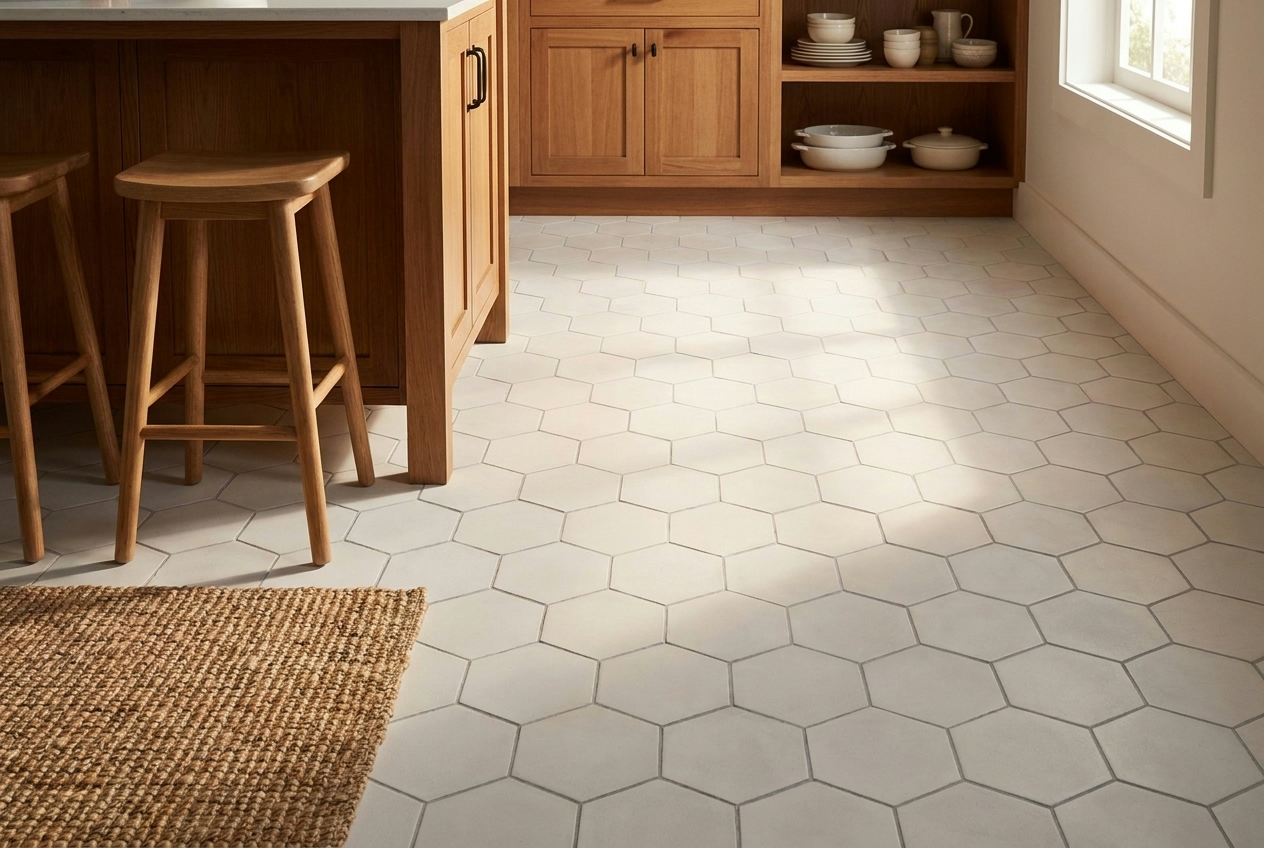
Plain tiles can relieve a patterned scheme around islands, sanitaryware, or fixed joinery without breaking the language of the floor.
Period style doesn’t require period clutter
One of the strongest uses of Victorian-style flooring today is contrast. A crisp kitchen with slab cabinetry, painted joinery, or modern brass can handle a traditional floor beautifully because the floor provides memory while the rest of the room provides clarity.
That’s also why designers keep revisiting custom combinations. A Victorian geometry in an edited palette often lands better in modern interiors than a full historical reproduction. For custom-led work, Original Mission Tile offers a design route built around handmade cement tile patterns and bespoke colour development, which suits projects where standard stock layouts don’t quite solve the brief.
Pattern should anchor the room, not fight every other surface in it.
Good placements and risky placements
Some applications are almost always rewarding. Hallways, mudrooms, powder rooms, hospitality entries, bars, and restaurant circulation zones all benefit from a floor that can carry identity. Bathrooms can work well too, provided the material choice matches the moisture conditions and maintenance expectations.
Riskier applications are the ones chosen only for trend value. An ornate floor in a room with no visual hierarchy can end up feeling loud. A Victorian pattern wrapped across every adjoining space can flatten the effect. These floors work best when they mark a destination, a threshold, or a zone with purpose.
Installation and Restoration Guidance for Professionals
The installer decides whether a patterned floor looks disciplined or amateur. Victorian layouts are unforgiving. Minor creep in alignment becomes obvious fast because the eye reads geometry before it reads color.

Installing new work without fighting the material
Start with the substrate. Flatness matters more than speed on patterned floors. Ceramic reproduction encaustics and handmade cement tiles both punish uneven prep, but they do it differently. Ceramic shows lippage and broken geometry. Cement can also telegraph handling mistakes through the finished surface if crews rush cutting, grouting, or pre-seal steps.
For cement-specific workflow, a practical reference is this guide to installing cement tile, especially for sequencing sealing, setting, and cleanup.
A sound job usually includes these checks:
- Dry-lay the pattern first so corner logic, border returns, and any cut conditions are settled before adhesive is mixed.
- Control the datum lines from the visual center or principal threshold, not just from the longest wall.
- Match setting materials to the tile type because dense fired ceramics and porous cement bodies don’t respond the same way during installation.
- Clean as you go and never assume residue will disappear later without consequence.
Restoration needs restraint before replacement
Historic floors often fail cosmetically before they fail structurally. The common instinct is to rip out the worst areas and relay everything cleanly. That’s usually the wrong instinct.
One of the hardest issues is differential wear, where softer inlaid clay slips in original Victorian tiles erode faster than the body, creating ridges. Sourcing replacements is also difficult because historic floors sometimes mixed tiles from up to 5 different manufacturers, as noted in Crossville’s discussion of encaustic wear patterns and matching problems. That means even “matching” salvage can feel slightly off in tone, edge profile, or scale.
Save more than you replace. Patina is usually an asset, not a defect.
A sensible restoration sequence
If the floor is original, work in this order:
Document the existing layout
Photograph every border turn, threshold, and damaged area before lifting anything.Test cleaning methods gently
Old floors can hold cement smears, paint, wax, and embedded dirt. Aggressive cleaning can do more harm than the original contamination.Lift only what must be lifted
Keep intervention local where possible. Wholesale replacement often destroys the very value the client wanted to preserve.Mock up repair tiles in place
Don’t approve replacement material from a loose sample alone.
Where moisture has also affected the subfloor or adjacent finishes, broader flooring remediation may be needed before tile work starts. In those situations, guidance on restoring water damaged flooring can help teams think through drying, structural checks, and replacement sequencing around the tiled area.
Maintenance checklist for installers handing over a job
Clients need different care instructions depending on the material.
For vitrified ceramic
Explain that routine cleaning is straightforward, but abrasive pads and harsh residues should still be avoided.For cement tile
Hand over sealing instructions in writing. Make it clear that stain prevention depends on maintenance, not wishful thinking.For both
Leave spare tiles, final pattern drawings, and product identification with the owner. That small step saves major detective work later.
Long-Term Care and Maintenance Tips
A patterned floor earns its keep over decades, so maintenance needs to match the material from the start. Ceramic encaustic and cement tile can both last well, but they do not ask for the same kind of care.
Caring for vitrified ceramic
Vitrified ceramic encaustic tiles are usually the lower-maintenance choice. Their fired surface resists everyday dirt and moisture far better than cement, which makes them a strong fit for busy halls, kitchens, and entrances where clients want pattern without a demanding care regime.
Routine care is straightforward. Sweep or vacuum grit before it gets ground into the surface, then wash with a pH-neutral cleaner. Harsh residues and abrasive pads are still a bad idea, especially on older joints and edges where wear tends to show first.
For day-to-day housekeeping methods that avoid common mistakes, this expert tile and grout cleaning guide is a useful practical reference.
Caring for cement tile
Cement tile asks for more attention, and that trade-off should be clear before specification, not after handover. The colour layer is dense but still porous, so sealer is part of the floor system. It is not a finishing extra.
A well-sealed cement floor can age beautifully. A poorly maintained one will mark quickly from oils, acids, standing water, and strong pigments.
The routine is straightforward:
- Use pH-neutral cleaners to protect both the surface and the sealer.
- Wipe spills promptly, especially wine, coffee, oil, and foods with strong colour.
- Avoid abrasive scrubbing because uneven dulling is hard to reverse.
- Reseal when wear indicates it, following the tile maker's instructions and the room's actual use.
The floors that perform best are the ones whose maintenance expectations were explained clearly on day one.
The long view
In real-world applications, the distinction between ceramic and cement is most significant. Ceramic usually suits clients who want durability with less ongoing intervention. Cement suits clients who value a softer, handmade surface and accept the maintenance that comes with it.
Problems usually start with the wrong match between material and brief. A family entrance or hard-working kitchen may benefit from vitrified ceramic's lower porosity. A quieter room, where the finish is part of the atmosphere, may justify the extra care cement requires.
Good maintenance is less about polishing and more about making the right choice early, then caring for the floor in a way that respects how it was made.
Create Your Own Piece of History
Victorian encaustic tiles remain compelling because they solve more than one design problem at once. They bring pattern, permanence, and architectural structure into a space. They also connect a new project to a long material tradition that runs from medieval floors to industrial ceramic mastery to today’s handmade reinterpretations.
The important distinction is now clear. Traditional ceramic encaustic and modern cement tile may share a visual language, but they differ in manufacture, porosity, installation demands, and long-term care. That isn’t a minor technical footnote. It’s the decision that shapes how the floor performs and how the project feels years later.
For restoration work, that means being careful with authenticity, matching, and intervention. For new work, it means choosing the material that fits the site conditions rather than the one that photographs well. Some rooms need vitrified ceramic discipline. Others come alive with the matte depth and handmade presence of cement.
Good patterned floors always look intentional. They belong to the building, not just the mood board.
If you’re planning a Victorian-style floor and want help turning the idea into a workable specification, Original Mission Tile offers resources on pattern selection, custom cement tile design, installation, and maintenance that can help homeowners, designers, and contractors move from inspiration to a buildable result.