You're probably in the middle of a familiar renovation moment. The cabinets are chosen, the wall color is close, and the floor is where the whole project can still go right or wrong.
Floor tile looks simple until you have to commit to it. One sample feels too cold, another looks good but seems risky in a wet room, and a third has the right price but not the lifespan you want. The question usually isn't just what looks best on day one. It's what still works after years of shoes, water, cleaning, sunlight, furniture movement, and changing tastes.
The best floor tile material depends on how the space will be used, how much maintenance you'll accept, and whether you want a floor that blends into the background or becomes part of the design story. That's where most buying guides fall short. They compare hardness and price, but they don't spend enough time on repairability, aging, and total ownership over the long run.
How to Choose the Right Floor Tile
A good tile decision starts with the room, not the showroom sample. A kitchen with daily cooking traffic has a different job than a powder room. A restaurant entry has different risks than a guest bath. If you choose by appearance alone, you can end up fighting the floor for years.
Here's the order I recommend using.
- Start with moisture exposure. Bathrooms, kitchens, mudrooms, bars, and entries need stronger water resistance and better slip performance than dry living areas.
- Measure traffic accurately. A formal room that gets occasional use can handle materials that would struggle in a busy family entry.
- Decide how much maintenance fits your life. Some floors ask very little once installed. Others reward care with a richer, more individual look over time.
- Match the surface to the design goal. Clean, modern interiors often lean toward porcelain. Historic homes, boutique hospitality, and character-driven spaces often benefit from natural stone or cement tile.
- Think about replacement and repair. A floor that can be patched, refinished, or updated in sections may offer better long-term value than one that is hard.
Practical rule: The best floor tile material is the one that matches the room's risk profile and the owner's tolerance for upkeep.
What most buyers get wrong
Many people overbuy for hardness and underbuy for traction. Others focus on initial material cost and ignore installation difficulty, sealing, grout upkeep, or the challenge of replacing damaged pieces years later.
The smarter approach is to balance five factors:
- Durability: Can it handle the wear you're going to put on it?
- Water behavior: Will it shrug off regular moisture, or does it need more protection?
- Safety: Is the surface appropriate when wet?
- Aesthetic lifespan: Will you still like it after trends change?
- Lifecycle value: Can it age well, be maintained properly, and avoid a full tear-out later?
If you use that framework, the field gets much clearer.
An Overview of Common Floor Tile Materials
Before comparing specs, it helps to know the personalities of the main tile families. Each one solves a different problem well.
| Material | Core identity | Typical strengths | Typical trade-off | Best fit |
|---|---|---|---|---|
| Porcelain | Modern workhorse | Dense, durable, water-resistant | Higher material cost, harder cutting | Busy homes, wet zones, commercial use |
| Ceramic | Versatile classic | Accessible, broad style range, easier install | More porous and lighter-duty than porcelain | Moderate-traffic interiors, value-driven remodels |
| Natural stone | Luxury statement | Organic variation, depth, patina | Sealing and maintenance demands | High-character residential and hospitality spaces |
| Cement tile | Artisanal storyteller | Pattern, matte texture, repairable visual character | Needs sealing and informed maintenance | Design-led projects with long-view value |
Porcelain as the performance baseline
Porcelain is usually the benchmark people compare everything else against. It's the material clients ask for when they want fewer compromises in kitchens, baths, entries, and commercial settings. It has a dense body, a broad range of looks, and a reputation for handling abuse without much drama.
Ceramic as the practical standard
Ceramic remains a strong choice because it covers a lot of ground well. It's familiar, widely available, and usually easier on the budget. For homeowners weighing style and cost, these ceramic tile options for renovations give a useful plain-language overview of where ceramic fits and where it doesn't.
Ceramic also offers one of the broadest visual ranges in the category, from simple field tile to decorative formats. If you want a quick reference point on tile families and styles, this overview of different types of tile helps frame the broader context.
Natural stone and cement as character materials
Natural stone behaves differently from manufactured tile. Marble, travertine, slate, and similar stones bring movement, variation, and a surface that tends to look better to the right client as it ages. That beauty comes with obligations. Stone asks for sealing, cleaner selection, and more respect during use.
Cement tile belongs in a separate conversation from both stone and porcelain. It isn't trying to be the hardest material in the room. Its value comes from pattern, depth of color, matte finish, and the way it can be maintained as a design surface rather than treated as a disposable finish.
Some floors are chosen to resist change. Others are chosen because they become more interesting with time.
Understanding Key Performance Metrics
Specs matter, but only if you know how to read them. For floor tile, three of the most important indicators are PEI wear rating, COF, and water absorption.

PEI tells you how the surface wears
PEI stands for Porcelain Enamel Institute. It's a wear classification that helps identify how a glazed tile surface stands up to abrasion. In plain language, it tells you whether the tile belongs on a quiet wall, a bedroom floor, or in a hard-working commercial environment.
The upper end matters most for busy spaces. Industry guidance notes that PEI Grade 4 is commonly used for heavy traffic, and PEI Grade V is the strongest category for commercial buildings. That same guidance also stresses that wear rating alone isn't enough, because a durable tile can still be the wrong choice if it's too slippery for the setting. A detailed explanation of those thresholds appears in MSI's guidance on tile grades and surface performance.
COF is the safety check many buyers skip
COF, or coefficient of friction, measures how slip-resistant a surface is. This is the number I want clients to pay attention to in bathrooms, kitchens, laundry rooms, pool-adjacent areas, entries, and any commercial floor that sees water.
Industry guidance recommends 0.6 or higher for wet residential areas and most commercial spaces, with 0.8 for ramps or slopes. That's why the best floor tile material isn't just the hardest one. It's the one with the right wear and safety profile for the exact location.
If traction is a core concern, especially in wet rooms, reviewing examples of anti-slip tile surfaces can help you connect the spec sheet to real finishes and textures.
Water absorption explains where a tile belongs
Water absorption tells you how porous the tile body is. Lower absorption usually means better performance in wet or freeze-thaw conditions.
Here's the practical breakdown:
- Non-vitreous: More absorbent. Better reserved for dry areas.
- Semi-vitreous: Improved resistance, but still not ideal for demanding wet use.
- Vitreous: Suitable for many common applications.
- Impervious: The category associated with the strongest moisture resistance.
Porcelain sits in the impervious end of that spectrum. Standard ceramic usually doesn't. That single difference affects everything from bathroom performance to stain resistance to outdoor suitability in cold climates.
A tile can be beautiful and durable, but if it's wrong for the water conditions, the project will feel compromised from the start.
A Side-by-Side Comparison of Popular Floor Tiles
Most decisions are often finalized here. Once clients see the materials side by side, the trade-offs stop being abstract.
According to Lowe's buying guidance, porcelain is denser and harder than ceramic, is waterproof, and is more durable for heavy-traffic areas. The same source notes typical floor thicknesses of about 1/2 inch to 3/4 inch for porcelain versus 1/4 inch to 3/8 inch for ceramic. Complementing that, Robbins reports porcelain tile typically has water absorption under 0.5%, compared with 3% to 7% for ceramic, and states porcelain reached 56.7% of the North American market share. Lowe's and Consumer Reports also describe porcelain as a standout performer for scratches, dents, spills, flooding, and UV exposure in demanding settings. You can review that comparison in Lowe's guide to tile flooring material differences.
Floor Tile Material Comparison
| Material | Durability (PEI) | Water Resistance | Maintenance | Avg. Cost / sq ft | Best For |
|---|---|---|---|---|---|
| Porcelain | Often selected in higher wear categories for busy floors | Excellent | Low to moderate | $3 to $10 | Wet rooms, heavy-use homes, commercial settings |
| Ceramic | Suitable for moderate residential wear when correctly specified | Moderate | Low to moderate | $1 to $5 | Kitchens, secondary baths, budget-sensitive remodels |
| Natural stone | Varies by stone and finish | Varies, usually needs sealing | Moderate to high | Varies by stone | Luxury interiors, feature areas, patina-driven projects |
Porcelain versus ceramic
Porcelain earns its reputation. If the project needs strong moisture resistance, dense body strength, and low day-to-day fuss, it's the safest recommendation in many cases.
Ceramic's advantage is value and workability. Robbins places ceramic at $1 to $5 per square foot and porcelain at $3 to $10 per square foot, while also noting ceramic is easier to cut and install. That matters on projects where labor sensitivity, layout complexity, or a DIY path affects the decision.
Trade-off to remember: Porcelain usually wins on performance. Ceramic often wins on budget flexibility and installation ease.
Where natural stone changes the conversation
Natural stone doesn't compete on the same terms. People choose it because manufactured products can't fully duplicate its variation, edge softness, and visual depth.
The downside is straightforward. Stone usually needs sealing, more careful cleaning, and realistic expectations about etching, wear, and natural variation. For the right client, those aren't flaws. They're part of the appeal.
A honed stone floor in a quiet primary bath can feel timeless. The same material in a busy family kitchen may frustrate an owner who wants a wipe-and-forget surface.
Which one is the best floor tile material
For pure all-around performance, porcelain usually takes the lead. For value-focused interiors, ceramic still does a lot right. For visual richness and permanence of character, natural stone holds its own.
The best answer depends on which type of value you care about most:
- Operational value: Porcelain
- Budget value: Ceramic
- Aesthetic and architectural value: Natural stone
That still leaves one major category out of the typical comparison. Handmade cement tile deserves its own lane because it performs on a different kind of metric.
The Heritage Choice Handmade Cement Tile
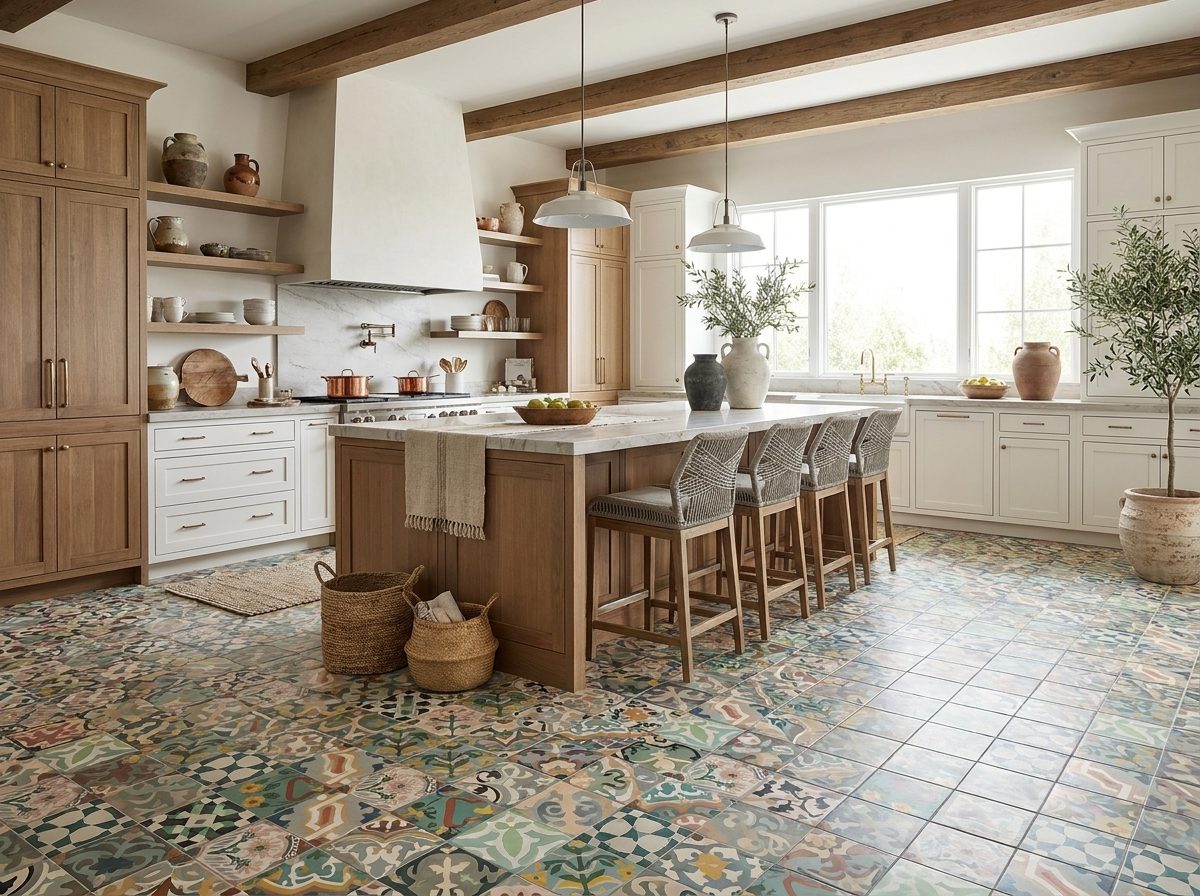
Handmade cement tile isn't the default recommendation for every project, and that's exactly why it matters. It solves a different problem. If porcelain is the performance baseline, cement tile is the design-led choice for people who want the floor to carry pattern, history, and tactile depth.

Unlike glazed tile, handmade cement tile is produced through a hydraulic pressing process rather than firing. The color isn't a printed face trying to imitate depth. It's part of the tile itself, which changes how the surface wears and how the floor reads up close.
Why designers choose it anyway
The appeal is easy to understand once you've seen a well-installed floor in person. The finish is matte, soft-looking, and architectural. Pattern feels integrated into the space rather than applied on top of it.
This is also where lifecycle value becomes more interesting. The broader design conversation has started to move past simple hardness rankings. A material like handmade cement tile can be the better total-value choice when it can be maintained, repaired, and customized, especially in design-forward residential and hospitality work. That perspective is reflected in this discussion of tile choices through a lifecycle lens.
What works and what doesn't
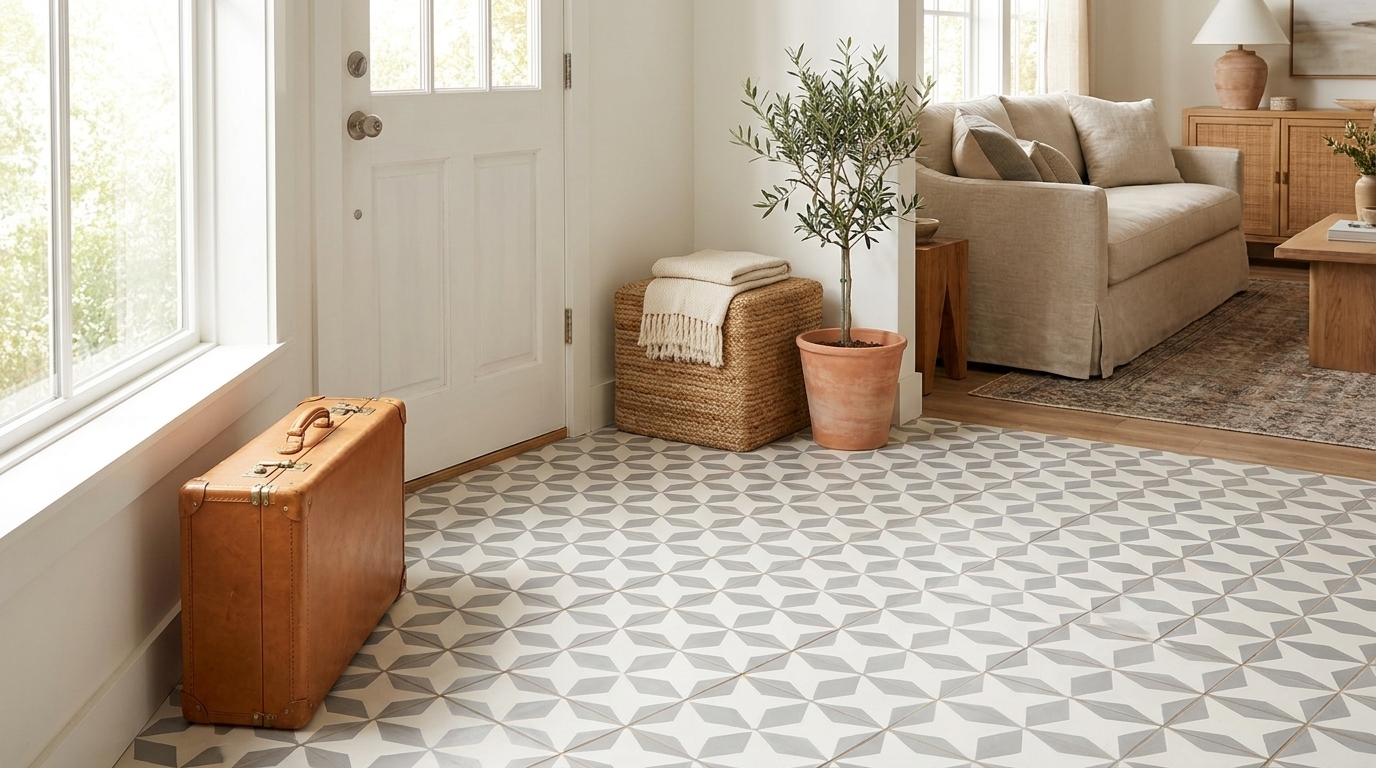
Cement tile works beautifully in kitchens, bathrooms, bars, powder rooms, laundry rooms, boutique retail, and hospitality spaces where visual identity matters. It also works in entries where a matte surface and strong pattern can hide everyday use gracefully.
It does not behave like impervious porcelain. That means installation and maintenance need to be respected.
Here's the practical reality:
- Sealing matters: Cement tile needs proper sealing and a maintenance plan that matches the setting.
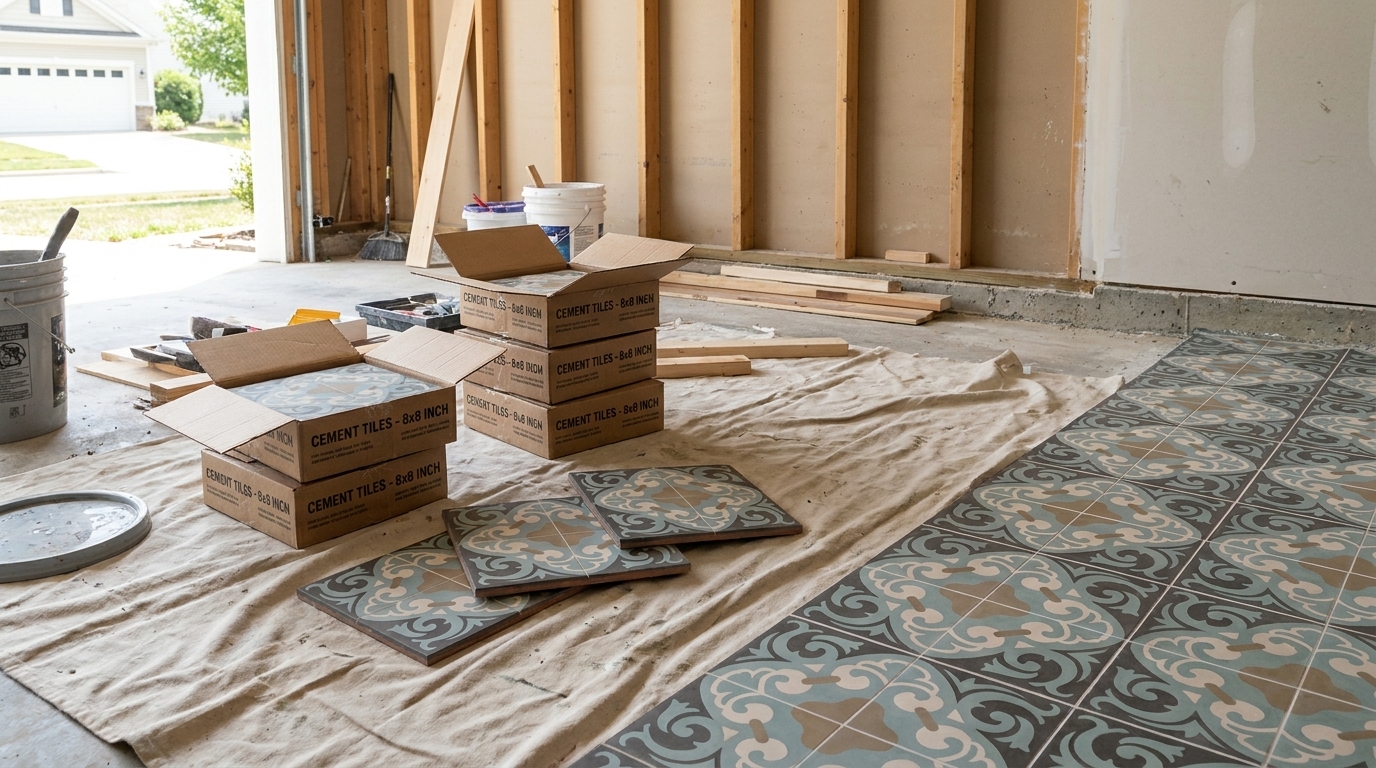
- Installer skill matters: Layout, mortar selection, grout handling, and surface protection during install all affect the final result.
- Cleaning products matter: Harsh cleaners can damage the finish or sealer.
- Patina is part of the value: This is a material for clients who appreciate aging, not clients who want a perfectly unchanged factory look forever.
Cement tile is a finish for people who want a floor with memory, not a floor that tries to look untouched forever.
Why repairability changes the value equation
The strongest argument for cement tile isn't that it beats porcelain on impermeability. It doesn't. The argument is that in the right project, it can deliver a richer long-term result because individual areas can be addressed, patterns can be matched intentionally, and the floor's aging can feel cohesive rather than damaged.
For projects seeking that kind of outcome, handmade cement tile is one material category worth evaluating alongside porcelain, ceramic, and stone. That includes patterned floors, custom palettes, and spaces where the floor is meant to be part of the architecture rather than a neutral backdrop.
Matching the Right Tile to Your Space
Room-by-room selection is where the right answer becomes obvious. A material can be excellent and still be wrong for a specific location.

Kitchens and baths
Kitchens need a floor that can handle moisture, cleaning, and steady traffic without feeling overly precious. Bathrooms raise the stakes because slip resistance becomes more important.
For most kitchens and primary baths, porcelain is the conservative choice. Ceramic can work well in secondary baths and moderate-use kitchens if the product is specified carefully and the surface is appropriate for the room. Cement tile works in both spaces when the client wants pattern and is prepared for sealing and proper care.
If you're narrowing bathroom finishes specifically, this guide to selecting bathroom tile is a useful companion for thinking through wet-zone priorities and style decisions.
Entries, mudrooms, and commercial floors
These are punishment zones. Shoes, grit, water, and repeated traffic expose every weakness.
Use a material that fits the abuse. In most cases, that means porcelain with the right slip performance. Cement tile can also make sense in entry statements or hospitality floors where design identity matters and maintenance is part of the operating plan.
For these spaces, keep three rules in mind:
- Choose texture intentionally: A floor that's easy to mop but slick when wet is not a good trade.
- Think about soil visibility: Some patterns and matte finishes hide daily use better than flat, uniform surfaces.
- Plan for replacement access: Save attic stock so future repairs don't turn into a sourcing problem.
Living areas and feature spaces
In open-plan homes, boutique hotels, restaurants, and historic renovations, the floor often needs to do more than survive. It needs to contribute to atmosphere.
That's where natural stone and cement tile tend to separate themselves. Stone gives you organic movement and quiet luxury. Cement gives you geometry, heritage, and color control. Porcelain can imitate both convincingly in many projects, but imitation and presence aren't the same thing.
The right tile for a hallway may be the wrong tile for a dining room, even if both are technically durable enough.
Making Your Final Decision on Floor Tile
By the time you're choosing samples, the decision should be less about which tile is “best” in general and more about which one fits your project without regret.
Start with a short checklist.
Questions worth answering before you buy
- What will this floor deal with every day? Water, grit, pets, commercial traffic, or mostly light residential use?
- Do you want low maintenance or a material that rewards care? Be honest about that now.
- Is the floor meant to disappear or make a statement? Neutral porcelain and patterned cement solve very different design goals.
- Can the installer handle the material well? Natural stone and cement tile especially benefit from experienced hands.
- Do you have extra tile for future repairs? You should.
Where value really shows up
Initial price is only part of cost. A cheaper tile that chips easily, looks dated quickly, or requires a full replacement after a localized failure may not be the bargain it first appeared to be.
The strongest floor choices usually do one of two things well. They either minimize ownership friction, which is where porcelain shines, or they build long-term design value through character, repairability, and graceful aging, which is where stone and cement can make more sense.
Order samples. View them in morning light, at night, and next to the cabinetry, paint, and grout color you're using. Then ask one final question: will this floor still feel right when the room is lived in, not just photographed?
That's usually where the right answer appears.
If your project calls for a floor with pattern, matte texture, and long-term design character, Original Mission Tile is worth exploring. The company focuses on handmade cement tile in stocked and custom designs, which makes it a practical resource for homeowners, designers, and builders looking beyond standard mass-produced surfaces.