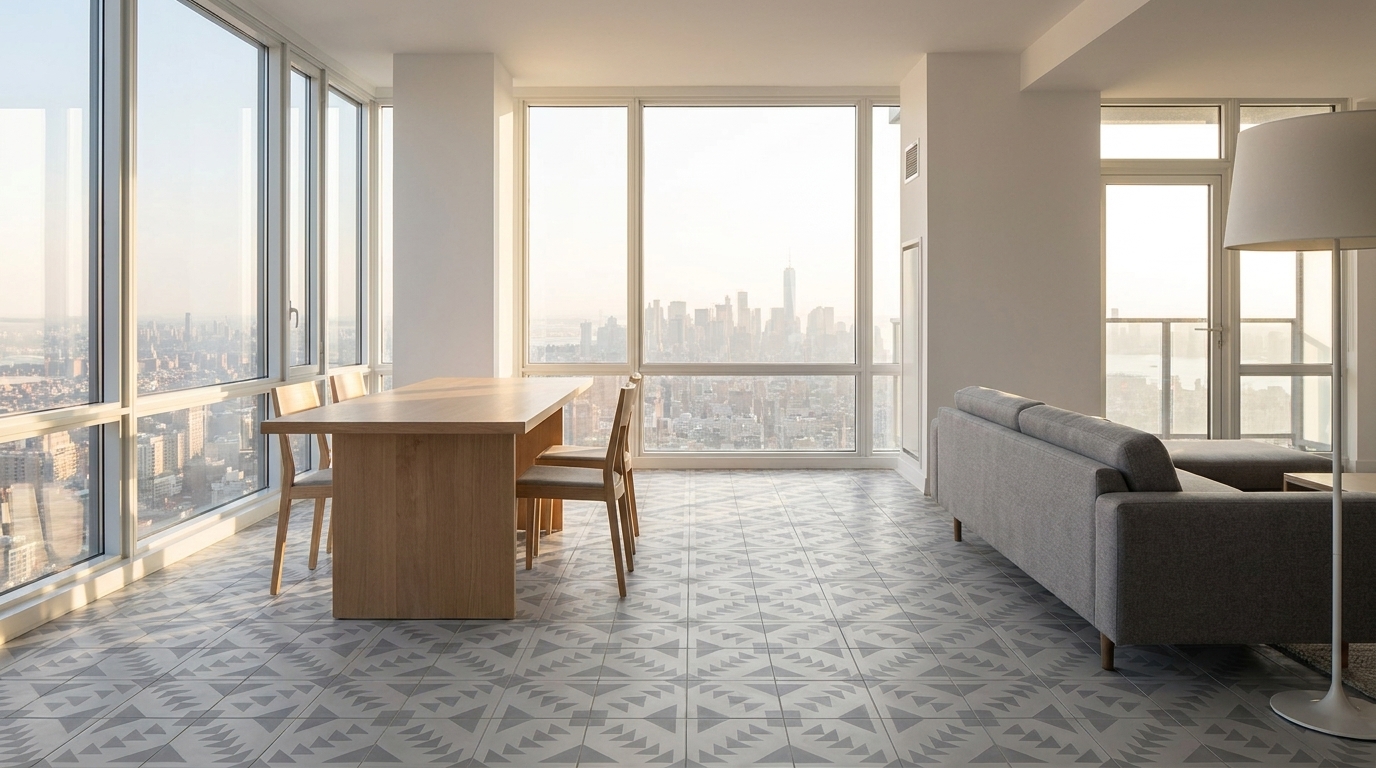
You found the cement tile you want for your condo. Then you read your HOA handbook and hit a wall: a minimum IIC rating for any hard-surface floor above an occupied unit. Now you’re wondering if beautiful, dense cement tile can even pass. It can. But only if you plan the whole floor assembly, not just the tile, around sound.
This guide explains what an IIC rating actually measures. We’ll cover why HOAs care so much, and how to build a cement tile floor that meets the number in your building’s rules. We’ll also cover the documentation most boards want before they’ll sign off on your project.
What an IIC Rating Actually Measures
IIC stands for Impact Insulation Class. It rates how well a floor-ceiling assembly blocks impact noise. Think footsteps, dropped toys, or a rolling chair, moving into the unit below. The higher the number, the quieter it sounds downstairs. A rating of 50 is a common baseline in building codes and HOA rules.
IIC is not the same as STC, or Sound Transmission Class. STC measures airborne noise, like voices, television, or music, passing through a wall or floor. A condo board might set minimums for both, but impact noise is the one that causes most flooring disputes. That’s because hard floors transmit footfall far more efficiently than carpet does.
You’ll also see two related terms in test reports. Lab-tested assemblies use the IIC label. A rating measured after installation, in the actual building, is called FIIC, or Field Impact Insulation Class. Field numbers usually run a few points lower than lab numbers. Real construction is never as controlled as a test chamber. Smart HOAs account for that gap when they set their minimum.
How HOA Flooring Rules Typically Work
Most condo associations don’t write their own acoustic standards from scratch. Instead, they borrow from building code baselines and add a safety margin. A common structure looks like this:
- Minimum IIC and STC of 50, matching the baseline in many versions of the International Building Code.
- A higher field requirement, often 55 or 60, specifically for hard-surface flooring like tile, stone, or wood.
- A requirement to submit your proposed flooring assembly for approval before installation begins.
- A right for the board to order a post-installation field test if a downstairs neighbor complains.
The rule targets the finished assembly, not the tile itself. So your cement tile doesn’t need its own IIC certificate; no tile does. What needs a rating is the complete stack: structural slab, any underlayment, the tile, and the ceiling treatment below. Always request your bylaws’ exact flooring section before you buy a single box of tile. Requirements vary widely by building, age, and construction type.
Construction type changes the starting point, too. Post-tension concrete high-rises, common in many newer condo towers, transmit impact noise differently than wood-frame mid-rises. Concrete is rigid and continuous. Without a resilient layer, it can actually carry footfall more efficiently than a wood joist floor does. That’s counterintuitive, since concrete feels so solid underfoot. But it explains why so many concrete-frame buildings set strict hard-surface rules.
Why Hard Tile Needs Help to Pass Sound Tests

Cement tile is dense, handmade, and roughly five-eighths of an inch thick. That mass is great for durability and for blocking airborne sound. However, mass alone does little for impact noise. Footsteps create vibration that travels through rigid, bonded materials almost like a drum skin.
A thinset-bonded tile floor over bare concrete often tests in the 25 to 35 IIC range, with no resilient layer. That’s well under most HOA minimums. Oddly, a wood-joist floor with thin carpet can sometimes outperform it. Carpet and pad absorb impact energy that rigid tile simply passes along.
The fix isn’t a thinner tile or a softer grout. Instead, you need to decouple the tile assembly from the structural floor below it. A resilient layer absorbs the vibration before it reaches the slab, which is what actually moves the IIC number. This is true whether you’re installing in-stock cement tiles or a custom made pattern.
Sound-Rated Underlayment Systems That Work Under Cement Tile
Several underlayment approaches can bring a cement tile floor up to HOA standards. Each works by inserting a resilient layer between the structural subfloor and the rigid tile assembly on top.
- Isolation membranes: Thin rubber or composite membranes install directly over the slab. The tile goes down in thinset mortar over a cement backer board bonded to the membrane. Look for membranes tested specifically with a tile assembly on top, not just with vinyl or laminate.
- Sound mats under a mortar bed: This method floats a thick mud bed over a compressed mat, then sets the tile into the mud bed. It’s traditional in high-rise condos. It also adds floor height, so confirm you have clearance at thresholds and door swings first.
- Acoustic underlayment panels: Rigid foam or cork-composite panels combine crack isolation with sound dampening in one layer. These can simplify installation compared with a separate membrane and backer board.
Whichever system you choose, two details matter more than brand names. First, the product needs a compressive strength rating suited to foot traffic and furniture loads. A mat that’s too soft can crack grout joints over time. Second, insist on test data for the exact tile-and-mortar assembly. Don’t settle for a generic rating pulled from a different flooring type. A membrane rated with vinyl plank tells you almost nothing about how it performs under 5/8-inch cement tile.
Choosing and Installing Cement Tile for Sound Compliance
Good news: pattern and color don’t affect your IIC number at all. You can choose any design you like once the underlayment system is sorted. For a calm, classic condo look, many owners lean toward quiet neutrals. Palace Gris 02 is one example, along with a graphic gray pattern such as Rombos Gris. Both read as sophisticated without competing with a view or furnishings.
Installation sequence matters more than aesthetics here. The resilient layer goes down first. Then comes backer board or a mortar bed, then the tile in a full, properly supported thinset bed. Skipping that sequence can void the manufacturer’s tested rating entirely. For example, setting tile straight over the membrane without backer board is a common mistake. Follow our installation guidelines alongside your underlayment manufacturer’s spec sheet. The two need to work together, not against each other.
Order with the standard 15% overage for cuts, breakage, and future repairs. An 8×8 box covers 5.17 square feet and holds 12 tiles. That makes it easy to calculate exactly how many boxes a room needs before you commit to a sound-rated subfloor buildup. Thickness and weight stay consistent across our in-stock collection, so swapping a pattern later won’t change your acoustic math.
Getting HOA Approval: A Practical Checklist

Boards reject flooring applications most often because of missing paperwork, not because tile can’t meet the standard. Here’s how to make approval straightforward:
- Request the exact flooring section of your governing documents in writing, including the required IIC and STC numbers.
- Choose an underlayment system with lab test data for a tile assembly that matches or exceeds that number.
- Submit the full assembly spec sheet, from slab to tile, along with your proposed cement tile pattern and thickness.
- Ask whether the board requires a licensed installer or a pre-installation walkthrough.
- Keep every document, including thinset and underlayment lot numbers, in case a post-installation field test is required later.
If your board has rejected a system before, ask why. Sometimes it’s an outdated product list; other times it’s a genuine height or load issue specific to the building. Either way, a short conversation up front saves you from ripping out a finished floor later.
It also helps to loop in your downstairs neighbor early, if you have a good relationship. A heads-up conversation, plus a copy of your test documentation, tends to prevent complaints. Most disputes start from uncertainty, not from an actual sound problem. A little transparency goes a long way.
Living With a Sound-Compliant Cement Tile Floor
Once your floor passes inspection, day-to-day care doesn’t change. Cement tile still needs the same sealing and gentle cleaning as any installation. Our maintenance and cleaning guide covers the full routine. The sound-isolation layer stays sealed inside the assembly. It has no effect on how you mop or reseal the surface.
For inspiration, browse our installation gallery for real condo rooms and real patterns. If you’re not sure which underlayment pairs best with a specific pattern or room shape, our team can help. Reach out through our contact page for a project-specific recommendation.
Frequently Asked Questions
Does cement tile have a worse IIC rating than other hard flooring?
Not inherently. Any rigid, bonded hard surface struggles with impact noise unless it sits over a resilient layer. That includes hardwood, porcelain, and stone. Cement tile performs the same as other tile types once a proper sound-isolation system goes in underneath it.
Can I just add extra padding under a floating floor instead?
Cement tile is a bonded, mortar-set product, not a floating floor like laminate. It needs a rigid backer or mortar bed on top of the resilient layer for stability. A soft foam pad alone, without that rigid layer, usually fails. It can crack tile or grout under point loads.
Who pays if my floor fails a field test after installation?
That depends on your HOA’s governing documents and your installation contract, so review both before work begins. Many boards require the unit owner to cover remediation. That’s exactly why pre-approval and documented test data matter so much upfront.
Does a thicker mortar bed always mean a higher IIC rating?
No. Thickness alone doesn’t determine the rating. The resilient layer’s compression and decoupling performance does the real work. A thin, well-tested membrane can outperform a thick mortar bed with no isolation layer at all. Always check the tested assembly, not just the dimensions.
See the tile in person before you commit
Photos only tell you half the story. Colors, texture and the handmade character of cement tile are best judged in your own light. Order a sample of any in-stock pattern for $20 (additional samples $10, free shipping) — or tell us about your project and we’ll help you narrow it down.
Browse in-stock cement tiles →
Talk to us about your project →