You're probably in one of two spots right now. Either you're a solid installer who can build a shower, set a clean layout, and finish a floor that stays flat, but you keep losing certain bids to somebody with letters after his name. Or you're a designer, builder, or homeowner staring at a tile proposal and wondering which contractor actually knows what they're doing.
That's where tile installer certification stops being a nice extra and starts becoming a business tool.
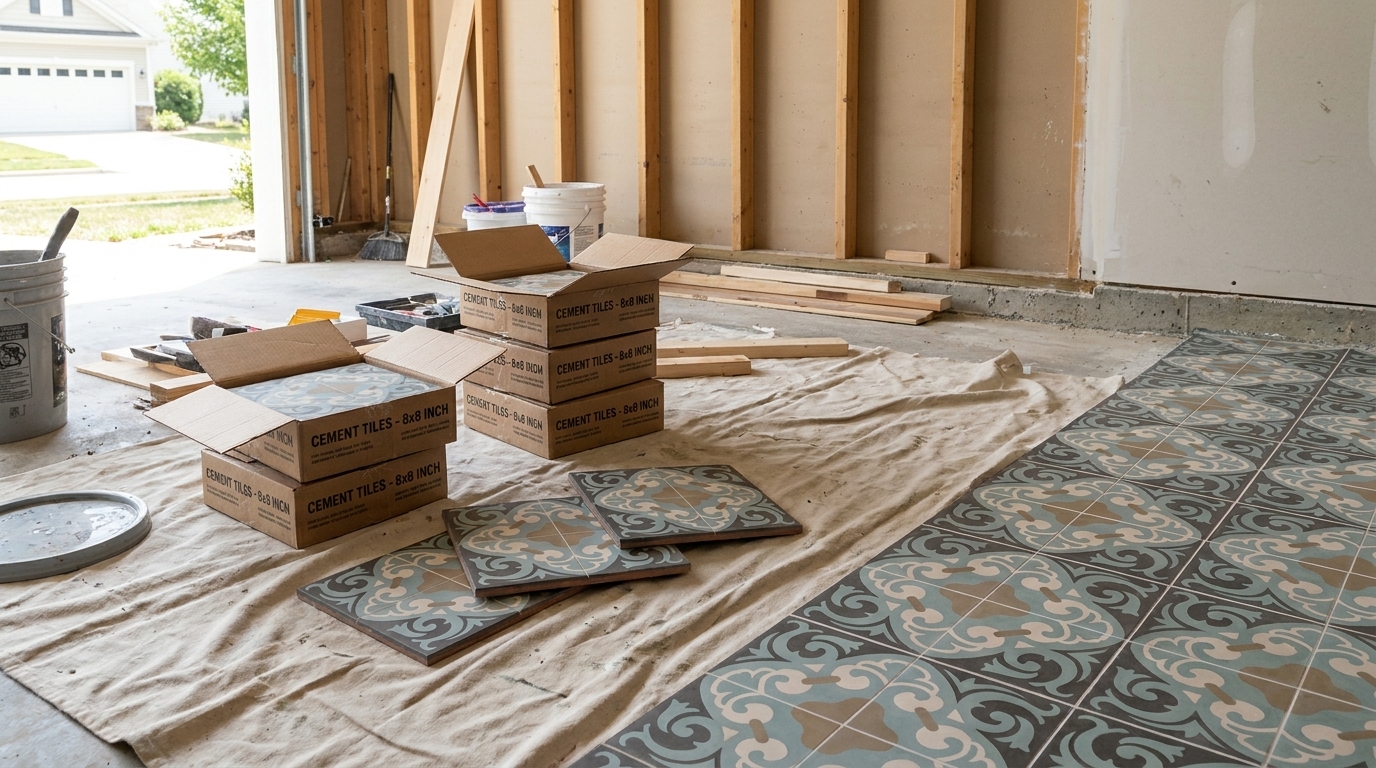
In tile, plenty of people can talk confidently. Fewer can prove they understand substrate prep, movement, layout, waterproofing, and finish quality under pressure. That gap matters on every project, but it matters even more when the material is expensive, handmade, or unforgiving. Cement tile is a good example. It looks simple until someone stains it, warps the layout, skips prep, or treats it like commodity porcelain. Then everybody pays for the mistake.
The point of certification isn't to make the trade more bureaucratic. It's to separate verified skill from sales talk.
Why Tile Installer Certification Is a Career Game Changer
A talented installer can still lose a good project for one simple reason. The client can't see your skill before the work starts.
This is the value of certification. It gives people who don't know you a way to trust you. If you're bidding on a custom bath, a restaurant floor, or a handmade cement tile entry, the buyer is trying to reduce risk. They're not just hiring a setter. They're hiring judgment.

What certification changes for the installer
In a crowded trade, being good and being selectable are not the same thing. Certification helps close that gap.
The field is also big enough that standing out matters. In the United States, the Bureau of Labor Statistics projects 6% employment growth from 2024 to 2034 for flooring installers and tile and stone setters, with about 112,300 jobs, median pay of $52,000 per year, or $25.00 per hour, and no formal educational credential typically required. In that kind of market, third-party credentials help skilled installers distinguish themselves, as noted in the TCNA contractor qualifications guide.
Here's what that means on the ground:
- Better jobs: Designers and general contractors tend to bring certified installers into projects where failure is expensive.
- Stronger positioning: When two bids are close, proof of competence can break the tie.
- Cleaner rate conversations: Certification gives you something concrete to point to when you're asked why your price isn't the lowest.
- Less dependence on word of mouth alone: Referrals still matter, but a credential helps when you're bidding outside your immediate network.
Practical rule: Certification won't fix weak workmanship. But if your workmanship is already strong, it helps the market see it faster.
What certification changes for the client
For clients and specifiers, certification is shorthand. Not perfect shorthand, but useful shorthand.
A certified installer still needs to understand the specific project. That part never goes away. Handmade cement tile, zellige, large-format tile, curbless showers, steam assemblies, and exterior work all demand separate conversations. But a recognized credential tells the buyer this person has already met a tested baseline.
That lowers uncertainty in a few ways:
| Hiring concern | What certification helps answer |
|---|---|
| Can this installer follow standards? | They've passed a recognized evaluation rather than just claiming experience |
| Will they respect layout and finish quality? | Certification testing is tied to execution, not just attendance |
| Can I justify this contractor to my client or GC? | A credential gives a third-party basis for selection |
| Is this a safe choice for high-value tile? | It improves confidence, though it should still be paired with mockups and method review |
For high-value materials, clients don't just want a tile mechanic. They want somebody who understands that every decision before setting day affects the finished surface. That's why certification has become a practical business advantage on both sides of the table.
Your Pathway to Becoming a Certified Tile Installer (CTI)
If you're aiming for a credential that owners, contractors, and specifiers recognize, CTI is the place most installers start.
The Ceramic Tile Education Foundation built CTI as a skills verification program, not a classroom participation trophy. You don't sit through a seminar and collect a badge. You prove you can do the work.

Start with eligibility
The first hurdle is experience. According to the CTEF Certified Tile Installer program requirements, candidates must already have at least two years of full-time lead installer experience before attempting the exam process.
That requirement matters for a reason. CTI isn't trying to teach somebody how to spread mortar for the first time. It's checking whether an installer already working in the field can execute to industry standards.
If you're still an apprentice, don't look at that as a setback. Look at it as your runway. Use that period to build habits that will carry into the test:
- Read plans carefully: A lot of field failures start with rushing layout.
- Watch prep work closely: Flatness, bonding surfaces, transitions, and moisture details separate real mechanics from fast ones.
- Practice complete assemblies: Don't just set tile. Learn the full build-up.
- Track materials by type: Handmade products, natural stone, porcelain, and cement tile all ask for different handling.
If you work around distinctive products regularly, it also helps to understand how material type affects installation decisions. Reviewing different types of tile used in residential and commercial projects sharpens that judgment.
Know what the test actually is
A lot of installers hear “certification” and think class. That's the wrong mental model.
CTI is a two-part gate. Candidates must pass a 155-question open-book multiple-choice exam and a hands-on field test. The practical portion verifies finish quality on critical assemblies that include complex layout, vapor retarder membrane, backer board, wall and floor tile, cementitious grout, and flexible sealant.
That distinction is important. Open-book doesn't mean easy. It means you're expected to know where the standards live and how to use them. In the field, that's exactly what good installers do.
The best exam prep for CTI isn't memorizing random answers. It's learning how standards connect to real installation choices.
Treat the written exam like a jobsite problem
The written portion rewards installers who can stay organized under pressure.
A smart way to prepare is to stop studying in fragments. Work through methods, terminology, and common failure points as systems. If you only know isolated facts, the test will expose that. If you understand why a method exists, you'll move faster and make fewer mistakes.
A few practical habits help:
- Tab your references clearly so you can move quickly.
- Review terminology used in standards instead of relying on shop slang.
- Practice finding answers rather than just reading passively.
- Work calmly. Rushing causes more trouble than lack of knowledge.
The hands-on test is where installers separate themselves
This part is what many good setters respect most about CTI. The practical exam checks whether your finished work meets a standard, not whether you can talk your way through a theory discussion.
The module forces you to manage sequence, cleanliness, cuts, alignment, and details while time pressure is in the background. That mirrors real work. You can't hide a crooked layout behind a polished explanation.
For jobs involving handmade cement tile, this mindset matters even more. Certification proves baseline execution. It does not replace project-specific planning. Cement tile still requires careful substrate prep, movement-joint planning, and mockup review before production work begins.
What works and what doesn't
Here's the blunt version:
| What helps you pass | What hurts you |
|---|---|
| Years of full-assembly work | Only setting simple backsplash work |
| Familiarity with standards language | Relying on “that's how my boss does it” |
| Practicing layout and sequence | Focusing only on speed |
| Clean, deliberate workmanship | Sloppy finish details |
| Respect for prep and movement | Treating tile as surface-only work |
A promising apprentice should aim for CTI early in their career, but not prematurely. Get the experience first. Build the habits. Then let the test confirm what your work already shows.
Beyond CTI with Advanced Certifications for Tile Installers
CTI tells the market you've proven core competency. That's valuable. But some jobs need more than a general credential.
If you're installing technically demanding systems, ACT, or Advanced Certifications for Tile Installers, becomes the more precise business signal. It tells the person hiring you that your skill has been evaluated in a specific installation category, not just tilework in a broad sense.

CTI versus ACT in real work
The easiest way to understand the difference is this. CTI answers, “Can this installer perform to an industry-tested baseline?” ACT answers, “Can this installer execute this specific type of installation?”
That's a major difference when the project is specialized.
According to the IMI overview of Advanced Certifications for Tile Installers, ACT is an industry-recognized evaluation program with certifications in nine key areas. To qualify, a candidate must typically be a BAC journeyworker or advanced apprentice, score at least 84% on a 25-question ANSI/TCNA standards exam, and at least 85% on a hands-on assessment.
When ACT matters most
Not every kitchen floor needs advanced specialization. But certain assemblies deserve it.
Consider these project types:
- Membranes and wet areas: Critical when the system depends on watertight sequencing and detail discipline.
- Shower receptors: A small mistake here often turns into a big failure later.
- Large-format tile: Coverage, lippage control, and substrate conditions become much less forgiving.
- Gauged porcelain installations: Material handling and technique matter from the first move.
- Mortar bed work: This asks for a different skill set than straightforward thin-bed work.
A generic tile credential is helpful. A matched specialty credential is better when the assembly is sensitive.
How clients and designers should think about it
For specifiers, the practical move is simple. Match the installer's credential to the system being built.
A few examples make that easier:
| Project type | Better hiring question |
|---|---|
| Custom shower with waterproofing details | Who has proven competency in the wet-area category involved? |
| Large-format commercial floor | Who has verified experience with large-format work and substrate prep? |
| Thin, fragile, premium material | Who can show specialty-level control, not just general tile experience? |
| Decorative handmade installation with demanding layout | Who can combine finish discipline with method planning and mockups? |
This is especially relevant when a project includes materials that don't tolerate casual handling. Handmade cement tile can punish shortcuts in prep and layout even if the setting itself looks clean on day one. ACT doesn't replace craft judgment, but it helps identify installers who've gone deeper than baseline competency.
The business upside for installers
ACT also changes what kind of work comes your way. Once you're known for a specialized category, you stop competing for every job in town. Instead, you start getting called for the jobs that fewer people can do well.
That shift matters. It tightens your market position, improves your proposal language, and gives builders and designers a sharper reason to choose you. Not because you say you're advanced, but because your certification is tied to a particular assembly.
How to Prepare for Your Certification Exams
Most certification mistakes happen before exam day. Not because the installer lacks ability, but because preparation is scattered.
Good candidates prepare in two lanes at once. They study the language of standards for the written exam, and they rehearse clean execution for the hands-on portion.

Build a study stack that mirrors the field
If you're serious about passing, keep your references organized and visible. The TCNA Handbook, ANSI standards, manufacturer instructions, and your field notes should work together, not sit in separate piles.
A smart prep routine looks like this:
- Read with a pencil in hand: Mark terms, methods, and recurring problem areas.
- Tab sections you'll need fast: Open-book rewards organization.
- Translate standards into field actions: Don't just read “movement joint.” Think through where it goes and why.
- Review quantity planning: Estimating material correctly is part of execution. Using a practical tile measurement guide for layout and ordering can help sharpen that side of your thinking.
Practice the hands-on test like a real install
The hands-on portion punishes disorganization more than anticipated.
Set up your tools ahead of time. Check your layout routine. Practice cuts that require accuracy, not just speed. Keep your work area clean. If your process gets chaotic halfway through, your finish usually follows it.
A few habits make a big difference:
- Lay out the sequence before touching material.
- Dry-fit mentally, even when you can't dry-fit physically.
- Protect line quality. Small drift becomes visible fast.
- Finish details cleanly. Grout and sealant work count because clients see them.
The exam doesn't care how confident you sound. It cares what the finished assembly looks like.
Here's a useful visual walkthrough to study before your test date:
Reduce avoidable stress
A lot of exam anxiety comes from basic logistics. Handle those early so your head stays on the work.
| Prep area | Better approach |
|---|---|
| Tools | Inspect, clean, and pack them early |
| References | Tab and organize before exam week |
| Timing | Practice under a realistic pace |
| Materials handling | Rehearse careful movement and setup |
| Sleep and travel | Keep the day before boring and predictable |
The goal isn't to become robotic. It's to free up your attention for the parts of the test that require judgment.
How Employers and Homeowners Should Evaluate Installers
Certification is a strong starting point. It is not the whole hiring decision.
A homeowner, designer, or builder still needs to ask whether the installer fits the exact project. That matters even more with handmade surfaces, decorative layouts, wet areas, and any assembly where prep details determine long-term performance.
First, verify the credential
Industry acceptance matters. The Ceramic Tile Education Foundation launched the CTI program in 2008, and by May 2025 it had reached its 2,000th certified installer, marking more than 17 years of sustained growth. Industry sources describe it as the gold standard for verifying installer competence, with backing from groups such as TCNA and NTCA, as reported in this Floor Covering News coverage of the CTEF milestone.
That history gives clients a benchmark they can use. If an installer claims CTI or ACT status, verify it through the official directories connected to the certifying body. Don't treat a logo on a truck as proof by itself.
Then ask project-specific questions
Once the credential checks out, shift to the actual work.
For example, if the project includes a shower, ask how the installer approaches substrate preparation, waterproofing sequence, transitions, and penetrations. A helpful starting point for homeowners who want to ask better questions is understanding the basics of how shower walls are waterproofed before tile goes on.
Use questions like these in interviews:
- What assemblies like mine have you completed recently?
- How do you handle mockups for decorative or handmade tile?
- What prep issues would stop you from setting tile on day one?
- How do you coordinate layout approval before installation starts?
- What manufacturer instructions or standards guide your method?
A certified installer who asks careful questions about substrate, sequence, and movement is usually safer than one who rushes straight to color and pattern.
Look for proof that the installer runs a professional business
Clients shouldn't evaluate workmanship in a vacuum. They should also look at how the contractor communicates, documents, and follows through.
That includes photos of finished work, written scope language, references, and online review patterns. For contractors trying to present themselves better, practical advice on how to increase contractor online reviews can make it easier for future clients to assess consistency before the first phone call.
A good hiring screen combines all of it:
| What to check | Why it matters |
|---|---|
| Certification status | Confirms tested baseline competence |
| Portfolio | Shows finish quality and style fit |
| References | Reveals communication and reliability |
| Scope clarity | Prevents assumptions about prep and exclusions |
| Material knowledge | Protects specialty tile from avoidable mistakes |
For high-end work, the safest choice is rarely the cheapest bid or the smoothest sales pitch. It's the installer who can verify competence and explain the assembly clearly.
Maintaining Certification and Marketing Your Expertise
A certification only helps your business if people know what it means.
Too many installers work hard to earn CTI or ACT, then bury the credential on a business card and never use it again. That's an underutilized asset. The point isn't just to pass. The point is to turn verified skill into better opportunities.
Keep the credential active in your daily business
Maintenance matters because stale credentials don't carry the same weight. Stay engaged with the certifying body, keep your listing current where applicable, and pay attention to any recertification or renewal requirements tied to your program.
More important, keep building the kind of work record that supports the credential:
- Photograph completed projects carefully
- Save mockups and detail shots
- Document assemblies, not just finished surfaces
- Keep proposal language aligned with the methods you use
That last point matters more than many installers realize. If your contract says one thing and your field process says another, certification won't protect you.
Use the credential where clients actually see it
Most clients won't dig for your qualifications. Put them in front of them.
Here are practical places to use certification well:
Website service pages
Mention your credential in plain language and connect it to real project types.Proposals and bid packages
Add one short section explaining what the certification verifies.Email signature and printed materials
Small touches build familiarity over time.Vehicle graphics and uniforms
Useful when your work is referral-driven and local.Conversations with designers and builders
Don't just say “I'm certified.” Explain why that matters for the assembly.
Clients don't buy certification by itself. They buy the lower risk, clearer process, and stronger craftsmanship they believe comes with it.
Market the skill, not just the logo
The strongest marketing ties the credential to the problems you solve.
If you specialize in showers, say the certification supports your discipline around prep and waterproofing. If you install decorative cement tile, explain that your process includes layout review, substrate checks, mockups, and surface protection. If you pursue ACT categories, connect each one to a project type clients already understand.
For installers trying to improve the digital side of that message, this guide on contractor website optimization offers practical ideas for turning expertise into clearer marketing.
Certification won't replace a reputation. It strengthens one. Used well, it helps you win trust faster, justify your standards, and move toward work that values precision instead of treating tile like a commodity.
If your next project involves handmade cement tile, custom patterns, or a surface that deserves careful installation planning, Original Mission Tile is a smart place to start. Their team supports homeowners, designers, and contractors with heritage-made tile, custom design options, and practical guidance that helps good installations start with the right material choices.