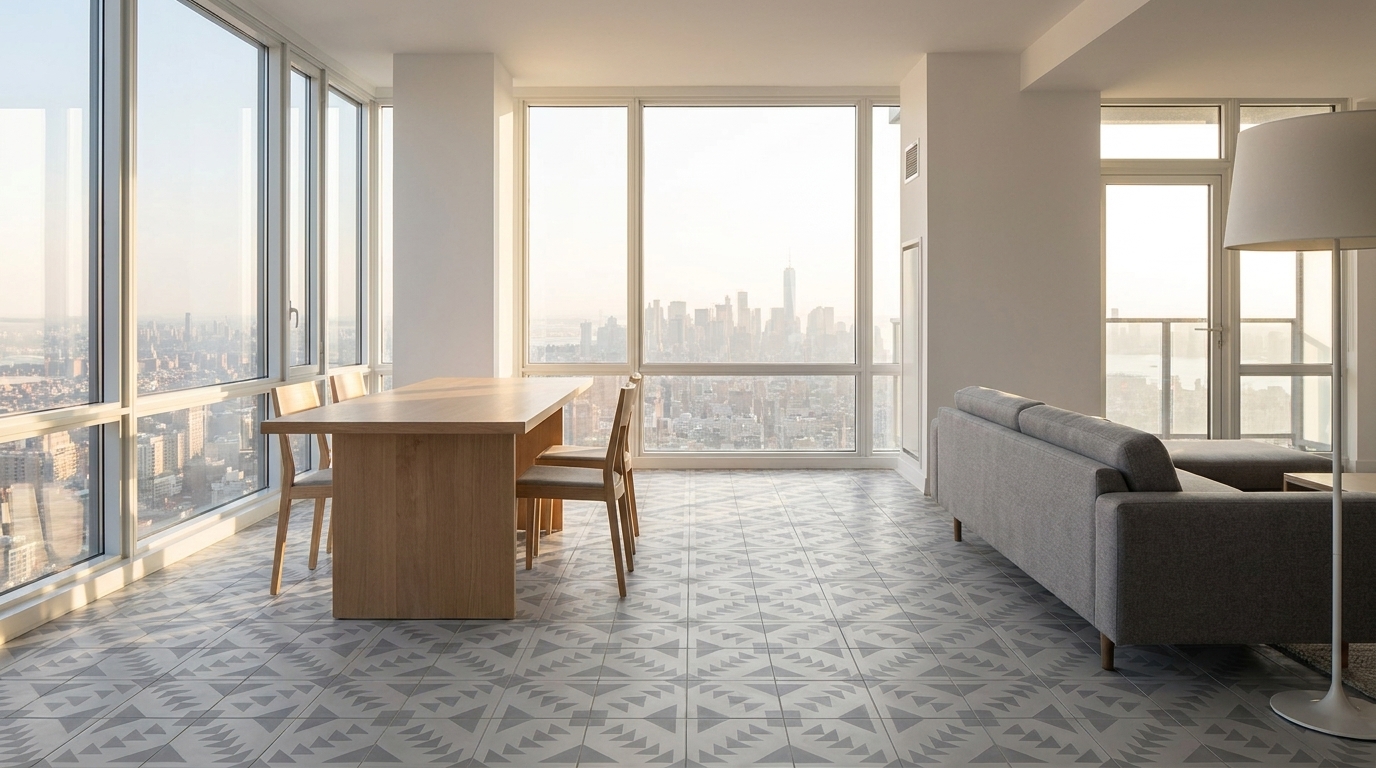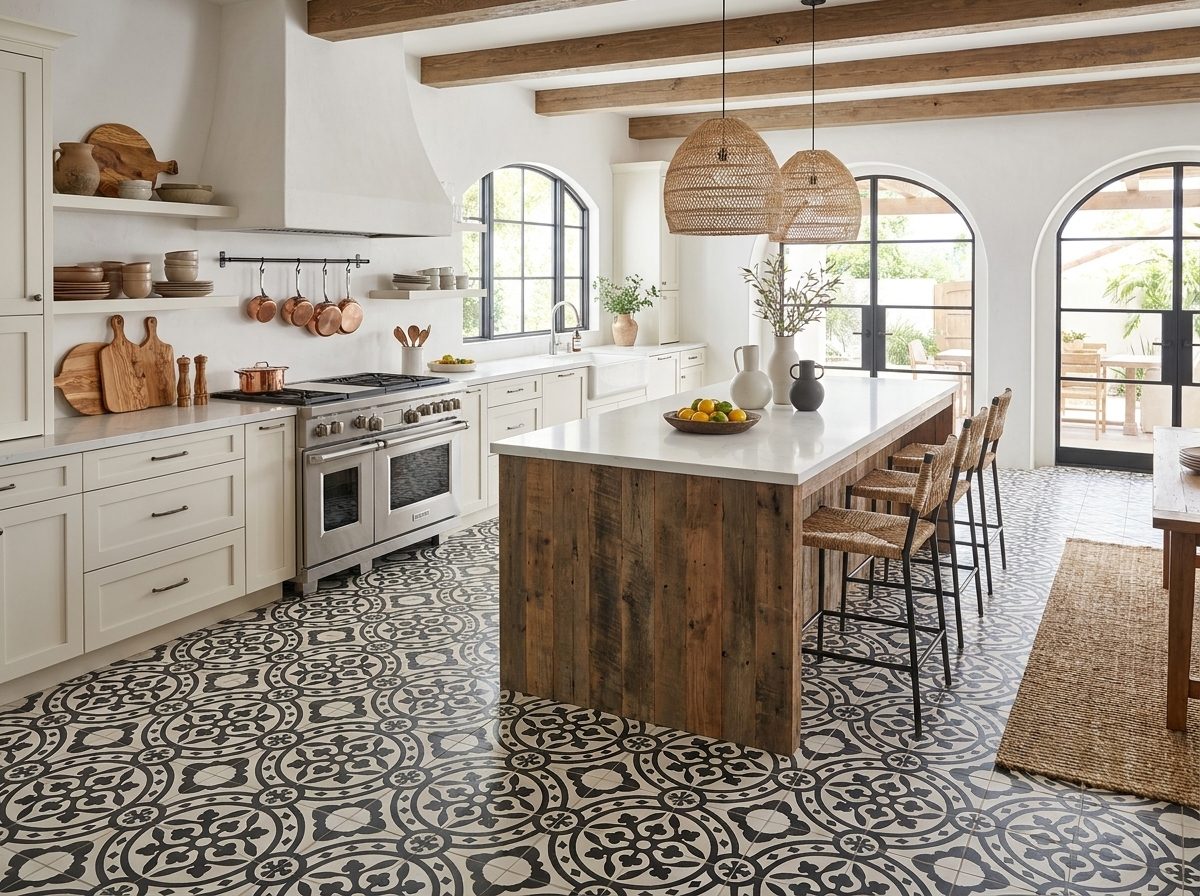
Walk into any tile showroom and you’ll face the same fork in the road: the warm, hand-pressed character of cement tile on one wall, and the glossy uniformity of porcelain on the other. Both cover floors and walls. Both come in endless patterns. And yet they couldn’t be more different — in how they’re made, how they age, and how they make a space feel.
Choosing between cement tile vs porcelain is the most common question our design team hears from homeowners, designers, and contractors alike. The honest answer? Each one wins in different situations — and knowing the real differences will save you money, headaches, and design regret.
In this guide, we’ll compare the two materials head to head: manufacturing, appearance, durability, maintenance, cost, and the best applications for each. By the end, you’ll know exactly which tile belongs in your project.
How They’re Made: Fire vs. Pressure
The core difference between these two materials starts at the factory — or in cement tile’s case, the workshop.
Porcelain is a refined clay tile fired in industrial kilns at extremely high temperatures (around 1,200–1,400°C). The design is almost always inkjet-printed onto the surface and sealed under a glaze. The result is a hard, dense, mass-produced tile — every piece identical to the last.
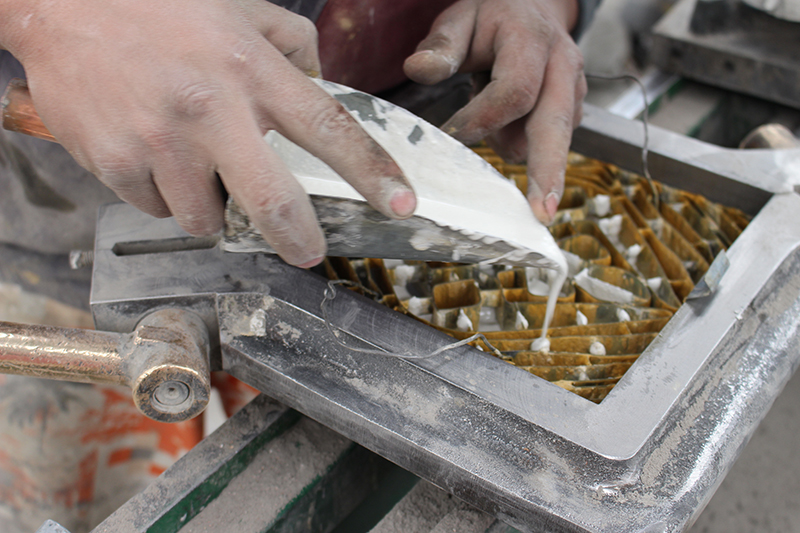
Cement tile is never fired. Each tile is made by hand: mineral pigments are poured into a metal mold, backed with a cement-sand mixture, and hydraulically pressed under tons of pressure, then cured slowly with water and air. The pattern isn’t printed — it’s a layer of pigmented cement several millimeters thick, fused into the body of the tile.

That difference — printed glaze versus solid pigment, kiln versus press, factory versus artisan — drives everything else in this comparison.
Appearance: Uniform Perfection vs. Handmade Character
Porcelain’s strength is consistency. Every tile matches, every edge is identical, and modern printing can imitate marble, wood, concrete — even cement tile itself.
But imitation has a ceiling. Here’s what handmade cement tile delivers that a printed surface can’t:
- Depth of color. The pigment layer is thick and matte, with a soft, velvety finish that shifts beautifully in changing light.
- Natural variation. Each tile is pressed by hand, so no two are exactly alike — and that’s precisely the point. An installed floor has a warmth and life that perfect uniformity can’t replicate.
- Authentic pattern heritage. Classic encaustic patterns — geometric, floral, Spanish colonial, Moroccan — were born in this material. Porcelain copies them; cement tile is them.
- True customization. Need a pattern in your client’s brand colors, or a historic design reproduced? With porcelain, you’re limited to the catalog. With cement tile, our Design Studio can produce virtually any pattern and palette.

Durability: How Each Material Ages
Porcelain is extremely hard and nearly waterproof (absorption below 0.5%), which makes it very resistant to scratching and staining. Its weak point is the glaze: a hard impact can chip it, exposing the clay body underneath — and a chipped porcelain tile can’t be repaired, only replaced.
Cement tile plays a longer game. Because the color runs millimeters deep rather than sitting in a surface glaze, wear doesn’t erase the pattern — it develops a soft patina that collectors and designers prize. This is why cement tile floors installed a century ago in haciendas, churches, and historic homes across Mexico and the American Southwest are still in service today.
The practical summary:
- Porcelain: superb hardness and stain resistance; damage is rare but permanent and visible.
- Cement tile: requires sealing and develops character over time; with basic care, it’s a generational floor that can also be re-buffed to refresh the surface — something a glazed tile can never offer.
Maintenance: What Each Tile Asks of You
Let’s be straightforward, because this is where the two materials genuinely differ in daily life.
Porcelain is close to maintenance-free: any household cleaner, no sealing, no special care. If low maintenance is your absolute top priority, porcelain earns real points here.
Cement tile is porous and needs a simple but real care routine:
- Seal at installation. A penetrating sealer protects against stains and moisture — this step is non-negotiable.
- Clean with pH-neutral products. Acidic or abrasive cleaners will etch and dull the surface.
- Re-seal periodically. Every 2–3 years in high-traffic or wet areas.
At Original Mission Tile, we walk every customer through this process — our care and cleaning guide covers it step by step. Thousands of our clients will tell you: a few minutes of sealing every couple of years is a small price for a floor with this much soul.
Cost: Sticker Price vs. Long-Term Value
Commodity porcelain is generally cheaper per square foot than handmade cement tile — there’s no way around the economics of mass production versus artisan work. Premium and designer porcelain lines, however, often land in the same price range as cement tile, and sometimes above it.
The fuller picture includes lifespan and value:
- A budget porcelain floor typically gets replaced every 15–25 years as trends and wear catch up with it.
- A well-installed cement tile floor is a permanent feature that adds character — and resale appeal — to the property.
- For commercial spaces, a signature patterned floor becomes part of the brand: photographed, shared, remembered.
For current numbers on material and installation, see our 2026 Cement Tile Cost Guide, and browse in-stock patterns that ship without custom lead times.
Where Each Tile Wins: Our Designers’ Verdict
Choose porcelain when:
- The area takes extreme abuse with zero maintenance (commercial kitchens, garages, high-traffic retail corridors)
- The budget is tight and the surface is purely functional
- You need large-format slabs with minimal grout lines
Choose cement tile when:
- The space is meant to be seen and remembered: kitchens, bathrooms, entryways, patios, restaurants, boutique hotels
- You want authentic pattern with depth — not a printed imitation
- The project calls for custom colors or a one-of-a-kind design
- You’re restoring or referencing Spanish colonial, Mediterranean, or mission-style architecture, where porcelain simply looks out of place
At Original Mission Tile, we recommend a simple test: if you’ll photograph the room when it’s done, it deserves cement tile. Browse the project gallery and you’ll see why.
Cement Tile vs. Porcelain FAQ
Is porcelain more durable than cement tile?
Porcelain is harder and more stain-resistant day to day, but a chipped glaze is permanent. Cement tile requires sealing, yet wears gracefully for generations and can be restored — historic cement floors over 100 years old are still in use.
Which is better for bathrooms?
Both work. Porcelain is effortless in wet zones; sealed cement tile performs beautifully on bathroom floors and walls, and its matte surface offers better slip resistance than glossy glazed tile.
Can cement tile be used outdoors?
Yes — with an outdoor-rated sealer, cement tile performs well on patios, terraces, and covered exteriors in moderate climates. It’s been used this way across Mexico and the Southwest for over a century.
Is “encaustic-look” porcelain the same as real cement tile?
No. Encaustic-look porcelain is a photograph of a pattern printed on glaze. Real cement tile carries the pattern in solid pigmented cement, with the depth, matte texture, and natural variation that make the originals so sought after.
How do I know how much tile to order?
Measure your square footage and add 10–15% for cuts and future repairs. Our team can help you calculate exactly what your project needs — contact us with your dimensions.
The Bottom Line
Porcelain is a practical, low-maintenance workhorse — and for purely functional spaces, a perfectly sensible choice. Cement tile is something else entirely: a handmade material with real pigment, real history, and a surface that gets more beautiful with age. One covers a floor; the other defines a room.
If your project deserves pattern with soul — a kitchen that stops guests mid-sentence, a bathroom with genuine character, a commercial space customers remember — the choice was never really close.
Working on a project? Our design team is here to help — browse hundreds of handmade patterns or contact us for samples and expert advice. Trade professional? Ask about our Trade Program.