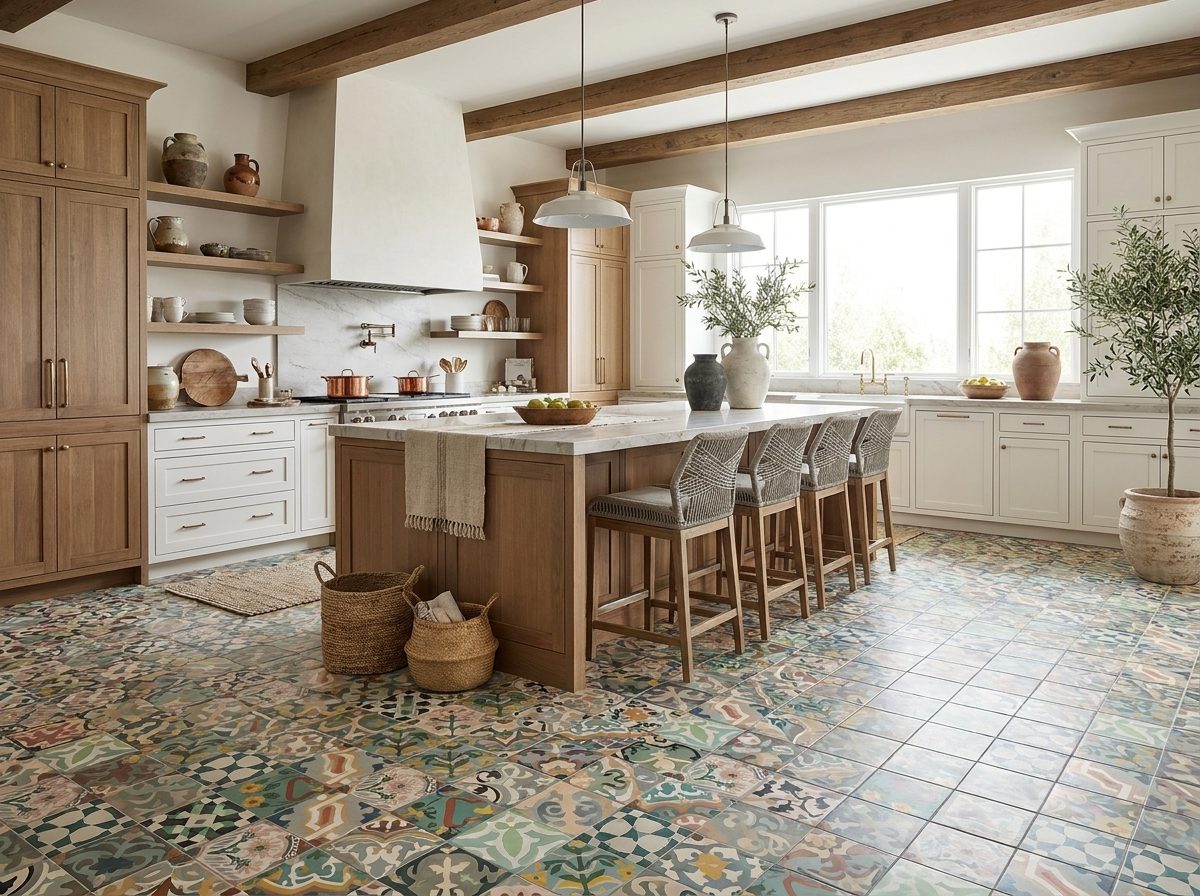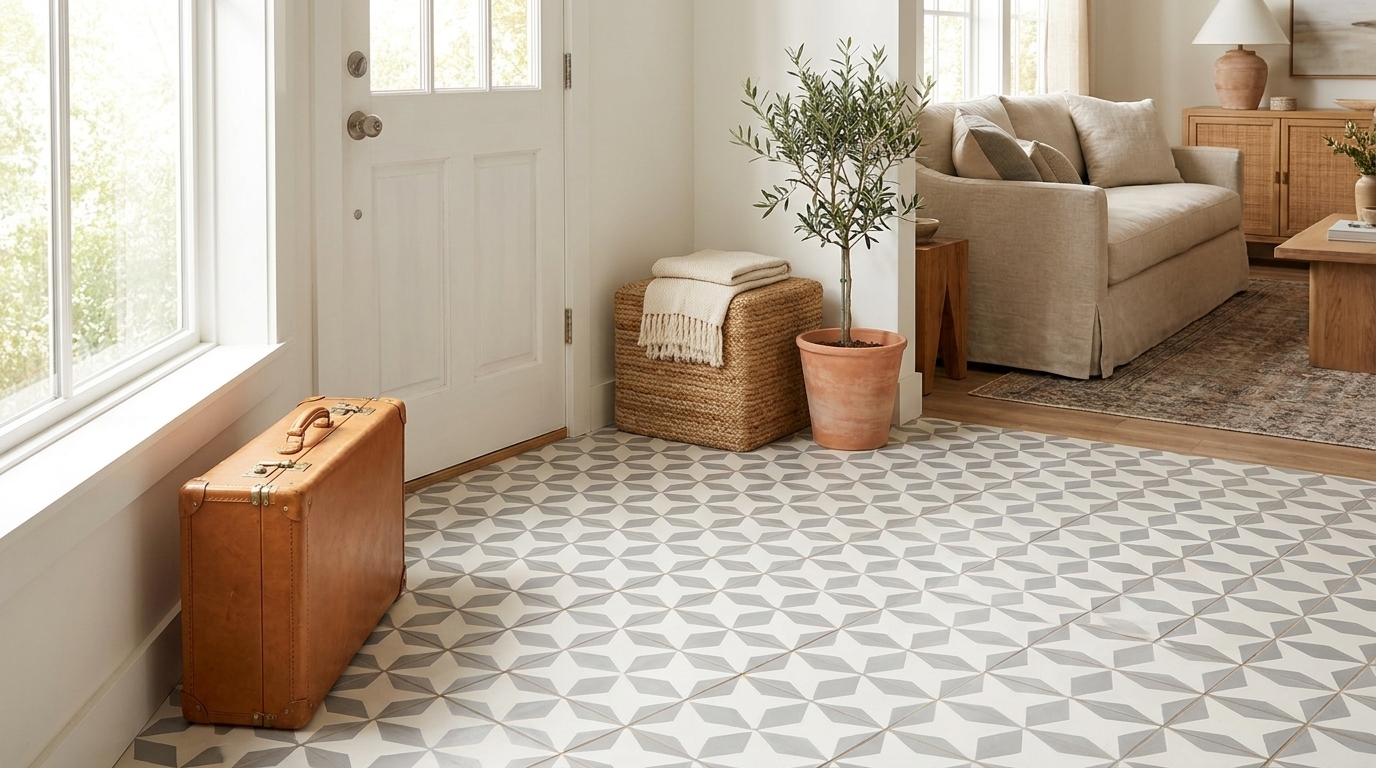
You're probably standing at that familiar threshold right now. The porch has good bones, the house has character, and the floor is the one surface dragging the whole space down. Bare concrete feels unfinished. Old coatings peel. Plain pavers do the job, but they don't give the entrance any soul.
A cement tile porch changes that. It turns a pass-through into an arrival. The floor starts carrying pattern, rhythm, and color, and the porch begins to feel tied to the architecture instead of added onto it. That's why so many designers and homeowners are drawn to handmade cement tile for porches. It has depth, a soft matte surface, and inlaid color that reads differently from factory-glazed material.
It also asks more of the installer. Cement tile is not the product for shortcuts, casual prep, or sloppy grouting. If you want a porch floor that still looks composed after seasons of sun, rain, tracked dirt, furniture movement, and daily use, the technical work has to match the beauty of the tile.
From Dream to Design The Art of a Tiled Porch
A tiled porch should feel like it belongs to the house. On a Spanish Revival, it can reinforce the geometry of arches and stucco. On a bungalow, it can add handcrafted warmth. On a more restrained facade, it can become the one richly detailed surface that gives the entry sequence its identity.
That idea isn't new. Durable floor tile sits inside a very long architectural tradition. The National Park Service notes that ceramic floor tiles can be traced to the fourth millennium B.C., and that industrial changes in the mid-19th century helped transform tile from a specialty luxury into a practical surface for homes and public buildings (National Park Service preservation brief). For a porch, that history matters. You're not choosing a novelty finish. You're working with a surface category shaped by centuries of use.
Handmade cement tile carries that same sense of permanence, but with a different visual language. Instead of a glossy skin sitting on top, the pattern is part of the tile itself. That gives a porch a grounded look that suits old houses, hospitality spaces, and new construction that wants a more rooted feel.
A porch floor does more than survive weather. It sets the tone before anyone reaches the front door.
The strongest porch designs usually do one of three things:
- Extend the architecture: repeat a motif that already exists in trim, ironwork, or window geometry.
- Frame a threshold: use the tile as a visual transition from exterior to interior.
- Create a destination: give a wide porch or veranda enough pattern to feel furnished even before furniture arrives.
If you're still choosing a direction, it helps to study real outdoor applications with borders, field patterns, and solid-color framing. This gallery of outdoor patio tiles cement tile designs is useful for seeing how handmade cement tile behaves visually in open-air spaces.
A porch can be modest and still feel memorable. The tile is often what makes that happen.
Planning Your Cement Tile Porch
Good porch installations are won before the first bag of mortar is opened. Layout, exposure, drainage, tile format, edge treatment, and material staging all need decisions early. Cement tile rewards that discipline because pattern mistakes and handling mistakes show immediately.

Start with exposure, not pattern
The choice of porch tile often begins with visual appeal. That's natural, but the porch itself has to lead the conversation.
Ask these practical questions before selecting a pattern:
- How much weather reaches the floor: A deep covered porch behaves differently from an exposed front stoop.
- Where does water travel: Wind-driven rain, planter overflow, and splashback at steps all matter.
- How shaded is the surface: Shade can hold moisture longer and change how quickly the floor dries after cleaning or rain.
- How hard will the porch be used: A private side entry and a busy main entrance don't wear the same way.
If the slab itself is still in planning, detailed slab guidance can save trouble later. For homeowners who are still sorting out structure and pour details, Firm Foundations porch slab help offers a practical overview of the concrete base side of the project.
Match the format to the architecture
A porch isn't just a rectangle to cover. It's part of the facade. The tile size and shape should support the proportions of the house.
A simple way to think about it is this:
| Porch condition | Tile approach that usually works |
|---|---|
| Narrow entry porch | Smaller repeating patterns that keep cuts controlled |
| Broad front porch | A field pattern with a border, or a rug-style inset |
| Porch with columns or awkward corners | Formats that can absorb cuts without making them obvious |
| Historic facade | Traditional motifs and muted contrast often sit more comfortably |
Classic square formats feel orderly and architectural. Hexagons soften straight porch lines. Patchwork layouts can work beautifully, but only when the rest of the architecture is calm enough to support them.
Plan the layout on paper before you order
A porch floor should look intentional from the front walk, not random from the saw table.
Use a measured drawing and decide:
- Your sightline: what visitors see first as they approach.
- Your center or anchor: doorway centerline, porch depth, or a major architectural feature.
- Your edge strategy: full tiles at the threshold, balanced cuts at the perimeter, or a dedicated border.
- Your transition details: how the tile meets steps, walls, posts, and door thresholds.
Practical rule: If a patterned porch has awkward slivers at the front edge, people notice the mistake even if they can't name it.
Order by system, not by piece
The easiest way to delay a porch job is to order tile first and all the other materials later. Cement tile installs go more smoothly when the full system is chosen up front.
That means confirming:
- Tile quantity: include enough material for cuts and breakage.
- Sealer: for pre-sealing and final protection.
- Mortar: one suited to the substrate and outdoor exposure.
- Grout: color and type chosen with the tile's porosity in mind.
- Movement-joint materials: especially at changes in plane and perimeter conditions.
When possible, keep all tile from the same production run grouped together during layout. Handmade cement tile has natural variation, and that variation is part of the appeal. Dry-laying and blending from multiple boxes helps keep the floor balanced rather than patchy.
The Critical Role of Substrate Preparation
Most porch tile failures don't begin at the tile surface. They begin below it. The pattern may be flawless, the cuts may be clean, and the grout color may be perfect, but if the substrate moves, holds water, or telegraphs cracks, the installation is already compromised.
That's why substrate prep is the hard line in outdoor tile work. Fine Homebuilding notes that porches must be structurally stable, properly pitched for drainage on open porches, and free of cracks, coatings, and moisture problems before tile is installed. The same guidance points to expansion joints every 8 to 12 feet in larger tile fields and recommends at least 95% mortar coverage on the back of each tile, verified by periodically lifting tiles during setting (Fine Homebuilding on tiling a porch).

Stop assuming the slab is ready
An old porch slab can look sound and still be a poor base for cement tile. Hairline cracks, paint residue, moisture migration, low spots, and a pitch that falls back toward the house are all common troublemakers.
Check the porch for these conditions before anything else:
- Bond breakers: old coatings, curing compounds, adhesive residue, or dust.
- Visible cracking: not every crack is fatal, but every crack needs evaluation.
- Flatness issues: handmade tile wants a stable, even bed.
- Drainage problems: water should move off the porch, not collect on it.
- Edge weakness: crumbling corners and exposed slab deterioration need repair first.
If the assembly includes backer materials or transitions that require board work, clean cuts matter more than people think. A rough edge creates uneven bearing and awkward seams. This guide to cutting cement board cleanly is a useful reference for getting those pieces fitted without ragged breakage.
Pitch, movement, and moisture are the real job
A porch tile installer isn't just bonding decorative units to a surface. Their primary task is managing movement and water.
The porch should pitch outward on open installations so water drains away instead of sitting in place or backing toward the structure. The substrate must also account for expansion and contraction. Outdoor assemblies move. Cement tile doesn't forgive denial on that point.
Here's where many failures are born:
| Mistake | What happens later |
|---|---|
| Tile over an unstable base | Cracks, loose tiles, hollow spots |
| Little or no drainage slope | Standing water, stained grout, slip issues |
| No membrane where one is needed | Moisture intrusion, crack transfer |
| Ignoring movement joints | Tent-ing, fractured grout, edge stress |
Waterproofing and movement control aren't luxury upgrades on a porch. They're what separates a finish from a repair cycle.
Build the assembly, not just the surface
On many porch projects, the best work is the least visible. That means cleaning the slab thoroughly, repairing damage, correcting depressions, and installing the right underlayment or membrane before the decorative work begins.
For installers evaluating assembly options, this resource on floor underlayment for tile is helpful for sorting out what belongs beneath the finished surface and why.
A disciplined prep sequence usually includes:
- Removing contaminants so mortar bonds to the substrate rather than dust or residue.
- Repairing cracks and damaged areas with materials compatible with the intended tile system.
- Confirming drainage before layout starts.
- Installing waterproofing or crack-isolation protection where conditions call for it.
- Checking plane and transitions at thresholds, posts, and step edges.
The trade secret most people skip
Installers often spend hours choosing grout color and almost none checking whether the porch dries properly after washing or rain. That's backward. Before setting tile, run water across the surface and watch where it goes. You'll learn more in a few minutes than you will from assumptions.
If water lingers, fix that before the first tile is laid. Cement tile is too beautiful, and too honest a material, to waste on a porch that hasn't earned it.
Installing Cement Tiles Step by Step
Once the porch is sound, drained, protected, and clean, the installation becomes a matter of control. Cement tile punishes rushed hands. It rewards slow layout, full support, careful handling, and immediate cleanup.
A clean process matters because these tiles are handmade and porous. You're not dropping in an anonymous factory floor. You're building a finished surface that shows every decision.
For a quick visual overview of sequence, this installation flow is a useful reference.

Dry layout before mortar touches the floor
Always dry-lay enough tile to understand the rhythm of the pattern, the border condition, and the cut locations. On a porch, dry-laying enables you to catch the awkward post notch, the off-center stair, or the threshold that needs a better visual anchor.
Mark reference lines clearly. A porch should read straight from the exterior approach, not just from one wall. The eye often judges the front edge and the doorway first, so use those as visual controls.
Use dry layout to confirm:
- Pattern orientation: especially with directional motifs.
- Balanced cuts: avoid tiny perimeter pieces when possible.
- Threshold treatment: decide where full tile should land.
- Box blending: distribute natural variation across the field.
Here's a helpful visual walkthrough of tile-setting sequence before grouting begins:
Set with consistency and full support
Home Depot's floor tile guidance recommends working from a reference line, spreading thin-set in consistent ridges, setting one tile at a time, checking level immediately, and using spacers to maintain grout joints. It also notes that mortar typically needs about 24 hours before the floor should be walked on, and that thin-set left in the joints must be removed before grouting so grout can fill the joint to full depth (Home Depot floor tile installation guidance).
For cement tile, I'd add one essential habit. Back-butter the tile. You want mortar contact across the back, not isolated ridges and hollow pockets. That support matters on porches where temperature shifts and moisture exposure are part of normal life.
A disciplined setting rhythm looks like this:
- Comb mortar in one direction with a notched trowel.
- Back-butter each tile to improve support and contact.
- Set one tile at a time rather than skating pieces into place.
- Beat in gently with a rubber mallet or a tapping block.
- Check level at once in multiple directions.
- Clean the face and joints early before residue hardens.
Cement tile doesn't like brute force. It likes even pressure, a flat bed, and patience.
Handle cuts as part of the design
The difference between a professional porch and a merely finished one often comes down to cuts. Straight cuts at the perimeter need to feel intentional. L-cuts around posts need enough body to remain strong. Curved or irregular cuts should be planned so they fall in less prominent areas whenever possible.
A few practical habits help:
- Measure from fixed reference lines, not from drifting tile edges.
- Leave room for movement and joint treatment where required.
- Test the cut against the actual obstacle before final setting.
- Protect the face during handling so pigments and edges stay clean.
If you're selecting material at the same time as planning the install, one option among many is Original Mission Tile, which offers handmade cement tile formats commonly specified for floors and outdoor applications. Whatever brand you use, keep the installation method tuned to handmade, porous cement tile rather than treating it like glazed ceramic.
Don't rush the cure
Fresh tile is vulnerable. People see the pattern down and assume the hard part is over. It isn't. Let the mortar cure undisturbed. Keep traffic off the surface until the setting bed has had time to develop.
That patience pays off later in flatter lines, stronger bond, cleaner joints, and fewer repairs.
Grouting Sealing and Finishing Touches
A cement tile porch isn't finished when the last tile is set. It's finished when the surface is protected. At this stage, many otherwise careful installations go wrong. The setter does beautiful pattern work, then treats sealing like a quick final wipe-on step. With cement tile, that mistake can leave permanent grout haze, pigment staining, and uneven weathering.
Pre-sealing is what protects the face
Cement tile is porous. That's part of its beauty, but it also means grout and jobsite residue can mark the surface if you leave it exposed.
Before grouting, apply a compatible sealer that helps prevent grout pigment from lodging in the face of the tile. This pre-grout seal doesn't replace final sealing. It gives you a buffer while you complete the finishing work.
The sequence should be deliberate:
- Tile is fully set and cured
- Surface is clean and dry
- Pre-grout sealer is applied
- Grout is installed and cleaned carefully
- Final sealer coats are applied after the grout has cured as directed by the product system
Grout joints need full depth and clean edges
A weak grout job usually starts before the grout bag is opened. If thin-set is left high in the joints, grout can't pack to full depth. The surface may look filled at first, but shallow joints are more vulnerable to wear, edge exposure, and moisture problems.
Use a float to pack joints fully and work in manageable areas. On handmade cement tile, cleanup should be controlled and gentle. Too much water, too much scrubbing, or aggressive acidic cleaning can do more harm than the grout itself.
A few judgment calls matter here:
| Finishing choice | Better practice |
|---|---|
| Grouting over dirty joints | Clean joints first so grout bonds fully |
| Skipping pre-seal | Risk staining the tile face |
| Flooding the surface during cleanup | Use restrained, careful washing |
| Treating sealer as decorative only | Choose it as surface protection |
Field note: The sealer isn't there to make the tile look finished. It's there to help the porch survive daily life.
Seal for service, not shine
The right sealed finish on a porch should still look like cement tile. It shouldn't turn the floor into something plasticky or overly glossy unless that look is specifically intended and the product is suited to the application.
For those comparing products and finish types, this guide to ceramic tile sealers is a useful starting point for understanding protective coatings and how different sealers behave. On cement tile, always confirm compatibility with porous cementitious surfaces and outdoor conditions.
Movement joints also deserve attention at this stage. Don't hard-grout every change in plane and every perimeter condition as if the porch were a static indoor room. Outdoor installations need room to move. If you lock the field too tightly, the floor eventually answers back with cracked grout, stressed edges, or broken tile.
The finishing touches are what keep the porch from aging badly. Done correctly, they also keep it looking handcrafted rather than overworked.
Long-Term Care and Avoiding Pitfalls
A cement tile porch can age beautifully, but it won't maintain itself. Outdoor surfaces collect fine grit, leaf tannins, moisture film, planter runoff, pollen, and all the other small abrasives and staining agents that porches live with. The goal of maintenance isn't to keep the floor frozen in brand-new condition. It's to protect the sealer, preserve traction, and catch minor issues before they turn structural.
Industry guidance on outdoor tile problems points to a broader truth that porch owners often miss. Performance isn't only about whether a tile is exterior-rated. Slip-and-fall risk from moisture, algae, or cleaning residues, moldy grout, and water intrusion in raised porch assemblies are all real practical problems that can lead to cracked tile and substrate damage (CoverTec on porcelain and ceramic tile floor problems).

Clean for traction as much as appearance
Porch owners often focus on color and stain protection, but safety should sit right beside aesthetics. Wet leaves, algae in shaded corners, and cleaner residue can all change how the floor feels underfoot.
A sound care routine usually includes:
- Frequent sweeping: grit acts like sandpaper under shoes and chair legs.
- Damp mopping with a pH-neutral cleaner: harsh chemistry can shorten the life of the sealer.
- Prompt spill cleanup: cement tile is less forgiving than glazed surfaces.
- Shaded area checks: north-facing or screened porches can stay damp longer.
If a porch starts feeling slick, don't assume the tile itself is the whole problem. Check for biofilm, soap residue, trapped organic matter, or poor drainage first.
Watch the porch like an installer would
Owners who get the longest life from a tiled porch tend to inspect it seasonally. They don't wait for visible failure.
Look for:
- Open grout joints near edges, steps, or transitions.
- Darkening that lingers after rain, which may suggest moisture retention.
- White surface deposits that can appear where moisture moves through cementitious materials.
- Movement at thresholds or perimeters where expansion stress often shows first.
- Furniture wear patterns under narrow metal feet or dragged chairs.
If one corner of the porch stays damp longer than the rest, treat that as a clue, not a cosmetic nuisance.
Reseal on condition, not on autopilot
There isn't one universal resealing calendar for every porch. Exposure drives the schedule. A covered entry with light use behaves differently from a porch that gets weather, planters, pets, and full daily traffic.
Instead of relying on a fixed interval, evaluate the surface:
| Condition | What to do |
|---|---|
| Water still beads and the surface cleans easily | Keep monitoring |
| Water darkens the tile quickly | Review whether resealing is due |
| Stains are harder to remove than before | Check sealer wear |
| Grout stays dirty despite normal cleaning | Inspect both sealer condition and drainage |
Use mats that can breathe and don't trap moisture against the tile. Lift planters periodically. Add felt or protective pads where furniture feet contact the floor. Small habits like these prevent the kind of concentrated wear that makes a porch look tired before its time.
A well-made porch floor shouldn't ask for constant attention. It should ask for informed attention. That's the difference.
If you're choosing handmade cement tile for a porch and want a pattern that suits the architecture as well as the installation demands, Original Mission Tile offers handmade cement tile collections, custom design options, and technical guidance that can help you plan the floor as a full system rather than just a finish.