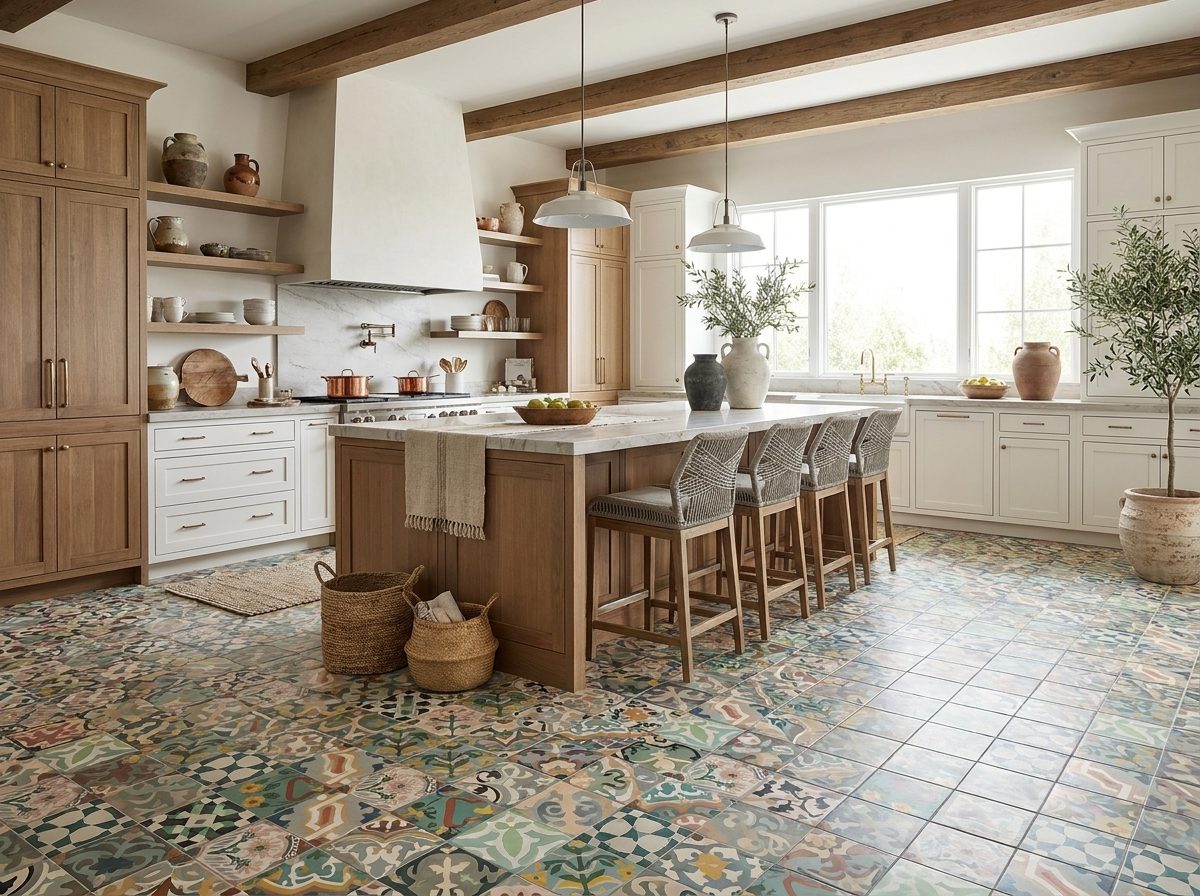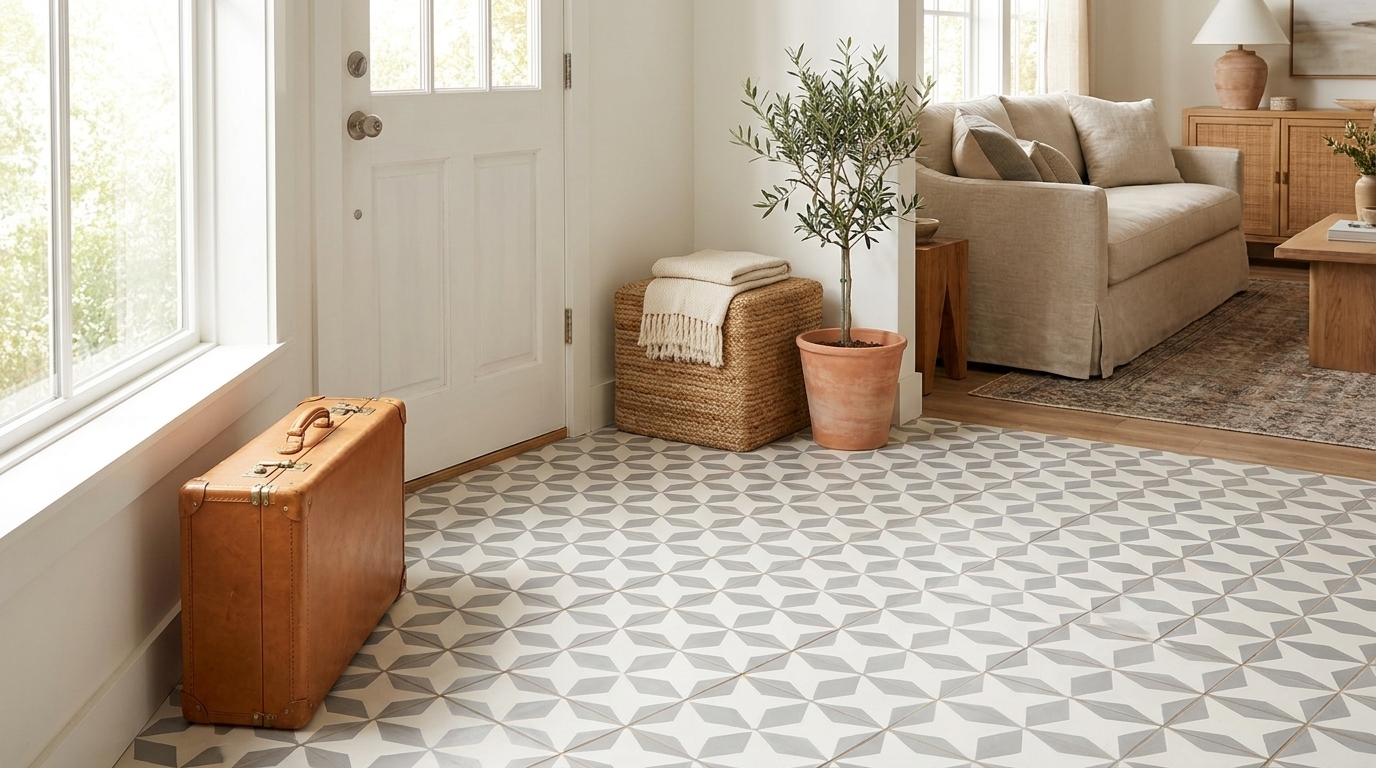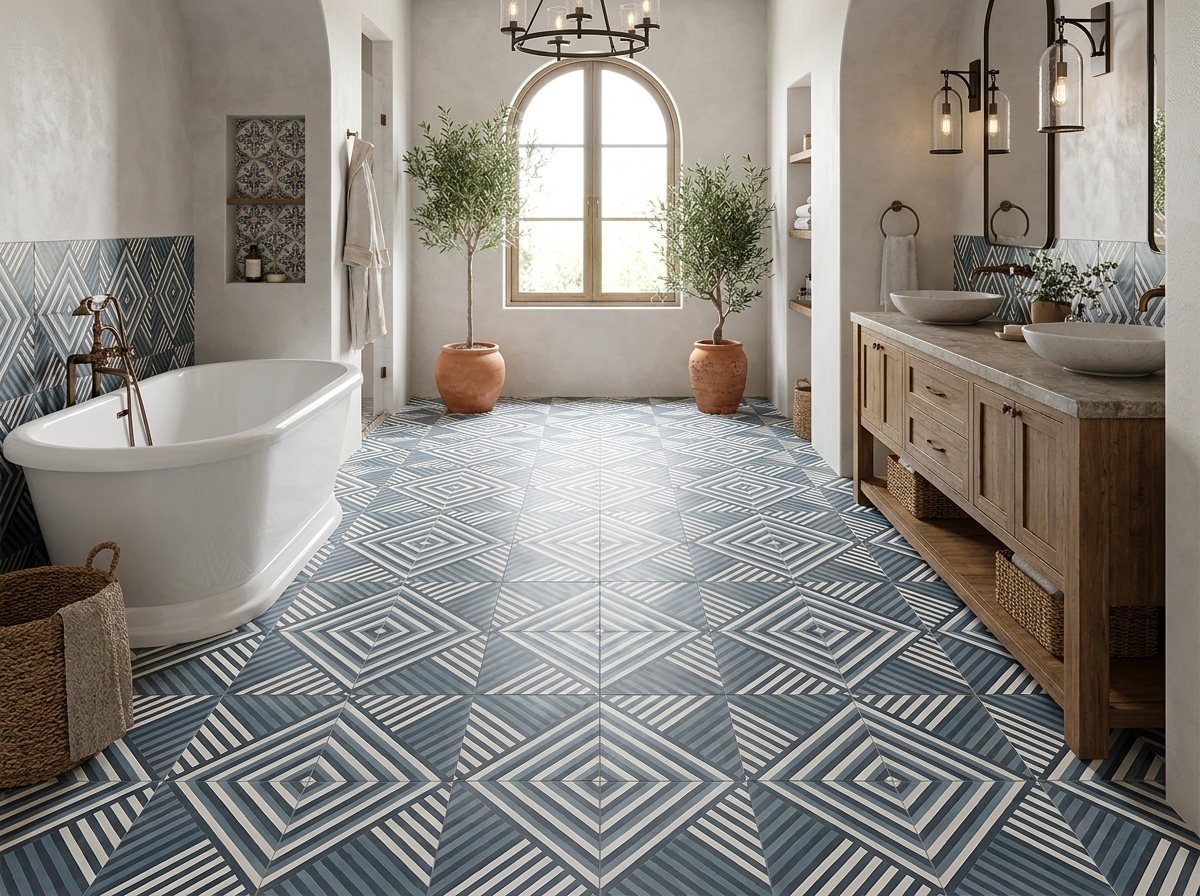
Pick up a factory tile and a handmade cement tile and your hands will know the difference before your eyes do. One is feather-light, glass-smooth, identical to the thousand tiles behind it. The other has weight, a matte mineral surface, and the barely-perceptible signature of the person who pressed it. The debate of handmade vs machine-made tiles isn’t really about which is “better” — it’s about understanding what each process produces, and which belongs in your project.
At Original Mission Tile, we’ve spent generations on the handmade side of this question, pressing tiles one at a time the way it’s been done for over a century. In this guide we’ll walk through how each type is made, what those processes mean for looks, durability, and cost — and why the difference matters more in some rooms than others.
Two Factories, Two Philosophies
Machine-made tile is an industrial marvel: clay or porcelain bodies extruded and pressed by automated lines, patterns inkjet-printed, glazes applied and kiln-fired by the truckload. The output is fast, cheap, and perfectly uniform — thousands of identical tiles a day.
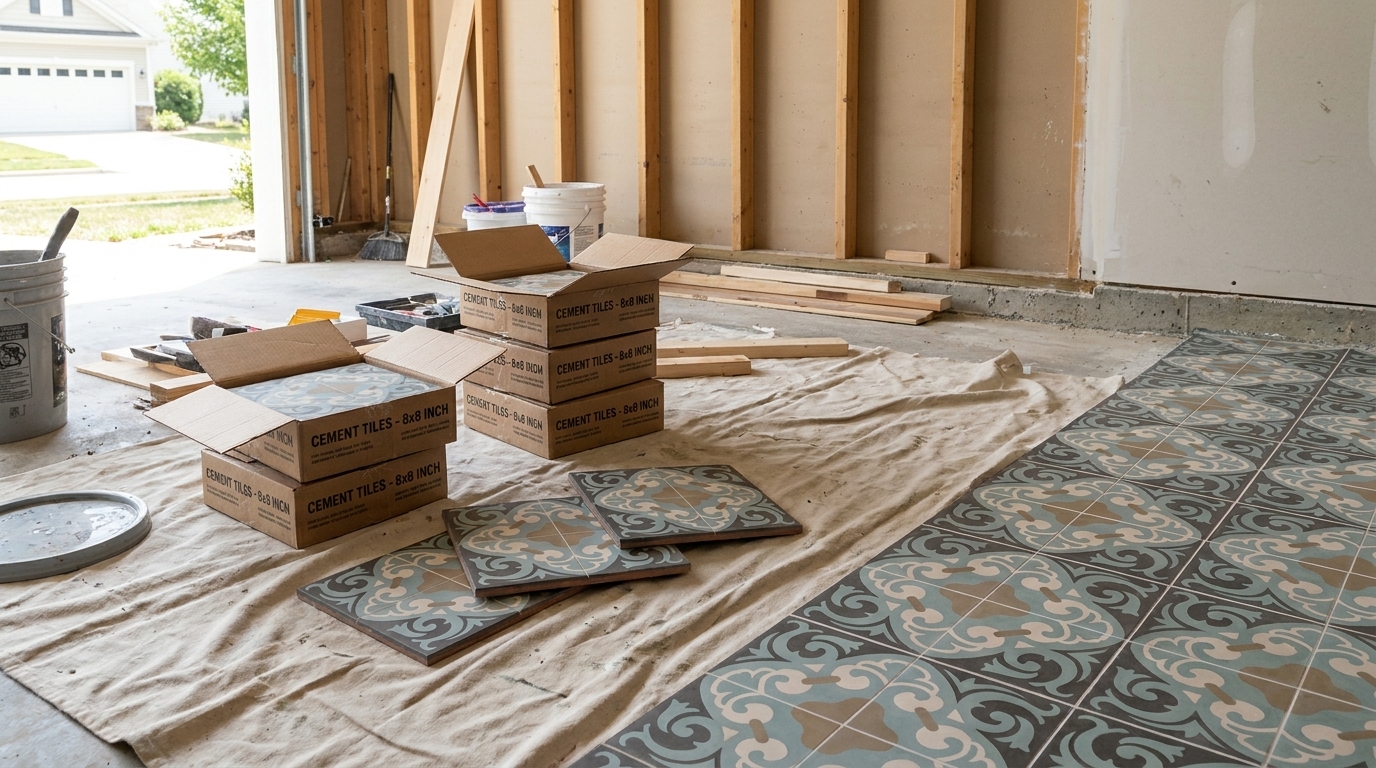
Handmade cement tile follows a process that hasn’t fundamentally changed since the 1800s: an artisan pours mineral pigments into a metal mold divider, backs it with cement, and presses the tile hydraulically — one tile, one press, one pair of hands at a time. No kiln, no glaze, no printing. The pattern is solid pigmented cement, millimeters deep.

What the Difference Looks Like
- Surface. Machine tile is sealed under glaze — uniform, often glossy. Handmade tile is matte and mineral, with a velvety depth that shifts in changing light.
- Variation. Every machine tile matches perfectly; that uniformity reads flat across a floor. Handmade tiles vary subtly in tone — and that’s precisely the point: the finished installation feels alive.
- Pattern integrity. A printed pattern is a picture of a design. A hand-pressed pattern is the design — pigment you can feel at the surface, that wear reveals rather than erases.
- Customization. Machine lines offer the catalog. Handmade production offers your palette, your pattern, even your logo — in any quantity.

Durability: Uniform vs. Enduring
Machine-made tile is hard and consistent, but its beauty lives in a thin glaze: chip it and the different-colored body shows through permanently; wear it and the printed pattern thins. Handmade cement tile works the opposite way — the color layer is thick solid pigment, so decades of traffic produce patina instead of damage. That’s why century-old handmade floors across Mexico, Europe, and the American Southwest are still in service, while machine-made floors typically cycle out every 15–25 years.
Cost: What You Pay and What You Get
Machine-made tile wins on sticker price — automation is cheap, hands are not. But the full accounting includes lifespan (one handmade floor vs. two or three replacement cycles), distinctiveness (your pattern vs. everyone’s catalog), and resale character. In statement areas — entries, baths, kitchens, hospitality spaces — the price difference per square foot buys a fundamentally different product.

When Each One Makes Sense
Machine-made is the practical pick when: budget rules a purely functional space, you need large formats with minimal joints, or zero maintenance is the top priority.
Handmade is the right call when: the room is meant to be seen and remembered; you want authentic matte pattern instead of a printed imitation; the project calls for custom colors or a one-of-a-kind design; or you’re building for decades, not renovation cycles.
Handmade vs. Machine-Made FAQ
Are handmade tiles harder to install?
The process is similar with a few extra steps — flat substrate, sealing before grout, narrow joints. Any experienced setter handles it well; we include installation guidelines with every order.
Is the tile-to-tile variation a defect?
It’s the signature. Subtle tonal variation is what gives a handmade floor movement and warmth — blend tiles from several boxes during installation to distribute it evenly.
Do handmade tiles need more maintenance?
They need sealing at installation and a re-seal every couple of years, plus pH-neutral cleaning. That modest routine is the trade for a floor that outlives every machine-made alternative. Our care guide covers it.
Can I see the difference before buying?
Absolutely — order samples of any pattern. Hold one in your hand and the handmade difference explains itself.
The Bottom Line
Machines make tiles efficiently. Hands make tiles memorably. If a floor’s only job is to be a floor, automation serves fine — but if it’s going to define a room, carry a pattern, and age into character, only the hand-pressed original delivers. Designs like ELLIS Navy, AGADIR Gris, and FLOR MEXICO Mohave exist because someone pressed them, one tile at a time — and that’s exactly what you feel when you walk into a room floored with them.
See the handmade difference yourself — browse hundreds of hand-pressed patterns, visit our project gallery, or contact us for samples.