Every tile project starts with the same deceptively simple question: how many tiles do I need? Order too few and you risk a mid-project halt waiting for material — or worse, a new production lot that doesn’t quite match the first. Order far too many and you’ve parked money in boxes you’ll never open. The good news: getting this right takes ten minutes, a tape measure, and the simple math in this guide.
At Original Mission Tile, we’ve helped thousands of homeowners, designers, and contractors order handmade cement tile for everything from powder rooms to hotel lobbies. This is the exact process our team walks customers through: how to measure any space, which waste percentage actually fits your layout, how tile size changes the count, and the ordering details that matter more with handmade tile than with anything off the shelf.
Step 1: Measure the Space (the Right Way)
- Break the area into rectangles. Almost any floor or wall can be divided into simple boxes — main area, alcove, closet, niche. Measure each rectangle’s length and width in feet.
- Multiply and add. Length × width for each rectangle, then add them together for total square footage.
- Don’t subtract small obstacles. Vanities, toilets, and islands feel like savings, but you’ll cut around them and lose those pieces. Only subtract truly large uncovered zones (a kitchen’s full cabinet run, a tub footprint).
- Measure walls the same way. For backsplashes and shower walls: width × height per wall, minus windows and doors only if they’re large.
Example: a 9 ft × 11 ft bathroom (99 sq ft) plus a 2 ft × 4 ft shower curb and niche area (8 sq ft) = 107 sq ft before waste.

Step 2: Add the Right Waste Percentage
“Waste” isn’t waste — it’s cuts, breakage, pattern matching, and your future repair stash. The right number depends on the layout:
- 10% — straight (grid) layout in a simple rectangular room. The minimum we recommend for any project, ever.
- 15% — diagonal layouts, herringbone, or rooms with many corners, niches, and angles. Diagonal cuts consume tile fast.
- 15% — patterned cement tile where motifs must align: every cut has to land in the right spot on the pattern.
- 20% — complex layouts: multi-pattern designs, borders with corner pieces, curved edges, or L-shaped rooms with diagonal orientation.
Our 107 sq ft bathroom with a patterned tile at 15% waste: 107 × 1.15 = 123 sq ft to order.
The handmade-tile reason to never skip this step: cement tiles are pressed in production lots, and color between lots can vary subtly — that’s the nature (and charm) of the craft. Ordering enough from a single lot, including spares, means every tile in your floor matches and future repairs are invisible.
Step 3: Convert Square Feet to Tile Count
Divide the area to order by the coverage of one tile:
| Tile size | Tiles per sq ft |
|---|---|
| 8″ × 8″ (the classic cement tile) | 2.25 |
| 4″ × 4″ | 9 |
| 6″ × 6″ | 4 |
| 8″ hexagon | ~2.6 |
| 2″ × 8″ border pieces | sold per linear foot — measure the perimeter |
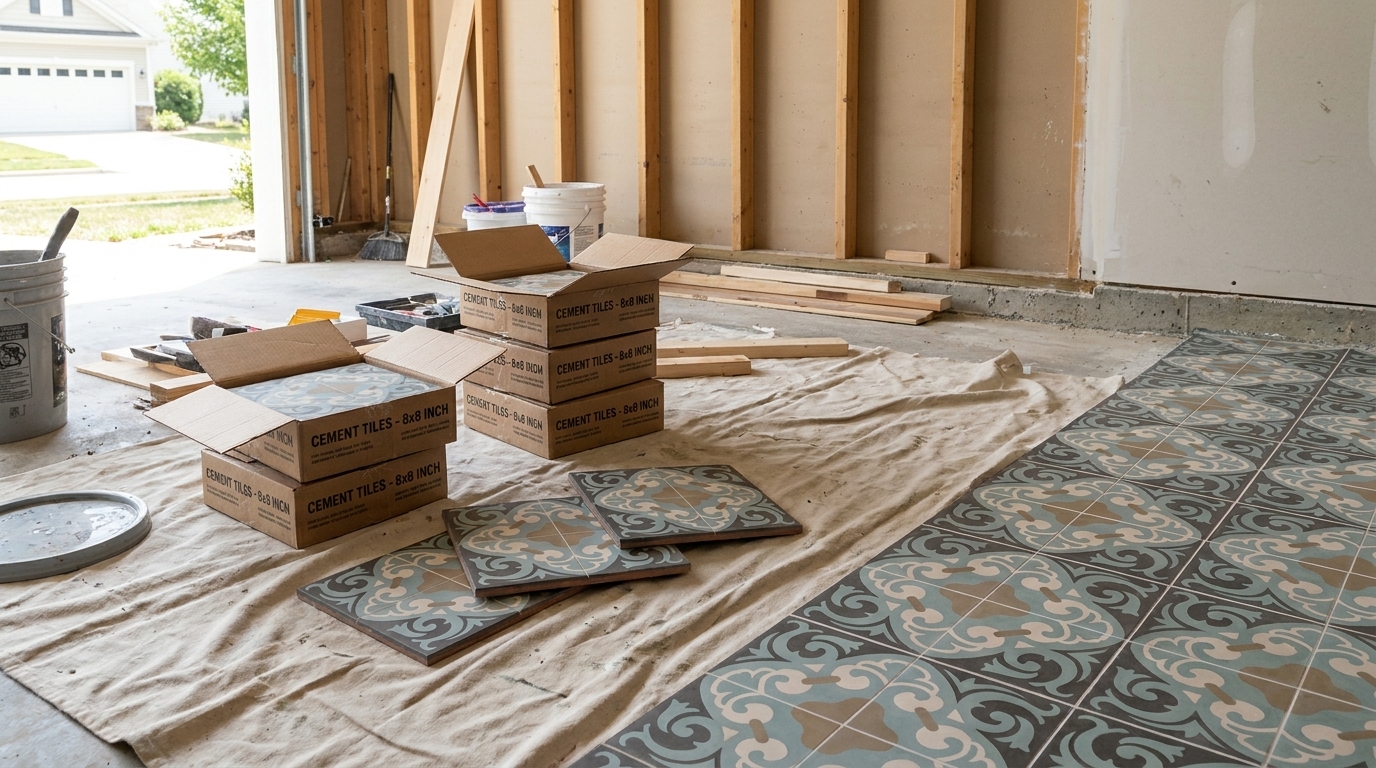
Our example: 123 sq ft × 2.25 = 277 tiles (8×8). Round up to the box — partial boxes aren’t a thing you want to negotiate on delivery day.
Borders and trims count separately. Measure the linear feet of the border path, add 10% for corner cuts, and remember corner pieces if the design uses them.

Step 4: Order Like a Pro
- Order everything at once. One order, one production lot, perfect color consistency. This is the single most important handmade-tile ordering rule.
- Keep the spares. After installation, box the leftovers and store them flat. A cracked tile in year ten gets an invisible, same-lot repair.
- Check coverage per box before ordering. Our product pages list exact tile dimensions and box coverage, so the math takes seconds — browse the in-stock cement tile collection to see it in practice.
- Doing a custom design? Custom orders through our Design Studio are produced to your quantity — getting the count right the first time keeps your timeline intact.
- Share the plan with your installer. A quick review of your layout and waste math by the person doing the cutting catches surprises before they’re expensive. Our installation guidelines cover the rest.
Quick Reference: The Formula
(Total sq ft) × (1 + waste %) ÷ (sq ft per tile) = tiles to order
- Measure in rectangles, add them up
- Add 10% (simple), 15% (diagonal/patterned), 20% (complex)
- Divide by tile coverage, round up to full boxes
- Order once, from one lot, and keep the spares
How Many Tiles Do I Need? FAQ
Is 10% waste really necessary for a simple room?
Yes. Even a perfect rectangle needs perimeter cuts, and shipping plus handling of any tile — handmade or industrial — involves occasional breakage. 10% is the professional floor, not a padding.
What if I run out mid-installation?
Contact us immediately — we’ll match your order to its production lot if stock remains. But new-lot color variation is always possible, which is why the answer to “should I round up?” is always yes.
How many tiles do I need for a backsplash?
Measure width × height per wall section, subtract only large openings, and add 10–15%. Small-format tiles and patterned designs sit at the 15% end.
Do you help with quantity checks?
Every day. Send your measurements and layout to our team and we’ll confirm the count, boxes, and borders before you order.
How much grout and thinset will I also need?
Grout depends on tile size and joint width; your installer will confirm quantities, and adhesive coverage is listed on the product bag. See our installation guidelines for the full materials checklist.
The Takeaway
“How many tiles do I need” has a real answer, and it isn’t a guess: measure in rectangles, add the waste percentage your layout demands, convert by tile size, and order it all in one lot with spares in the closet. Ten minutes of math protects your budget, your timeline, and the flawless color consistency that makes a handmade floor look like it was always meant to be there.
Ready to run your numbers on a real design? Browse hundreds of handmade patterns in stock, or contact our design team — send us your measurements and we’ll confirm your exact order, boxes and all.