Our tile calculator guide answers “how many tiles do I need” for a simple square layout. But the moment you choose a hexagon, a scallop or a diagonal pattern, the waste number changes — and ordering wrong in either direction costs real money. This is the missing chapter: waste percentage by tile pattern, with the numbers installers actually use.
The waste table
Straight grid (square tile): 7-10% overage. Diagonal / diamond layout: 12-15% — every wall edge becomes a diagonal cut. Herringbone: 13-15%, the diagonal problem on every row. Hexagons: 10-12% — half-hex cuts at two walls. Fishscale / scallop: 10-12%, cut rows where scales meet edges. Connected 4-tile patterns (where motifs must stay whole): 12-15%, because centering the pattern sacrifices perimeter tiles. Start from your base number in How Many Tiles Do I Need? and apply the right percentage.

Scallops meeting a pool edge: every curve at that line is a cut — that’s your 10-12%.
Why the pattern changes the math
Waste is made at edges. A square tile meeting a straight wall wastes almost nothing; a hexagon meeting the same wall loses half a tile per row; a centered connected pattern loses whatever the border eats. More edges, more angles, more waste — which is why an L-shaped room or a floor full of cabinets wastes more than an open rectangle of the same area.

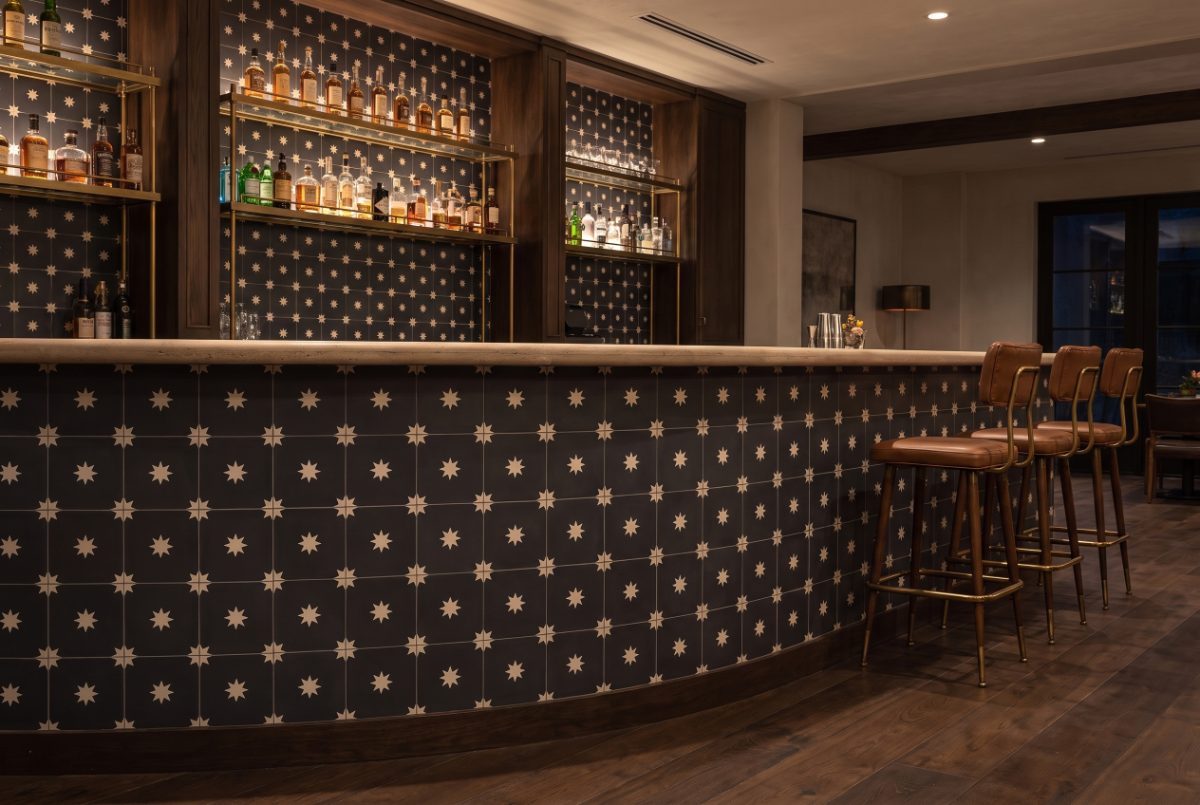
A bold connected pattern like Tyler II: centering it is what makes it look right — budget the perimeter for it.
The two expensive mistakes
Under-ordering means a second freight charge and, with handmade tile, a different production lot — our shade variation guide explains why lots matter. Over-ordering beyond ~15% is money on a shelf. The fix is boring and reliable: measure twice, apply the pattern’s percentage once, and keep 4-6 spare tiles after the install for future repairs.

The exception that saves money: patchwork layouts have no motif to break, so 7-8% covers them.
Pro move: send us the floor plan
For connected patterns and shaped tiles, a sketch with measurements lets us count the cut rows for your actual room instead of a rule of thumb. Send it over with your design pick, or start with samples and the in-stock catalog — we’ll make sure the order is right the first time.