You’re standing in the room that needs the most help. Maybe it’s a plain backsplash, a bath wall with no focal point, or an entry floor that feels flat the moment you walk in. The goal is usually the same. Add pattern, color, and craftsmanship without turning the space into a stage set.
That is the ultimate test behind strong moroccan tile design ideas. Good Moroccan-inspired work is not just decorative. It uses pattern with discipline, respects how the room will be cleaned and lived in, and matches the installation method to the material. Homeowners usually respond to the romance first. Installers and designers have to solve the rest, including scale, grout joints, layout, slip resistance, and budget.
Moroccan tile has lasted because the design language is ordered, not random. The patterns come from a long craft tradition, but they still fit modern kitchens, baths, courtyards, and fireplace walls when the proportions are handled well. Historic influence matters, but so does editing. A full wall of movement can be beautiful. It can also overwhelm a small room if every surrounding surface competes with it.
This guide treats each idea as a design decision, not just a photo reference. You’ll see what defines each look, where it performs well, where it creates problems, and how to adapt it for a current interior. For projects that need a custom color, shape, or layout approach, custom Moroccan and zellige tile options from Original Mission Tile make it possible to get the character of traditional work while fitting the realities of a specific space.
For modern rooms, restraint usually gives better results than excess. Use Moroccan geometry where it will carry the room, then calm the rest of the palette and finishes around it. If you want a solid framework for mixing active patterns with quieter surfaces, these Miller Waldrop Furniture & Decor tips for working with patterns in a room are a useful reference.
1. Zellige Tile Patterns
Zellige is the reference point for almost every Moroccan surface story. It’s hand-cut, geometric, and visually alive in a way machine-perfect tile usually isn’t. That slight irregularity is the appeal, not the flaw.

Historically, Islamic artistic principles pushed Moroccan tile design toward geometry rather than depictions of living things. That constraint became one of Zellige’s defining strengths, and you can still see it in places like the 14th-century Madersa Ben Youssef in Marrakech and the Alhambra in Granada, as described by Riad Tile's overview of Moroccan tile history. For a homeowner, that means these patterns don’t read as random decoration. They read as ordered design.
In practice, Zellige works best on walls. Kitchen backsplashes, fireplace surrounds, vanity walls, fountain walls, and niche interiors all suit it well. Full floors are a different conversation. They can be beautiful, but they demand more planning and the right application.
Where Zellige works best
A powder room accent wall is often the safest entry point. You get shimmer, handcrafted depth, and pattern without forcing the whole room to compete.
A kitchen backsplash also makes sense. It’s visible at eye level, it catches light, and it lets the variation do the work.
Practical rule: Don’t ask Zellige to behave like a rectified porcelain. If you want tight, uniform lines, choose another material.
For homeowners who love the look but want a direct path into the style family, Original Mission Tile's zellige-inspired collection is a useful starting point.
A common mistake is pairing richly varied Zellige with too many other competing textures. If the wall already has gloss, tonal variation, and geometric movement, keep the counters, cabinets, and adjacent field tile quieter. The strongest rooms usually have one visual lead and several supporting materials.
If you want to see the craft in motion, this installation video gives helpful visual context.
2. Geometric Star and Cross Patterns
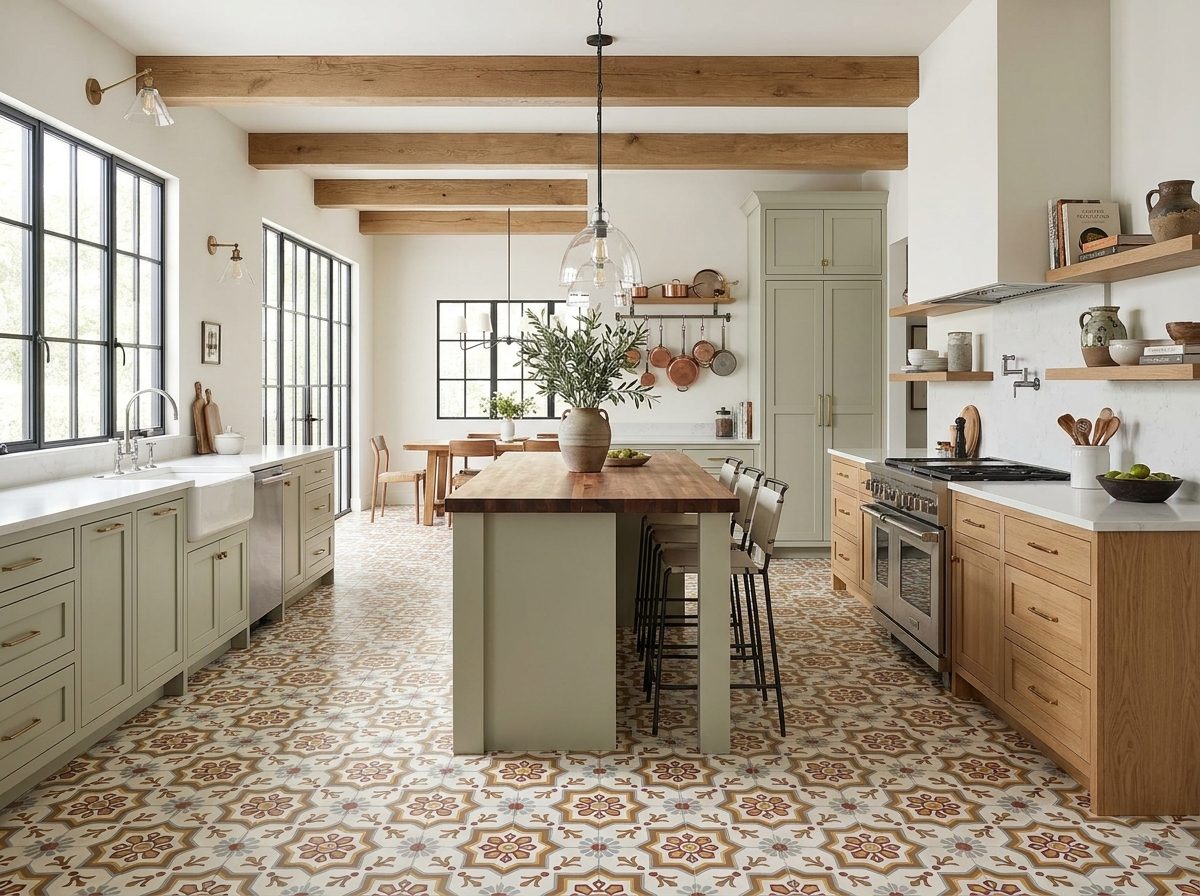
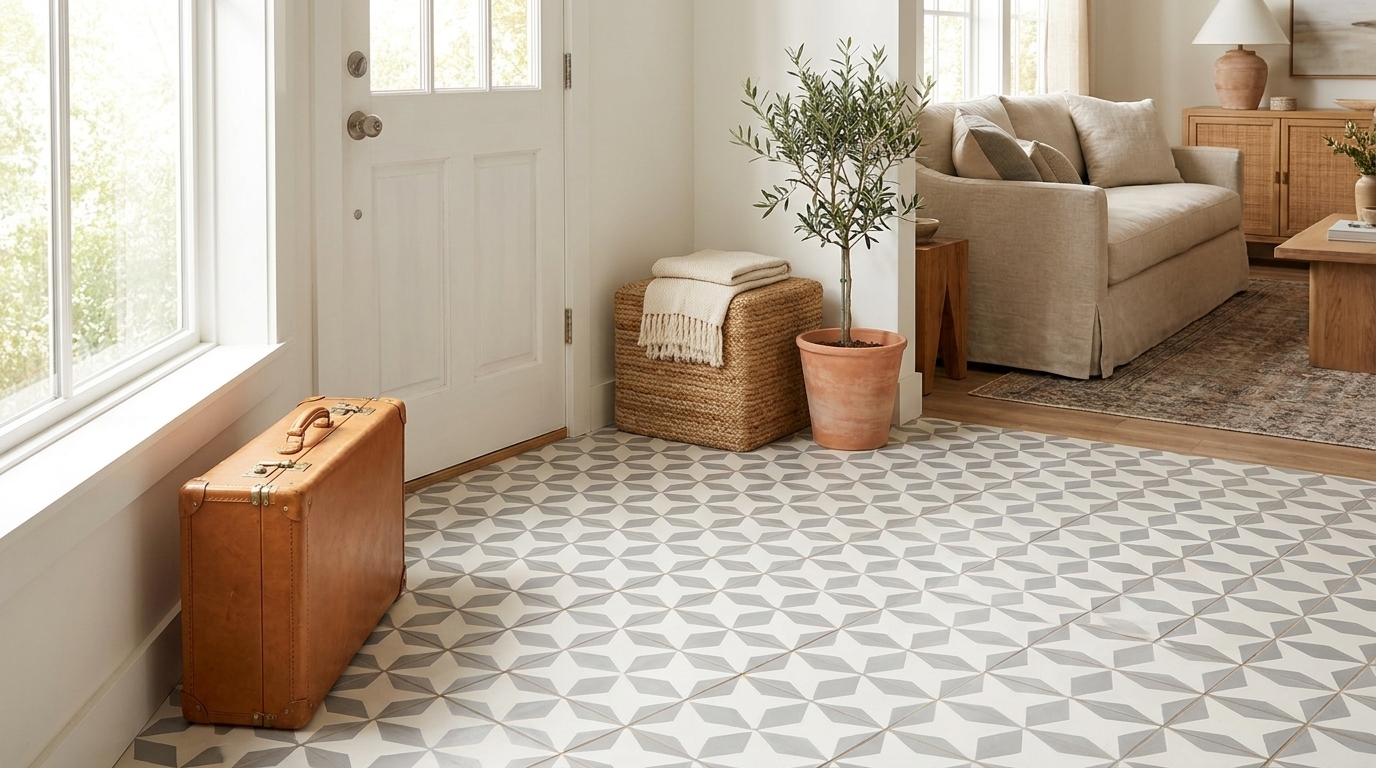
If someone asks for the classic Moroccan look, star and cross is usually what they mean. It’s architectural, rhythmic, and highly adaptable. Traditional versions feel historic. Monochrome versions feel almost graphic and modern.

These patterns earn their keep on floors because they create order across a larger surface. In an entry, mudroom, bar area, or covered patio transition, they read clearly from a distance. In a small bath, they can turn a plain footprint into a designed room.
What works and what doesn’t
What works is giving the pattern boundaries. Frame it with a border, stop it cleanly at a threshold, or use it as a rug effect inside a larger plain field. What doesn’t work is letting a high-energy pattern drift into every adjacent plane with no visual stop.
I often recommend two approaches:
- Monochrome interpretation: Use one color family for a quieter, more contemporary version.
- Bordered field: Wrap the star and cross pattern with a solid perimeter tile so the installation looks intentional.
- Runner layout: In long spaces, use the motif as a central run rather than wall-to-wall coverage.
This style also connects nicely to broader Moroccan and Iberian traditions. It’s especially useful if you want a floor that feels rooted in history without leaning ornate.
3. Arabesque and Floral Motifs
Not every Moroccan-inspired room needs sharp geometry. Arabesque and floral motifs soften the composition. They bring movement, curve, and a more lyrical rhythm to spaces that might otherwise feel too rigid.
This category is strong in powder rooms, boutique-style bathrooms, and hospitality settings where the goal is elegance more than strict symmetry. A vanity wall in a deep blue or green arabesque pattern can feel layered and old-world without looking heavy. A restaurant backsplash can use the same language and feel refined rather than rustic.
Best use in modern interiors
Arabesque patterns usually perform better when they aren’t competing with a busy floor. Put the ornament on the wall, then ground the room with simpler flooring. That balance matters.
For designers looking for motifs that lean historical rather than trendy, Original Mission Tile's historic tile patterns are a practical reference.
Use arabesque as the jewelry of the room, not the entire outfit.
Color matters here more than people expect. Jewel tones can look rich and authentic, but if the room is small or low-lit, they can also make the envelope feel close. In those cases, a softer neutral pattern with stronger contrast in hardware, millwork, or paint usually holds up better.
One thing I’d avoid is combining arabesque walls with highly figured stone counters, patterned wallpaper, and decorative floor tile all at once. Each element may be beautiful alone. Together, they fight.
4. Fish Scale and Scallop Patterns
Fish scale and scallop shapes aren’t the first pattern commonly associated with Moroccan tile, which is exactly why they can work so well. They bring a softer curve into a design language that often leans geometric.

These shapes shine on vertical surfaces. Think shower feature walls, kitchen backsplashes, bar fronts, and niche backs. The repeating curve creates motion without the strict formality of star geometry.
Why this shape feels current
Scallop layouts fit especially well in homes that mix Mediterranean, coastal, modern, and Moroccan cues. They’re decorative, but they don’t feel locked into one era. In matte cement tile, they also read differently than glossy ceramic versions. The effect is softer and more tactile.
A few practical notes make a big difference:
- Use shape as the main feature: Pick a restrained color if the silhouette is already expressive.
- Light it well: Curved layouts reveal more depth with good side lighting or layered ambient light.
- Keep adjacent surfaces simple: Flat field tile, plaster, stone, or painted drywall usually pairs well.
Climate and maintenance deserve more attention here than most style galleries give them. There’s very little detailed discussion of how Moroccan-style cement tiles behave in mixed climates, especially around humidity, UV exposure, or freeze-thaw conditions, according to My Stone Floor's discussion of Moroccan-inspired tile gaps. That matters if you’re considering an exterior wall, sun-heavy patio zone, or damp bath.
For that reason, I’d reserve fish scale cement tile for protected walls unless the spec has been reviewed carefully for the exact environment.
5. Hexagon and Multi-Sided Format Tiles
Hexagon tile is one of the easiest ways to bring Moroccan influence into a space without going fully traditional. The geometry does much of the work on its own. Even a solid-color hex field has enough presence to feel considered.
This is a strong move for people who like Moroccan structure but don’t want an overtly historic pattern. In a kitchen floor, it feels grounded. In a bath, it can read clean and refined. In a commercial entry, it adds shape without visual clutter.
Smart applications
I like hexagons in three scenarios. First, as a single-color field with a contrasting grout that emphasizes the shape. Second, as a tile rug where patterned hexagons sit inside a border of solids. Third, as a wall treatment where the geometry supports open shelving, mirrors, or brass fixtures without competing with them.
The shape also sits comfortably beside modern materials like white oak, honed stone, concrete, and blackened steel. That makes it one of the easiest moroccan tile design ideas to adapt for newer homes and mixed-style renovations.
In many projects, format creates enough personality. You don’t always need a busy pattern on top of a distinctive shape.
What tends not to work is mixing too many polygonal ideas in one room. If the floor is hexagon, keep the wall tile calmer. If the backsplash is a multi-sided pattern, don’t force an unrelated geometric rug tile underfoot unless the room is large enough to separate the reads.
6. Solid Colors with Strategic Layouts
Some of the best Moroccan rooms aren’t pattern-on-pattern. They use solids with discipline. Then they place the ornament exactly where it matters.
That approach is also practical. In Morocco’s commercial flooring market, vitrified ceramic tiles held the largest revenue share in commercial flooring in 2022, and that segment is projected to maintain its lead through 2030 because developers prioritize durability, low maintenance, and consistent sizing for large-format installations, according to Grand View Research's Morocco commercial flooring outlook. The takeaway for residential work is simple. Consistent field surfaces are useful. Pattern has more impact when it’s targeted.
How to make solids feel Moroccan
Use color and layout, not just print. Terracotta, chalky white, deep green, warm sand, muted blue, and black all sit naturally in this vocabulary. Then arrange them in checkerboards, stripe bands, framed thresholds, stair risers, or wainscot-style fields.
For homeowners who want a cement-tile look without committing to full-room pattern, Original Mission Tile's encaustic-style cement tile collection offers a range of solids and patterns that can be mixed intentionally.
This strategy is especially effective in remodels where budget and schedule are tight. Most Moroccan tile content focuses on full decorative installations, yet there’s limited practical guidance on using a smaller accent wall or modular patchwork to control cost and labor, a gap noted by Lavish Ceramics in its Moroccan tile design article. That’s exactly where solids help. They let you preserve the pattern’s impact without overloading the scope.
A good example is a kitchen with a mostly solid backsplash and one patterned range wall, or a bathroom floor in solids with a single decorative band at the vanity.
7. Brass and Metal Accent Integration
Brass changes the mood immediately. It moves Moroccan tile away from rustic warmth and toward refined luxury. Used well, it can echo lanterns, tray tables, mirror frames, and other metalwork traditions without feeling theatrical.
This idea makes the most sense in small, high-visibility zones. A powder room floor insert, a vanity backsplash panel, a bar front, or an entry medallion can justify the detail. A large whole-room installation usually doesn’t.
Where metal inlays earn their cost
Metal accent integration works when the layout has breathing room. If every tile line is busy and every finish is reflective, the brass gets lost. If the surrounding field is controlled, the metal reads clearly.
I’d treat it like this:
- Feature placement: Use brass-inlaid tile as a focal panel or rug effect.
- Finish coordination: Pair it with warm hardware so the room feels coherent.
- Material restraint: Keep nearby stone, wallpaper, and lighting finishes disciplined.
One trade-off is maintenance visibility. Brass can show age, fingerprints, and shifts in patina depending on finish and location. Some clients love that. Others expect a frozen-in-time look. That expectation needs to be settled before you specify it.
This is also not the place to cut corners on fabrication or layout review. Custom metal work needs exact drawing approval, exact transitions, and an installer who understands how the tile, grout, and adjacent finishes all meet.
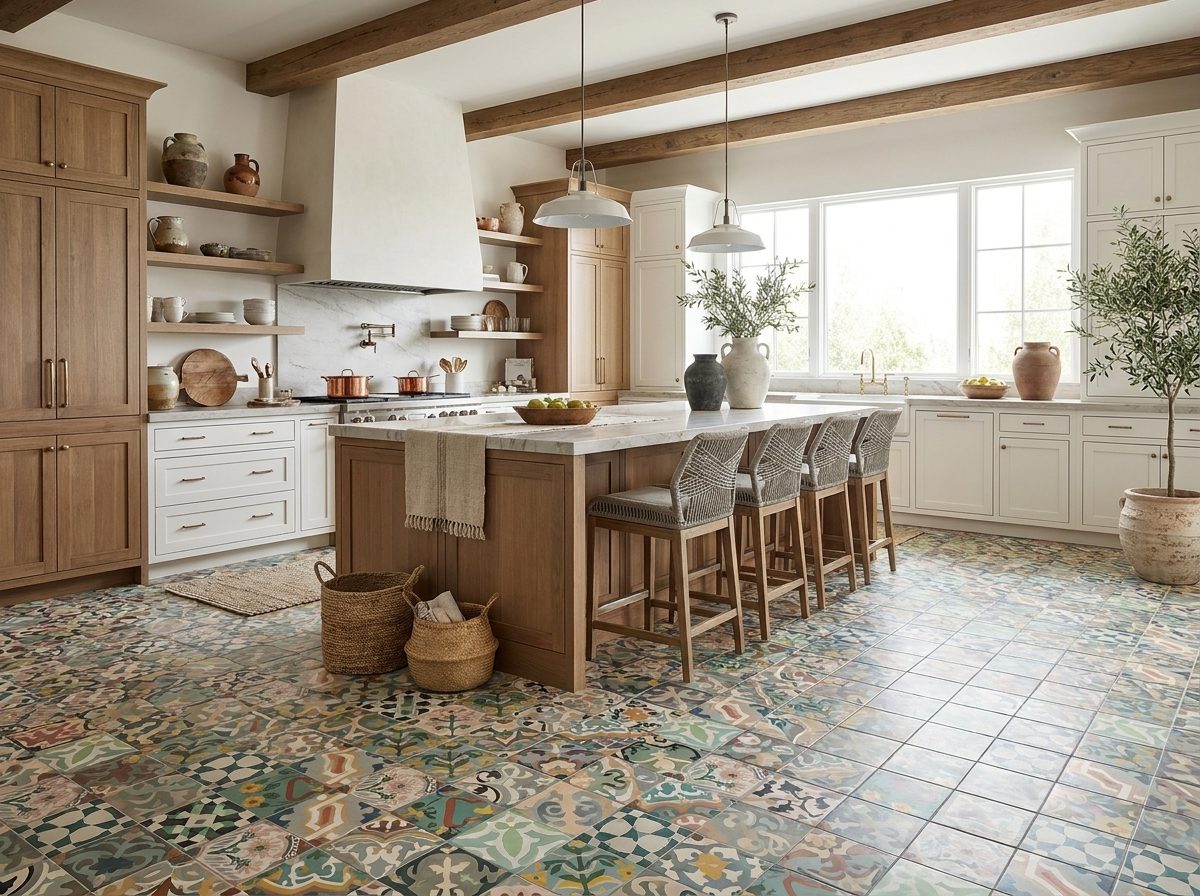
8. Mixed Pattern Layouts and Patchwork Designs
A homeowner falls in love with six Moroccan tile patterns, orders all six, and expects the installer to make them work on site. That is usually where patchwork goes wrong. The best mixed layouts are designed before a single box is opened, with a clear hierarchy, controlled color, and a plan for where the eye should rest.
Patchwork earns its place in compact, high-impact areas. Backsplashes, powder rooms, stair risers, fireplace surrounds, and short feature walls all benefit from that collected-over-time look. On a large floor, though, too much variation can make the room feel busy and shorten the life of the design.
The practical advantage is flexibility. Mixed layouts let you pull from several Moroccan traditions, geometric repeats, floral motifs, and quieter solids, then tune the composition to the architecture instead of forcing one pattern everywhere. The trade-off is planning time. Random placement rarely looks intentional once grout is in.
How to keep patchwork cohesive
Start with one organizing rule and hold it. In some projects, that rule is color. In others, it is scale, border structure, or a repeating interval that keeps stronger motifs from competing with each other.
Use this framework:
- Choose a lead pattern: Let one motif carry the design, then support it with secondary patterns.
- Control the palette: Shared glaze colors or related cement tones keep the mix from splintering.
- Vary intensity carefully: Pair bold tiles with quieter pieces so every square foot is not asking for attention.
- Set the layout in advance: Dry-lay the field, map it digitally, or number sheets before installation begins.
Material choice matters here. Handmade tile gives patchwork warmth, surface variation, and the slight irregularity that makes the composition feel collected and human. Factory-made tile gives tighter repetition and easier replacement if a piece is damaged later. Neither is automatically better. The right choice depends on whether the goal is character or precision.
This is also one of the smartest places to use Original Mission Tile's custom capabilities. A designer can start with established Moroccan pattern language, adjust the colorway for the room, and combine motifs into a layout that feels specific to the project instead of lifted from a catalog. That custom control is what keeps patchwork from looking accidental.
8-Style Moroccan Tile Design Comparison
| Tile Type | Implementation Complexity 🔄 | Resource Requirements ⚡ | Expected Outcomes 📊 | Ideal Use Cases 💡 | Key Advantages ⭐ |
|---|---|---|---|---|---|
| Zellige Tile Patterns | High, hand-cut, precision layout; skilled installers required | High, artisan labor, longer lead times, higher install cost | Dramatic, textured luxury focal points; each installation unique | Accent walls, backsplashes, entryways, luxury hospitality | Authentic craftsmanship; highly customizable; strong cultural storytelling |
| Geometric Star and Cross Patterns | Medium, precise alignment but available ready-to-ship options | Medium, standard cement tile costs; less custom labor than zellige | Timeless, repeatable visual impact; scales from accents to full floors | Floors, borders, courtyards, residential & contemporary spaces | Recognizable Moroccan aesthetic; scalable; faster deployment |
| Arabesque and Floral Motifs | Medium–High, intricate layouts need careful planning | Medium–High, design sensibility and careful installation | Elegant, flowing rhythm; refined and calming visual effect | Feature walls, spas, upscale hospitality, backsplashes | Organic sophistication; refined elegance; strong photographic appeal |
| Fish Scale and Scallop Patterns | Medium, alignment and complex cuts around fixtures | Medium, special cutting, more grout maintenance | Textural, tactile matte finish; soft, organic movement | Feature walls, bathroom surrounds (walls), backsplashes | Unique texture; contemporary yet classic; high visual interest |
| Hexagon & Multi‑Sided Format Tiles | Medium, edge treatments and borders require planning | Medium, available ready-to-ship but often pricier per sqft | Dynamic honeycomb flow; geometric character for floors and walls | Kitchens, bathrooms, entries, boutique hospitality | Versatile geometry; modern interpretation of traditional forms |
| Solid Colors with Strategic Layouts | Low–Medium, simple install but layout planning matters | Low, cost-effective for large areas; easier maintenance | Clean, versatile base that grounds a room and highlights accents | Floors, large fields, commercial spaces, as a pattern foundation | Highly versatile; durable and easy to maintain; cost-effective |
| Brass & Metal Accent Integration | High, metal inlay production and precision installation | High, premium materials, skilled craftsmanship, maintenance needs | Luxurious, bespoke high-impact installations | Powder rooms, boutique hotels, statement feature areas | Elevates perceived luxury; exceptional customization; very photogenic |
| Mixed Pattern Layouts & Patchwork Designs | High, intensive design planning and complex install | High, design time, varied materials, longer install labor | Highly unique, narrative-driven focal points with strong impact | Feature walls, curated backsplashes, design-forward hospitality | Personal expression; showcases multiple styles; flexible creativity |
Bring Your Moroccan Tile Vision to Life
A remodel usually gets real the moment samples hit the counter. The blue zellige that looked perfect on a mood board suddenly feels too busy for a full shower wall. The patterned cement tile you loved online may be better on a vanity wall than on the entire floor. Good Moroccan tile design starts with that kind of honest edit.
The strongest rooms come from matching the tile to the job. A kitchen backsplash can carry more movement and color because it is viewed in shorter bursts. A primary bath floor needs a pattern that still reads clearly once the vanity, tub, and rugs are in place. In an entry or hospitality setting, durability and slip resistance matter just as much as visual impact. Historical Moroccan patterns have lasted for centuries because they balance ornament with structure, and that same principle still works in current projects.
Material choice decides whether the design will age well. Use porcelain or another tightly controlled field tile where you need low absorption, easy cleaning, and consistent sizing across a large area. Use handmade cement tile where variation, depth, and hand-drawn character are part of the point. I often steer clients toward a hybrid approach. Let the more technical material handle the hard-working surfaces, then place the artisanal tile where the eye lands first.
That usually means feature areas do the heavy lifting.
Backsplashes, stair risers, vanity walls, fireplace surrounds, inset panels, and rug-style floor layouts often deliver more character than covering every square foot with pattern. The room feels more intentional, and the installation is easier to control. You also avoid a common mistake. An ambitious Moroccan pattern can overwhelm a space if there is no visual resting area around it.
Original Mission Tile is a practical source for this kind of project because it offers handmade cement tile, stocked patterns, and custom design capability from one manufacturer. That matters when a standard pattern is close but not quite right. Color adjustments, scale changes, border development, and specialty formats can make the difference between a tile that feels borrowed and one that feels built for the room.
Keep the selection process disciplined. Start with placement, then performance, then pattern. Ask how much water and foot traffic the tile will see, how much variation you want, and whether the room needs a focal point or a quieter field tile. For broader material planning during renovation, this guide to finding renovation materials is a practical companion read.
If you’re ready to turn these Moroccan tile ideas into a real specification, explore Original Mission Tile for in-stock cement tiles, custom pattern options, and design support for residential or commercial projects.