If you’ve been searching for Saltillo tiles, you already know what you’re after. That warm, earthy terracotta tone. The feeling of a sun-drenched Mexican courtyard. The sense that the floor beneath your feet was made by hand, from the earth itself. That visual and emotional quality is real, and it’s genuinely worth pursuing.
However, Saltillo tiles — the traditional kiln-fired clay tiles that have defined Mexican and Southwestern interior design for centuries — come with a set of performance limitations that cause real problems in contemporary residential and commercial projects. Before committing to a Saltillo installation, it’s worth understanding exactly what those limitations are, what causes them, and whether a better alternative exists for your specific project.
The good news is that it does. Handmade cement tiles in terracotta and earthy palettes deliver the same warmth and visual richness as Saltillo — with significantly better durability, dimensional consistency, and maintenance characteristics. This guide explains the difference, room by room, and helps you make the decision that’s right for your home or project.
What Are Saltillo Tiles, and Why Are They So Beloved?

Saltillo tiles take their name from the city of Saltillo, in the Mexican state of Coahuila, where they’ve been produced for generations. They’re made from natural clay, hand-formed or pressed into shape, and kiln-fired at relatively low temperatures. The result is a tile with a distinctive, slightly irregular surface, warm terracotta tones, and a porous, earthy quality that feels genuinely handmade.
Their appeal is understandable. Saltillo tiles carry cultural and historical weight. They connect a home to a rich design tradition, and they bring an earthy warmth that few other materials can replicate. For decades, they’ve been a defining feature of Southwestern, Spanish Colonial, and Mexican-influenced interiors across the United States.
Furthermore, when maintained well, a Saltillo tile floor can look beautiful for years. Their irregular edges and variable tones give a floor a lived-in character that mass-produced tiles can never achieve.
So what’s the problem?
The Real Limitations of Traditional Saltillo Tiles

High Porosity Is a Daily Maintenance Challenge
Saltillo tiles are among the most porous tile materials available. Unsealed, they absorb liquids almost immediately. Even when properly sealed, the porous clay body beneath the surface coating requires constant vigilance in kitchens and bathrooms, where spills happen every day.
Consequently, acidic substances — wine, citrus juice, coffee, tomato sauce — can stain or etch the surface even through a sealer. Resealing requirements are frequent, and the process is more involved than with denser tile materials. For homeowners who want a low-maintenance kitchen floor, this is a significant drawback.
Dimensional Inconsistency Complicates Installation
Traditional Saltillo tiles are hand-formed, which means thickness variation from tile to tile is significant. Therefore, installers must work carefully to compensate for uneven tile bodies, using more adhesive in some areas than others to achieve a level surface. As a result, lippage — where one tile sits higher than its neighbor — is common in Saltillo installations.
For contractors, this dimensional inconsistency adds time and skill demands to the installation process. Furthermore, it makes achieving a refined, contemporary finish difficult, since a perfectly flat floor requires tiles with consistent thickness.
Fragility Under Impact and Freeze-Thaw Conditions
Kiln-fired at lower temperatures, Saltillo tiles have a relatively soft body compared to denser tile materials. They chip at edges and corners under normal residential use, and in climates where temperatures drop below freezing, moisture trapped in the tile body can expand and crack the tile.
Additionally, for outdoor applications in most U.S. climates, traditional Saltillo tiles are a risky specification. Their porosity allows moisture penetration, which freeze-thaw cycling then converts into physical damage.
How Cement Tiles Solve the Saltillo Problem

Cement tiles achieve the same earthy warmth and handmade quality as Saltillo tiles through a fundamentally different manufacturing process — one that solves all three of Saltillo’s core limitations.
The process: Each cement tile is hand-pressed, not kiln-fired. Mineral pigments mixed with white cement are poured into a metal mold, followed by a layer of cement and marble powder. A hydraulic press compresses the layers under thousands of pounds of pressure. The result is a denser, more dimensionally consistent tile with color that runs through the full wear layer, not sitting on a porous surface coating.
Durability advantage: Because the body is denser and the pigment runs through the full tile, cement terracotta tiles resist chipping, staining, and impact far more effectively than Saltillo. Moreover, they handle freeze-thaw conditions significantly better in covered outdoor applications.
Consistency advantage: The hydraulic press produces tiles of consistent thickness, making installation more straightforward. As a result, contractors achieve flatter floors with less adjustment and a more refined finished appearance.
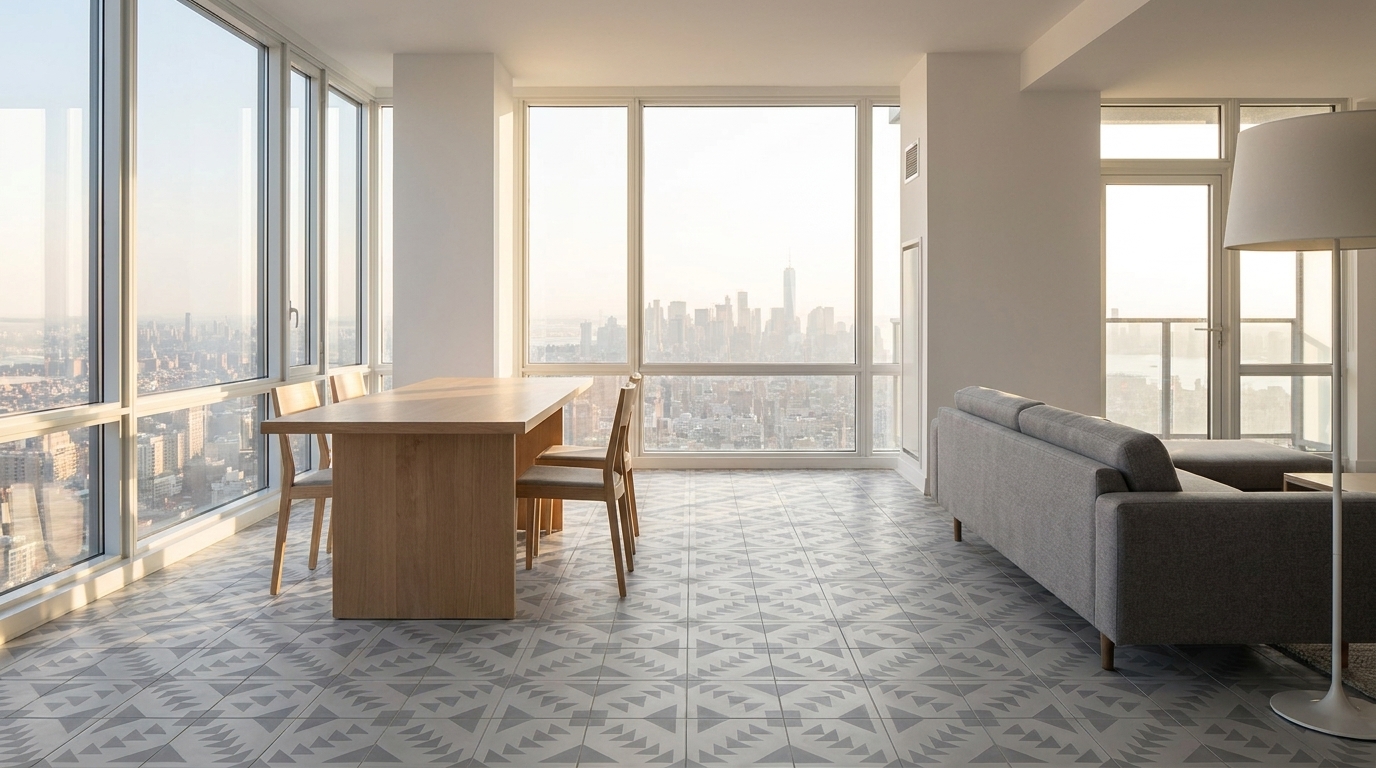
Pattern advantage: This is where cement tiles go beyond anything Saltillo can offer. Because the pattern is created by the mold rather than by the natural clay body, cement tiles can combine terracotta tones with geometric and Moroccan patterns. A Saltillo floor is always a uniform terracotta field. A cement tile floor can be a bold eight-pointed star in terracotta and cream, or a classic encaustic diamond in burnt sienna and warm white.
Room-by-Room: Where Cement Terracotta Tiles Outperform Saltillo
Kitchens

The kitchen is where the Saltillo vs. cement tile decision matters most. Daily cooking creates exactly the conditions that challenge Saltillo: acidic spills, grease, moisture, and heavy foot traffic. Cement terracotta tiles handle all of these with significantly greater resilience.
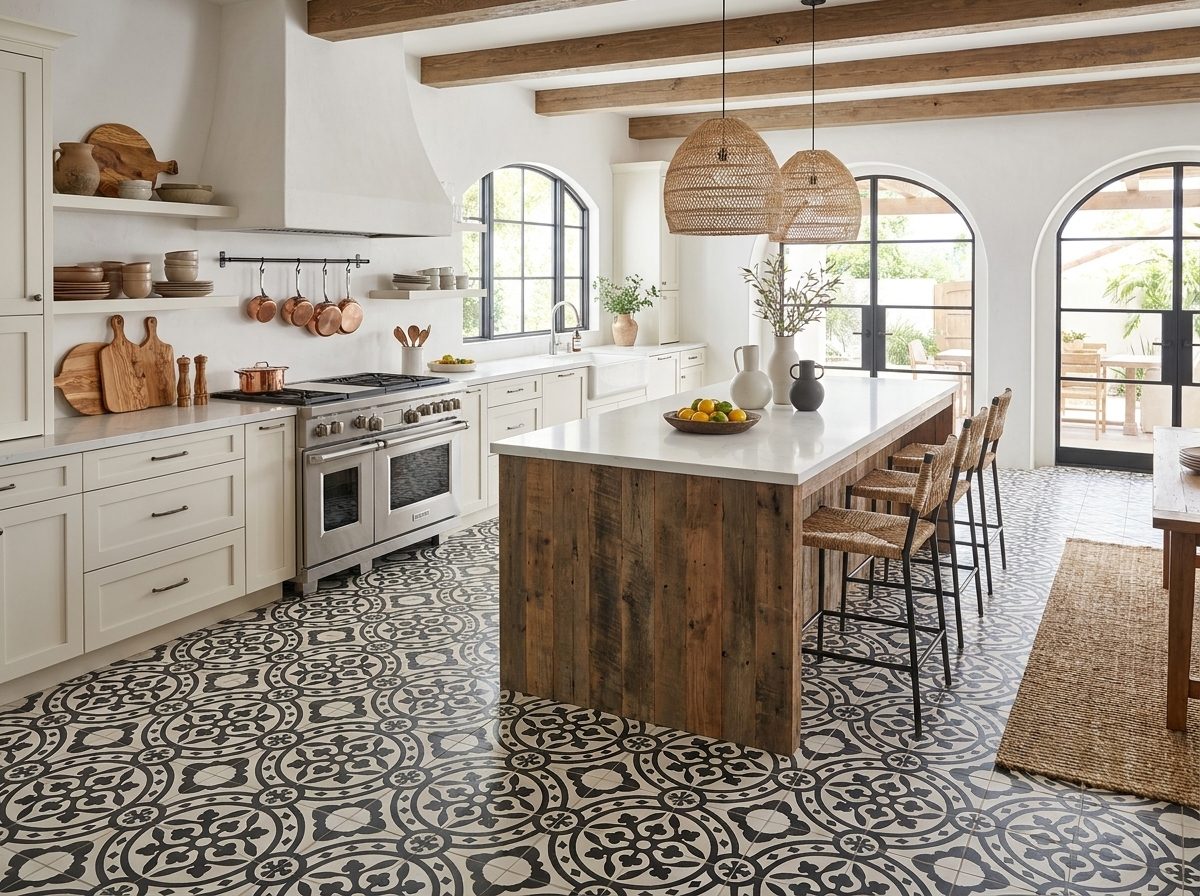
Furthermore, the pattern options available in cement tile give kitchen floors a visual richness that a plain Saltillo field rarely achieves. A terracotta and cream geometric pattern beneath simple white cabinetry creates the same warm, earthy atmosphere as a Saltillo floor — plus a level of visual interest that elevates the whole room.
Bathrooms
In bathrooms, Saltillo’s porosity is a genuine problem. Moisture exposure is constant, resealing schedules are demanding, and any surface damage in a wet area is difficult to address without affecting the whole floor.
Cement terracotta tiles in bathrooms, by contrast, offer the same earthy warmth with a more manageable maintenance routine. Specify a wet-area penetrating sealer before and after installation, and the floor handles daily shower and bathing moisture gracefully. Additionally, the natural matte surface provides better slip resistance than many alternatives.
Entryways
Entryways receive heavy foot traffic, tracked-in grit, and occasional moisture from wet shoes. For all of these reasons, a denser tile body is a significant specification advantage. Cement terracotta tiles handle entryway conditions reliably, while Saltillo’s softer body is more vulnerable to abrasion and edge chipping under daily foot traffic.
Patios and Covered Outdoor Spaces
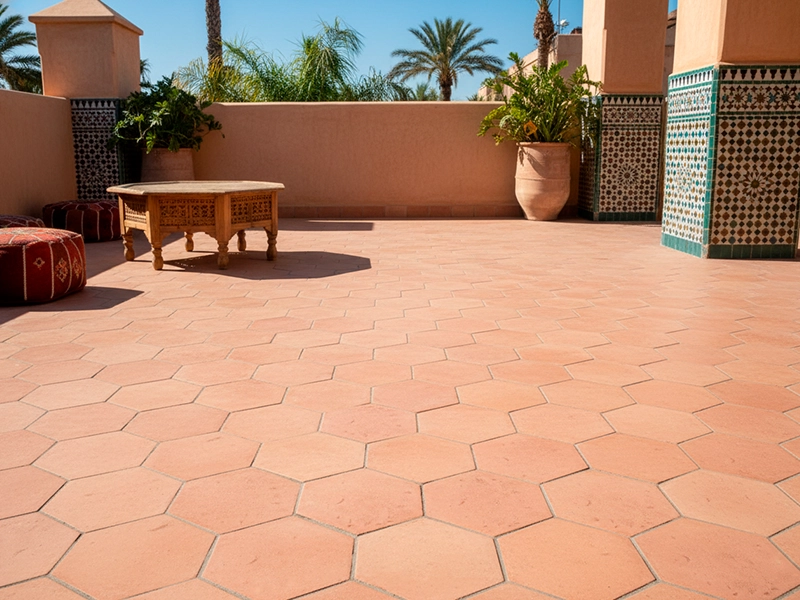
For covered outdoor patios in warm climates, cement terracotta tiles perform well with appropriate outdoor sealing. Saltillo, by contrast, is a risky choice in any climate with significant rainfall or temperature variation. Therefore, for homeowners who want that warm terracotta outdoor floor, cement tile is the safer, longer-lasting specification.
Explore terracotta and warm-palette patterns in the In-Stock Collection for all four of these applications.
What About the Cultural Heritage of Saltillo?
This is a fair question, and it deserves a direct answer. Saltillo tiles carry genuine cultural significance, and that heritage is worth respecting rather than dismissing.
However, handmade cement tiles share their own deep craft tradition — one that stretches back to 19th-century France, Morocco, and Spain, and that has been central to Mexican and Latin American architectural culture for well over a century. Furthermore, Original Mission Tile produces its tiles using the same hydraulic press tradition the company has maintained since 1900, based in San Luis Potosí, Mexico.
Choosing cement tiles over Saltillo isn’t trading cultural authenticity for a synthetic alternative. Instead, it’s choosing one handmade, craft-driven material tradition over another — with the added advantage of better performance for today’s residential and commercial demands.
For projects where a custom terracotta colorway tied to a specific regional or cultural palette is required, the Custom Made Collection supports bespoke development in collaboration with the design team.
Specifying Cement Terracotta Tiles: Practical Guidance
Sealing: Apply a penetrating sealer before grouting and a topcoat appropriate for the use type after installation. For kitchens and bathrooms, specify sealers formulated for those specific conditions. Additionally, plan a resealing schedule — annually for kitchens and high-use bathrooms, every two years for lower-traffic spaces.
Grout color: Warm sand, honey, or warm gray grout integrates naturally with terracotta palettes. In contrast, cool gray or white grout creates contrast that can feel jarring against the warmth of the tile.
Overage: Specify 10–15% above the calculated area. Dye lot consistency matters for future repairs, and terracotta tones can shift between production runs.
Pattern exploration: Use the Design Studio to visualize terracotta pattern combinations before ordering physical samples. This is particularly useful for homeowners comparing a simple field tile option against a more complex geometric or Moroccan pattern.
Browse completed terracotta and Saltillo-alternative installations in the Projects Gallery.
FAQ: Saltillo Tiles vs. Cement Tiles
Are cement tiles a direct replacement for Saltillo tiles? In most residential and commercial applications, yes. Cement tiles in terracotta palettes deliver the same earthy warmth and handmade quality as Saltillo, with better durability, dimensional consistency, and a wider pattern range. For projects where pattern isn’t a priority and budget is tight, Saltillo remains a viable option in low-moisture, low-traffic applications.
Can cement tiles go in a shower where Saltillo would be problematic? Yes. With proper waterproofing behind the substrate and a wet-area penetrating sealer, cement terracotta tiles handle shower applications safely. Saltillo’s porosity makes it a poor choice for wet areas without intensive maintenance.
Do cement tiles look as warm as Saltillo? Yes — mineral-pigmented cement tiles in terracotta and earthy tones carry genuine warmth and depth. In fact, because the pigment runs through the full wear layer rather than sitting on a porous surface coating, cement tiles maintain their color richness over time in a way that worn Saltillo tiles often don’t.
Are cement tiles more expensive than Saltillo? Cement tiles typically carry a modest price premium over standard Saltillo, reflecting the hydraulic press production process and the quality of mineral pigments. However, when total cost of ownership is considered — including sealing, maintenance, and longevity — cement tiles frequently represent better long-term value.
Conclusion: The Warmth of Saltillo, the Performance of a Modern Material
The appeal of Saltillo tiles has never been in question. The earthy warmth, the connection to Mexican craft tradition, the feeling of a floor made from the ground itself — these qualities are real and genuinely worth pursuing.
What’s also real, however, are the performance limitations that make Saltillo a difficult specification for kitchens, bathrooms, wet areas, and outdoor applications subject to moisture or temperature variation. In 2026, homeowners and designers don’t have to choose between that warmth and a floor that performs reliably. Cement terracotta tiles offer both.
The tradition is there. The craft is there. And the floor you install today, properly sealed and maintained, will look richer and more beautiful in twenty years than the day it went in.
Ready to explore the warm terracotta alternative to Saltillo?
Browse terracotta and earthy patterns in the In-Stock Collection, develop a custom colorway through the Custom Made Collection, or visualize combinations in the Design Studio.
Contact the Original Mission Tile design team for samples and expert guidance →