The 2026 Trend That’s Redefining Bathrooms & Kitchens
Most tile projects ask a simple question: where should the tile go? Tile drenching asks the opposite: where should it stop?
The answer, increasingly, is nowhere. Tile drenching — the practice of covering every surface of a room in a single tile, from floor to ceiling, across walls, shower surrounds, niches, and even ceilings — is the breakout interior design trend of 2026. Designers, homeowners, and hospitality developers are embracing it with a confidence that would have felt audacious just a few years ago.
The result is a category of interior that feels unlike anything a restrained, surface-by-surface tile approach produces. Immersive. Transportive. Intentional in a way that registers before a conscious thought forms. As designer Cara Woodhouse described it in a 2026 interview: “a cocoon-like environment that feels intentional, transportive, and incredibly luxurious when done correctly.”
This guide explains what tile drenching is, why it works, where it’s appearing in 2026, and how handmade cement tiles are one of the most compelling materials for executing this trend at the highest level.
What Is Tile Drenching?

Tile drenching is exactly what it sounds like: immersing an entire room — or a significant portion of it — in a single tile. Rather than using tile as a backsplash, a floor treatment, or a feature wall, tile drenching eliminates the boundary between surfaces altogether. The floor flows into the wall. The wall continues across the ceiling. The shower surround, the niche, the built-in shelf — all the same tile, all continuous.
The term itself is relatively new, but the underlying design logic is ancient. Moroccan hammams, Andalusian courtyards, Victorian conservatories — all of them understood that immersing a space in a single material creates an atmosphere that piecemeal decoration never achieves. Tile drenching is a contemporary name for a very old idea: that total material commitment produces total sensory impact.
In 2026, the trend is appearing across residential and commercial projects in several forms. Sometimes the drenching is floor-to-ceiling in a single bathroom. Sometimes it’s a shower enclosure where every surface — back wall, side walls, floor, ceiling — is the same tile. Sometimes it’s a kitchen where the backsplash runs uninterrupted from counter level to ceiling. The scale varies, but the principle is consistent: one material, fully committed to.
Why Tile Drenching Works
It Eliminates Visual Interruption
When tile stops at a grout line between the floor and wall, or at the top of a standard backsplash height, the eye registers that boundary. Furthermore, it registers the visual interruption as a design decision — one that says “the tile ends here.” In contrast, tile drenching removes all such interruptions, allowing the pattern and color to read as architecture rather than applied decoration.
The result is a room that feels more spatial and more cohesive. Paradoxically, a fully tiled room often feels larger than the same room with tile on only part of its surfaces, because the material continuity eliminates the visual fragmentation that multiple surface treatments create.
It Photographs Extraordinarily Well
In an era when interior design is increasingly experienced through images, tile drenching is one of the most camera-friendly design moves available. The pattern wrapping around corners, the continuous surface moving from underfoot to eye level to overhead — it creates imagery that stops a scroll in a way that a conventional tile backsplash rarely does.
Consequently, tile drenching has spread rapidly across design platforms and publications, generating demand from clients who encounter it visually before they understand it conceptually. This is a significant factor driving its acceleration in 2026.
It Commits to an Atmosphere
Above all, tile drenching works because it commits. Half-measures in interior design often produce results that feel uncertain — as though the designer almost made a decision but stopped short. Tile drenching, by definition, makes no such compromise. The commitment to a single material across every surface signals to anyone who enters that this space was designed with total intention.
For cement tiles specifically, that commitment pays particular dividends. The mineral pigment depth, the handmade variation from tile to tile, the pattern that shifts and develops as it wraps around a corner — all of these qualities intensify when the tile drenches an entire room. A patterned cement tile that reads beautifully on a floor becomes extraordinary when it rises up the walls and continues across a ceiling.
Tile Drenching With Cement Tiles: Why the Material Matters

Not every tile material is equally suited to tile drenching. Large-format porcelain in a single color creates a sleek, minimalist drenching effect — striking in contemporary architecture but cool and somewhat industrial in quality. Ceramic subway tile drenching creates pattern through grout lines alone, which can feel repetitive at scale.
Handmade cement tiles, however, bring something to tile drenching that manufactured surfaces cannot: the natural variation of a handmade object, multiplied across every surface of a room.
When a Moroccan geometric pattern in deep indigo and cream wraps from the floor of a bathroom up the walls and across a shower ceiling, each tile reads slightly differently — the mineral pigment shifting subtly in tone, the surface texture catching light at different angles as the plane of each surface changes. The pattern is consistent, but the material is alive. Furthermore, the pattern continuity at corners — the geometric design flowing around a wall corner as though the corner doesn’t exist — creates the kind of spatial magic that only a repeat-pattern tile can achieve.
Additionally, cement tiles’ natural matte surface has a particular advantage in tile drenching applications. Glossy or reflective tiles in a fully drenched room can feel overwhelming — too much reflection from too many angles creates visual noise. Cement tiles’ matte finish absorbs and softens light rather than bouncing it, which makes the immersive application feel calming and enveloping rather than intense.
Explore patterns well-suited to tile drenching applications in the In-Stock Collection, or develop a pattern specifically designed for a floor-to-ceiling application through the Custom Made Collection.
Where Tile Drenching Is Appearing in 2026
Bathrooms: The Natural Home of Tile Drenching

The bathroom is where tile drenching is having its most dramatic impact in 2026. Specifically, the trend is appearing in three types of bathroom applications.
The fully drenched shower enclosure covers every surface — floor, all four walls, ceiling — in the same tile. When executed in a handmade cement tile with a strong geometric or Moroccan pattern, the result is a shower experience that feels genuinely transported from everyday space into something closer to a hammam or spa environment.
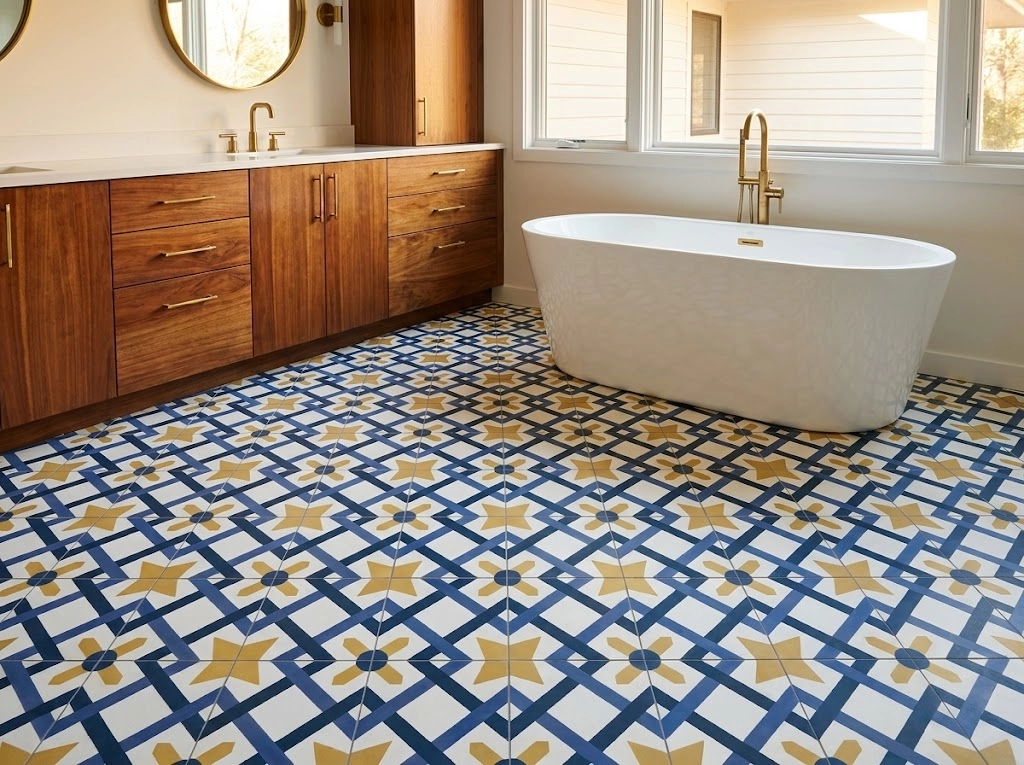
The fully drenched bathroom takes the concept further, extending the tile beyond the wet zone into the broader bathroom — across the floor, up every wall, potentially across the ceiling. This application is particularly powerful in primary bathrooms and in hotels, where the bathroom is a destination in itself rather than simply a functional room.
The powder room drench is perhaps the most accessible entry point. A powder room is typically small — three walls, a floor, perhaps a ceiling — making full tile drenching achievable at modest material cost. Consequently, powder rooms have become the most common residential starting point for homeowners who want to experience tile drenching without the investment of a full bathroom renovation.
Kitchens: The Extended Backsplash
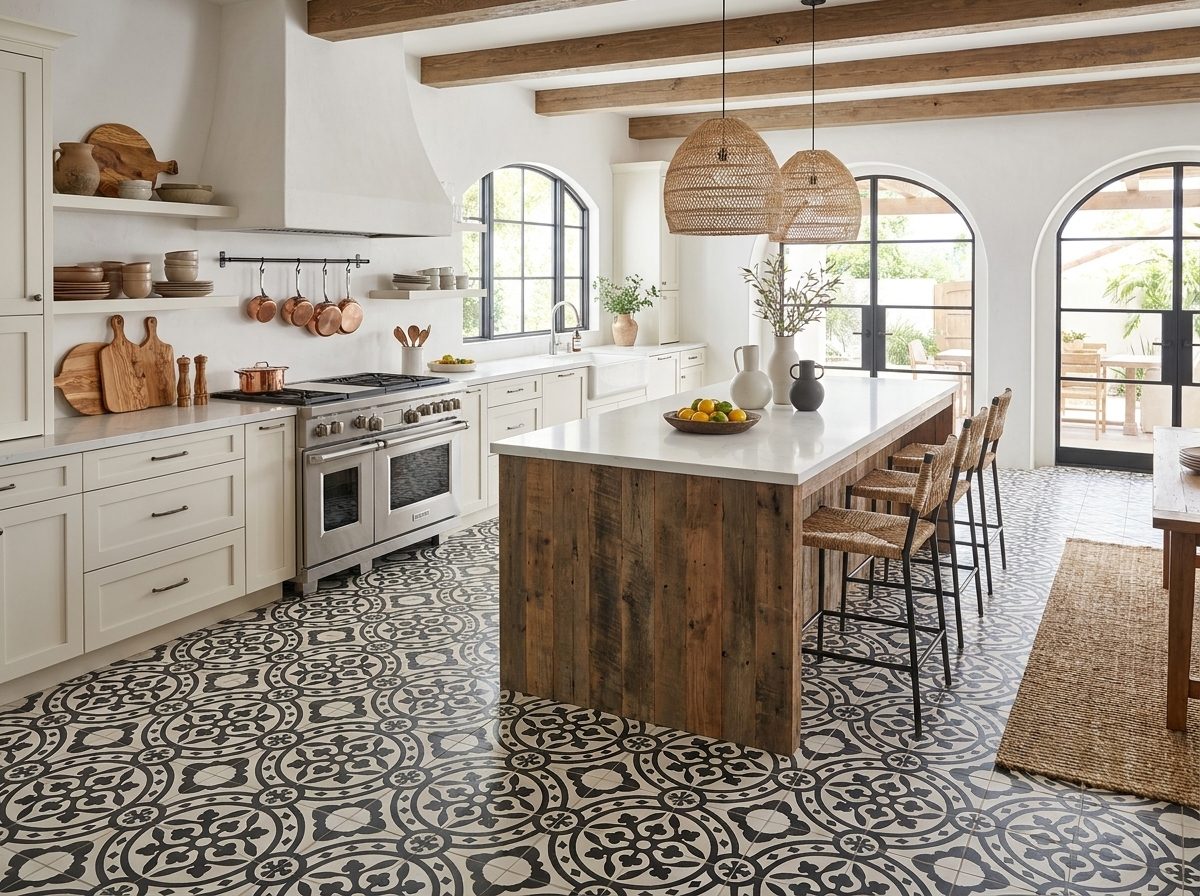
In kitchens, tile drenching takes a specific form: the backsplash that doesn’t stop. Rather than tiling from countertop to the underside of upper cabinets — the standard 18-inch backsplash zone — a drenched kitchen backsplash continues from the countertop to the ceiling, covering the full wall above. In kitchens with no upper wall cabinets, this creates a dramatic uninterrupted tile surface that transforms the kitchen’s entire visual character.
Furthermore, some 2026 kitchen drenching applications extend beyond the backsplash wall, wrapping onto adjacent walls or running across kitchen islands. The goal in each case is the same: to make the tile feel like the room’s architecture rather than its decoration.
Hospitality Spaces: Restaurants, Hotels & Spas
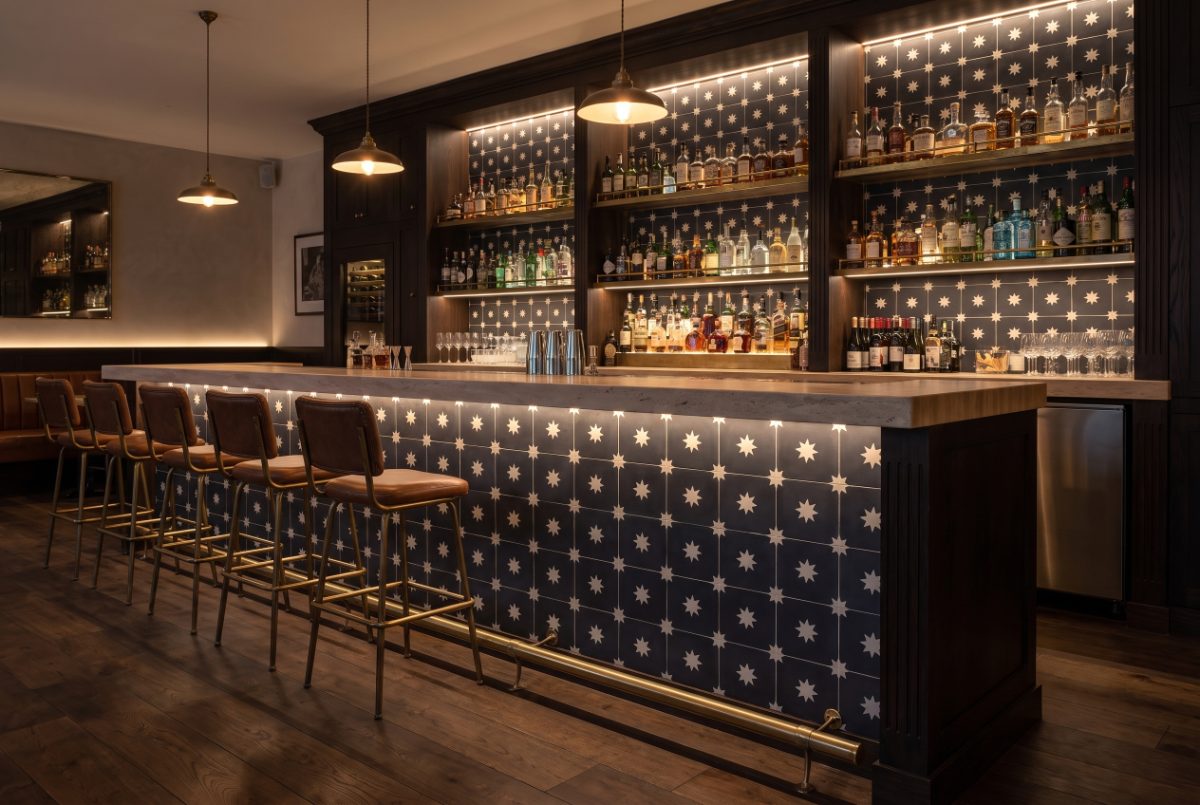
Commercial tile drenching is well established in the most design-forward hospitality projects of 2026. Restaurant bar areas where the wall, the bar front, and the back bar are all the same tile. Hotel bathrooms where the floor, all walls, and the shower are a single continuous pattern. Spa treatment rooms where every surface is immersed in a calming, earthy tile that makes the space feel genuinely transformative.
Browse completed tile drenching installations across residential and commercial projects in the Projects Gallery.
How to Execute Tile Drenching Well: Practical Guidance
Tile drenching is a powerful design move, but it requires more careful planning than conventional tile applications. Here is what every designer, contractor, and homeowner needs to know before specifying it.
Pattern Scale Matters More Than Usual
In a conventional tile application, pattern scale is important. In a tile drenching application, it’s critical. A pattern that works beautifully on a floor may feel overwhelming when it wraps onto walls and a ceiling at the same time — particularly in a smaller room.
As a general principle, smaller-scale, more tightly structured geometric patterns tend to drench more gracefully than large-scale or loosely structured ones. A classic Moroccan eight-pointed star in a 8×8 tile format, for instance, creates a continuous geometric rhythm that reads as intentional at any viewing distance. Therefore, choose your pattern with the full room surface in mind, not just the floor.
Color Restraint Amplifies the Effect
Tile drenching with a two-color or tonal pattern — rather than a highly complex multi-color design — typically produces the most enveloping, atmospheric result. When a single pair of colors wraps around every surface of a room, the color becomes the atmosphere. Deep indigo and cream. Warm terracotta and sand. Charcoal and warm white.
Use the Design Studio to visualize how a specific pattern and colorway reads across a full room before committing to a drenching specification. This step is particularly important for tile drenching, where the scale of the color commitment is much larger than in a conventional application.
Lighting Design Is Inseparable From the Tile Choice
In a fully tiled room, every light source interacts with every surface. Consequently, the lighting design for a tile drenching project should be planned alongside the tile selection, not after it.
For cement tiles specifically, warm-temperature light sources (2700K–3000K) enhance the mineral warmth of the pigments significantly. Directional or grazing light sources — wall washers, recessed spots positioned to skim across a tiled wall — create shadow and depth that makes the handmade texture visible and beautiful. In contrast, flat, even overhead illumination flattens the surface and reduces the dimensional quality that makes cement tile drenching extraordinary.
Waterproofing in Wet-Area Applications
For tile drenching applications that include shower walls and floors, proper waterproofing is essential. In any application where tile covers both a wet surface (shower floor, shower walls) and adjacent dry surfaces (bathroom floor, bathroom walls), the waterproofing membrane must be specified and installed correctly before tile installation begins.
Furthermore, for wet-area cement tile applications, specify a penetrating sealer formulated for continuous moisture exposure. Apply before grouting and again after installation. Include a maintenance specification in the project handover — a properly sealed cement tile shower that’s maintained correctly will perform beautifully for decades.
FAQ: Tile Drenching With Cement Tiles
Is tile drenching too bold for a residential bathroom? Not at all — and the powder room is proof. The most successful tile drenching projects in residential design are often in small, enclosed spaces like powder rooms, where the full-surface commitment feels luxurious rather than overwhelming. For larger bathrooms, color restraint in the chosen pattern makes the drenching effect enveloping rather than intense.
Does tile drenching make a room feel smaller? Counterintuitively, no. When executed with a continuous pattern and consistent material, tile drenching often makes a room feel more spatial — because the material continuity removes the visual fragmentation that multiple surface treatments create. A fully tiled bathroom frequently photographs larger than it is.
Can I drench just one zone rather than the entire room? Yes. A partial drench — the shower enclosure only, or the kitchen backsplash wall only, extended floor-to-ceiling — is a valid and increasingly popular application. Furthermore, it’s a lower-commitment entry point for clients who are intrigued by the concept but not yet ready for a fully drenched room.
How much overage should I order for a tile drenching project? Order 15% overage for a tile drenching project — slightly more than the standard 10–15% recommendation for conventional tile. Because multiple surfaces and many corner cuts are involved, waste is higher than in a standard floor or wall application.
Does tile drenching work with any cement tile pattern? Most cement tile patterns drench well, but tighter, more structured geometric patterns — Moroccan geometric, classic encaustic combinations, simple diamond repeats — tend to read most coherently when wrapping across multiple surfaces. Very large-scale or asymmetric patterns can feel disorienting when they appear on walls and ceilings simultaneously.
Conclusion: The Room That Commits to Itself
Tile drenching is, at its core, a commitment. It says: this room has a material identity, and every surface belongs to it. No hedging, no backing off, no boundary where the design decision stops and ordinary wall paint begins.
For handmade cement tiles, that commitment is the natural expression of what the material has always offered — pattern with depth, color with warmth, and the kind of surface that rewards the person who lives with it every day rather than merely impressing the person who walks past it once.
In 2026, the most memorable interiors are the ones that fully commit. Tile drenching, executed with the right pattern and the right material, is one of the clearest ways to get there.
Ready to drench your next space?
Explore patterns suited to floor-to-ceiling applications in the In-Stock Collection, develop a custom design for a specific drenching concept through the Custom Made Collection, visualize full-room pattern effects in the Design Studio, and browse completed immersive installations in the Projects Gallery.