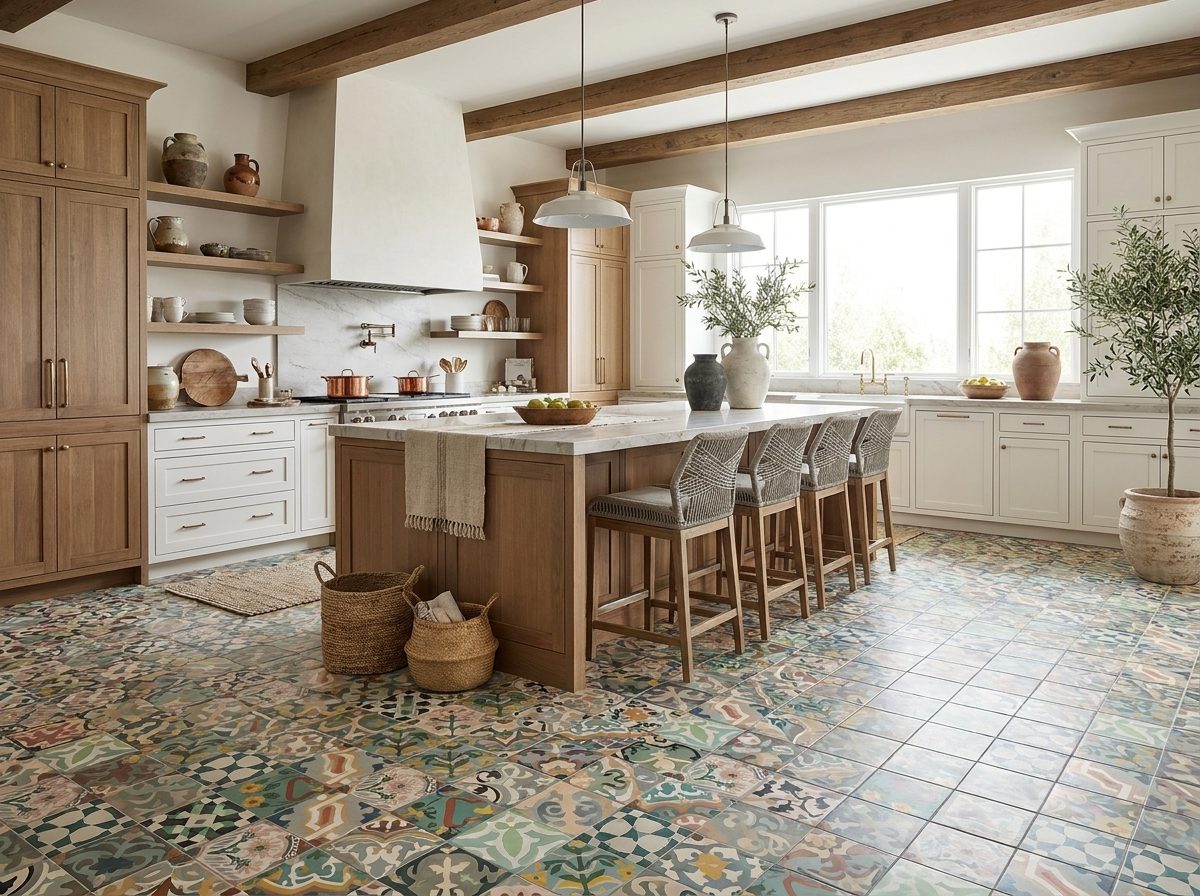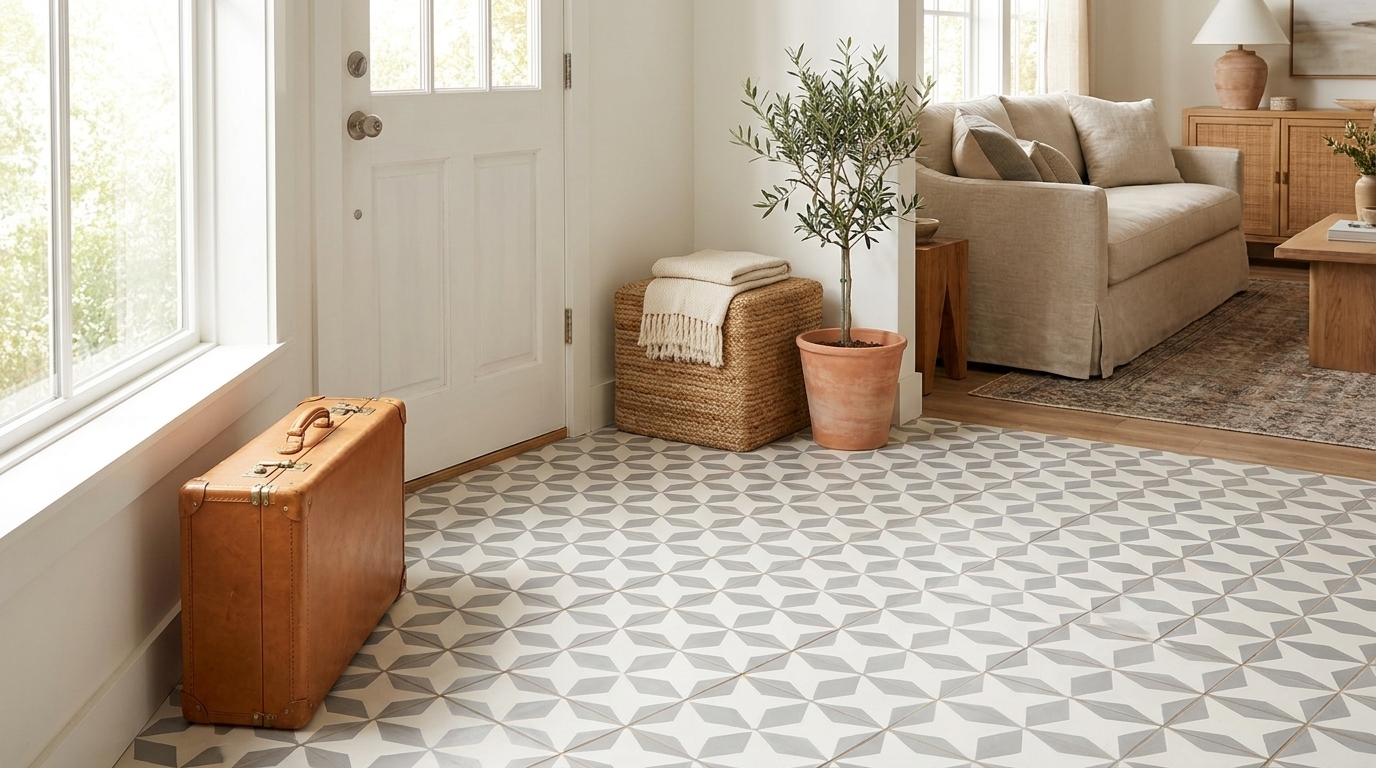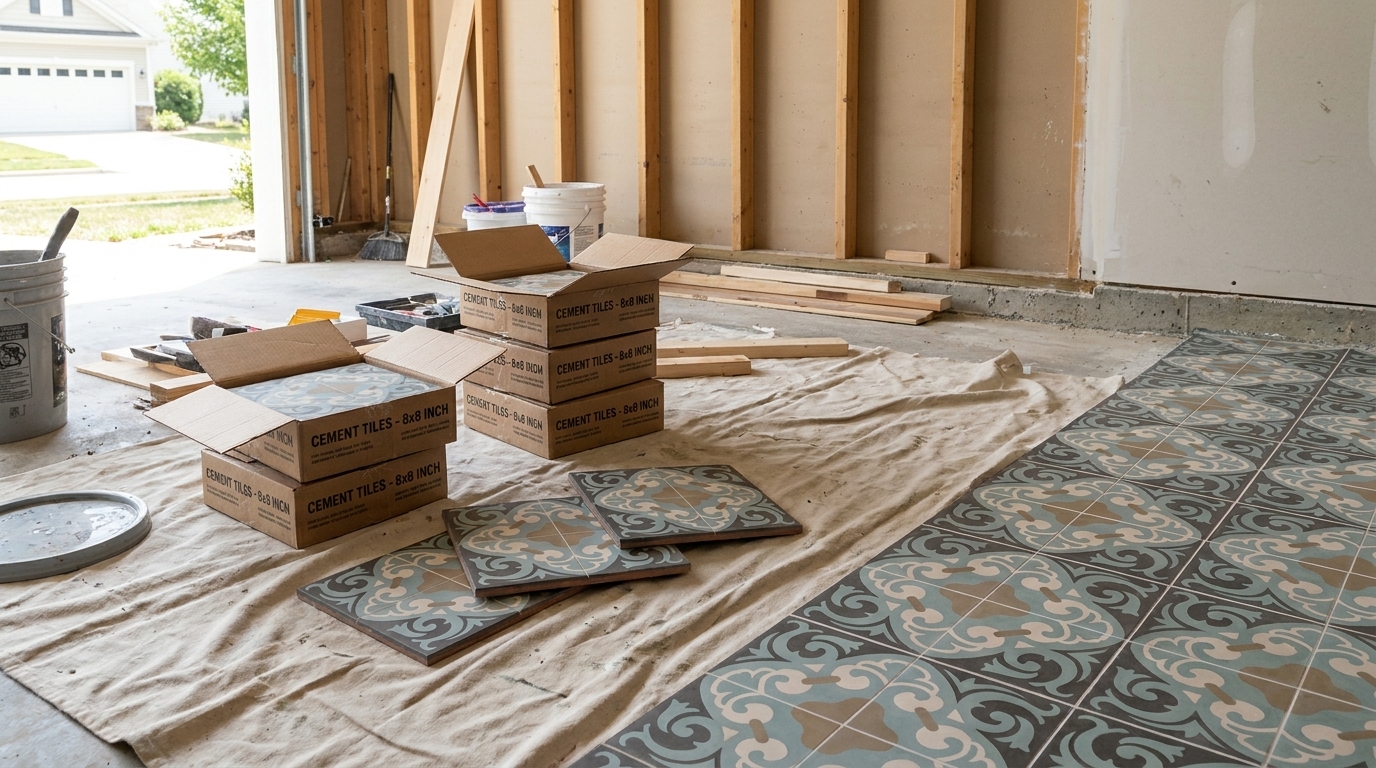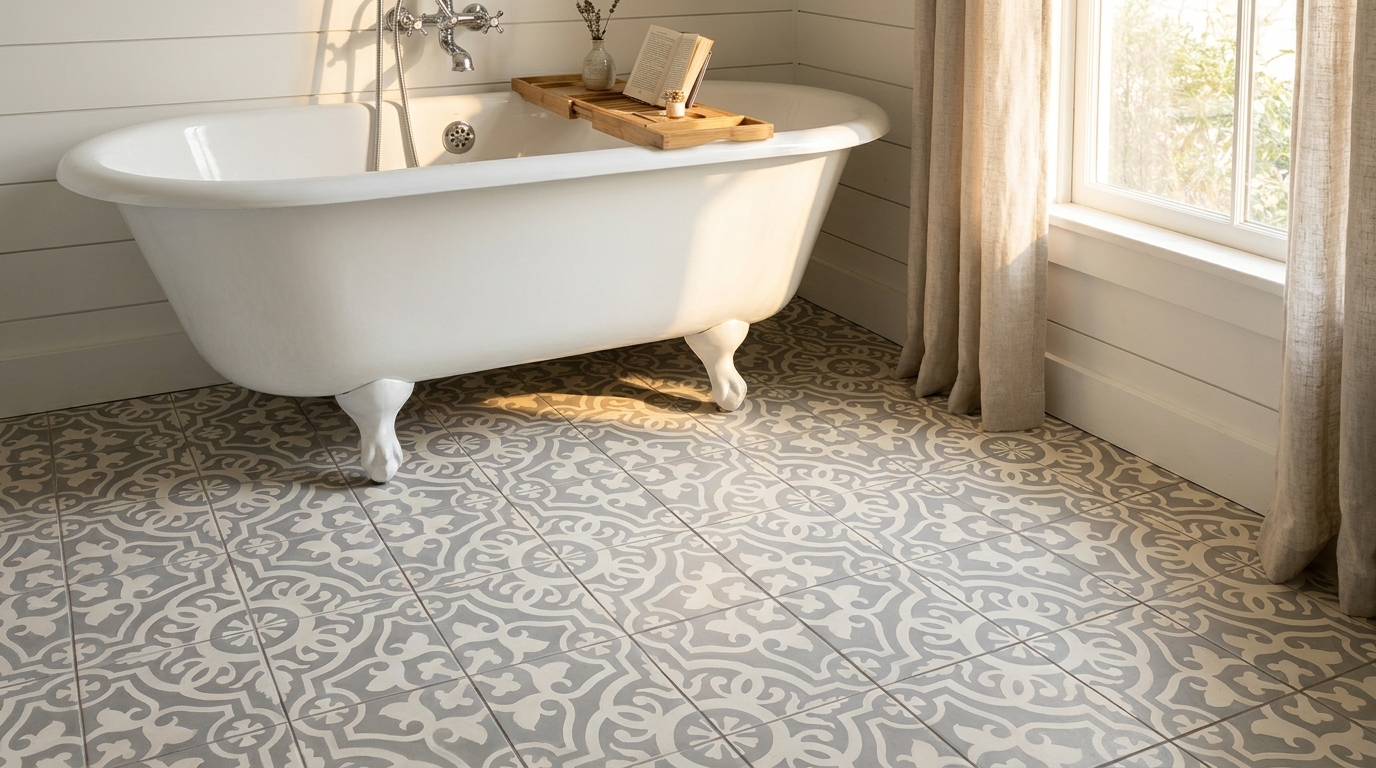
Ask five contractors what cement tile costs and you’ll get five different answers. That’s because the sticker price on a box of tile is only one line in a much longer bill. If you’re planning a project for 2026, you need the full cement tile cost picture: material, freight, installation labor, and the hidden line items that catch homeowners off guard. This guide breaks down every dollar so you can budget accurately instead of guessing.
What You’re Actually Paying For With Cement Tile
Cement tile isn’t fired in a kiln like ceramic or porcelain. Instead, a thin layer of pigmented cement is hydraulically pressed onto a denser cement backing, then cured slowly with water over several weeks. That extra labor and curing time explains why cement tile costs more than mass-produced ceramic, but it’s also why the color runs all the way through the tile instead of sitting in a thin glaze.
Because it’s handmade, price varies by pattern complexity and pigment cost. Simple single-color fields sit at the low end. Multi-color patterns with fine detail, or tiles finished with metallic accents, cost more because every color needs its own mold segment and hand-poured mix.
Material Cost: Price Per Box vs. Price Per Square Foot
Most cement tile is sold by the box, not the square foot, so you need to do a quick conversion before you can compare it to other flooring. A standard 8×8 box holds 12 tiles and covers 5.17 square feet. Here’s how that shakes out across a typical in-stock range:
- Budget tier (around $10.21 per sq. ft.): Simpler colorways like S-160 Azul Rey or S-367 Crema run about $52.80 per box.
- Mid-range (around $14.86 per sq. ft.): The majority of patterned designs, from florals to geometrics, land near $76.80 per box.
- Premium (around $26.00 per sq. ft.): Metallic-inlay tiles such as Brass Traverser 01 cost more because they combine cement with a real brass strip.
Trim pieces add cost too. A bullnose edge, like the one available for the S-101 Black pattern, typically runs higher per box than a standard field tile because it needs a rounded, finished edge on one side. Budget for trim separately if your project needs it, for example on a stair nose or an open shower curb.
In-Stock vs. Custom Pricing: The Short Version
You can browse the full range of in-stock cement tiles and get pricing instantly, because those patterns are already made and sitting in the warehouse. Custom made tiles cost more because every mold, color, and border has to be built for your specific design, and they take roughly 4-6 weeks to produce instead of shipping in days.
If budget is tight, start with in-stock. You still get 300+ patterns to choose from, and you skip the custom tooling cost entirely. Save custom orders for projects where no existing pattern fits, like a monogram entry or a logo floor for a business.
Shipping and Freight: The Cost People Forget to Budget

Cement tile is heavy, and that weight drives shipping cost more than almost anything else in the project. Tile ships from the warehouse in Laredo, Texas, and freight is typically priced by pallet weight and distance rather than by the box. A small sample order can ship in a standard parcel box, but a full-room order of several hundred square feet usually moves by freight truck on a pallet.
That’s why it pays to order samples before you commit. A sample costs $20 for the first one and $10 for each additional, with free shipping, so you can hold the actual color and texture in your hand before you commit to a freight shipment you can’t easily return. Order two or three patterns you’re considering side by side; lighting and undertones look different in person than on a screen.
To keep freight cost down, consolidate your order. Ordering field tile, trim, and any accent tile together in one shipment is almost always cheaper than placing three separate orders over several weeks.
Installation Labor: Why Cement Tile Costs More to Install
Labor is usually the single biggest line item in a cement tile budget, often larger than the material cost itself. National tile installation labor generally ranges from about $8 to $25 per square foot, and cement tile tends to sit at the higher end of that range for a few reasons.
First, cement tile is more porous than porcelain before it’s sealed, so installers need to seal the face before grouting to prevent grout haze from staining the surface permanently. Second, patterned tile requires careful layout planning so the design lines up across the room instead of drifting off-grid. Finally, cement tile is heavier and more brittle to cut than porcelain, which slows down the job and increases waste.
Ask your installer for a written quote that separates labor, materials, and any subfloor prep. That way you can see exactly what you’re paying for instead of one lump number. Our installation guidelines are a good document to hand your contractor before the job starts, since they cover the sealing and setting steps specific to cement tile.
Hidden Costs Homeowners Don’t Budget For
Beyond tile and labor, a handful of smaller costs add up fast if you don’t plan for them.
- Overage waste: Always order 15% more than your measured square footage to cover cuts, breakage, and future repairs. Skipping this often means a rushed, expensive reorder mid-project, and dye lots can shift slightly between production runs.
- Sealer and topical finish: Cement tile needs a penetrating sealer before grouting and a topical or renewable finish afterward. Our maintenance and cleaning guide covers exactly what products and schedule to use.
- Subfloor prep: Cement tile needs a flat, stable substrate. If your existing floor is uneven or flexes underfoot, budget for self-leveling compound or backer board before tile goes down.
- Freight for reorders: If you underorder, a second freight shipment for a small quantity often costs nearly as much as the original shipment, because freight pricing has a high minimum regardless of load size.
- Acclimation time: Cement tile should sit in the installation space for a day or two before setting so it adjusts to the room’s temperature and humidity. That’s not a dollar cost, but it does affect your project timeline, so build it into your schedule.
A Real-World Cost Example: 100 Square Foot Bathroom Floor

Let’s put real numbers against a common project size. Say you choose a mid-range 8×8 pattern like a color from our full palette, at $76.80 per box.
- Tile with 15% overage: 115 sq. ft. ÷ 5.17 sq. ft. per box ≈ 23 boxes × $76.80 = about $1,766
- Freight shipping: Varies by location; request a quote through our contact page for an exact number before you finalize your budget.
- Sealer and setting materials: Roughly $150-$300 depending on the products your installer uses.
- Installation labor at $8-$25 per sq. ft.: $800-$2,500 for the 100 sq. ft. finished floor.
Add it up and a mid-range bathroom floor typically lands somewhere between $2,700 and $4,600 all-in, before freight. That’s a wide range, but it reflects real variation in labor rates by region and pattern complexity. Getting quotes for both tile and installation before you start is the only way to narrow that number for your specific project.
How to Control Cement Tile Costs Without Cutting Corners
You can manage cost without downgrading quality. Start by choosing an in-stock pattern instead of a custom design; you’ll still get a handmade look, just without the tooling cost or the wait. Next, order samples first so you don’t gamble a full freight shipment on a color you haven’t seen in your own light.
Consolidate every part of the order, field tile, trim, and accents, into one shipment. Because freight pricing has a base cost regardless of load size, combining orders spreads that fixed cost over more square footage. Finally, hire an installer who has set cement tile before. A contractor unfamiliar with the sealing step can turn a routine job into a costly redo if grout haze bonds to unsealed tile.
Browse our installation gallery for real projects at a range of budgets, from single-pattern floors to layered designs with borders and trim, so you have a realistic sense of what different price points look like finished.
Is cement tile more expensive than ceramic or porcelain tile?
Yes, generally. Cement tile is handmade and hydraulically pressed rather than mass-produced and fired, so both material and installation costs run higher than standard ceramic or porcelain. The tradeoff is color depth that goes all the way through the tile instead of sitting in a surface glaze.
Does sealing cement tile add much to the total cost?
Sealer itself is a relatively small cost, usually a couple hundred dollars for an average room. However, it does add labor time, since the tile needs sealing before grout goes down and again after installation. Skipping this step to save money isn’t worth it, since unsealed tile can stain permanently during grouting.
How much should I budget for shipping cement tile?
Shipping cost depends heavily on order size and destination, because larger orders ship by pallet freight rather than standard parcel. Request a freight quote through our contact page once you know your square footage so you can budget accurately before ordering.
Is custom cement tile worth the extra cost?
It depends on your design needs. If an existing pattern from our 300+ in-stock designs fits your project, in-stock tile saves money and time. Custom tile is worth the added cost when you need a specific size, color, or metallic accent that doesn’t exist in the current catalog.
See the tile in person before you commit
Photos only tell you half the story. Colors, texture and the handmade character of cement tile are best judged in your own light. Order a sample of any in-stock pattern for $20 (additional samples $10, free shipping) — or tell us about your project and we’ll help you narrow it down.
Browse in-stock cement tiles →
Talk to us about your project →