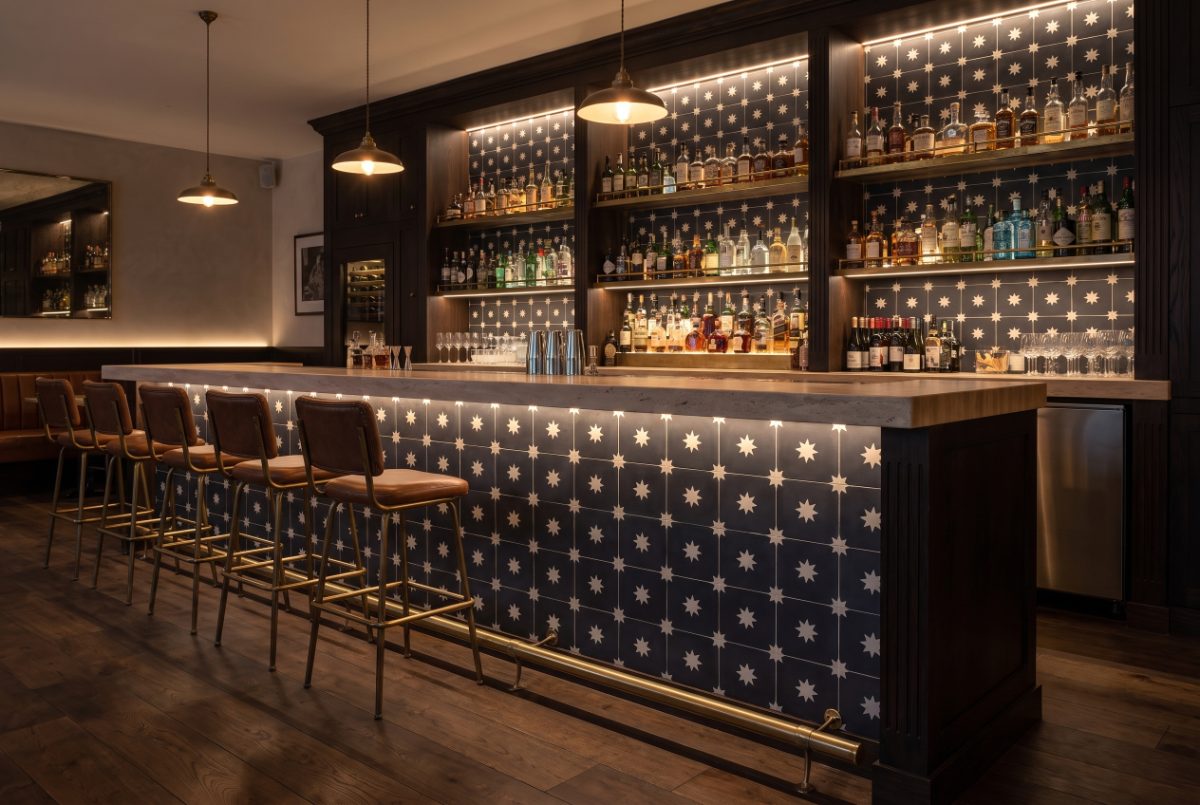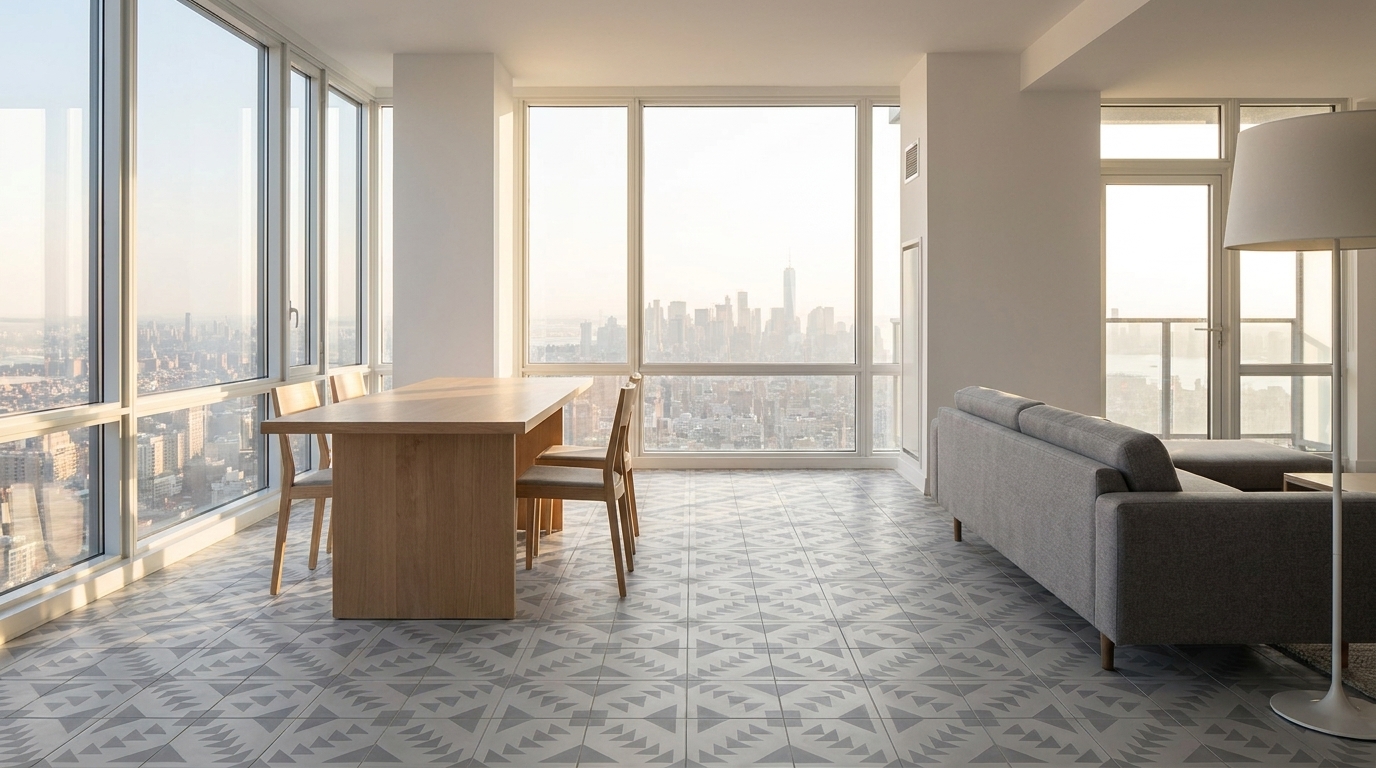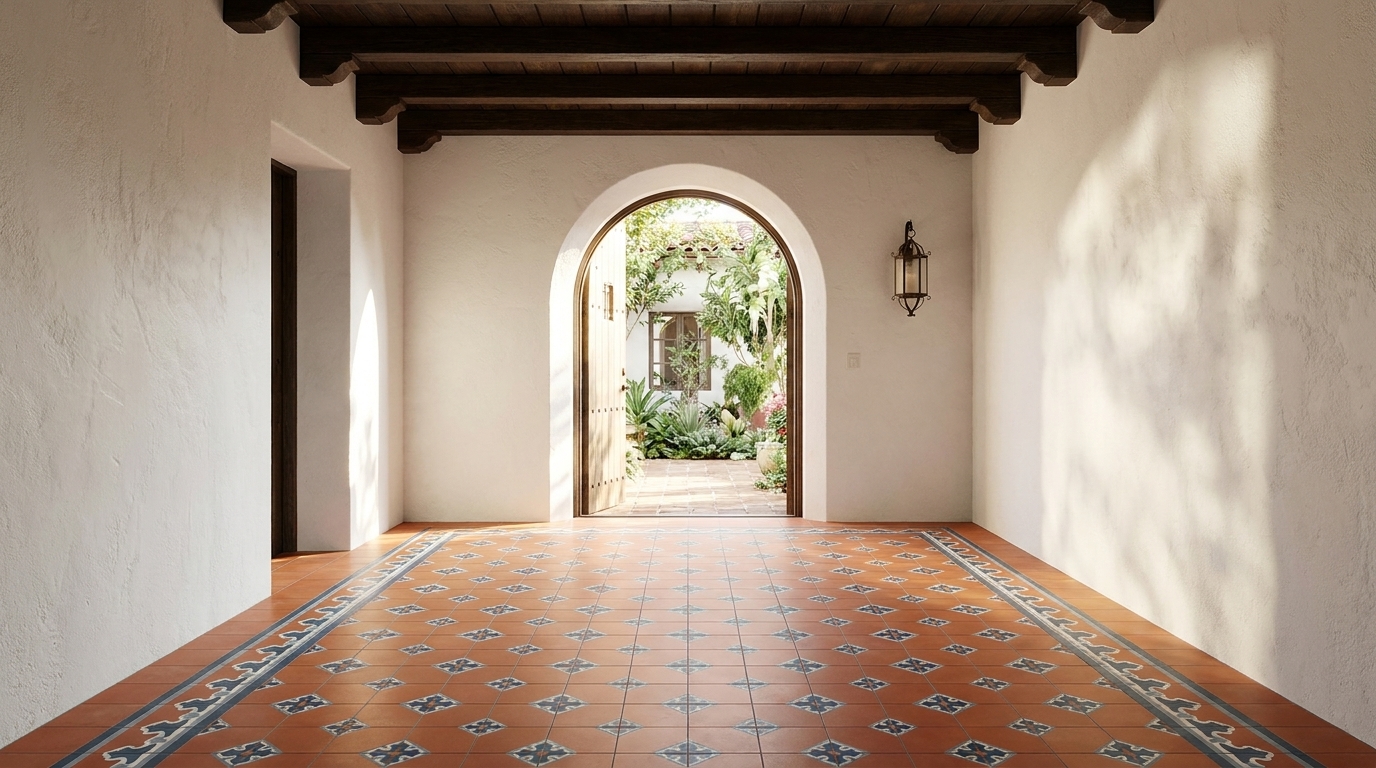
If you own a Spanish Colonial Revival home, you already know the problem: the house asks for tile, but most tile on the market doesn’t answer. Big-box porcelain looks flat next to a hand-troweled arch. Imported “Spanish style” tile often leans cartoonish. And the real historic patterns can be hard to find in a size and price that work for a real renovation. This guide sorts out what actually belongs in Spanish Colonial Revival tile design, and what’s just borrowing the name.
We have a stake in getting this right. Our company is named after the style, and our factory in San Luis Potos\u00ed, Mexico has pressed cement tile the same way since 1900 — the same decade this architecture took hold in the United States. So this isn’t a trend piece. It’s a practical guide to the patterns, colors and layouts that read as authentic, plus where cement tile fits into a house that was originally roofed in clay.
Mission Tile vs. Spanish Colonial Revival Tile: Clearing Up the Name
These two styles get used interchangeably, but they aren’t the same thing. Mission Revival came first, roughly 1890 to 1915. It borrowed the plain stucco walls, bell-shaped gables and arcades of California’s Franciscan mission churches. Ornament stayed minimal, because the missions themselves were simple buildings.
Spanish Colonial Revival followed, peaking from about 1915 to the 1940s. It kept the stucco and the arches but added richer detail: carved wood, wrought iron, and colorful decorative tile pulled from Moorish Spain and colonial Mexico. The 1915 Panama-California Exposition in San Diego pushed this fuller, more ornamented look into the national spotlight.
That distinction matters for tile. A true Mission Revival interior wants restraint: plain floors, maybe one patterned accent. Spanish Colonial Revival invites more pattern, more color, and more tile overall. Knowing which era your house (or your client’s house) belongs to tells you how far to push the design.
Where the Pattern Tradition Comes From
The tile language of Spanish Colonial Revival didn’t come from Spain alone. It’s a blend of three traditions layered on top of each other over centuries. First, Moorish Spain brought geometric tilework north from North Africa, full of repeating stars, interlocking lines and tight symmetry. Then Spanish colonists carried that aesthetic to Mexico, where local kilns and makers adapted it with their own motifs and colors. Finally, American architects of the 1920s revived all of it at once, mixing eras freely to create something romantic rather than strictly historical.
That mixed inheritance is good news for you. It means there’s no single “correct” Spanish Colonial Revival pattern. A bold Moorish star, a quiet terracotta field and a Mexican-inflected floral medallion can all belong in the same house, because they already belonged together a hundred years ago. Our installation gallery shows how differently that range of patterns can read from one project to the next.
Cement tile fits this history more naturally than people expect. While roof tile in this style was always clay, decorative floor and wall tile from the early 1900s through the 1930s was frequently cement, pressed by hand in molds and cured slowly, exactly as we still make it today. It’s not a modern substitute standing in for something else. It’s the original material.
Building the Palette: Colors That Actually Belong
Spanish Colonial Revival color comes from sun, clay and glaze, not from trend forecasts. Keep your palette anchored to a few families and the whole room will feel coherent instead of busy.
- Terracotta and sand carry the warmth of the original clay roofs and adobe walls. Colonial Doble Terracotta 01 and Geneva Sand 01 work as a quiet base layer in an entry or kitchen.
- Cobalt and navy reference the glazed Talavera pottery of Puebla and the deep blues of Moorish tilework. Ellis Navy 03B and Pescadero Blue 04 deliver that punch without needing hand-painted ceramic.
- Sage and olive greens show up in courtyard plantings and in historic tile borders. La Espanola Sage 01 is a softer way to bring in that green.
- Black and charcoal ground a busy pattern and read as the iron and dark wood details of the style. Merida Black 01 is a go-to for this.
If you’d rather start from color and work backward, our designs by color collection groups patterns this way, so you can compare every terracotta or every navy option side by side.
Choosing a Pattern: From Quiet Terracotta to Full Moorish Geometry

Pattern intensity is the real design decision here, more than color. Think of it as a dial, not a switch. On the quiet end, a plain terracotta or sand field tile lets the architecture do the talking. That’s the right call for a large room, a rental property, or a Mission Revival house that wants restraint.
Moving up the dial, patterns like Brick S-100 White or the Brick Blanc 2×8 bring in texture and a herringbone or running-bond layout without introducing busy color. They work well on a kitchen floor you still want to feel calm.
At the bold end sit the true Moorish-geometric patterns: interlocking stars, lattice and medallion designs. S-924 Azul Morocco, S-118 Peacock, and Hex Star Black 02 all draw directly from that tradition. Hexagon shapes in particular echo the star-and-cross tilework found throughout Andalusian and Moorish interiors. These patterns carry a room on their own, so use them where you want a focal point: an entry, a powder room, or a kitchen backsplash.
For something that splits the difference, look at patterns named for the places that inspired them: Alhambra Navy 02, Estrella Antigua Blue 01, and Cordoba Weathley 01. Each has enough geometry to feel Spanish Colonial Revival, but a softer color story than the full-saturation options.
Room by Room: Where This Style Wants Tile

Spanish Colonial Revival homes were built around a handful of tiled moments, and those are still the best places to spend your budget today.
Entries and courtyards. This is the heart of the style. A tiled entry, often open to a courtyard, is the first thing a visitor sees. A bordered terracotta field or a bold medallion both work here, because the space is usually generous and gets filtered, indirect light.
Kitchens. Original haciendas used tile for backsplashes and sometimes full floors, since cement and clay both handle heat and spills well. A terracotta or brick-pattern floor paired with a bolder backsplash pattern is a classic combination that still reads current.
Bathrooms. Smaller rooms are the easiest place to try a bold Moorish geometric without overwhelming the house. A powder room floor in a saturated pattern gives you drama with almost no risk, because the room is small and easy to change later if tastes shift.
Stair risers and thresholds. Spanish Colonial Revival houses often used tile as a line, not just a field: a run of pattern on stair risers, or a border marking the threshold between rooms. It’s a low-cost way to bring in color without tiling an entire floor.
Before you commit to any of these, walk through our installation guidelines. Cement tile needs sealing and a slightly different setting process than ceramic, and getting that right protects the investment for decades.
Keeping Proportions Honest: How Much Pattern Is Too Much
The biggest mistake we see in this style isn’t choosing the wrong pattern. It’s using too much of a bold one. Spanish Colonial Revival architects were generous with arches and stucco, but they were usually disciplined with pattern, saving it for one or two rooms and letting plain plaster and wood carry the rest of the house.
A good rule: pick one statement pattern per sightline. If your kitchen floor is patterned, keep the backsplash simpler. If the entry gets a bold medallion, let the adjoining hallway run plain terracotta. That contrast is what makes the statement piece feel intentional instead of overwhelming.
Borders help too. A plain field with a contrasting border, for example terracotta edged in navy or black, gives you the structure of a rug without the visual noise of pattern wall to wall. It’s also a historically accurate move; bordered floors show up constantly in 1920s and 1930s Spanish Colonial Revival interiors.
If you’re torn between two patterns, order samples before you decide. Samples run $20 for the first and $10 for each additional, with free shipping, so you can hold a few candidates up against your cabinetry and your light before committing a full room.
Making It Work in a Modern or Non-Spanish Home
You don’t need a stucco arch to borrow from this tradition. Terracotta and Moorish-geometric cement tile both read beautifully against plain white walls, black steel windows, or warm wood cabinetry. The tile carries the reference; the architecture around it can stay contemporary.
The safest way to bring this style into a non-Spanish house is through one room rather than the whole plan. A terracotta kitchen floor, a navy geometric powder room, or a bordered mudroom entry all borrow the feeling without requiring you to repaint the exterior. Keep the surrounding palette neutral, and the tile will do the work.
If none of our 300-plus in-stock patterns match a specific historic tile you’re trying to replace or reference, our custom made tiles program can reproduce it, typically in four to six weeks. That’s often faster than it sounds for a pattern this specific.
Frequently Asked Questions
Is cement tile historically accurate for a Spanish Colonial Revival home?
Yes, for floors and interior walls. Roof tile in this style was always clay, but decorative cement tile was widely used for floors, borders and backsplashes starting in the early 1900s, made the same way we still make it: hand-pressed, hydraulic-cured, no kiln required.
What’s the real difference between Mission and Spanish Colonial Revival?
Mission Revival (1890–1915) is the plainer, earlier style, based directly on the Franciscan mission churches. Spanish Colonial Revival (1915–1940s) came next and added richer ornament, including the colorful tilework most people now associate with “Spanish style” homes.
Can I mix different Spanish Colonial Revival patterns in one house?
Yes, and historically that’s exactly what happened. Just keep one pattern per room or sightline so each choice reads as intentional. A terracotta field in the hallway and a bold geometric in the kitchen is a classic, period-correct pairing.
How much tile should I order for a project in this style?
Order 15% over your measured square footage to cover cuts and breakage, standard for any cement tile project. An 8×8 box covers 5.17 square feet, so a 200-square-foot room needs about 45 boxes with overage included.
See the tile in person before you commit
Photos only tell you half the story. Colors, texture and the handmade character of cement tile are best judged in your own light. Order a sample of any in-stock pattern for $20 (additional samples $10, free shipping) — or tell us about your project and we’ll help you narrow it down.
Browse in-stock cement tiles →
Talk to us about your project →